








Contents
- 1 The Rise of AI Coding Agents and the Future of Developer Productivity
- 2 What AI Coding Agents Actually Are
- 3 Why AI Coding Agents Are Gaining Momentum
- 4 How AI Agents Are Changing Software Development Workflows
- 5 Will Developers Actually Become More Productive?
- 6 The New Developer Skill Set
- 7 Where Coding Automation Delivers the Most Value
- 8 Risks and Limitations Teams Need to Manage
- 9 What High-Performing Teams Are Doing Differently
- 10 The Future of Developer Productivity AI
- 11 Conclusion
- 12 FAQ
The Rise of AI Coding Agents and the Future of Developer Productivity
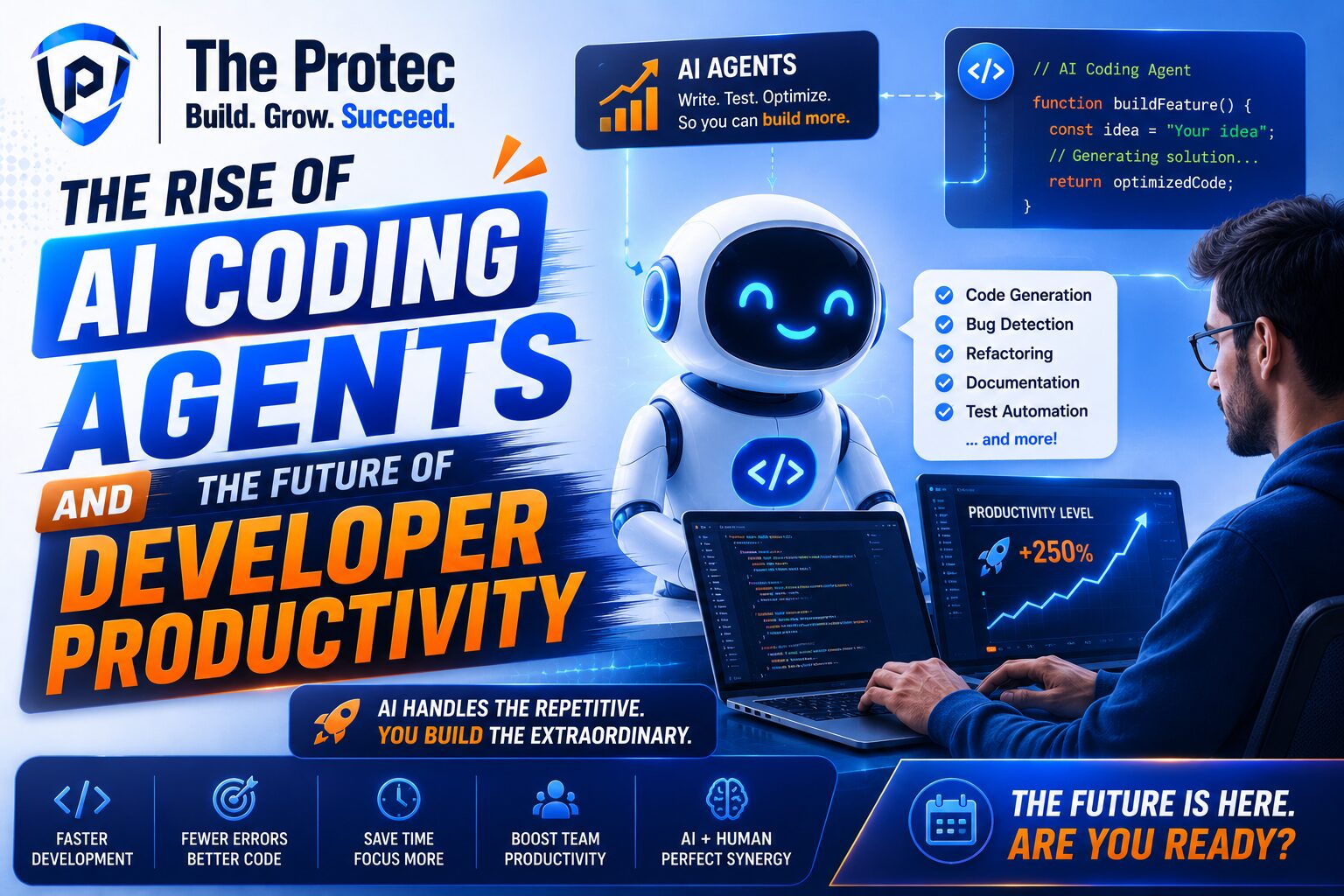
AI coding agents are no longer a futuristic concept or a novelty tucked into a code editor. They are becoming active participants in software delivery, capable of reading repositories, planning changes, writing code, generating tests, fixing bugs, and even opening pull requests with minimal human guidance. For engineering teams, this shift is bigger than a faster autocomplete experience. It represents a new operating model for software development, one where developer productivity AI can handle increasingly complex parts of the workflow.
That shift is already changing how teams think about coding automation. Instead of asking whether an AI can finish a line of code, developers are now asking whether an AI agent can complete a feature, refactor a module, or investigate a production issue. The answer is increasingly yes, at least for many well-scoped tasks. But the real story is not just that AI can code. It is that AI coding agents are changing the shape of the work itself.
As these tools mature, the question is not whether developers will become more productive. The better question is how productivity will be measured when a larger share of the repetitive, mechanical, and exploratory work is delegated to software agents. The most successful teams will likely be the ones that learn how to direct these agents effectively, verify their output intelligently, and redesign workflows around human judgment instead of manual repetition.
What AI Coding Agents Actually Are
AI coding agents are systems designed to perform multi-step software tasks with limited supervision. Unlike traditional code completion tools that suggest the next token or line, agents can reason across a repository, use tools, gather context, and execute actions. They may inspect files, run tests, edit code, search documentation, and summarize their own work.
This distinction matters. A conventional assistant helps a developer type faster. An agent helps a developer move faster through the entire development loop. That loop includes understanding requirements, planning implementation, writing code, validating changes, and preparing the result for review. In practice, these tools are often embedded in IDEs, command-line workflows, or issue-driven automation systems.
Recent progress in large language models, tool use, and long-context reasoning has made these systems more capable than earlier generations of coding assistants. They can now handle larger codebases, follow instructions more reliably, and perform chained tasks without constant prompting. That does not mean they are perfect. It does mean they are useful in ways that directly affect throughput.
Why AI Coding Agents Are Gaining Momentum
The rise of AI coding agents is being driven by several forces at once. First, software teams are under constant pressure to deliver more with fewer interruptions. Product cycles are shorter, user expectations are higher, and engineering backlogs rarely shrink. Second, the complexity of modern stacks makes routine work increasingly time-consuming. A simple feature can involve frontend updates, API changes, tests, observability, security review, and deployment validation.
Third, the industry has learned that productivity gains do not come only from typing less. Real gains come from reducing context switching and eliminating low-value tasks. AI coding agents excel at exactly that. They can draft boilerplate, update repetitive code patterns, generate documentation, and assist with debugging without requiring a developer to manually traverse every step.
There is also a cultural shift happening. Teams are becoming more comfortable with AI as a collaborator, especially when outputs can be reviewed and validated. In many organizations, the conversation has moved from “Can we trust it?” to “Where does it save the most time, and how do we control risk?” That is a much more practical question, and it is one that coding automation can increasingly answer.
How AI Agents Are Changing Software Development Workflows
The biggest impact of AI coding agents is not isolated to the act of writing code. It shows up across the entire development workflow.
1. Faster task breakdown and planning
Before a line of code is written, developers spend time understanding the request, identifying dependencies, and planning implementation. AI agents can help summarize requirements, propose a task breakdown, and highlight files likely to be affected. This reduces the time spent on initial exploration and gives engineers a clearer starting point.
2. More efficient code generation
For straightforward implementation work, agents can generate first drafts of functions, components, and utility modules. This is especially valuable for repetitive patterns, CRUD operations, schema transformations, API client wrappers, and test scaffolding. The human developer remains responsible for architecture and correctness, but the mechanical burden is lower.
3. Automated refactoring
Refactors are often postponed because they are tedious and risk-prone. AI coding agents can help rename symbols, update patterns across files, migrate APIs, or modernize code styles more quickly than manual editing alone. When paired with tests, these refactors become far more approachable.
4. Smarter debugging support
Debugging is where developer productivity AI can be especially valuable. Agents can inspect stack traces, search code paths, compare likely causes, and suggest fixes. Some can even run tests or reproduce failures in controlled environments. While they are not a replacement for engineering judgment, they can shorten the path from symptom to root cause.
5. Test creation and maintenance
One of the most underrated benefits of coding automation is test generation. AI agents can draft unit tests, integration tests, edge-case checks, and fixture data much faster than a human working from scratch. They can also help update test suites when APIs change, which makes regression coverage easier to maintain.
6. Documentation and knowledge sharing
Teams often lose time because knowledge lives in someone’s head, not in the repository. AI agents can summarize code changes, draft README updates, explain unfamiliar modules, and generate release notes. That creates a more transparent workflow and reduces onboarding friction for new developers.
Will Developers Actually Become More Productive?
In many cases, yes, but not automatically. The productivity gains from AI coding agents depend on how well they are integrated into the development process. When used well, they reduce the time spent on repetitive work, speed up prototyping, and improve the pace of iteration. When used poorly, they can create noisy code, hidden bugs, and more review overhead than they save.
The strongest gains tend to appear in work that is already well-defined. Examples include scaffolding a new service, generating boilerplate, writing test cases, converting code patterns, or implementing a small feature with clear acceptance criteria. In those situations, AI can accelerate the “blank page” problem and get developers to a reviewable version much faster.
Productivity also improves when agents help developers stay in flow. Context switching is expensive. If an agent can gather information, propose changes, and prepare a draft patch while the developer focuses on architecture or product decisions, the overall pace of delivery increases. That is especially true for senior engineers who spend significant time reviewing, orchestrating, and making trade-offs rather than typing code line by line.
However, the productivity story is more nuanced for complex, high-stakes systems. In security-sensitive, distributed, or highly regulated environments, the cost of an incorrect suggestion can be high. In those cases, agents may accelerate some parts of the process but also require more verification. The net gain depends on quality control, testing maturity, and team discipline.
The New Developer Skill Set
As AI coding agents become more capable, the role of the developer is not disappearing. It is evolving. The most valuable engineers will likely be those who know how to direct agents effectively and review their output critically.
That means several skills are rising in importance:
- Task framing: breaking requests into agent-friendly steps with clear constraints and acceptance criteria.
- Code review judgment: spotting when an AI-generated change is technically correct but architecturally poor.
- Testing discipline: using tests and validation to catch subtle failures before they reach production.
- System thinking: understanding how a small change affects performance, security, observability, and maintainability.
- Prompt and tool orchestration: knowing when to use an IDE agent, a terminal agent, a repository-wide assistant, or a custom workflow.
In other words, developer productivity AI rewards engineers who think like editors, reviewers, and system designers. The ability to write code remains important, but the ability to shape and validate agent-generated work becomes equally important.
Where Coding Automation Delivers the Most Value
Not every task benefits equally from AI coding agents. The best results usually come from work that is repetitive, bounded, and testable.
- Prototyping: quickly turning an idea into a working first draft.
- Boilerplate creation: generating repetitive structures across services, components, or endpoints.
- Migration work: updating APIs, frameworks, or syntax across a codebase.
- Test generation: adding coverage for known behavior and common edge cases.
- Bug triage: narrowing likely causes from logs, traces, and code context.
- Documentation updates: explaining changes in human-readable form.
In contrast, highly ambiguous product decisions, novel algorithms, or deeply domain-specific logic still need strong human involvement. AI agents can help explore options, but they are not a substitute for understanding user needs or business constraints. The best workflow is collaborative: humans define direction, agents accelerate execution, and tests enforce correctness.
Risks and Limitations Teams Need to Manage
Every productivity tool introduces trade-offs, and AI coding agents are no exception. The most obvious risk is incorrect code. Agents can produce convincing output that compiles but fails in edge cases, violates design principles, or introduces security problems. Because the code often looks polished, teams may be tempted to trust it too quickly.
There is also the risk of over-automation. If developers rely too heavily on agents for routine judgment, they may lose familiarity with the codebase or miss subtle architectural issues. This is especially dangerous when teams use AI-generated changes without a robust review and testing process.
Security and compliance concerns are another major consideration. Sensitive code, proprietary logic, and internal documentation should be handled carefully. Organizations need clear policies around what data can be shared with external models, how outputs are reviewed, and which environments are allowed to use agentic tools.
Finally, there is the issue of maintainability. A coding agent can rapidly generate a patch, but speed does not guarantee clarity. If teams accept too many low-quality shortcuts, they may create technical debt faster than they can pay it down. The real goal is not maximum code output. It is sustainable delivery.
What High-Performing Teams Are Doing Differently
Teams getting the most value from AI coding agents are not treating them like magic. They are treating them like junior collaborators with strong execution speed but limited judgment. That mindset leads to better workflows.
High-performing teams typically do the following:
- Use agents for scoped tasks with clear boundaries.
- Require tests or validation for AI-generated changes.
- Keep humans responsible for architecture and final approval.
- Track where AI saves time versus where it adds review overhead.
- Standardize prompts, workflows, and code review expectations.
Some engineering organizations are also experimenting with agent-driven pull requests, where an AI agent opens the first draft and a human reviewer refines it. This can work well for small changes, especially when the repository has strong conventions and reliable automated tests. It is less effective in messy legacy systems where context is sparse and dependencies are hidden.
The broader lesson is that coding automation works best when paired with process maturity. AI can amplify good engineering habits, but it can also amplify bad ones. Teams with strong testing, clear ownership, and disciplined review practices are most likely to benefit.
The Future of Developer Productivity AI
The next stage of AI coding agents will likely involve more autonomy, better tooling, and deeper integration with the software delivery pipeline. We are already seeing tools that can plan tasks, execute multi-file edits, interact with terminals, and coordinate across repositories. As these systems improve, they may handle larger portions of routine engineering work end to end.
But the future is not simply “AI replaces developers.” A more realistic outcome is that developer productivity AI becomes embedded in the workflow the way linters, CI systems, and version control became standard. The role of the engineer shifts upward: less time spent on repetitive implementation, more time spent on design, verification, product thinking, and coordination.
That shift could make development teams faster, but it also raises expectations. If agents can produce a working draft in minutes, stakeholders may expect faster delivery across the board. That means engineers will need to be even stronger at prioritization, quality control, and communicating trade-offs.
The companies that benefit most will not be the ones that ask AI to do everything. They will be the ones that use AI coding agents strategically to remove friction from the development process while preserving human oversight where it matters most.
Conclusion
AI coding agents are changing software development in a meaningful way. They are moving coding automation beyond small suggestions and into the realm of task execution. For developers, this creates a real opportunity to become more productive than ever, especially in areas where work is repetitive, well-scoped, and testable.
At the same time, the value of these tools depends on how they are used. Teams that combine AI speed with strong engineering discipline will see the best results. Those that treat agents as shortcuts without review will likely create more problems than they solve.
The future of software development is not humans versus AI. It is humans working with AI agents to remove bottlenecks, improve focus, and deliver better software faster. For developers who adapt early, the rise of AI coding agents may turn out to be one of the most important productivity shifts in modern engineering.
FAQ
What are AI coding agents?
AI coding agents are tools that can perform multi-step programming tasks such as planning changes, generating code, writing tests, debugging, and editing files with limited human supervision.
How do AI coding agents improve developer productivity?
They reduce time spent on repetitive work, speed up prototyping, help with debugging, generate tests, and cut down on context switching across the development workflow.
Are AI coding agents replacing developers?
No. They are better understood as productivity multipliers. Developers still need to make architectural decisions, validate correctness, manage trade-offs, and ensure software quality.
What is the biggest risk of using coding automation?
The biggest risk is trusting generated code too quickly. AI can produce plausible but incorrect or insecure changes, so review and testing remain essential.
Where do AI coding agents work best?
They work best on repetitive, bounded, and testable tasks such as boilerplate generation, migrations, test creation, bug triage, and documentation updates.
For a deeper technical perspective on current agentic systems, see the OpenAI Codex overview and the GitHub Copilot product page.