







AI Search Engines vs Google: Which One Gives Better Results?
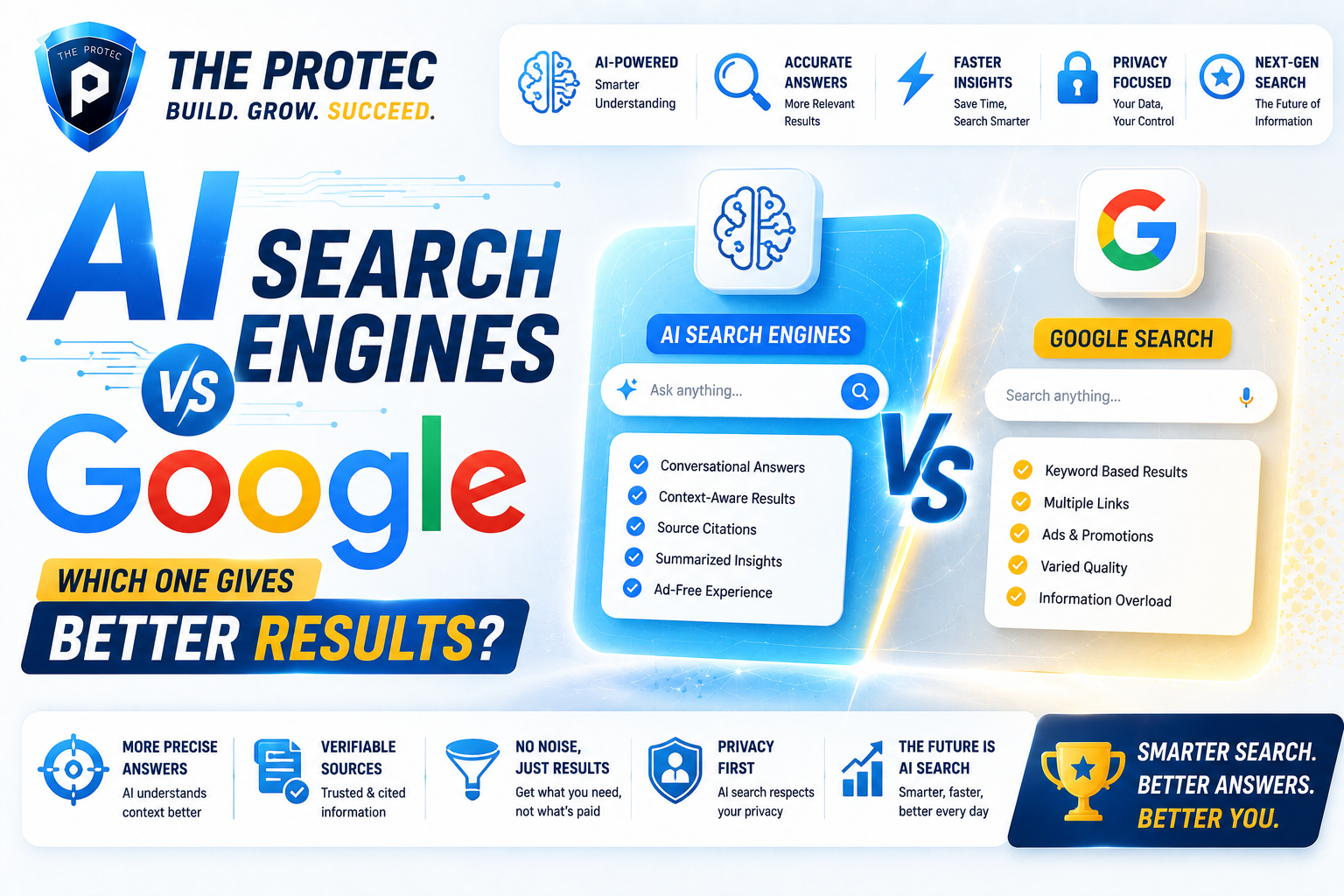
Search is no longer just about typing a query and scanning ten blue links. Over the last few years, the rise of the AI search engine has changed what users expect from an answer. Instead of forcing people to piece together information from multiple pages, AI-powered search tools can summarize, explain, and cite sources in one place. That convenience has made many users ask a very practical question: do AI search engines actually give better results than Google?
The answer is not simple. Google remains the dominant search engine because of its scale, index depth, freshness, and speed. But AI search tools are closing the gap in certain use cases, especially when users want a concise answer, source-backed summaries, or a more conversational experience. The real comparison is not just about which platform is “smarter.” It is about which one performs better for accuracy, speed, citations, and overall usability depending on the task.
This article breaks down the strengths and weaknesses of AI search engines and Google, including a practical look at Perplexity vs Google, so you can decide which search experience works best for your needs.
What Is an AI Search Engine?
An AI search engine combines traditional web search with large language models and retrieval systems to generate direct answers. Instead of only ranking links, it tries to understand the query, collect relevant information from the web, and present a synthesized response. Many of these tools also show citations, related questions, and follow-up prompts that make the search feel more interactive.
In practice, an AI search engine usually does three things:
- Finds relevant content across the web or from licensed data sources
- Summarizes the information into a readable answer
- Links to sources so users can verify the result
This is one reason people exploring Google alternatives AI are so interested in these tools. They reduce the time spent opening multiple tabs and reading long pages just to answer a single question.
How Google Still Dominates Search
Google is still the benchmark for search because it is built on an enormous index, sophisticated ranking systems, and years of user behavior data. It is exceptionally good at identifying authoritative pages, understanding intent, and serving results quickly across almost any topic.
For navigational searches, local queries, shopping comparisons, and highly time-sensitive information, Google remains hard to beat. If you want a nearby service, a product page, a news story, or the official website of a company, Google often gives you the answer faster than an AI summary can.
Google’s ecosystem also matters. Features like Maps, Shopping, News, Images, and rich results make it a powerful all-in-one discovery engine. Even as AI search engines become more capable, Google’s depth and breadth remain a major advantage.
Accuracy: Which One Gives Better Results?
Accuracy is where the comparison becomes interesting. Google is usually more reliable when the goal is to find the most authoritative source or the freshest page. It does not invent answers; instead, it points you to pages that it believes are relevant and trustworthy. That makes it strong for verification and research.
An AI search engine can feel more accurate because it provides a clean answer immediately, but that answer is only as good as the retrieval and synthesis behind it. When the system pulls from weak sources, misreads context, or combines several partial truths, the result can sound polished while still being wrong. This is why AI search can sometimes create a false sense of confidence.
That said, AI search engines have improved dramatically. Better citation systems, real-time retrieval, and answer grounding have reduced the risk of hallucinated responses. For straightforward informational questions, they can be highly effective. For example, asking for a definition, a quick comparison, or a step-by-step summary often yields excellent results.
Where Google still wins is in high-stakes queries, edge cases, and searches that require nuanced interpretation. If you are researching medical, legal, financial, or technical topics, the safest workflow is often to use Google to identify primary sources and then read them directly.
Accuracy verdict
- Google: Better for source verification, authority, and freshness
- AI search engine: Better for quick summaries and context-rich answers
- Best approach: Use AI for synthesis, Google for validation
Speed: Fast Links vs Fast Answers
Speed means different things in search. Google is faster in the traditional sense because results load instantly and users can jump straight to a page. If you already know what you want, Google gets you there with minimal friction.
An AI search engine can also be fast, but its speed is measured by how quickly it delivers a useful answer, not just a list of links. For simple questions, that can save time. Instead of clicking through several pages, the user gets a summarized response in one shot. That is a major advantage for students, researchers, analysts, and knowledge workers.
However, AI search engines often spend a little more time processing the query, retrieving sources, and generating the answer. That extra step can make them feel slower than Google, even if they reduce total research time. In other words, Google is faster for browsing, while AI search is often faster for understanding.
The type of query matters here:
- Google is faster: local searches, site lookups, shopping, breaking news
- AI search engine is faster: complex questions, comparisons, explanations, synthesis
Citations and Source Transparency
Citations are one of the biggest reasons people are testing AI search engines. Traditional Google results require you to open and evaluate sources yourself. AI search tools often bundle those sources into the answer, which makes verification easier.
This is especially relevant in the Perplexity vs Google conversation. Perplexity has become one of the best-known AI search platforms because it emphasizes citations and source-backed answers. Users can see where the information came from, click through, and judge whether the result is trustworthy. That makes it feel more transparent than a generic AI chatbot and more streamlined than standard search.
Still, citations are not a guarantee of accuracy. A well-cited answer can still overstate conclusions or rely on sources that are outdated, biased, or weakly connected to the query. The best AI search engines help users inspect the sources, but the responsibility to verify still matters.
Google, by contrast, gives users more control over source selection because it presents multiple links rather than a single synthesized response. That means the user can compare perspectives, check primary documents, and avoid overreliance on one generated summary.
Best practices for using citations
- Open the cited source instead of trusting the summary alone
- Check the publication date and author credibility
- Look for primary sources when the topic is technical or sensitive
- Use multiple sources to confirm important facts
User Experience: Conversation vs Control
User experience is where AI search engines often feel like the future. They let users ask follow-up questions in natural language, refine the request without starting over, and explore a topic more fluidly. That conversational style is easier for many people than scanning a page of search results and reformulating keywords.
For example, instead of searching for multiple queries about a topic, a user can ask an AI search engine: “Compare the main approaches, cite sources, and give me a short summary first.” That kind of prompt would be awkward in traditional search but natural in an AI interface.
Google still offers more control, though. Some users prefer to see the entire landscape of sources and choose what to read themselves. Search professionals, journalists, and researchers often want that level of control because they need to inspect search intent, source diversity, and ranking patterns.
So the UX question comes down to preference:
- AI search engine: better for guided exploration and conversational refinement
- Google: better for manual source selection and broad discovery
When AI Search Engines Are Better Than Google
AI search engines are often the better choice when the user wants speed of understanding rather than speed of clicking. They shine when the question is broad, multi-step, or comparative. They are also useful when the user does not know the exact keywords to search for.
Common scenarios where AI search can outperform Google include:
- Summarizing long or complex topics
- Comparing products, tools, or concepts
- Getting a quick overview of recent developments
- Asking follow-up questions without restarting the search
- Finding source-linked explanations instead of just links
For professionals who need to move quickly through research, this can be a major productivity gain. AI search is especially useful during early-stage exploration, when the goal is to understand a topic before diving into primary sources.
When Google Is Still the Better Choice
Google remains the stronger option when search intent is specific, transactional, or location-based. It also performs better when freshness, breadth, and direct access to original pages matter more than a summarized answer.
Google is usually the better choice for:
- Breaking news and rapidly changing events
- Local search and map-based results
- Shopping and product discovery
- Official websites and login pages
- Deep research that requires checking multiple viewpoints
Another advantage is consistency. Google’s ranking systems are mature, and users generally know what to expect. AI search engines may vary more in style, source selection, and response quality depending on the platform and the query.
Perplexity vs Google: A Practical Comparison
The Perplexity vs Google comparison captures the broader shift in search behavior. Perplexity represents the new AI-first search model: concise answers, citations, and a conversational workflow. Google represents the classic search model: comprehensive indexing, ranked results, and a massive ecosystem of adjacent tools.
If you ask a factual question that benefits from a synthesized answer, Perplexity can feel better. It reduces friction and surfaces the sources right away. If you ask a question that requires exploring many pages, checking official documents, or finding the latest coverage, Google often remains superior.
The most useful way to think about the comparison is not “which one is universally better?” but “which one is better for this specific search task?” In many workflows, the answer is both. Users may start with an AI search engine to understand the topic, then move to Google to verify details or expand the research.
The Latest Trend: Search Is Becoming Multimodal and Agentic
One of the biggest shifts in modern search is that users are no longer limited to text-only queries and result pages. Search interfaces are increasingly multimodal, meaning they can handle text, images, voice, and even structured tasks. At the same time, AI-powered search is becoming more agentic, helping users plan, compare, and take action instead of only retrieving information.
This trend matters because it changes the definition of “better results.” In the old model, a good search engine gave you the best links. In the new model, a good search engine may give you a reliable answer, a source trail, and a next step. That is why many Google alternatives AI products are gaining traction: they are not just search tools, they are research assistants.
Still, the most successful search experiences are likely to combine the strengths of both worlds. The future of search is probably not a total replacement of Google by AI search engines. It is a hybrid model where users get AI-generated synthesis on top of an index that is still powered by web-scale search infrastructure.
How to Choose the Right Search Tool
If you are deciding between an AI search engine and Google, start by asking what you need from the search. The best tool depends on the task, not the trend.
- Choose an AI search engine when you want a quick explanation, summary, or comparison
- Choose Google when you need breadth, freshness, navigation, or source diversity
- Use both when accuracy matters and you want to move efficiently from overview to verification
A practical workflow looks like this: ask the AI search engine for a summarized answer, inspect the citations, then search Google for the original sources or additional viewpoints. That combination gives you the best of both worlds and reduces the risk of missing important context.
Final Verdict: Which One Gives Better Results?
If the question is strictly about finding a fast, readable answer with citations, an AI search engine can absolutely give better results than Google. It is often more efficient for synthesis, explanation, and conversation. For users who want to understand a topic quickly, AI search is a major upgrade.
If the question is about reliability, breadth, and direct access to authoritative sources, Google still gives better results overall. It is especially strong when the query is specific, local, or time-sensitive. Its ranking systems and ecosystem remain unmatched in many everyday search scenarios.
The most honest conclusion is this: AI search engines are better at answering; Google is better at indexing. AI search is becoming the better experience for exploration, while Google is still the better engine for discovery and verification. In practice, the smartest users will not treat them as competitors only. They will treat them as complementary tools.
FAQ
Are AI search engines more accurate than Google?
Not universally. AI search engines can be more helpful for quick summaries and explanations, but Google is often more reliable for verifying sources and finding the most authoritative pages.
Is Perplexity better than Google for research?
Perplexity can be better for starting research because it provides concise answers with citations. Google is usually better when you need to explore multiple sources, compare perspectives, or check primary documents.
Do AI search engines replace Google?
Not yet. AI search engines are changing search behavior, but Google still leads in scale, freshness, navigation, and ecosystem features. Most users will likely use both depending on the task.
Why do AI search engines give citations?
Citations help users verify the response and inspect the source material. They are one of the main reasons AI search tools are becoming popular as Google alternatives AI.
What is the biggest advantage of an AI search engine?
The biggest advantage is speed of understanding. AI search engines reduce the time needed to read multiple pages by summarizing the key information in one place.
Conclusion
The debate over AI search engines vs Google is really a debate about how we want to find and consume information. Google is still the best all-purpose search engine for discovery, verification, and breadth. AI search engines are better at interpretation, synthesis, and guided answers. Neither is perfect, but each is excellent in different contexts.
If your goal is to move faster through information, AI search tools are worth using. If your goal is to confirm facts and explore the open web thoroughly, Google remains essential. The best results often come from combining both.