








How AI Is Changing Smartphone Cameras Forever
Smartphone cameras have evolved far beyond the days when better photos simply meant a larger sensor or a brighter lens. Today, the biggest leap in mobile photography is happening in software, not hardware. AI smartphone camera systems are now responsible for much of what users see, from sharper portraits and cleaner night shots to more natural colors and smarter zoom. In many cases, the camera in your pocket is no longer just capturing an image; it is interpreting the scene, predicting the outcome, and rebuilding details in real time.
This shift is driven by computational photography, a combination of image processing, machine learning, and multi-frame analysis that helps small phone sensors compete with larger dedicated cameras. Instead of depending on one single exposure, modern smartphones use phone camera AI to merge multiple frames, reduce noise, enhance detail, balance highlights, and identify what is in front of the lens. The result is a camera experience that feels almost magical, but it is the product of very deliberate engineering.
What makes this moment especially important is that AI is no longer limited to premium flagships. From mid-range devices to foldables and ultra-thin phones, AI-powered photography features are becoming standard. As mobile processors become more capable and on-device neural engines improve, smartphone cameras are beginning to act less like passive hardware and more like intelligent imaging systems. That change is reshaping consumer expectations and redefining what “good camera quality” means.
Why AI Became the Biggest Camera Upgrade
For years, smartphone makers competed primarily on megapixels, aperture size, and optical zoom. Those factors still matter, but they cannot fully overcome the physical limits of tiny camera modules. A small sensor collects less light, a thin lens offers less optical flexibility, and a compact body leaves little room for moving parts. AI solves many of these constraints by improving the image after capture, and often during capture, through computational methods.
Rather than relying on a single frame, AI smartphone camera pipelines now analyze a burst of images captured milliseconds apart. They can combine the best parts of each frame, correct for motion, and reduce the weak points of mobile optics. This is especially useful in low light, where sensors struggle, and in high contrast scenes, where bright skies and dark shadows are difficult to balance. AI lets a phone simulate a more advanced camera system without requiring a much larger device.
The shift is also being accelerated by user behavior. Most people want photos that look polished immediately, without editing. They expect vibrant colors, crisp details, and flattering portraits straight from the camera app. Phone camera AI delivers that convenience by making decisions automatically, often invisibly. It can detect a face, recognize food, identify a sunset, or understand that a moving pet needs faster shutter control. These are not small improvements; they are fundamental changes in how the camera sees the world.
Computational Photography: The Engine Behind Modern Mobile Cameras
Computational photography is the foundation of today’s advanced smartphone imaging. It combines hardware input with software intelligence to create a final image that often looks better than a raw single shot could ever achieve. The process starts before you even press the shutter. The camera app may already be buffering frames, measuring light, tracking motion, and preparing a scene analysis in the background.
Once you tap capture, the system can merge several exposures into one final image. This helps preserve detail in shadows and highlights, a technique that is essential in HDR photography. AI also helps align frames that may be slightly shifted by hand movement, which reduces blur and improves sharpness. In many devices, the camera uses semantic segmentation, meaning it can understand which parts of the image are people, skies, hair, plants, text, or backgrounds. That contextual understanding allows the software to apply different adjustments to different parts of the frame.
Recent advances have made computational photography more sophisticated than ever. Modern systems can reconstruct edges more accurately, suppress noisy artifacts without smearing detail, and preserve skin texture more naturally than older filters. This matters because the best AI enhancements are subtle. The goal is no longer to make every photo look heavily processed. The goal is to make the image appear as though the camera simply performed better under difficult conditions.
How Phone Camera AI Improves Everyday Photos
The most visible impact of phone camera AI is in everyday shooting. Whether someone is taking a family portrait, a restaurant photo, or a quick snapshot on the street, the camera now interprets the scene and adjusts its output accordingly. This reduces the amount of manual effort required and improves consistency across different lighting situations.
Smarter scene detection
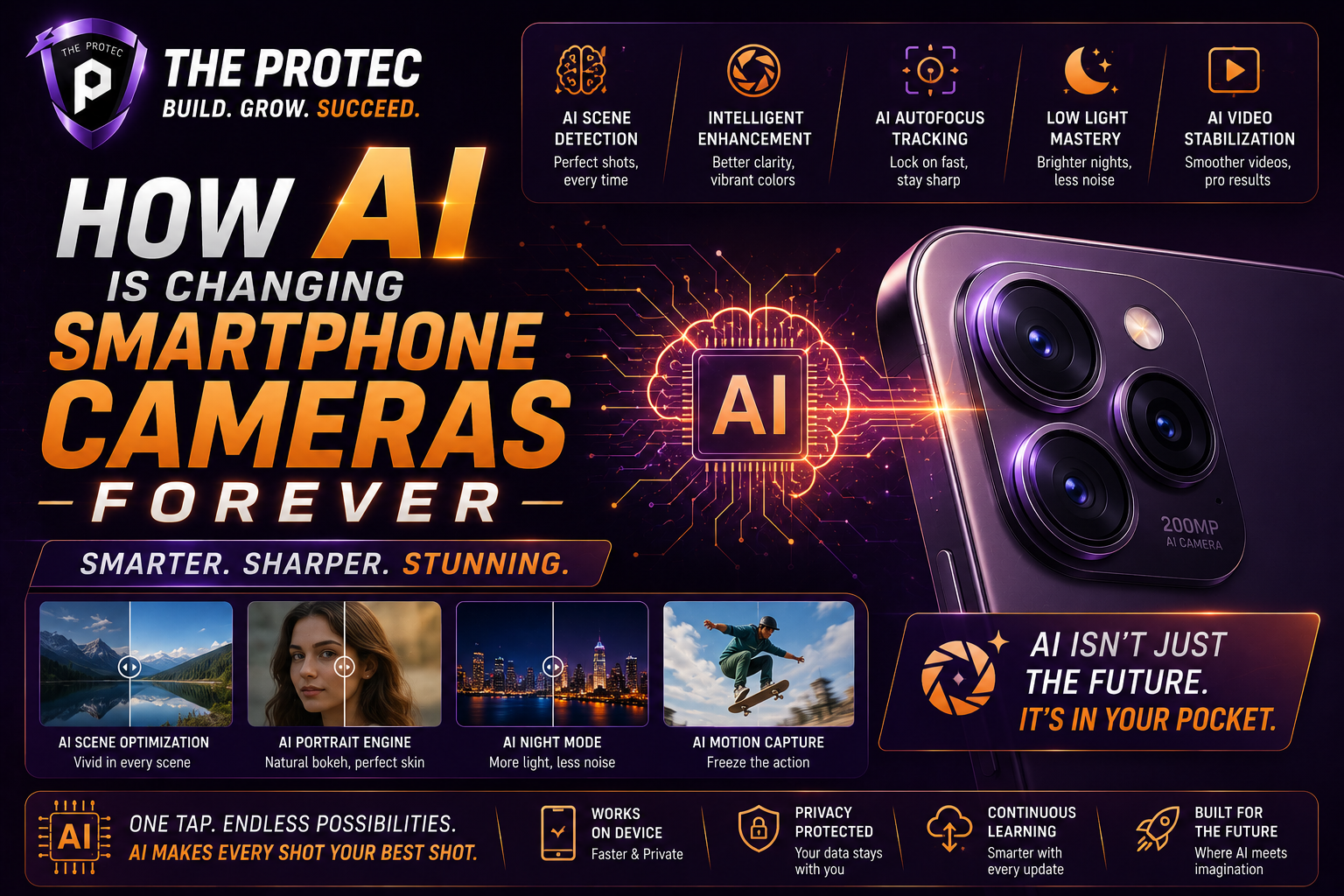
Scene detection has become much more advanced than the old preset modes that simply labeled a photo as “portrait” or “landscape.” Now, AI can recognize subtle differences between a night cityscape, a backlit face, a reflective surface, and a close-up subject. It then tweaks contrast, saturation, white balance, and local sharpening in a more targeted way. This helps the camera produce images that are not only brighter or more vivid, but more accurate to the subject.
Better low-light photography
Night photography is one of the clearest examples of AI’s value. Small sensors struggle when light levels drop, but AI helps by combining multiple frames, denoising intelligently, and recovering details that would otherwise be lost. It can distinguish between grain and texture, preserving building edges, clothing patterns, and facial features while eliminating the muddy look that used to define low-light phone photos. In many cases, the image is built from several short exposures rather than one long one, which reduces motion blur and makes handheld night shooting much more practical.
Improved portraits and subject separation
Portrait mode has also matured dramatically. Early versions often struggled around hair, glasses, and irregular edges. Modern AI smartphone camera software uses advanced depth estimation and segmentation to create more realistic background separation. It can identify the subject more accurately and apply bokeh effects in a way that feels more natural. Some systems also preserve facial tones more carefully and avoid over-smoothing, which has become a major concern for users who want flattering but realistic portraits.
Color tuning that feels more natural
AI is increasingly used to make color output more consistent across scenes. In the past, some phones produced overly saturated greens, unnatural skin tones, or contrast-heavy images that looked dramatic but inaccurate. Newer AI pipelines analyze the scene context and adjust for more believable results. This is especially important as consumers demand cameras that can handle a wider range of lighting and subject types without requiring manual corrections.
The Rise of On-Device AI and Real-Time Processing
One of the most important developments in smartphone imaging is the move toward on-device AI. Instead of sending photos to the cloud for enhancement, phones increasingly process images locally using neural accelerators, NPUs, and optimized imaging pipelines. This makes camera features faster, more private, and more reliable in places with poor connectivity.
Real-time processing is now a major part of the camera experience. A phone may analyze the frame as you compose the shot, suggesting better exposure, recognizing faces, stabilizing preview output, and preparing image corrections before the photo is taken. This gives users a more responsive viewfinder and improves the odds of capturing the best possible image on the first try.
On-device processing also supports new creative features. Video noise reduction, live portrait adjustments, background blur in video calls, and even subject-aware autofocus all benefit from AI working instantly on the device. As mobile chipsets continue to improve, these features will become more common and more sophisticated. The gap between what a smartphone can do and what a dedicated camera can do is narrowing in areas that matter most to everyday users.
AI and the New Era of Mobile Zoom
Zoom has long been one of the hardest problems for smartphone cameras. Optical zoom requires physical lens movement and space, both of which are limited in thin devices. AI has become essential in extending zoom performance beyond what hardware alone can provide. Through multi-frame fusion and detail reconstruction, a phone can create a sharper image at higher zoom levels than would otherwise be possible.
At moderate zoom, AI can sharpen edges and reduce artifacts while preserving the integrity of text, faces, and architectural details. At higher zoom levels, some systems use advanced reconstruction methods to infer missing detail from patterns learned during training. While this does not replace true optical zoom, it dramatically improves the usability of digital zoom and makes telephoto photography more accessible in everyday use.
This is particularly important for travel, sports, concerts, and wildlife photography, where users often cannot move closer to the subject. AI helps make mobile zoom more practical by balancing detail, stability, and noise reduction in ways that older smartphones could not. The result is a camera that can reach farther without needing a much larger lens assembly.
Video Is Becoming Smarter Too
AI is not changing only still photos. It is also transforming smartphone video, which may be the more demanding challenge of all. Video requires consistency from frame to frame, and any flaw in exposure, focus, or color becomes noticeable immediately. AI helps by stabilizing motion, tracking subjects, reducing noise, and balancing scene changes in real time.
Modern phone camera AI can adjust focus as a subject moves through the frame, keeping faces or objects sharp even when the camera is handheld. It can also support cinematic effects such as background blur, subject isolation, and automatic reframing. In low light, AI-powered denoising makes video cleaner without producing the waxy, over-processed look that older algorithms often created.
Another major trend is intelligent video enhancement after capture. Phones can now improve dynamic range, smooth motion, and refine color grading automatically. Some devices also use AI for audio cleanup, separating voice from wind or background noise. That makes the camera system more useful for creators, not just casual users. As mobile content creation continues to grow, AI-assisted video will become a major differentiator.
How AI Is Making Camera Hardware More Efficient
AI does not replace hardware entirely; instead, it helps hardware perform better. This is one reason the latest smartphones can deliver impressive camera results even with slim bodies and modest lens stacks. By understanding the scene, AI can make the most of each sensor readout and extract better output from the available components.
For example, sensor-shift stabilization and electronic stabilization both become more powerful when combined with AI motion analysis. The software can distinguish between intentional movement and unwanted shake, which improves both stills and video. Similarly, autofocus benefits from machine learning models that recognize faces, eyes, pets, vehicles, and other subjects more reliably than older contrast-based systems.
AI also helps compensate for trade-offs in lens design. Wide-angle cameras can suffer from edge distortion, while ultra-thin periscope modules may introduce softness or color fringing. Software correction can reduce these flaws significantly. In practice, this means consumers get a more balanced camera experience without requiring the phone to become thicker or heavier.
What Users Should Watch For: Benefits and Limits
Even though AI has improved smartphone cameras dramatically, it is not perfect. Users should understand both the advantages and the limitations so they can get the most from their device.
- Benefit: Better low-light performance with less noise and more detail.
- Benefit: More accurate portraits and subject separation.
- Benefit: Smarter color balance and exposure correction.
- Benefit: Faster, more intuitive shooting with less manual adjustment.
- Limit: Excessive processing can still make images look unnatural if the tuning is too aggressive.
- Limit: AI reconstruction at extreme zoom may improve visibility but can invent details.
- Limit: Motion, glass, reflections, and complex textures can still challenge scene recognition.
The best smartphone cameras are not the ones with the most aggressive AI, but the ones with the most refined AI. Good tuning should preserve realism, maintain texture, and respect the scene. That balance is what separates premium imaging systems from gimmicky filters.
What Comes Next for AI Smartphone Camera Technology
The next phase of smartphone photography will likely be even more intelligent, more personalized, and more context-aware. We are already seeing camera systems that adapt to the user’s habits, preferred color style, and common shooting scenarios. Future updates may take that further by learning how specific people like to shoot and tailoring the output accordingly.
Another major direction is generative enhancement, where AI can reconstruct missing image information more convincingly. That could improve zoom, motion correction, and low-light detail even further, but it also raises questions about authenticity and trust. As cameras become more capable of altering reality, manufacturers will need to be transparent about what is captured and what is synthesized.
There is also growing interest in multimodal AI, where camera systems understand not just pixels but context from other sensors and device inputs. A phone may soon combine visual recognition with scene history, motion data, and user intent to make even better decisions about focus, exposure, framing, and enhancement. In the long run, the camera may become one of the most intelligent parts of the smartphone.
Why This Shift Matters for Everyone
The rise of AI in smartphone cameras matters because photography is now a daily activity for billions of people. Most users are not trying to manually control aperture, shutter speed, and ISO. They want their photos and videos to look good quickly and consistently. AI makes that possible by handling the complex technical work in the background.
At the same time, the technology is raising expectations for all mobile devices. Consumers now assume that a phone should recognize scenes, improve difficult lighting, and produce shareable results without editing. That expectation is pushing the industry forward and forcing camera makers to think beyond hardware specs. The best mobile camera is increasingly the one that understands the moment, not just the one with the largest number on a spec sheet.
As computational photography continues to mature, the line between photography and image generation will keep shifting. But for now, the most important takeaway is simple: AI smartphone camera systems have changed mobile photography from a convenience feature into the core of the imaging experience. The camera is no longer just a sensor and lens. It is an intelligent visual engine.
FAQ
What is an AI smartphone camera?
An AI smartphone camera uses machine learning and computational photography to improve photos and videos automatically. It can detect scenes, merge exposures, reduce noise, sharpen details, and optimize colors in real time.
How does computational photography improve phone photos?
Computational photography combines multiple frames and applies intelligent image processing to create a better final photo than a single exposure could produce. It helps with low light, HDR, portrait effects, and detail preservation.
Does phone camera AI replace traditional camera hardware?
No. AI enhances hardware, but it does not replace the sensor, lens, or stabilization system. The best results come when strong hardware and advanced software work together.
Can AI make smartphone photos look unnatural?
Yes, if processing is too aggressive. Over-sharpening, oversaturation, and excessive smoothing can make images look artificial. The best camera systems aim for balance and realism.
Is AI useful for video as well as photos?
Absolutely. AI improves video stabilization, autofocus, noise reduction, color consistency, and even audio cleanup, making smartphone video significantly more capable than before.
External sources: Learn more about computational photography from Wikipedia’s overview of computational photography and Apple’s approach to advanced mobile imaging in its Newsroom.