






Contents
- 1 AI in Cybersecurity Operations: Automating Threat Detection and Response
- 2 Why SOC Teams Need AI Now
- 3 How Threat Detection AI Works in Practice
- 4 Security Automation: From Alert to Action
- 5 How AI Is Transforming SOC Operations
- 6 Where AI Cybersecurity Tools Deliver the Most Value
- 7 What Good AI Security Automation Looks Like
- 8 Risks and Limitations of AI in the SOC
- 9 The Latest Direction of AI in Cybersecurity Operations
- 10 How to Adopt AI Without Disrupting Operations
- 11 Conclusion
- 12 FAQ
AI in Cybersecurity Operations: Automating Threat Detection and Response
Security operations centers are under pressure from every direction. Attack volumes keep rising, cloud environments are expanding, identities are becoming the new perimeter, and adversaries are using automation just as aggressively as defenders. In that environment, traditional alert triage and manual response simply cannot keep up. This is where AI cybersecurity tools are changing the day-to-day reality of the SOC.
AI is not replacing security teams. It is helping them work faster, investigate more accurately, and respond with greater consistency. The biggest shift is not just in detection. It is in how organizations connect detection, investigation, enrichment, prioritization, and response into a more automated workflow. That evolution is turning security operations from a reactive function into a faster, more adaptive defense layer.
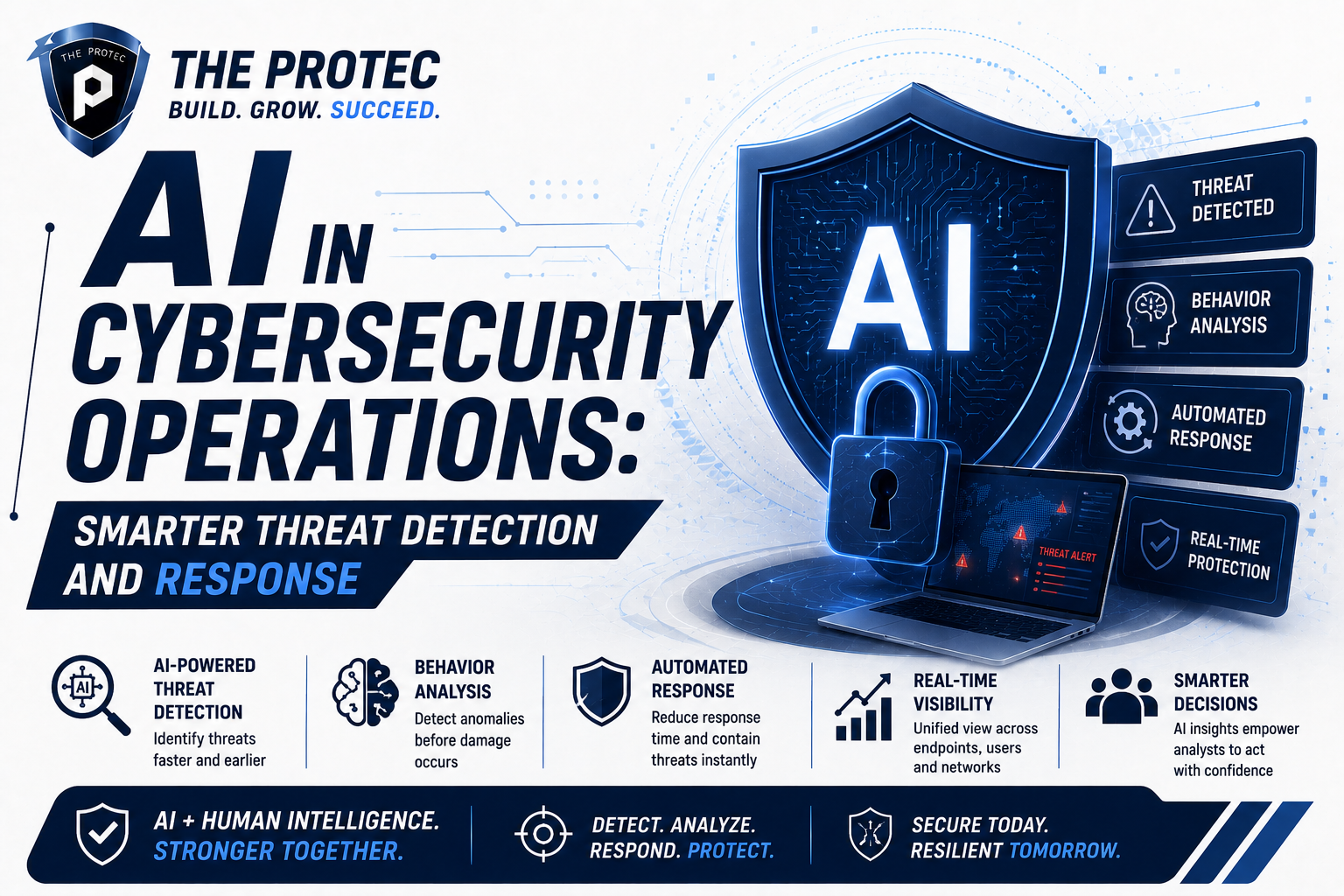
Today’s threat detection AI is built to process large volumes of telemetry across endpoints, identities, SaaS platforms, cloud workloads, and networks. It can identify subtle anomalies, correlate events across sources, and surface the alerts most likely to matter. When paired with security automation, AI can also help drive containment actions, ticket creation, case enrichment, and escalation paths with less manual effort. The result is a SOC that can focus on judgment-heavy work instead of repetitive noise.
Why SOC Teams Need AI Now
Modern SOCs face a structural problem: the quantity of telemetry is growing much faster than the number of skilled analysts. A single breach may generate alerts across dozens of tools. Even when those alerts are valid, the process of validating them can consume hours. Add alert fatigue, false positives, and incomplete context, and the SOC quickly becomes overwhelmed.
Threat actors are also moving faster. Phishing kits are more convincing, malware loaders are more modular, and post-compromise activity can unfold in minutes. Many organizations now operate hybrid and multi-cloud environments where logs are fragmented and identities can be compromised without any obvious network signature. In that environment, human-only analysis is too slow.
AI helps close this gap by continuously learning normal patterns, scoring suspicious behavior, and correlating weak signals that would be difficult to connect manually. It is especially valuable in environments where defenders need to identify not just one suspicious event, but the full chain of activity behind it. That includes lateral movement, privilege escalation, data staging, and exfiltration indicators.
How Threat Detection AI Works in Practice
Threat detection AI is most effective when it combines pattern recognition, anomaly detection, and contextual correlation. Instead of relying only on static signatures, AI models can evaluate behavior across users, devices, applications, and data flows. This allows SOC teams to catch threats that do not match a known signature or hash.
Behavioral baselines and anomaly detection
AI cybersecurity tools often begin by learning what “normal” looks like for a user, asset, or workload. A login from a new geography, an unusual process launch sequence, or a sudden spike in file access can all become signals. By comparing current behavior against historical baselines, threat detection AI can flag suspicious activity before it becomes a full incident.
Cross-domain correlation
One of AI’s most valuable capabilities is correlation. A single event may not be meaningful on its own, but a combination of signals can tell a very different story. For example, an impossible travel login, followed by MFA fatigue attempts, followed by cloud privilege changes and data downloads, may indicate account takeover. AI can link those events faster than a human analyst switching between tools.
Risk scoring and prioritization
Not every alert deserves immediate attention. AI helps assign risk scores based on asset criticality, identity context, reputation data, and historical patterns. That means analysts can focus on the most dangerous threats first instead of working through a flat queue of alerts.
Natural-language investigation support
Many modern SOC platforms now use AI assistants to summarize alerts, generate investigation timelines, and recommend next steps. This does not replace analyst judgment, but it does reduce time spent gathering basic context. The more repetitive the investigation step, the more AI can help compress it.
Security Automation: From Alert to Action
Detection alone is not enough. The real value appears when AI and security automation work together to shorten the time between detection and response. In many SOCs, the longest delays happen after an alert is generated. Analysts still need to enrich the event, validate impact, notify stakeholders, and trigger containment. Automating those steps can dramatically reduce dwell time.
Security automation can support a wide range of actions, including:
- Creating incident tickets with prefilled context
- Enriching alerts with threat intelligence and asset data
- Isolating compromised endpoints
- Disabling suspicious accounts or forcing password resets
- Blocking malicious IPs, domains, or URLs
- Quarantining files or emails
- Escalating high-confidence cases to human analysts
The key is not to automate everything blindly. The best security automation uses confidence thresholds, policy controls, and approval logic. For low-risk, high-confidence scenarios, automated containment may be appropriate. For more sensitive situations, AI can prepare the response package and hand it to an analyst for final approval. This balance keeps the organization fast without removing human oversight.
How AI Is Transforming SOC Operations
AI is changing the SOC at multiple levels, not just at the alerting layer. It affects triage, investigation, orchestration, and reporting. The result is a more efficient operational model that can scale without adding the same amount of headcount.
1. Less alert fatigue, better focus
Analysts spend too much time on false positives and low-value alerts. AI can suppress redundant signals, cluster related events, and prioritize by impact. That means fewer distractions and more time for threat hunting, tuning, and proactive defense.
2. Faster mean time to investigate
AI tools can summarize what happened, identify related users and assets, and show a timeline of activity. Instead of manually pivoting through dashboards, analysts get a structured starting point. This is especially helpful during active incidents when every minute matters.
3. More consistent response playbooks
Human response can vary depending on who is on shift. AI-assisted automation helps standardize the first steps of containment and escalation. This improves operational consistency and reduces the chance of missed actions during a high-pressure event.
4. Better use of scarce expertise
Experienced analysts should spend their time on ambiguous threats, detection engineering, and incident strategy. AI can absorb the repetitive work, allowing senior staff to focus on high-value decisions. That creates leverage across the entire security team.
5. Improved visibility across fragmented environments
Many organizations struggle because telemetry is spread across endpoint tools, identity systems, cloud logs, and SaaS applications. AI can help unify those signals into a more coherent picture. That is especially important as attackers increasingly target identities, tokens, and cloud control planes rather than only endpoints.
Where AI Cybersecurity Tools Deliver the Most Value
Not every security use case benefits equally from AI. The biggest gains tend to appear in high-volume, pattern-rich workflows where speed matters and manual review is expensive.
Email and phishing analysis
AI can identify suspicious sender patterns, lookalike domains, malicious attachments, and social engineering language. It can also correlate email threats with identity events and endpoint activity, which is crucial when a phishing message leads to credential theft.
Identity threat detection
As identity becomes the main attack surface, AI is increasingly used to detect unusual authentication behavior, token abuse, privilege escalation, and MFA bypass attempts. This area is especially important for cloud-first organizations.
Cloud and SaaS monitoring
Cloud environments generate huge volumes of telemetry and often involve complex permission models. AI cybersecurity tools can help detect risky configuration changes, impossible access patterns, and suspicious API activity faster than manual review alone.
Endpoint investigation
Endpoint telemetry is rich but noisy. AI can help cluster process activity, detect malicious chains, and highlight suspicious parent-child relationships. That makes it easier to distinguish genuine compromise from legitimate administrative activity.
Threat hunting support
AI does not eliminate the need for threat hunters. Instead, it makes hunting more efficient by highlighting outliers and surfacing patterns worth investigating. Hunters can move from raw data gathering to hypothesis testing much faster.
What Good AI Security Automation Looks Like
Effective AI in cybersecurity operations is not just about adding a model to a dashboard. It requires thoughtful integration, clean data, and operational guardrails. Organizations that get value from AI usually follow a few common principles.
- Start with high-confidence use cases: automate repetitive tasks where the decision logic is clear.
- Keep humans in the loop: use analyst review for ambiguous or high-impact actions.
- Measure outcomes: track false positives, response time, containment speed, and analyst workload.
- Use explainable outputs: analysts should understand why an alert was prioritized or an action was recommended.
- Continuously tune models: environments change, and so should thresholds, baselines, and playbooks.
Without these controls, AI can create new noise instead of reducing it. With them, it becomes a force multiplier that improves both speed and confidence.
Risks and Limitations of AI in the SOC
AI is powerful, but it is not magic. Security teams need to understand its limitations so they can deploy it responsibly. One common challenge is data quality. If telemetry is incomplete, mislabeled, or inconsistent, AI outputs will suffer. Another issue is overreliance. Analysts who trust automated outputs too much may miss subtle context that the model cannot see.
There is also the risk of adversarial adaptation. Attackers are already experimenting with evasion techniques designed to confuse detection systems. That means AI must be layered with traditional controls, strong identity security, logging discipline, and continuous validation. It should strengthen the SOC, not become the only line of defense.
Privacy and governance matter as well. AI systems may process sensitive user activity, communication data, or business context. Organizations should define data access boundaries, retention policies, and auditability requirements before broad deployment.
The Latest Direction of AI in Cybersecurity Operations
The most important trend is the shift from isolated AI features to agentic workflows. Instead of simply classifying alerts, newer systems can orchestrate multi-step investigations, pull in evidence from several tools, draft case notes, and recommend response actions. In mature environments, AI is becoming a coordinator across detection, enrichment, and response layers.
Another major trend is tighter integration with identity security, cloud security, and exposure management. Because attackers increasingly exploit valid credentials and misconfigurations, AI needs to understand business context, privilege structure, and asset exposure, not just raw event volume. The best systems are moving toward richer contextual awareness rather than narrower alert scoring.
There is also growing interest in smaller, task-specific models deployed inside controlled environments. Many security teams want AI capabilities without exposing sensitive logs to unnecessary third parties. This is pushing vendors to offer more flexible deployment models, better privacy controls, and stronger governance features.
For broader context on the rapidly evolving threat landscape, CISA’s guidance on incident response and cyber defense remains useful: CISA Incident Response Playbooks. For a practical view of how AI is being applied across security workflows, Microsoft’s Security blog is also worth tracking: Microsoft Security Blog.
How to Adopt AI Without Disrupting Operations
Organizations often make the mistake of trying to automate too much too quickly. A better approach is to introduce AI in stages. Start with alert enrichment and prioritization. Then move into analyst assistance, case summarization, and low-risk containment actions. Once the team trusts the outputs and the metrics improve, expand into more advanced orchestration.
It also helps to align AI adoption with the SOC’s existing playbooks. If your incident response process is already clear, AI can support it. If the process is inconsistent, automation will only amplify the inconsistency. In other words, good security automation depends on good operational design.
Training is equally important. Analysts need to understand what the system is doing, where it can fail, and how to validate its recommendations. The goal is not passive acceptance. It is informed collaboration between the analyst and the machine.
Conclusion
AI is transforming cybersecurity operations by helping SOC teams detect threats earlier, investigate incidents faster, and automate repetitive response tasks. The real value of AI cybersecurity tools is not that they replace analysts, but that they remove friction from the most time-consuming parts of the workflow. With the right data, governance, and playbooks, threat detection AI and security automation can meaningfully improve speed, accuracy, and resilience.
As attacks become more identity-driven, cloud-centric, and automated, the SOC must evolve as well. Organizations that use AI thoughtfully will be better positioned to reduce alert fatigue, improve response quality, and keep pace with modern threats. The future SOC is not fully automated, and it is not fully manual. It is a blended operation where humans lead and AI accelerates.
FAQ
What are AI cybersecurity tools used for in a SOC?
AI cybersecurity tools are used to analyze logs, detect anomalies, prioritize alerts, enrich incidents, summarize investigations, and automate parts of the response process. Their main value is reducing manual effort while improving speed and consistency.
How does threat detection AI reduce false positives?
Threat detection AI reduces false positives by learning baseline behavior, correlating related events, and scoring alerts based on context such as asset importance, user role, and historical patterns. This helps separate real risk from routine activity.
Can security automation replace human analysts?
No. Security automation is best used to handle repetitive, well-defined tasks such as enrichment, containment, and ticketing. Human analysts are still needed for judgment, escalation decisions, and ambiguous investigations.
What is the biggest benefit of AI in cybersecurity operations?
The biggest benefit is faster decision-making at scale. AI helps SOC teams triage more effectively, investigate incidents quicker, and respond with less delay, especially when alert volumes are high.
Is AI safe to use for incident response?
Yes, if it is deployed with guardrails. Organizations should define confidence thresholds, logging, review workflows, and permission boundaries so AI-assisted response actions are controlled and auditable.