









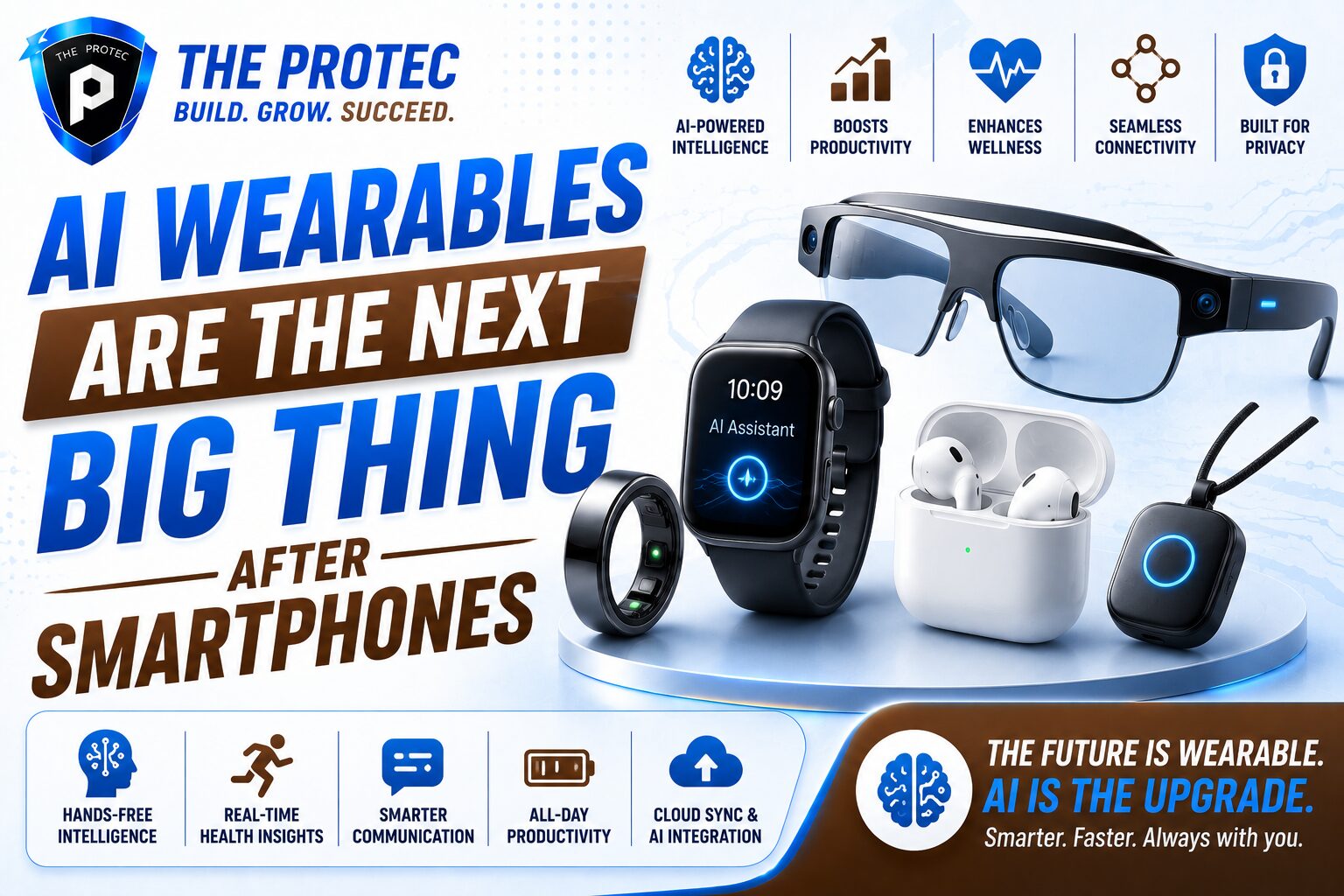
AI Wearables Are Changing the Shape of the Next Computing Platform
For more than a decade, the smartphone has been the center of digital life. It is the device we reach for first, the screen we use most, and the tool that quietly replaced cameras, maps, wallets, music players, and even many laptops. But the next major shift in personal computing is already underway, and it looks less like a rectangle in your pocket and more like a mix of smart glasses AI, AI-powered rings, earbuds, and always-available assistants.
AI wearables are becoming the most compelling answer to a problem smartphones cannot solve: how to make intelligence feel present without demanding attention. Instead of forcing people to open an app, tap through menus, or stare at a screen, future wearable technology aims to understand context, anticipate needs, and respond in the background. That shift is why AI wearables are being discussed not as accessories, but as the next big platform after smartphones.
The timing matters. As AI models become more efficient, on-device processing improves, and sensors become smaller and more power-conscious, wearables are finally capable of delivering useful intelligence in a form people may actually keep on all day. The result is a new category that blends convenience, ambient computing, and personal assistance in a way that feels increasingly inevitable.
Why AI Wearables Are Gaining Momentum Now
The rise of AI wearables is not happening by accident. Several technology trends have converged at the same time, making the category practical rather than speculative. First, AI models are now powerful enough to perform real-time summarization, translation, voice interaction, and visual understanding in compact form factors. Second, battery efficiency, chip design, and sensor miniaturization have improved dramatically. Third, users are increasingly open to devices that reduce screen time instead of adding to it.
Another major factor is the shift from reactive technology to proactive assistance. Traditional smartphones wait for commands. AI wearables are being designed to notice what is happening around the user and help accordingly. That could mean identifying a meeting participant, translating a street sign, logging a workout automatically, or reminding someone of a task based on location and activity.
Industry interest has also accelerated because of the success of multimodal AI. When a device can hear, see, and understand context, it becomes far more useful than a simple voice assistant. That is the core promise of future wearable technology: intelligence that is not only accessible, but embedded into daily life.
Smart Glasses AI: The Most Visible Front Door to the Future
Among all AI wearables, smart glasses AI has become the most visible and discussed category. That is because glasses sit in a uniquely powerful position: they can see what the wearer sees, hear what the wearer hears, and provide information without requiring the user to look down at a phone. In other words, they are one of the best possible interfaces for contextual AI.
Modern smart glasses are moving beyond basic notifications and camera features. The most exciting systems now focus on live translation, hands-free capture, object recognition, navigation support, and conversational assistance. Some can answer questions about what the wearer is looking at, summarize what is happening in a room, or help with tasks in real time. This is where AI turns glasses from a novelty into a practical tool.
There is also a social shift happening here. Earlier wearable attempts often failed because they looked awkward, felt intrusive, or lacked a clear purpose. Newer smart glasses are becoming more stylish, more lightweight, and more aligned with everyday use. As design improves, adoption becomes easier. Users do not want a computer strapped to their face; they want glasses that happen to be intelligent.
For a useful overview of how the wearable category is evolving, the Gartner technology trends outlook highlights how AI and ambient computing are influencing the next wave of consumer devices.
What smart glasses AI can actually do
- Provide real-time captions and translation during conversations
- Identify landmarks, products, or objects in the user’s field of view
- Offer voice-guided directions without pulling out a phone
- Take photos and short clips hands-free
- Summarize notes, reminders, or meeting details on command
- Act as an always-ready AI assistant for quick answers
The most important development is not a single feature, but the combination of features. When visual understanding, speech interaction, and context awareness work together, smart glasses become a new interface layer for everyday life.
AI Rings: Small Device, Big Potential
While smart glasses get most of the attention, AI rings may prove just as important. Rings are appealing because they are discreet, comfortable, and always with the user. Unlike a phone, they do not need to be held. Unlike glasses, they do not affect appearance in a noticeable way. And unlike a smartwatch, they do not compete for attention on the wrist.
AI rings are emerging as powerful health and interaction devices. They can track sleep, heart rate, temperature trends, readiness, and activity. But the real promise lies in how they can become control surfaces for digital life. A ring can authenticate identity, trigger commands, control smart devices, or interact with other wearables. In some ecosystems, the ring is becoming a silent remote control for the user’s digital environment.
This matters because the future of wearable technology may not depend on one device replacing the smartphone entirely. Instead, it may depend on a network of devices that divide roles intelligently. Smart glasses handle vision and context. Rings handle input and biometric awareness. Earbuds handle audio and voice. Together, they create a more natural computing experience than any single screen ever could.
Why AI rings are gaining trust
- They are less intrusive than larger wearables
- They support continuous health monitoring
- They are easier to wear consistently than many wrist devices
- They can enable discreet authentication and control
- They pair well with voice-first and screen-light computing
For users who want intelligence without another display, AI rings represent one of the most elegant pathways into ambient computing.
The Rise of the Always-On AI Assistant
One of the clearest signs that AI wearables are becoming the next major platform is the evolution of the assistant itself. The old model of digital assistants was simple: wake word, command, response. The new model is fundamentally more capable. It listens selectively, understands context, can summarize streams of information, and increasingly acts across multiple apps and devices.
On wearables, that assistant becomes even more valuable. A smartwatch can detect activity and urgency. Smart glasses can connect the assistant to the user’s visual environment. A ring can help initiate commands or confirm actions. This creates an assistant that is not confined to a phone screen, but distributed across the places where life actually happens.
The practical implications are significant. Imagine walking into a conference and receiving a subtle prompt about the person you are meeting. Or standing in a store and getting a concise comparison of two products. Or traveling in a foreign city and hearing live translation without opening an app. These are not futuristic fantasies; they are the kinds of everyday tasks AI wearables are increasingly capable of handling.
The assistant also becomes more useful when it can act in the background. Instead of asking the user to remember everything, it can surface what matters, when it matters. That is the essence of future wearable technology: reducing cognitive load rather than adding more digital noise.
Why AI Wearables Could Succeed Where Previous Wearables Fell Short
Wearables have had waves of excitement before, but many earlier products failed to become essential. The reasons were familiar: weak battery life, limited features, social awkwardness, and a lack of meaningful daily utility. AI wearables are different because they solve a real pain point that smartphones created as much as they solved: constant attention fragmentation.
People are increasingly aware of the costs of screen dependence. They want faster access to information, but they do not want to live inside a phone. AI wearables offer a promising alternative by making interaction more natural. Speak instead of type. Look instead of search. Tap a ring instead of unlocking a device. Hear a summary instead of reading a long thread.
Another reason for optimism is ecosystem integration. The best AI wearables will not try to replace every function of a smartphone on day one. They will complement existing devices and gradually absorb the tasks that are easiest to make ambient. That approach is more realistic and much more likely to succeed. Consumers adopt tools that fit into life, not devices that demand life be reorganized around them.
The winning formula for adoption
- Useful enough to wear every day
- Comfortable and socially acceptable
- Reliable battery life and connectivity
- Strong privacy controls
- Clear use cases beyond novelty
- Seamless integration with existing phones and apps
In short, AI wearables have a better chance than earlier generations because they are being built around intelligence and context, not just hardware novelty.
Privacy, Trust, and the Real Barriers to Adoption
No discussion of AI wearables is complete without privacy. Devices that see, hear, and infer context raise real concerns. Smart glasses AI can capture images and audio in public spaces. Rings and earbuds can collect biometric and behavioral data continuously. Assistants can infer patterns about habits, health, and relationships. That power is useful, but it also demands trust.
Users will expect transparent data handling, clear recording indicators, local processing where possible, and simple ways to control what is stored or shared. The companies that win in this category will likely be the ones that treat privacy as a product feature, not a legal afterthought. In a world where wearable technology becomes more intimate, trust is the real moat.
Battery life and comfort remain important too. If a device dies mid-day or feels awkward after an hour, it will not become part of daily behavior. The best AI wearables must disappear into routine use. They should feel like a natural extension of the body, not another burden to manage.
There is also the question of etiquette. Public acceptance will depend on how unobtrusive these devices are. Visible recording cues, voice-first interactions, and good design will matter far more than raw technical capability. For AI wearables to scale, they need both social permission and technical performance.
How AI Wearables Will Reshape Daily Life
The long-term impact of AI wearables goes beyond convenience. They may change how people learn, communicate, work, and move through the world. In the workplace, smart glasses could make field service, logistics, healthcare, and manufacturing more efficient by putting instructions and context directly into view. In education, they could support language learning, note taking, and instant clarification. In travel, they could remove friction from navigation, translation, and cultural understanding.
For consumers, the benefits are equally strong. AI wearables could replace dozens of small phone interactions each day with faster, more natural ones. That means less screen fatigue and more presence in the physical world. A ring can quietly monitor wellness. Glasses can guide and inform. An assistant can summarize and plan. Together, these tools promise a life that is more connected but less distracted.
There is also a broader design shift underway. Smartphones made computing personal. AI wearables may make it ambient. That is a much bigger idea than smaller screens or faster chips. It suggests a future where computing fades into the background and intelligence becomes available wherever the user is.
What the Future Wearable Technology Landscape Looks Like
Looking ahead, the most likely future is not a single product that replaces smartphones overnight. Instead, it is an ecosystem of AI wearables that work together. Smart glasses will lead in visual context and hands-free assistance. Rings will excel in discreet input and biometrics. Earbuds will become more conversational and adaptive. Watches will remain useful for notifications, fitness, and quick interactions. The phone will still exist, but it will become one node in a broader personal computing network.
This layered model is powerful because it reflects how people actually live. Different tasks deserve different interfaces. Reading a long message on a phone makes sense. Getting a quick answer through a wearable assistant makes more sense. Capturing a moment with smart glasses is more natural than reaching into a pocket. Tracking readiness through an AI ring is more seamless than remembering to check an app.
The future wearable technology market will likely reward products that solve specific problems with high reliability. The winners will not be the loudest devices. They will be the ones that quietly make everyday life easier, faster, and more intuitive.
Conclusion: The Next Computing Era Is Already Taking Shape
AI wearables are not a distant idea. They are already moving from experimental gadgets to practical tools, and the momentum is strong. Smart glasses AI is opening a new visual interface for information and assistance. AI rings are turning tiny devices into powerful biometric and control hubs. Assistants are becoming more contextual, conversational, and ambient. Together, these technologies point to a future where the most important computing platform is no longer the smartphone alone.
That does not mean phones disappear tomorrow. It means the center of gravity begins to shift. As AI wearables improve, people will rely less on reaching into a pocket and more on technology that is already where they are, already aware of context, and already ready to help.
If the smartphone era was about putting the internet in your hand, the AI wearable era is about putting intelligence around you.
FAQ
What are AI wearables?
AI wearables are smart devices worn on the body that use artificial intelligence to provide context-aware assistance, health tracking, communication, and automation without relying on a phone screen.
Why are smart glasses AI considered important?
Smart glasses AI can combine visual awareness, voice interaction, and real-time assistance, making them one of the most promising interfaces for hands-free and context-aware computing.
Are AI rings just fitness trackers?
No. While many AI rings include health and wellness tracking, they are also evolving into discreet controllers for digital life, authentication tools, and parts of a broader wearable ecosystem.
Will AI wearables replace smartphones?
Not immediately. The more likely outcome is that AI wearables will handle many tasks that phones currently do, while smartphones remain important as hubs and fallback devices.
What should users look for in future wearable technology?
Comfort, battery life, privacy controls, real utility, and seamless integration with other devices are the most important factors when evaluating future wearable technology.