








Contents
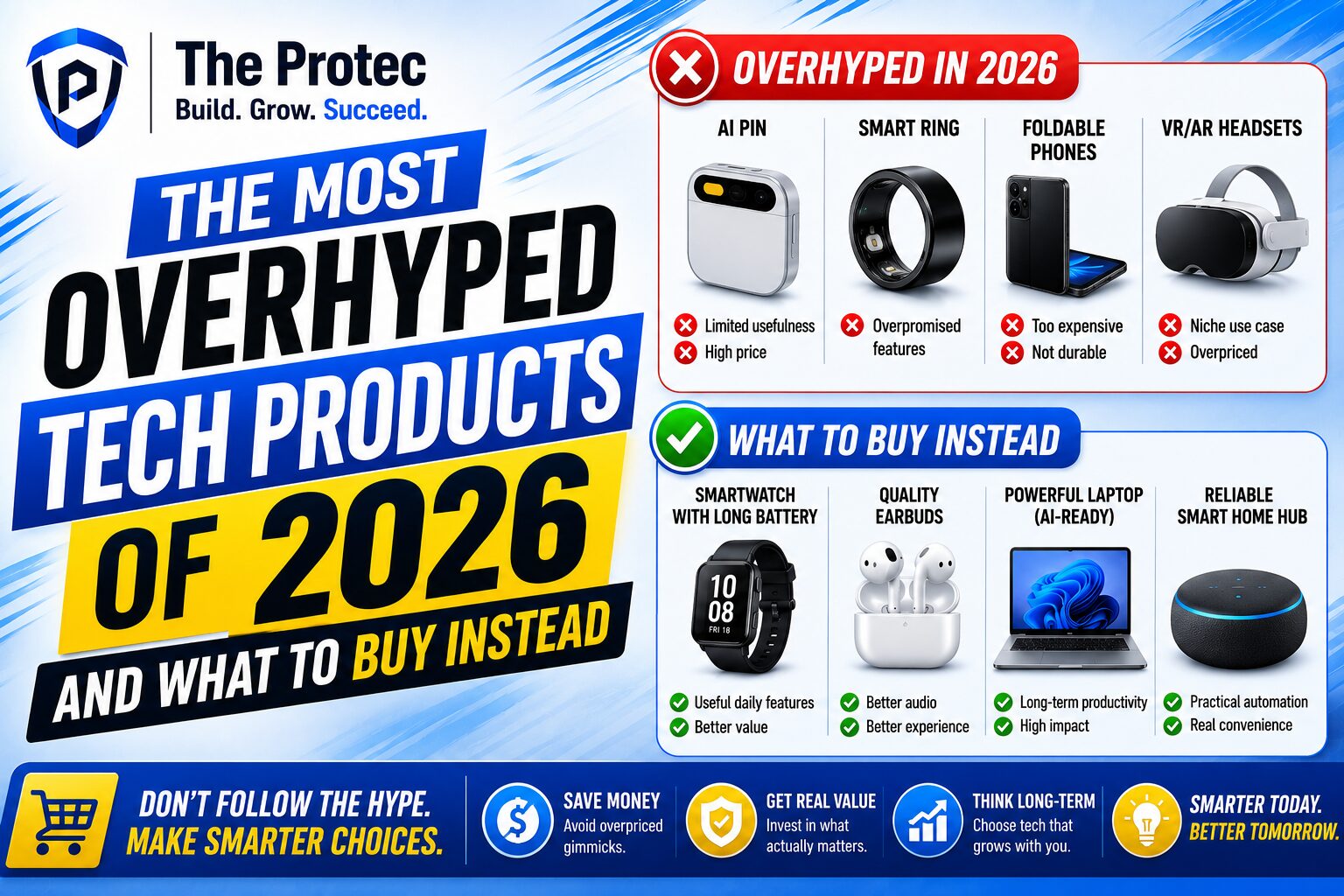
- 1 The Most Overhyped Tech Products of 2026 and What to Buy Instead
- 2 Why hype beats utility so often
- 3 1. AI Pin-style wearable assistants
- 4 2. Foldable phones for everyone
- 5 3. Subscription-first smart home gadgets
- 6 4. “AI PCs” that are just average laptops with a sticker
- 7 5. Smart rings as a replacement for everything
- 8 6. Ultra-premium wireless earbuds with tiny upgrades
- 9 7. Gimmicky projector phones and portable cinema boxes
- 10 8. Overpriced gaming handhelds with limited libraries
- 11 What smart buyers should look for instead
- 12 How to spot the next overhyped launch
- 13 FAQ
- 14 Final verdict
The Most Overhyped Tech Products of 2026 and What to Buy Instead
Every year, the tech world finds a handful of products it wants you to believe are essential. Some are genuinely useful. Others are expensive answers to problems most people do not have. By the time the hype machine finishes its work, a lot of shoppers have spent too much money on gadgets that look futuristic, sound revolutionary, and end up collecting dust.
This year is no different. The biggest overhyped tech products are not necessarily bad products. That is the trick. They are often competent, polished, and heavily marketed. But being good is not the same as being worth buying. If you are looking for real value, the smarter move is to cut through the buzz and focus on best tech alternatives that solve practical problems better, cheaper, or more reliably.
This technology buying guide is opinionated on purpose. It is not a roundup of everything shiny. It is a reality check for anyone tired of paying a premium for hype. If you want devices that genuinely improve your daily routine, read this before your next upgrade.
Why hype beats utility so often
Tech companies do not just sell hardware anymore. They sell identity, status, and the promise of a better version of yourself. A folding screen, a wrist-worn AI assistant, or a subscription-powered device can sound like the future even when the day-to-day benefit is marginal. Add influencer demos, launch-event theatrics, and limited-time preorder pressure, and suddenly “nice to have” becomes “must buy.”
The issue is not innovation. Innovation matters. The issue is timing. A product can be impressive and still be the wrong purchase today. That is especially true when battery life, repairability, software support, ecosystem lock-in, and total cost of ownership are ignored in the marketing copy.
The best buyers ask a different question: what job is this product doing for me, and is there a simpler way to do it better? That mindset exposes a lot of overhyped tech products instantly.
1. AI Pin-style wearable assistants
Wearable AI assistants have been positioned as the next major interface shift: no screen, no app juggling, just ask and receive. In theory, that sounds elegant. In practice, the category has struggled with something basic: phones already do most of this well, and they do it without making you wear another device on your body.
The biggest problem with these wearables is not the concept. It is the friction. People want fast voice input, reliable answers, and useful context. Instead, they often get awkward interactions, limited battery life, and features that work better in a demo than in a real commute, office, or grocery run.
Buy instead: a smartphone with strong on-device AI features, a good pair of earbuds, or a smartwatch if you want truly glanceable information. Those options are far more mature. A modern phone with built-in AI tools can summarize, translate, draft, and search without adding another device to charge or carry.
Best tech alternatives for wearable AI
- Flagship smartphone with on-device AI
- Wireless earbuds with voice assistant support
- Smartwatch for notifications and quick actions
2. Foldable phones for everyone
Foldables have improved dramatically, and for the right buyer they are genuinely exciting. But the category is still one of the most overhyped tech products because it is marketed as the future of smartphones when it is still a compromise-heavy niche.
Yes, the larger inner display is useful for multitasking, reading, and entertainment. But foldables still bring trade-offs: thicker designs, higher prices, hinge anxiety, and long-term durability concerns that do not disappear just because the latest launch event looks polished. Many buyers end up paying a luxury premium for a feature they use occasionally.
Buy instead: a premium slab-style phone with excellent battery life and a great display, or a small tablet if you really want more screen. If your main goal is productivity, a conventional phone plus a compact tablet is often cheaper, sturdier, and more versatile than a foldable.
For a useful comparison of device support and buying considerations, check manufacturer repair and service policies before you spend. Apple’s support pages and Google’s device support documentation are a good reminder that software longevity matters as much as design.
3. Subscription-first smart home gadgets
The smart home market has become crowded with products that look inexpensive at checkout and expensive over time. Cameras, doorbells, air purifiers, and even robot vacuums now arrive wrapped in subscription prompts. The device itself is only the entry fee. The real cost is the ongoing monthly payment for features that used to be standard.
This is where hype becomes especially annoying. The hardware may be sleek, the app may be polished, and the marketing may promise “peace of mind.” But if basic functions like video history, advanced alerts, or automations are locked behind a paywall, the product is not smart for the buyer. It is smart for the company.
Buy instead: smart home devices that support local storage, open standards, or at least full functionality without an ongoing subscription. Look for products compatible with Matter or those that integrate cleanly with your existing ecosystem. The best tech alternatives here are the ones that avoid recurring fees and still work well.
What to prioritize in a smart home purchase
- Local control and local storage
- Clear privacy policy
- No mandatory subscription for core features
- Compatibility with Matter, HomeKit, Google Home, or Alexa
4. “AI PCs” that are just average laptops with a sticker
One of the loudest marketing trends right now is the AI PC. The pitch is simple: buy a laptop with a dedicated neural processor and suddenly your machine becomes smarter, faster, and more future-proof. In reality, many shoppers are paying extra for capabilities they may not use, while giving up battery life, thermals, or price competitiveness.
If you are a developer, designer, video editor, or heavy multitasker, there are real reasons to care about next-gen chip architecture. But for most people, the term AI PC is mostly packaging. The average buyer needs a fast CPU, enough RAM, good battery life, a quality display, and a keyboard that does not feel like an afterthought.
Buy instead: the best laptop you can get for your actual workload, not the one with the loudest AI branding. In many cases, a well-rounded ultrabook or a MacBook with strong efficiency still beats an “AI-ready” Windows laptop that is trying too hard to sound futuristic.
When shopping, compare real-world battery tests, fan noise, and upgradeability rather than relying on chip labels. The best tech alternatives are frequently the boring ones that simply perform better.
5. Smart rings as a replacement for everything
Smart rings are one of the most fascinating wearables on the market, which is exactly why they are so easy to overhype. They promise discreet health tracking, sleep insights, and in some cases even payment or gesture features. The problem is that most people do not need a ring to do what a smartwatch or fitness tracker already does better.
For sleep tracking, heart rate trends, and basic wellness insights, smart rings can be surprisingly good. But they are not a universal replacement for watches, phones, or dedicated fitness devices. Comfort issues, sizing headaches, charging limitations, and narrow feature sets make them less practical than the marketing suggests.
Buy instead: a reliable fitness tracker or smartwatch if you want broader functionality. If sleep tracking is your only priority, a smart ring can make sense, but only if you value subtlety over versatility. For everyone else, the best tech alternatives are still wrist-based wearables with stronger ecosystems and more complete health features.
The premium earbuds market is another classic hype zone. Every new generation promises improved noise cancellation, clearer calls, and “studio-grade” sound. Sometimes the upgrades are real. Often they are incremental enough that most buyers would never notice the difference in daily use.
What makes this category overhyped is the price curve. Once you pass a certain point, you are often paying for brand cachet and minor refinements instead of a dramatic listening upgrade. Meanwhile, midrange models keep getting better, especially in battery life, ANC performance, and app control.
Buy instead: a strong midrange pair from a reputable brand with excellent comfort, reliable Bluetooth, and balanced sound. Unless you are an audiophile or spend hours on calls in noisy environments, the marginal gains of the most expensive model are usually not worth it.
If you want great value, prioritize fit and codec support over headline features. A comfortable pair you actually wear will outperform a luxury pair that lives in a drawer.
7. Gimmicky projector phones and portable cinema boxes
Portable projection has a certain sci-fi appeal. The idea of turning any wall into a screen is undeniably cool. That is why projector-based gadgets always generate attention. But when the novelty wears off, buyers often realize that ambient light, focus adjustments, battery drain, and mediocre speaker quality limit the experience.
For a few niche uses, they can be fun. For everyday media consumption, they rarely beat a tablet, laptop, or even a compact streaming setup connected to a real TV. The same applies to “portable cinema” bundles that lean hard on emotional marketing and soft on actual image quality.
Buy instead: a quality tablet for travel, or a small 4K TV and a compact streaming stick for home use. If your goal is movies on the go, screen quality and battery life matter more than the novelty of projection.
8. Overpriced gaming handhelds with limited libraries
Gaming handhelds are having a major moment. That part is real. What is overhyped is the assumption that every handheld deserves a premium price because it can run PC games or cloud services. In practice, many buyers discover that ergonomics, heat, battery life, and game compatibility matter more than raw specs.
Some handhelds shine as portable backlogs machines. Others are brilliant but expensive. The mistake is buying one because social media says handheld gaming is the future, then realizing you mostly play the same few titles and still need a charger nearby.
Buy instead: a device that matches your actual gaming habits. If you mostly play indie titles and older games, a more affordable handheld may be enough. If you want the most flexibility, a gaming laptop can still be the best value. And if you want family-friendly portability, a dedicated console ecosystem often makes more sense than chasing the newest premium handheld.
What smart buyers should look for instead
A proper technology buying guide should not just criticize hype. It should give you a better filter. Here is the practical checklist I use before buying any new device:
- Does it solve a real problem? If the use case is vague, skip it.
- What is the total cost? Include subscriptions, accessories, repairs, and replacements.
- How long will it be supported? Software updates matter.
- Can it be repaired? Fragile, sealed devices often cost more in the long run.
- Will you use it weekly? If not, the novelty will fade quickly.
- Is there a simpler alternative? The best tech alternatives are often the least flashy.
In other words, buy the tool, not the marketing story.
How to spot the next overhyped launch
The same pattern repeats every cycle. A company rebrands existing features as a revolution, reviewers praise the ambition, and the product trends hard on social media. That does not mean you should ignore new tech. It means you should be skeptical of products that lead with vibes instead of value.
Be cautious when a device is described with words like “game-changing,” “redefining,” or “the future of.” Those phrases are not always false, but they are often used to paper over trade-offs. Ask what the product does better than your current setup, how much it costs to keep using, and whether the benefit is worth the switch.
The most overhyped tech products usually share the same traits: high price, narrow use cases, and a launch narrative that is better than the real-world experience.
FAQ
What makes a tech product overhyped?
A tech product becomes overhyped when marketing and media attention create expectations that exceed its real-world usefulness. It may still be a solid device, but the value often does not match the price or the promises.
No. Premium products can be worth it if they solve a problem you actually have. The key is separating genuine quality from branding, especially when cheaper best tech alternatives provide 90% of the same experience.
How do I choose the right alternative?
Start with your actual use case. If you want better battery life, choose for efficiency. If you want fewer subscriptions, choose devices with local features. If you want portability, compare size and weight. This technology buying guide approach usually leads to smarter purchases than chasing the newest launch.
Should I wait before buying new tech?
Usually, yes, if the category is still maturing. Waiting helps you avoid early-adopter problems, inflated prices, and rushed software. If your current device works fine, patience often saves money and frustration.
Final verdict
The tech industry is excellent at making ordinary upgrades feel essential and niche products feel universal. But the smartest shoppers are not the ones who buy first. They are the ones who buy well. That means ignoring the noise around overhyped tech products and focusing on practical, durable, and genuinely useful devices instead.
If a product is expensive, narrow in scope, dependent on subscriptions, or built around a marketing story more than a user need, pause. There is probably a better option. The best tech alternatives are not always the flashiest, but they are usually the ones you will still appreciate six months later.
That is the real technology buying guide: spend less on hype, more on utility, and choose devices that earn their place in your life.
For buyers comparing ecosystems and support policies, the official pages from Google Support and Apple Support can help you evaluate software updates, repairs, and long-term ownership before you commit.