








Contents
AI-Augmented Databases: How Databases Are Becoming Intelligent
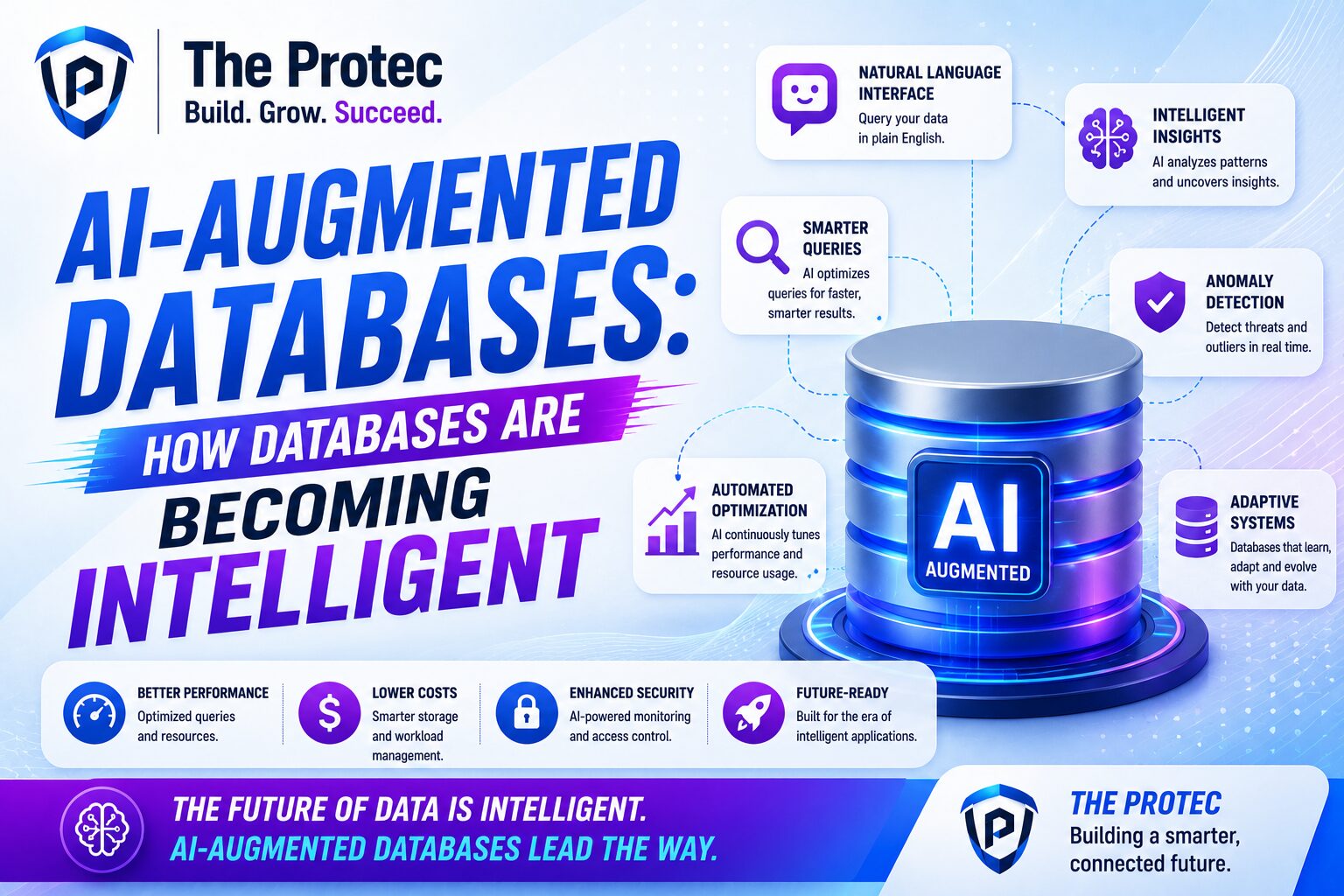
Databases have always been the quiet engine behind digital business. They store transactions, power applications, and keep operations running. But a major shift is underway. Modern AI databases are moving beyond passive storage and retrieval to become active, intelligent systems that can optimize themselves, explain their behavior, and surface insights faster than traditional platforms ever could.
This evolution is not just about adding a few machine learning features to a database engine. It is about rethinking what a database can do. Smart database systems are now using database AI to improve query planning, automate maintenance, detect anomalies, and help teams make better decisions from data that is constantly growing in volume, variety, and velocity.
As organizations adopt real-time analytics, vector search, and AI-assisted development, the database is becoming a strategic layer in the AI stack. The result is a new generation of systems that are more adaptive, more efficient, and far more useful than conventional databases.
What Are AI-Augmented Databases?
AI-augmented databases are database platforms that use artificial intelligence and machine learning to improve core database functions. Instead of relying only on fixed rules, manual tuning, and static query planners, these systems learn from workload patterns and operational data to make better decisions automatically.
In practical terms, database AI can help a system choose better indexes, predict query behavior, detect unusual access patterns, recommend schema changes, and even support natural language interaction with data. Some smart database systems also integrate vector capabilities for AI applications, making them suitable for semantic search, retrieval-augmented generation, and embedding-based workloads.
The goal is simple: reduce the manual burden on database teams while improving performance, reliability, and insight generation. That is why AI databases are gaining traction across cloud platforms, enterprise analytics, SaaS applications, and data-intensive AI products.
Why Databases Need Intelligence Now
The modern data environment is far more complex than it was a few years ago. Companies are dealing with hybrid cloud deployments, distributed architectures, streaming data, unstructured content, and AI applications that demand low-latency access to both structured and semantic data. Traditional database management approaches struggle to keep up.
Database administrators and engineers often spend significant time on tasks such as query tuning, index selection, workload balancing, capacity planning, and troubleshooting. As workloads grow and become more unpredictable, manual optimization becomes expensive and error-prone.
At the same time, businesses want faster answers. They do not just want data stored safely; they want systems that can help interpret it. Smart database systems answer this need by using database AI to continuously learn from usage patterns and automate parts of the operational stack. This makes the database not only a storage layer but also an intelligent advisor.
How Database AI Improves Query Optimization
Query optimization is one of the most important areas where AI is making a measurable difference. Traditional optimizers rely on statistics, heuristics, and rule-based planning to determine the best execution strategy. While effective in many cases, they can struggle with complex joins, rapidly changing data distributions, or unpredictable workloads.
AI databases enhance this process by learning from previous query executions and improving future decisions. Machine learning models can estimate cardinality more accurately, select better join orders, and predict which execution plans are likely to perform best under specific conditions. Over time, the optimizer becomes more aware of real-world behavior rather than only theoretical cost models.
These systems can also detect when workload patterns shift. If a database sees a sudden increase in analytical queries, for example, it may adjust caching, indexing, or resource allocation strategies accordingly. In cloud-based environments, this can translate into lower latency, better throughput, and reduced infrastructure waste.
Some smart database systems go a step further by using reinforcement learning or adaptive plan selection to refine performance continuously. This is especially valuable in large-scale environments where query patterns change frequently and manual tuning cannot keep pace.
Examples of AI-Driven Query Improvements
- Predictive indexing based on common access patterns
- Adaptive join order selection for complex queries
- Cardinality estimation informed by learned workload behavior
- Automatic plan regression detection after schema or data changes
- Runtime re-optimization when a query behaves differently than expected
Smart Database Systems and Autonomous Operations
One of the most exciting aspects of database AI is autonomy. Many organizations want less firefighting and fewer repetitive maintenance tasks. Smart database systems are designed to reduce operational overhead by automating routine decisions that traditionally required expert intervention.
For example, AI can help determine when to create or drop indexes, when to rebalance partitions, when to scale compute resources, and when to flag data anomalies that may indicate a problem. This does not remove the need for database professionals, but it changes their role. Instead of constantly tuning the system by hand, teams can focus on governance, architecture, and higher-value optimization.
Autonomous database behavior is especially valuable in distributed and cloud-native environments. In these settings, the cost of inefficiency is amplified by elastic scaling, replication, and global traffic patterns. A database that can self-adjust in response to workload changes can save money while improving user experience.
According to Oracle’s overview of autonomous database capabilities, automation is now central to reducing human error and improving resilience in database operations (<a href=