








Contents
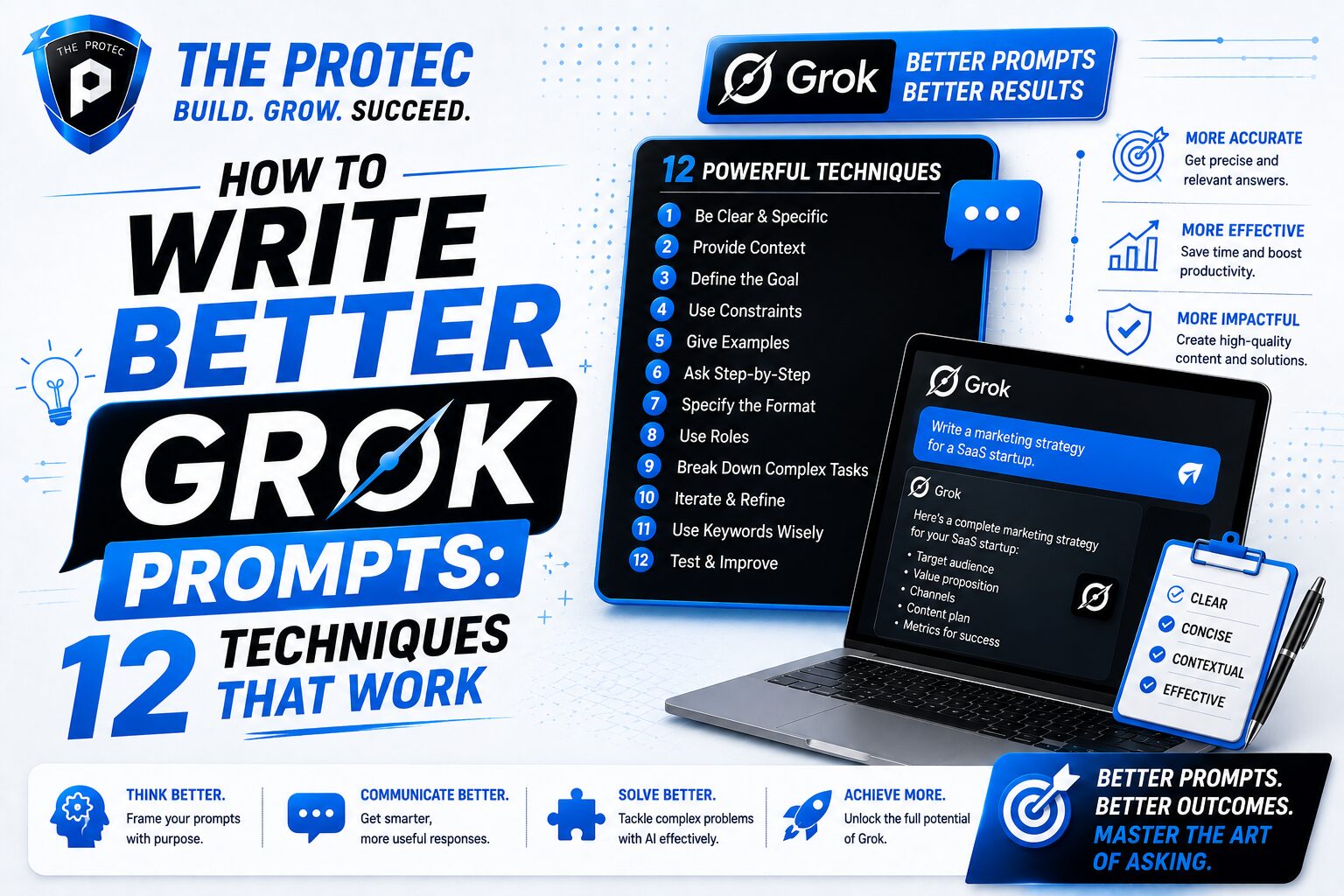
- 1 How to Write Better Grok Prompts: 12 Techniques That Actually Work
- 2 1. Start with a clear goal
- 3 2. Give the model a role or perspective
- 4 3. Add enough context to avoid generic answers
- 5 4. Specify the output format
- 6 5. Break complex requests into smaller steps
- 7 6. Use constraints to sharpen the response
- 8 7. Ask for reasoning, not just conclusions
- 9 8. Provide examples of the style you want
- 10 9. Use iterative prompting instead of one-shot perfection
- 11 10. Be specific about the audience
- 12 11. Test for ambiguity before you send the prompt
- 13 12. Combine Grok’s strengths with current information carefully
- 14 Putting it all together: a strong Grok prompt formula
- 15 Common mistakes to avoid
- 16 FAQ
- 17 Final thoughts
How to Write Better Grok Prompts: 12 Techniques That Actually Work
Grok has quickly become one of the most talked-about AI assistants because it can respond with speed, personality, and strong awareness of current conversations. But like every advanced model, its output depends heavily on how you ask. If your prompt is vague, the response will usually be vague. If your instructions are structured, specific, and context-rich, Grok can produce far better results.
That is the real skill behind prompt engineering Grok users need to master: not clever tricks, but clear communication. Whether you are using Grok for research, content drafting, brainstorming, technical explanations, social media analysis, or workflow automation, better prompts lead to better AI prompts and better outcomes.
This guide breaks down how to write Grok prompts using 12 techniques that actually work. You will learn how to shape requests, control tone, reduce ambiguity, and get outputs that are more accurate, useful, and easier to refine.
If you want more reliable results from Grok, start here.
1. Start with a clear goal
The most common mistake in prompt engineering Grok is asking the model to do too many things at once without stating the primary objective. Before you type anything, decide what success looks like. Are you trying to summarize an article, compare products, write a draft, generate ideas, or explain a concept?
A strong prompt begins with a direct outcome. Instead of saying, “Tell me about Grok and prompt writing,” use a goal-oriented request such as:
- “Explain how to write Grok prompts for market research summaries.”
- “Draft a LinkedIn post about better AI prompts for startup founders.”
- “Compare three ways to prompt Grok for faster content ideation.”
When the goal is clear, Grok can prioritize the right information and avoid drifting into unnecessary detail.
2. Give the model a role or perspective
One of the easiest ways to improve output quality is to assign Grok a role. Roles help frame the response style, depth, and expertise level. This is especially useful when you want a certain voice or domain focus.
Examples include:
- “Act as a senior SEO strategist.”
- “Respond like a product manager explaining tradeoffs to a founder.”
- “Write as a technical editor reviewing an AI workflow.”
Role prompts are not magic, but they do help narrow the model’s attention. If you want better AI prompts, use roles to define the lens through which Grok should answer. This works especially well for content creation, analysis, and decision support.
3. Add enough context to avoid generic answers
Grok can only work with the information you provide. If the prompt lacks context, the response will usually be broad, safe, and less useful. Context tells the model who the audience is, what the situation is, and why the request matters.
For example, compare these two prompts:
Weak: “Write tips for prompting Grok.”
Stronger: “Write practical tips for marketing managers who use Grok to brainstorm campaign angles, analyze competitors, and draft short-form content.”
The second version gives Grok a much better frame. It knows the audience, the use case, and the type of output expected. When you want precise answers, always include the relevant background.
4. Specify the output format
One of the best habits in how to write Grok prompts is to define the exact format you want. If you do not, Grok may choose a structure that is technically correct but not useful for your workflow.
You can request:
- A bullet list
- A numbered checklist
- A comparison table
- A short summary
- A step-by-step guide
- A paragraph written in a specific style
For example: “Create a numbered list of 7 prompt-writing rules for Grok, with one sentence of explanation for each.”
This reduces editing time and makes the response easier to scan. It also improves consistency when you are using Grok repeatedly for similar tasks.
5. Break complex requests into smaller steps
Trying to ask for everything at once is a fast way to get a messy response. Better prompt engineering Grok means splitting large tasks into manageable parts. This is especially important when the task requires analysis, synthesis, or multiple deliverables.
Instead of asking, “Write a full strategy for using Grok in a content team, including workflows, examples, risks, and training tips,” try dividing the request into stages:
- First, ask for a workflow outline.
- Then, ask for sample prompts.
- After that, request edge cases or risks.
- Finally, ask for a training checklist.
This step-by-step approach often produces better AI prompts because the model can focus on one layer at a time. It also gives you more control to refine the direction as you go.
6. Use constraints to sharpen the response
Constraints are one of the most underrated tools in prompt writing. They help Grok make decisions by reducing the number of acceptable answers. Without constraints, the model may produce a response that is too long, too broad, or too general.
Useful constraints include:
- Word count limits
- Tone requirements
- Audience level
- Time frame
- Source type
- Do-not-include instructions
Examples:
- “Keep the answer under 200 words.”
- “Use a confident but practical tone.”
- “Avoid jargon and explain terms simply.”
- “Focus only on workflows that a solo creator can use.”
Constraints make prompts more precise and outputs more usable. In many cases, fewer allowed options means a stronger final answer.
7. Ask for reasoning, not just conclusions
Good prompts do not only request answers; they ask for the logic behind them. When you want Grok to produce more thoughtful output, ask it to explain why a recommendation matters or how it reached a conclusion.
This is especially useful for:
- Comparisons
- Strategic decisions
- Content planning
- Technical tradeoffs
- Research summaries
For example:
“Compare three ways to use Grok for competitive research and explain the strengths and limitations of each.”
That prompt encourages more useful analysis than simply asking for a list. It also helps you judge whether the response is actually worth using. If you are serious about how to write Grok prompts, make room for reasoning.
8. Provide examples of the style you want
Examples are one of the fastest ways to improve output quality. Grok responds better when it can infer the desired pattern from a sample. This works for tone, format, level of detail, and structure.
You do not need to provide a full template every time. Even a short example can anchor the response.
For instance:
- “Write in this style: direct, concise, and practical.”
- “Use a structure like: problem, insight, action step.”
- “Match the format of this sample summary, but make it shorter.”
Examples are especially useful when building repeatable prompt systems. If you want better AI prompts consistently, examples reduce guesswork and make output more predictable.
9. Use iterative prompting instead of one-shot perfection
Even the best prompt rarely produces a perfect final answer on the first try. The strongest users treat Grok as a collaborative drafting tool. They ask for an initial version, evaluate it, then refine with follow-up instructions.
This process is called iterative prompting, and it is one of the most effective techniques in prompt engineering Grok users can adopt.
Try this sequence:
- Ask for a first draft.
- Request a shorter version.
- Ask for stronger examples.
- Change the tone.
- Remove weak sections.
Example follow-up:
“Revise the draft to be more concise, add one practical example, and make the opening more engaging.”
Iterative prompting gives you more control than trying to force perfection in one prompt. It also helps Grok adapt to your preferences over time.
10. Be specific about the audience
A prompt becomes much stronger when Grok knows exactly who the output is for. Audience specificity changes vocabulary, depth, examples, and tone. A response for executives should not sound the same as one for beginners or technical users.
Compare:
- “Explain prompt engineering Grok for beginners.”
- “Explain prompt engineering Grok for content strategists who already use AI daily.”
- “Explain prompt engineering Grok for founders who need fast decision support.”
Each version signals a different level of sophistication. If you want better AI prompts, define the reader or user as clearly as possible. This simple step often improves relevance more than adding extra detail elsewhere.
11. Test for ambiguity before you send the prompt
Ambiguity is one of the biggest reasons Grok outputs miss the mark. Words like “best,” “good,” “simple,” or “effective” can mean different things to different people. If your prompt contains unclear terms, the model may interpret them in a way you did not intend.
Before sending the prompt, ask yourself:
- Could this phrase mean more than one thing?
- Did I define what success looks like?
- Are there hidden assumptions the model might miss?
- Would a new user understand this request?
For example, instead of saying “Give me the best Grok prompt tips,” say “Give me 12 practical tips for writing clearer Grok prompts for marketing tasks, with examples.”
That version is harder to misread. Testing for ambiguity is one of the most reliable habits for how to write Grok prompts that produce useful results.
12. Combine Grok’s strengths with current information carefully
Grok is particularly useful when your task depends on current events, live discussions, or fast-changing online context. That makes it valuable for trend analysis, social listening, and up-to-date summaries. But current information still needs careful prompting if you want accurate results.
When asking Grok to work with recent developments, specify:
- The time window you care about
- The type of source or signal you want
- Whether you want a summary or analysis
- How cautious the model should be with uncertain claims
For example:
“Summarize the main themes around AI prompt engineering on X over the past 7 days, and separate repeated opinions from evidence-based claims.”
That prompt tells Grok to distinguish between chatter and substance. As AI systems become more connected to live information, this kind of careful prompting matters even more. For current best practices on prompt design, OpenAI’s prompt engineering guide is a helpful reference point for general structure principles: OpenAI Prompt Engineering Guide. For a broader look at modern AI model behavior and safety, Anthropic’s prompt engineering resources are also useful: Anthropic Prompt Engineering Overview.
Putting it all together: a strong Grok prompt formula
If you want a simple framework, use this formula:
- Goal: What do you want Grok to do?
- Role: What perspective should it take?
- Context: Who is the audience and what is the situation?
- Format: What shape should the answer take?
- Constraints: What limits or rules should it follow?
- Iteration: What should be improved after the first draft?
Example:
“Act as a senior content strategist. Explain how to write Grok prompts for SaaS marketers who need faster research summaries. Give the answer as a numbered list of 8 practical techniques, keep each point under 3 sentences, and include one sample prompt at the end.”
This kind of prompt is clear, actionable, and easy for Grok to execute. It combines all the core principles of prompt engineering Grok users rely on for better AI prompts.
Common mistakes to avoid
Even with good intentions, people often weaken their prompts in predictable ways. Watch out for these errors:
- Being too vague about the task
- Mixing multiple unrelated goals into one prompt
- Forgetting to define the audience
- Leaving out format requirements
- Using overly abstract language
- Expecting one prompt to solve everything
The fix is usually simple: simplify the request, add context, and specify the output more clearly. Good prompting is less about complexity and more about precision.
FAQ
What is the best way to start writing Grok prompts?
Start with the goal. Decide exactly what you want Grok to produce, then add role, context, format, and constraints. This structure makes your prompt much more likely to produce a useful response.
How do I make Grok give more accurate answers?
Use specific context, define the audience, and ask for reasoning or source-aware analysis when appropriate. Also avoid ambiguous words and split complicated requests into smaller steps.
Are short prompts or long prompts better for Grok?
Neither is automatically better. Short prompts work well for simple tasks, while longer prompts are better when you need precision, structure, or detailed context. The best prompt is the one that gives Grok enough information without unnecessary clutter.
Can I use these techniques for other AI tools too?
Yes. These techniques apply broadly to most modern AI models because clear instructions, context, and formatting improve output across platforms. The exact phrasing may change, but the principles stay the same.
Final thoughts
Learning how to write Grok prompts is less about memorizing tricks and more about developing a clear communication habit. The best prompts are specific, structured, and intentional. They tell Grok what to do, who it is helping, how to respond, and what boundaries to follow.
If you apply the 12 techniques in this guide, you will quickly notice the difference: fewer generic answers, stronger structure, better relevance, and more useful results. Whether you are using Grok for strategy, writing, research, or day-to-day productivity, better AI prompts will save time and improve output quality.
Start small, refine often, and treat every prompt like a brief. That is how prompt engineering Grok users turn a capable model into a genuinely practical assistant.