







Contents
- 1 Can Cloud Gaming Replace Gaming PCs?
- 2 Why Cloud Gaming Matters More Than Ever
- 3 Latency: The Biggest Barrier, Still the Most Important Metric
- 4 Performance Improvements: Cloud Gaming Looks Better Than Before
- 5 Cost: Is Gaming Without a PC Actually Cheaper?
- 6 The Best Cloud Gaming Services: What Matters Most
- 7 Can Cloud Gaming Replace Gaming PCs for Most People?
- 8 Where Gaming Without a PC Makes the Most Sense
- 9 The Limits Cloud Gaming Still Has to Overcome
- 10 Verdict: Will Cloud Gaming Replace Gaming PCs?
- 11 FAQ
Can Cloud Gaming Replace Gaming PCs?
Cloud gaming has spent years living in the shadow of the traditional gaming PC. For every major promise about instant access, no downloads, and playing anywhere, there has usually been a catch: input lag, resolution drops, bandwidth limits, or a library that looked strong on paper but felt thin in practice. In 2026, though, the conversation is different. Faster internet access, more capable data centers, better video codecs, and wider device support have pushed cloud gaming much closer to mainstream viability.
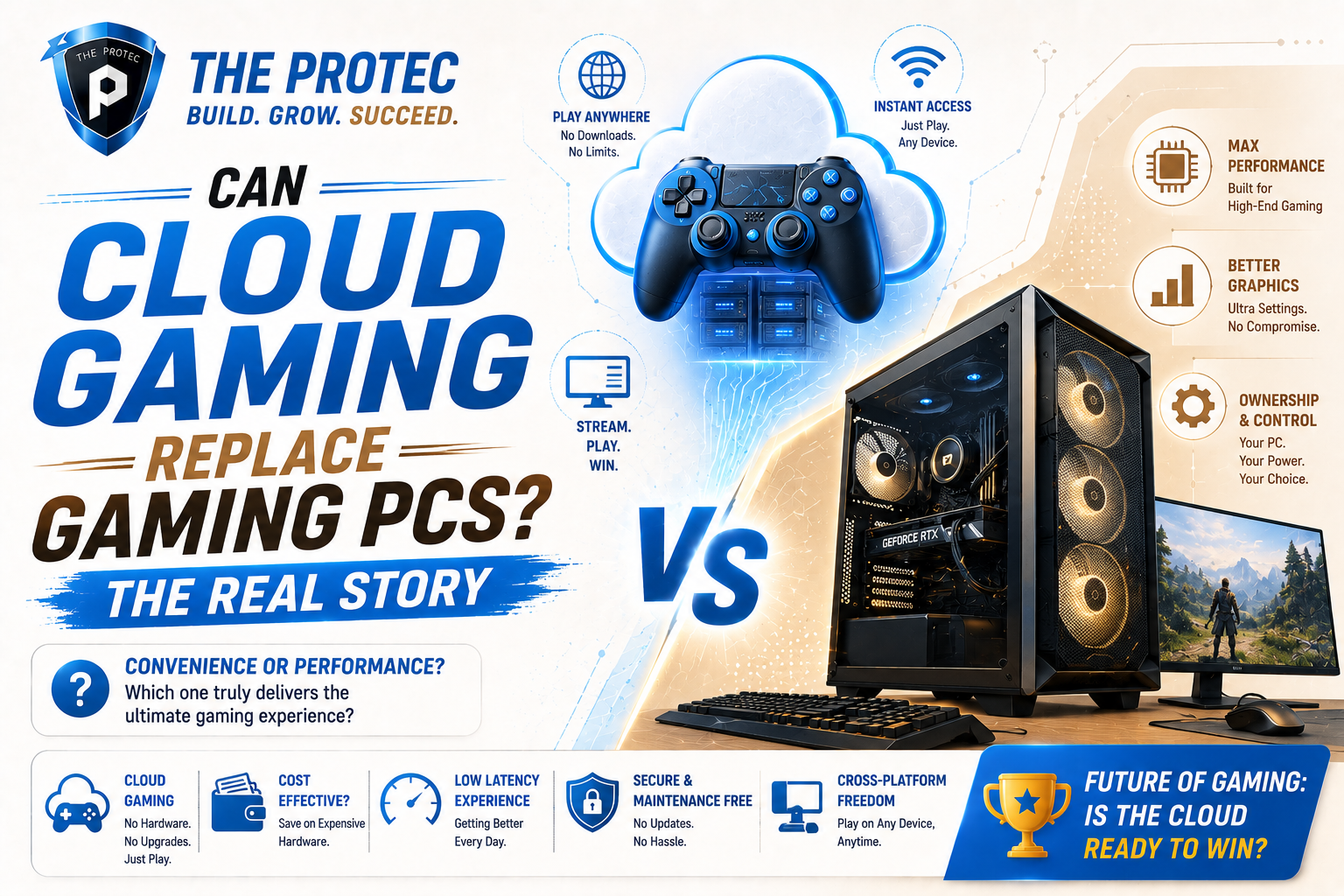
The question now is no longer whether cloud gaming works at all. It does. The real question is whether it can finally replace gaming PCs for most players. That depends on what kind of gamer you are, how you value convenience versus control, and how sensitive you are to latency, cost, and visual fidelity. For some people, gaming without a PC is already a practical reality. For others, a local gaming rig still offers a level of consistency and performance that cloud platforms cannot fully match.
This article breaks down cloud gaming in 2026 through the lens that matters most: real-world playability. We will look at latency, performance improvements, subscription costs, device flexibility, and the best cloud gaming services shaping the market today.
Why Cloud Gaming Matters More Than Ever
Cloud gaming is not a new concept, but it has matured significantly over the last few years. The core idea is simple: instead of running a game on your own hardware, the game runs on a remote server and streams video to your device while your inputs travel back to the data center. That means you can play demanding games on lightweight laptops, tablets, phones, smart TVs, and even older desktops.
What has changed is the infrastructure behind the experience. More regions now have access to low-latency data centers, fiber internet is more common, and modern video compression has improved image quality at lower bitrates. Several services now support 1080p, 1440p, and even 4K streaming depending on the plan and device. Variable refresh rate support, better controller mapping, and improved browser-based play have also made the experience feel less like a tech demo and more like a real gaming option.
As a result, cloud gaming is no longer just a fallback for people who do not own a gaming PC. It is becoming a legitimate choice for commuters, casual players, families, and even some enthusiasts who want convenience over hardware maintenance.
Latency: The Biggest Barrier, Still the Most Important Metric
When people ask whether gaming without a PC can work, latency is usually the first concern. And for good reason. In any cloud gaming setup, your controller input has to travel to a server, the game must process that input, and the resulting video frame must travel back to you. That round trip creates delay. Even if the delay is small, competitive players can feel it.
In 2026, latency has improved enough that many single-player games, RPGs, strategy titles, racing games, and slower action games feel very good over the cloud. For many players on strong connections, the experience can be close to local play. But it is still not identical. A good local gaming PC has the advantage of instant input response, no network dependency, and no stream encoding overhead.
The most successful cloud gaming experiences today tend to happen under the following conditions:
- Users are within a reasonable distance of the nearest data center
- Internet stability is more important than raw advertised speed
- Ethernet is used instead of congested Wi-Fi whenever possible
- Games are not extremely latency-sensitive, such as top-tier competitive shooters
For esports players, a cloud platform still has a hard ceiling. Even if the stream itself looks crisp, the added delay can affect flick shots, parries, rhythm timing, and high-level reaction play. For casual multiplayer, however, the difference may be acceptable. That is a major shift. Cloud gaming no longer struggles just to be playable; it now struggles mainly to satisfy the most demanding players.
How much latency is acceptable?
There is no universal number, but many players can tolerate a cloud setup if the end-to-end delay feels reasonably close to 50 to 80 milliseconds total under stable conditions. Beyond that, the experience starts to feel noticeably “soft,” especially in fast action games. The exact feel depends on the game engine, display response time, controller type, and network consistency.
That is why cloud gaming in 2026 is best judged by genre, not just by technical specs. A turn-based strategy game can feel perfect on the cloud, while a competitive fighting game might still demand local hardware for serious play.
Performance Improvements: Cloud Gaming Looks Better Than Before
Visual quality has improved substantially. Modern cloud gaming services can now deliver sharper image quality, better color handling, and more consistent frame pacing than earlier generations. Support for H.265 and AV1 streaming has helped reduce compression artifacts while preserving detail at lower bandwidths. That matters because cloud gaming is not only about low latency; it is also about how clean the game looks in motion.
Another important development is the rise of more powerful server hardware. Some platforms now use hardware that rivals or exceeds mid-range gaming PCs, especially for standardized workloads. That means players can stream games at high settings without worrying about local GPU upgrades, driver issues, or thermal throttling. For people who mainly want to play modern titles at respectable quality, cloud gaming is more capable than ever.
Still, there are trade-offs. Even when the server is strong, the stream itself is compressed. Fine texture detail, distant foliage, particle effects, and fast camera motion can sometimes reveal the limitations of the pipeline. On a large 4K monitor, a high-end gaming PC still has an edge in clarity and responsiveness. On a laptop, tablet, or living room TV, the gap narrows considerably.
The best cloud gaming services in 2026 are those that minimize the gap between remote and local play by combining strong server hardware, efficient codecs, and low-latency network routing. That combination is what makes cloud gaming feel genuinely competitive with traditional setups for more and more users.
Cost: Is Gaming Without a PC Actually Cheaper?
Cost is where cloud gaming becomes very compelling. A gaming PC can require a large upfront investment, especially if you want strong 1440p or 4K performance. Add in upgrades, peripherals, power consumption, and potential repair costs, and the total cost of ownership grows quickly. Cloud gaming flips that model. Instead of buying hardware, you pay a subscription fee and use whatever device you already own.
For many players, especially those who only play a few hours a week, cloud gaming can be significantly more affordable. A monthly subscription often costs far less than financing a new GPU, motherboard, power supply, and cooling setup. If your current device is capable of streaming video smoothly, the entry cost is almost zero.
That said, cloud gaming is not always cheaper in the long run. Over several years, subscription fees add up. If you play heavily and want access to premium tiers for better resolution or priority access, the recurring expense can rival or exceed the price of owning a mid-range gaming PC. The cost equation depends on use case:
- Light to moderate players: cloud gaming is often cheaper and more practical
- Heavy players: a local PC may become more economical over time
- Families or shared households: cloud gaming can be cost-effective because one service can serve multiple devices
Another hidden savings point is maintenance. A gaming PC needs updates, storage management, troubleshooting, and occasional hardware replacement. Cloud gaming removes most of that burden. For users who value simplicity, that convenience has real economic value even if it is hard to quantify.
The Best Cloud Gaming Services: What Matters Most
There is no single winner for everyone. The best cloud gaming services depend on the games you want, the devices you use, and whether you care more about library access or raw performance. In 2026, the strongest platforms generally fall into two broad categories: services that stream games you already own, and services that provide a curated library as part of the subscription.
When comparing platforms, the most important criteria are latency, image quality, game library breadth, device compatibility, and session reliability. A strong service should also make it easy to jump in quickly, support controllers and keyboards where appropriate, and maintain stable performance during peak hours.
For readers researching the best cloud gaming services, it helps to think about them this way:
- Best for owned-PC-game libraries: services that let you stream titles from your existing storefronts
- Best for convenience: services with included game catalogs and quick access
- Best for premium performance: platforms with higher-tier hardware and advanced streaming options
Independent performance comparisons continue to show that network distance and service architecture matter as much as the subscription tier itself. For a helpful overview of how cloud gaming performance is measured, see Digital Foundry. For a practical look at streaming-capable hardware and device requirements, NVIDIA GeForce NOW remains one of the best-known examples of a mature cloud gaming platform.
Can Cloud Gaming Replace Gaming PCs for Most People?
The honest answer is: yes, for some people, and not yet for everyone.
If your gaming habits lean toward single-player adventures, story-driven titles, indie games, simulation, strategy, or casual multiplayer, cloud gaming may already be good enough to replace a gaming PC. If your priority is instant access, minimal maintenance, and the flexibility to play on multiple devices, the cloud can be a better overall experience than owning a desktop tower.
But if you are a competitive player, a modding enthusiast, or someone who wants absolute control over graphics settings, local installs, and frame-time consistency, a gaming PC still offers advantages cloud platforms cannot fully duplicate. Mods, custom launchers, anti-cheat edge cases, file access, and offline play remain areas where PCs are stronger.
So the real answer is not whether cloud gaming can replace gaming PCs in a binary sense. It is whether it can replace them for the majority of everyday players. In 2026, the answer is increasingly yes especially if the user values convenience, portability, and lower upfront cost more than absolute performance.
Where Gaming Without a PC Makes the Most Sense
Cloud gaming shines in situations where a traditional rig is inconvenient or unnecessary. It is especially appealing for:
- Students living in dorms or shared spaces
- Travelers who want one account across multiple devices
- Families that prefer a single subscription over multiple consoles or PCs
- Players with older laptops or compact devices
- Gamers who care more about access than hardware ownership
It also makes sense when you want to play without a dedicated desk setup. A smart TV with a controller can become a gaming station. A tablet can become a portable game screen. A lightweight work laptop can double as a gaming device after hours. That flexibility is one of cloud gaming’s most underrated strengths.
For people who do not want to deal with GPU shortages, Windows maintenance, storage upgrades, or heat and noise, gaming without a PC can feel liberating. You simply launch the game and play.
The Limits Cloud Gaming Still Has to Overcome
Despite the progress, cloud gaming still faces structural limits. First, it depends on internet quality. A local gaming PC works even when your connection drops. Cloud gaming does not. Second, image compression and network variability can still impact the experience, especially on larger displays. Third, game availability is fragmented across services, and not every title is accessible everywhere.
There is also the issue of ownership. Some players prefer knowing that their games run locally and remain available regardless of subscription changes or server-side decisions. Cloud gaming shifts more control to the platform provider. That can be convenient, but it is also a different relationship with your library.
Finally, advanced PC features still matter to a dedicated audience. High refresh rates, custom modding, uncapped performance, ultrawide monitors, and niche peripherals are all areas where the local gaming PC remains unmatched.
Verdict: Will Cloud Gaming Replace Gaming PCs?
Cloud gaming in 2026 is good enough to replace gaming PCs for a growing share of players, but not all of them. The biggest breakthroughs have come from lower latency, better compression, more powerful servers, and more flexible device support. Those improvements have made gaming without a PC practical in ways that were not realistic just a few years ago.
If you want the simplest answer, here it is: cloud gaming is no longer a compromise only for emergencies. For many people, it is a smart default. It is cheaper to start, easier to manage, and more flexible across devices than a traditional PC. But if you want the highest possible performance, the lowest latency, and complete control, a gaming PC still wins.
The most likely future is not cloud gaming replacing gaming PCs entirely. It is a hybrid market where more people use cloud gaming as their primary option and fewer people feel the need to build a powerful desktop. In that sense, cloud gaming may not kill the gaming PC but it may finally make owning one optional for millions of players.
FAQ
Is cloud gaming good enough for competitive games?
It can be for casual or mid-level play, but serious competitive players usually still prefer a local gaming PC because latency and input consistency matter more at high skill levels.
What internet speed do I need for cloud gaming?
Speed matters, but stability matters more. A strong, consistent connection with low packet loss is more important than peak advertised bandwidth. Ethernet often delivers the best results.
Are the best cloud gaming services worth it?
Yes, if you value convenience, flexibility, and lower upfront cost. Premium tiers can be worth it for better resolution, priority access, and stronger hardware, especially if you play regularly.
Can I use cloud gaming on a weak laptop or tablet?
Usually yes, as long as the device can handle video playback and support your preferred controller or keyboard setup. Cloud gaming shifts most of the heavy lifting to the server.
Will cloud gaming ever fully replace gaming PCs?
Probably not for every type of player. It is more likely to become the default for mainstream gaming while PCs remain essential for enthusiasts, modders, and competitive players.