








Contents
- 1 The New Face of Business Fraud: Deepfakes at Work
- 2 What Deepfake Scams Actually Look Like
- 3 Why Cybercriminals Are Turning to AI Fraud Attacks
- 4 Real-World Incidents Show the Scale of the Problem
- 5 How Deepfake Scams Bypass Traditional Defenses
- 6 Warning Signs of a Deepfake Scam
- 7 Practical Prevention Techniques for Business Cybersecurity
- 7.1 1. Build out-of-band verification into payment workflows
- 7.2 2. Use dual approval for high-risk actions
- 7.3 3. Restrict public exposure of executive audio and video
- 7.4 4. Harden identity verification for remote meetings
- 7.5 5. Train employees on deepfake-specific social engineering
- 7.6 6. Monitor for identity and payment anomalies
- 7.7 7. Prepare incident response playbooks for fraud, not just malware
- 8 How to Detect Deepfakes Without Special Tools
- 9 Building a Deepfake-Resilient Culture
- 10 The Future of AI Fraud Attacks
- 11 FAQ
The New Face of Business Fraud: Deepfakes at Work
Business fraud has always relied on trust. Criminals have long impersonated executives, vendors, and employees to push fraudulent wire transfers, steal credentials, or manipulate decision-making. What has changed is the quality of the impersonation. With deepfake scams, attackers can now generate highly convincing fake voices, videos, and even live interactive personas that make deception far more believable than email phishing alone.
This shift matters because modern organizations depend on fast communication. Finance teams approve payments under pressure, executives join meetings across time zones, and employees respond to voice notes, video calls, and chat messages without always verifying identity. Cybercriminals are exploiting that speed. AI fraud attacks are no longer limited to badly written phishing emails or obvious spoofed calls. Today’s attackers can clone a CEO’s voice, stage a fake video meeting, and use synthetic identities to gain access to money, data, and trust.
For business cybersecurity leaders, this is more than a technical problem. It is an operational and human risk that affects payment controls, vendor relationships, incident response, and executive protection. The organizations most at risk are not only large enterprises. Mid-sized companies, professional services firms, logistics providers, manufacturers, and fast-growing startups can be equally vulnerable because they often have valuable financial workflows and less mature verification processes.
What Deepfake Scams Actually Look Like
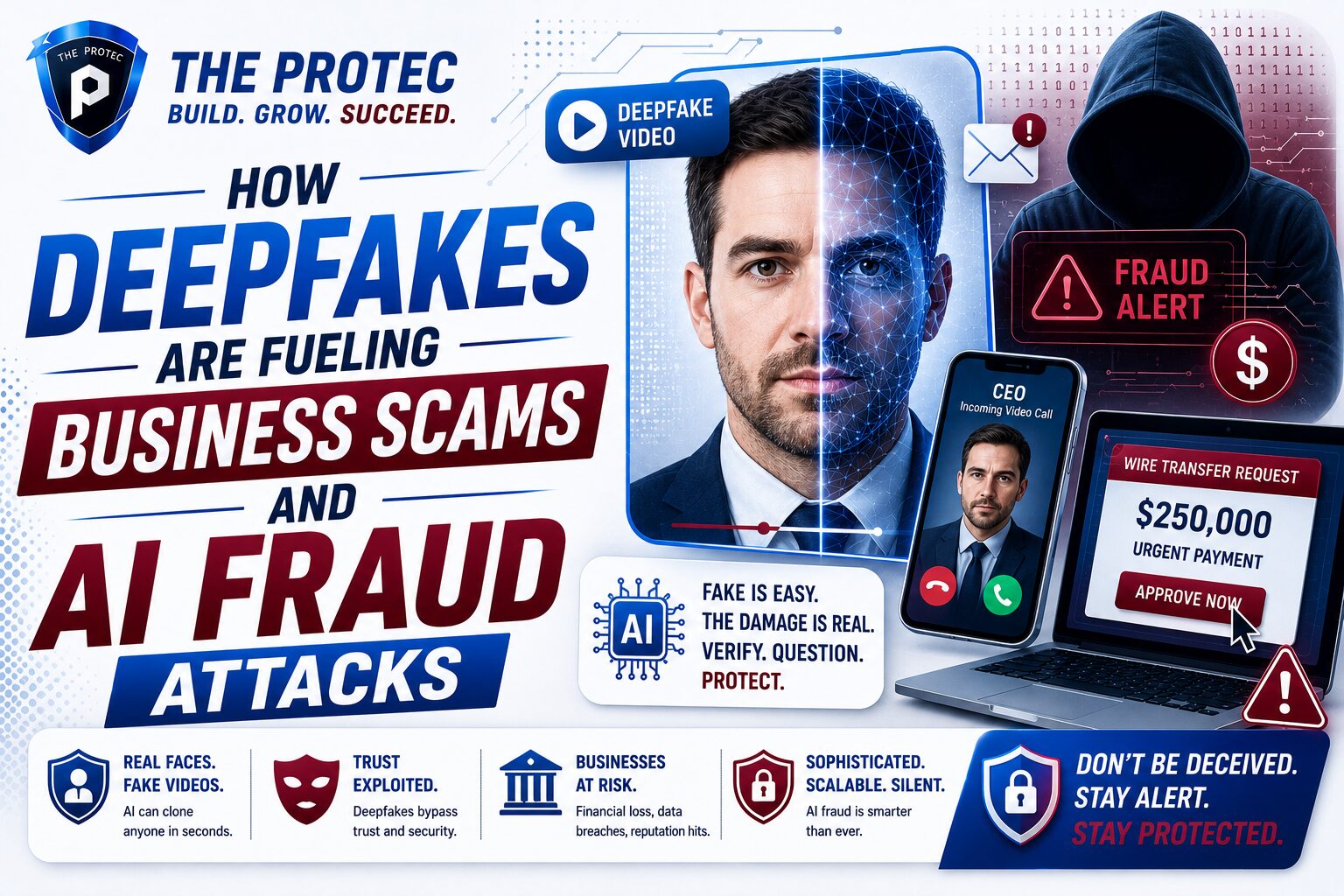
Deepfakes are synthetic media generated or altered by artificial intelligence to mimic a real person’s face, voice, or mannerisms. In business scams, the goal is usually not entertainment or misinformation in the abstract. The goal is action: get someone to send money, reveal data, approve a change, or trust a false instruction.
Common deepfake scam scenarios
Voice-cloned executive fraud: An employee receives a phone call that sounds exactly like the CFO or CEO requesting an urgent wire transfer, gift-card purchase, payroll change, or confidential document.
Fake video meeting scams: Criminals use synthetic video or face-swapped footage in a live call to impersonate a senior leader, vendor contact, or investor.
Vendor payment manipulation: Attackers pose as a supplier and use a cloned voice or realistic avatar to request updated banking details.
Customer support deception: Fraudsters impersonate customers or business partners to reset accounts, bypass identity checks, or obtain sensitive information.
Recruitment and onboarding fraud: Synthetic identities are used to pass interviews, gain remote access, and infiltrate organizations from the inside.
These attacks are especially effective because deepfakes reduce the friction that often gives scams away. A voice message sounds familiar. A video call seems personal. A request seems urgent and specific. When combined with email spoofing, stolen metadata, social engineering, and public information from social media or company websites, deepfake scams can appear alarmingly authentic.
Why Cybercriminals Are Turning to AI Fraud Attacks
Cybercriminals are adopting deepfakes because the economics are favorable. Traditional fraud often requires extensive manual effort, while AI allows attackers to scale impersonation faster and more convincingly. A few seconds of audio from a public earnings call, interview, or conference presentation may be enough to clone a voice. A short video clip can help generate a synthetic face that appears credible in a live exchange.
There are several reasons this threat is accelerating:
Cheap access to powerful tools: Deepfake generation tools have become easier to find and simpler to use.
Public data abundance: Executive speeches, podcasts, webinars, LinkedIn profiles, and company social media give attackers raw material.
Remote work habits: Distributed teams are more accustomed to digital-only approvals and less likely to confirm identity in person.
Payment process speed: Many organizations still rely on email, text, or phone for urgent approvals.
Growing trust in AI media: As synthetic content becomes common in marketing and customer service, it becomes harder to distinguish legitimate AI use from malicious impersonation.
The result is a new class of business cybersecurity threat: attacks that target human trust at scale, not just systems or passwords. Deepfake scams work because they exploit decision fatigue, authority bias, and the pressure to respond quickly.
Real-World Incidents Show the Scale of the Problem
Deepfake-enabled fraud is not hypothetical. Law enforcement and security researchers have documented multiple incidents where businesses lost significant sums or narrowly avoided disaster because attackers used synthetic audio or video to impersonate trusted individuals.
One of the most widely reported examples involved a multinational firm in which a finance employee was tricked into approving a large transfer after a video call that appeared to include senior leadership. The call used synthetic likenesses and convincing accents to reinforce authority. The employee believed the request was legitimate because the participants looked and sounded like real company executives.
In another incident reported by industry and law enforcement sources, criminals used a cloned executive voice during a phone call to pressure a subordinate into transferring funds urgently. The scam succeeded because the voice carried the familiarity, tone, and urgency expected from a top leader. The attacker did not need to compromise the company’s email system or infiltrate its network. They simply manipulated the person at the point of approval.
There have also been cases where criminals used deepfake audio in vendor impersonation scams, changing bank account details through phone calls that sounded like trusted contacts. These attacks are particularly dangerous because they exploit established business relationships. If a supplier has sent real invoices for years, a seemingly routine request for updated payment instructions may not raise alarm.
For current threat intelligence and law enforcement guidance, organizations can review resources from the FBI Internet Crime Complaint Center and the INTERPOL cybercrime unit. Both organizations continue to warn businesses about AI-enabled impersonation and social engineering.
How Deepfake Scams Bypass Traditional Defenses
Many organizations have spent years hardening their perimeter with firewalls, endpoint detection, email filtering, and multifactor authentication. Those controls still matter, but they do not stop a finance team member from voluntarily approving a fraudulent transfer after a convincing conversation.
Deepfake scams are effective because they attack the weakest link in many environments: trust-based workflows. If a process allows an exception for urgent payments, if a manager can override verification, or if an employee is trained to “move fast and help,” attackers can exploit that flexibility.
Traditional red flags also become less reliable. Poor grammar, mismatched accents, and awkward pauses used to be telltale signs of fraud. Deepfakes can now reproduce natural speech patterns, emotional tone, and facial expressions. As models improve, the most obvious warning signs are disappearing.
Another challenge is context. Attackers often study the target organization before striking. They may learn who approves payments, which vendors are active, what names appear in press releases, and when executives are traveling. That intelligence allows them to time the scam when the target is distracted, such as during a product launch, quarter-end close, merger activity, or holiday staffing shortage.
Warning Signs of a Deepfake Scam
Even advanced synthetic media has weaknesses. The key is to slow down and look for inconsistencies across channels and behavior patterns. A single signal may not prove fraud, but several together should trigger verification.
Urgency without a normal process: The sender insists a payment, password reset, or policy exception must happen immediately.
Channel mismatch: A request appears on a phone call or video meeting, but cannot be confirmed through the organization’s standard system.
Unusual emotional pressure: The attacker uses fear, secrecy, or authority to prevent checking.
Inconsistencies in speech or visuals: Delayed responses, odd lip synchronization, strange lighting, limited facial movement, or unnatural blinking may appear.
New payment instructions: Changes to bank accounts, beneficiary details, or payroll data are a major fraud indicator.
Requests to bypass policy: The supposed executive says the matter is confidential and should avoid normal approvals.
Organizations should train staff to treat these signs as prompts to verify, not as proof of guilt. Deepfake scams succeed when employees feel social pressure to act before they have time to confirm.
Practical Prevention Techniques for Business Cybersecurity
Preventing AI fraud attacks requires a layered approach. No single tool can eliminate the threat, but strong process design, staff awareness, and identity verification can significantly reduce risk.
1. Build out-of-band verification into payment workflows
Any request involving money, banking changes, or sensitive data should require confirmation through a separate trusted channel. For example, if a request comes by email, confirm it by calling a known number from the company directory or using a secure internal workflow system. Never rely on the contact information provided in the suspicious message.
2. Use dual approval for high-risk actions
Large transfers, vendor account changes, and payroll modifications should require two-person approval. For especially sensitive actions, require approval from a manager outside the originating department. This reduces the chance that one compromised employee can complete a fraud request alone.
3. Restrict public exposure of executive audio and video
Executives should be aware that every public interview, keynote, and podcast can become training material for attackers. While organizations cannot eliminate public-facing content, they can be more intentional about what is shared, how often leaders speak on record, and which voices are exposed in high-quality recordings.
4. Harden identity verification for remote meetings
Staff should verify meeting participants using calendar invites, corporate directories, internal chat, or pre-established code words for sensitive discussions. If a meeting includes a surprise participant or a sudden request involving money or credentials, pause and confirm identity before proceeding.
Generic phishing training is no longer enough. Teams need examples of voice cloning, live video impersonation, and vendor payment fraud. Training should focus on how to verify requests, how to challenge unusual urgency, and how to escalate concerns without fear of reprisal.
6. Monitor for identity and payment anomalies
Business cybersecurity teams should watch for changes in bank account data, login patterns, unusual vendor communications, and requests coming from newly registered domains or unfamiliar numbers. Fraud often leaves operational clues even when the synthetic media looks convincing.
7. Prepare incident response playbooks for fraud, not just malware
Many incident response plans focus on ransomware or data breaches. Organizations also need a playbook for deepfake scams. That playbook should define who to call, how to freeze transactions, how to preserve call records and chat logs, and how to notify banks, vendors, and insurers quickly.
How to Detect Deepfakes Without Special Tools
While advanced detection software can help in some environments, many teams can catch fraud by using disciplined verification habits. Listen for changes in tone that do not match the person’s normal style. Watch for pressure to avoid normal procedures. Confirm that the request aligns with what you know about the person’s role and current activity.
Another useful tactic is to ask a verification question that is hard for an attacker to answer using public information. That question should not be a secret stored in email or shared in chat. It should be part of a prearranged validation process, such as a code phrase, an internal reference number, or a callback step through a known contact method.
For video-based impersonation, compare the request with other channels. Does the same person confirm the request through a corporate email thread already known to be legitimate? Does the vendor confirm it independently from a previously verified address? If not, treat the request as unconfirmed, no matter how real the video appears.
Building a Deepfake-Resilient Culture
Technology helps, but culture determines whether people feel empowered to pause a suspicious request. Employees must know that verifying a request is a sign of professionalism, not distrust. The most resilient organizations normalize double-checking, especially when money, credentials, or confidential information are involved.
Leadership should model this behavior. If an executive is willing to be challenged on a payment or identity check, employees are more likely to follow policy. Finance, IT, HR, procurement, and legal teams should align on escalation steps so that fraud prevention is consistent across departments.
It also helps to run tabletop exercises that simulate deepfake scams. Use realistic scenarios: a cloned CEO voice requesting an emergency transfer, a vendor video call asking for a bank change, or a fake recruiter trying to obtain access. These exercises reveal gaps in response time, approval controls, and communication between teams.
The Future of AI Fraud Attacks
Deepfake scams are likely to become more personalized, more interactive, and harder to detect. Attackers will continue combining synthetic audio and video with stolen data, social engineering, and automated reconnaissance. We can expect more use of multilingual voice cloning, real-time face animation during live calls, and synthetic identities that persist across many platforms.
At the same time, businesses will need to adopt stronger verification frameworks, more secure payment controls, and smarter awareness training. The organizations that adapt early will be better positioned to protect cash flow, reputation, and customer trust.
The key lesson is simple: if a request matters, verify it through a process that deepfakes cannot easily mimic. In a world where anyone’s voice or face can be copied, business cybersecurity must move beyond trust by appearance and toward trust by verification.
FAQ
What is a deepfake scam in business?
A deepfake scam uses AI-generated or AI-altered audio, video, or images to impersonate a real person, often an executive, vendor, or employee. The goal is usually to trick the target into sending money, sharing data, or approving a fraudulent request.
Why are deepfake scams so effective?
They work because they imitate familiar people and exploit urgency, authority, and routine business processes. When a voice or video looks and sounds real, employees may act before verifying the request through a separate channel.
What should a company do if it suspects a deepfake fraud attempt?
The company should stop the transaction or request immediately, verify the person through a known trusted contact method, preserve evidence such as call logs and messages, notify internal security or fraud teams, and contact financial institutions if money is involved.
Can business cybersecurity tools detect deepfakes automatically?
Some tools can help identify synthetic media, but they are not foolproof. The strongest defense is a combination of verification procedures, employee training, payment controls, and incident response planning.
Which departments are most at risk?
Finance, accounts payable, procurement, HR, executive assistants, IT help desks, and customer support teams are frequent targets because they handle requests that involve money, access, or sensitive identity information.
Deepfakes are changing the rules of fraud. Businesses that treat voice, video, and identity requests with a healthy level of verification will be far better protected than those relying on trust alone.