








AI-Powered Search Engines vs Google: A Shift in How We Find Information
For more than two decades, Google has defined how the internet is searched. Type a query, scan a list of links, open a few pages, and piece together an answer. That workflow is still powerful, but it is no longer the only way people search. AI-powered search engines are changing expectations by delivering direct answers, summarizing sources, and handling complex questions in a more conversational way.
This shift is bigger than a new interface. It is changing search behavior itself. People are asking longer questions, expecting context instead of just links, and relying on systems that can synthesize information across multiple sources. At the same time, Google is evolving quickly with AI Overviews, multimodal search, and deeper integration of generative AI. The result is not a simple replacement story. It is a competition and convergence story.
If you are trying to understand the future of search technology, the key question is not whether Google disappears. It is how AI search engines will influence what users expect from search, how businesses earn visibility, and how trustworthy information is discovered online.
What Makes AI-Powered Search Engines Different?
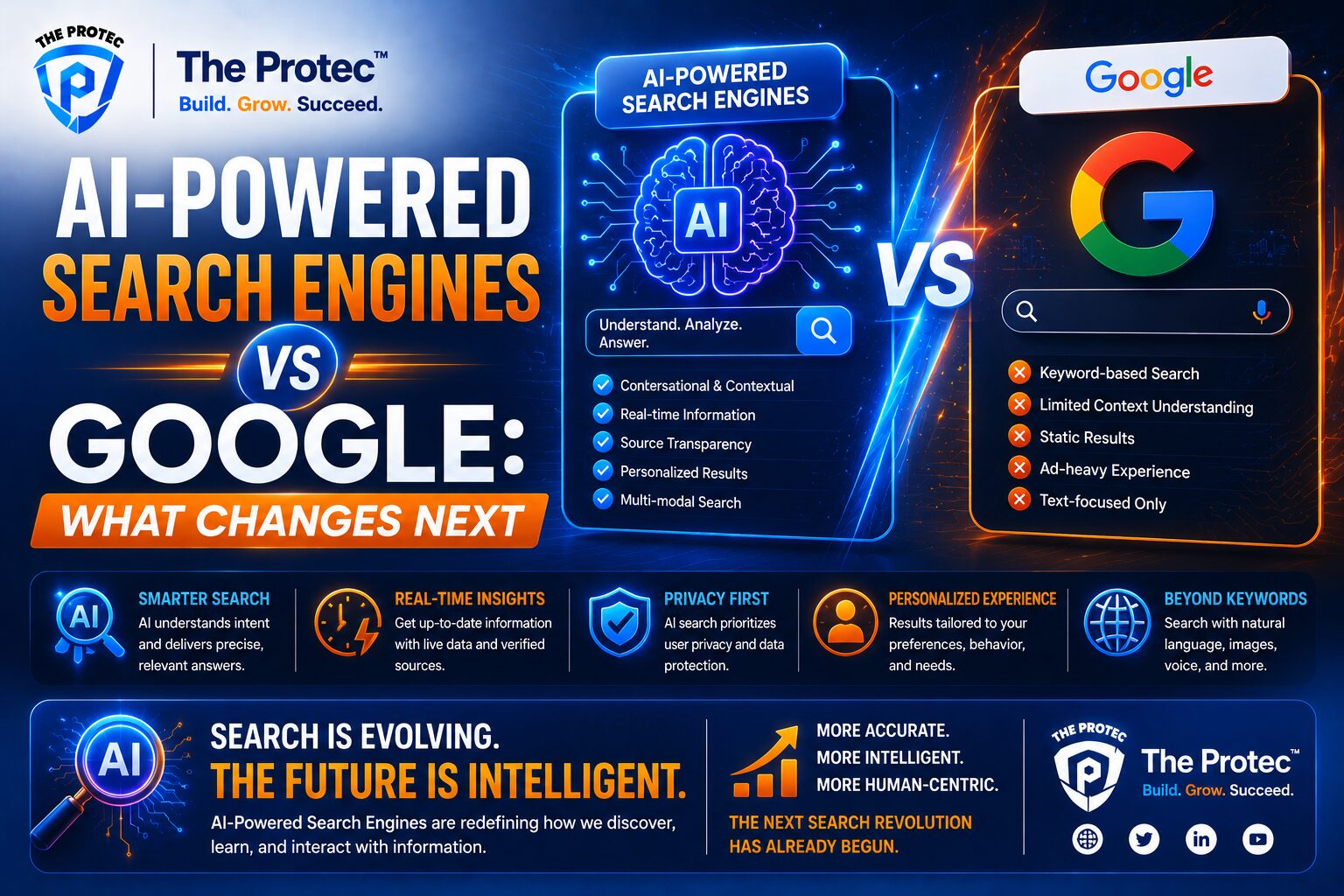
Traditional search engines are primarily retrieval systems. They match keywords, rank pages, and present a list of results. Users then do the work of reading, comparing, and deciding what matters. AI-powered search engines take a different approach. They use large language models, retrieval-augmented generation, and contextual reasoning to create answers that feel more like a conversation with an assistant than a query against a database.
In practical terms, that means AI search engines can:
- Summarize multiple sources into a single answer
- Explain complex topics in plain language
- Refine results based on follow-up questions
- Handle natural, long-form prompts better than keyword-only queries
- Support multimodal inputs such as images, voice, or mixed text and media
This matters because users increasingly want speed, context, and clarity. Search is no longer only about finding pages. It is about getting to an answer with less friction.
How Google Still Dominates Search
Despite the rise of AI search engines, Google remains the default gateway to the web for most users. Its strength is not just scale. It has a massive index, a mature advertising ecosystem, strong local search features, maps, shopping integrations, and deep trust built over years. For many queries, especially navigation-based searches, local discovery, and commercial intent, Google still performs extremely well.
Google also has advantages that newer AI search tools are still trying to match:
- Index depth: Google has enormous coverage across the web.
- Freshness: It excels at surfacing newly published content and breaking news.
- Ranking systems: It has refined quality signals for many years.
- Search ecosystem: Maps, Shopping, YouTube, and Discover give it a broad advantage.
- User trust: Many people still view Google as the safest first stop for important searches.
Google’s recent AI integrations show that it is not ignoring the shift. Instead, it is blending classic search with AI-generated assistance. That hybrid model is likely to remain central for a long time.
AI Search Engines vs Google: Key Differences
1. Answer format
Google traditionally provides ranked links, snippets, and structured search features. AI search engines often provide a synthesized response first, with supporting citations or sources attached. This changes the user experience dramatically. Instead of choosing between ten blue links, users may receive a concise explanation that already resolves the query.
2. Search intent handling
Google is excellent at understanding intent categories such as informational, transactional, navigational, and local. AI search engines are often better at interpreting open-ended or multi-part prompts. For example, a user might ask for a comparison, a recommendation, and a step-by-step explanation in one query. AI systems are built to handle that kind of complexity more naturally.
3. Follow-up interaction
In Google, each search is usually treated as a separate query. AI search engines are designed for continuity. Users can ask follow-up questions, narrow the scope, or shift the task without starting over. That conversational loop is one of the biggest reasons people are exploring Google alternatives.
4. Source visibility
Google gives users the source by ranking the page. AI search engines often hide more of the synthesis process behind the answer itself. Good systems cite sources clearly, but the final response may still feel more opaque than a classic results page. That creates a tension between convenience and transparency.
5. Speed of insight
For simple questions, AI search can be faster because it removes the need to open multiple pages. For research-heavy or high-stakes topics, Google’s link-based model can still be better because it allows users to verify claims directly and compare original sources.
Why AI-Powered Search Engines Are Growing So Fast
The rise of AI search engines is being driven by a simple user pain point: traditional search often forces people to do too much work. When a query requires reading five articles to answer one question, AI-generated summaries become compelling. This is especially true for research, product comparisons, coding help, troubleshooting, travel planning, and learning new concepts.
Several trends are accelerating adoption:
- Conversational interfaces: People are used to chatting with AI tools and want the same convenience in search.
- Information overload: Users want answers, not just links.
- Multimodal search: Voice, image, and text inputs make search more flexible.
- Better summarization: AI models can compress large amounts of information quickly.
- Task completion: Search is becoming more action-oriented, not just discovery-oriented.
One useful external resource for understanding how this works in a real product is Perplexity, which has become a leading example of AI-first search. Another important reference point is Google Search’s official blog, where Google continues to reveal how it is adding AI capabilities to core search experiences.
How Search Behavior Is Changing
The biggest transformation is not just technological. It is behavioral. Users are learning to ask better questions because AI search systems reward specificity and context. Instead of typing “best laptop,” people may now ask for “best lightweight laptop for video editing under a certain budget with strong battery life.” That style of query reflects a more natural search habit.
There are several behavioral changes worth noting:
- Longer queries: Users are writing queries the way they speak.
- More iterative search: People refine answers with follow-up prompts instead of starting over.
- Higher expectation for summaries: Users want the search engine to do the first layer of analysis.
- Greater trust in synthesis: Many users increasingly accept AI summaries if citations are visible.
- Less tolerance for clutter: Sponsored results and repetitive pages feel less useful when a direct answer is available.
This does not mean all users want the same thing. Some people still prefer the control and transparency of a traditional search results page. Others value speed above all else. The future of search technology will need to support both behaviors.
Where Google Still Has the Advantage
AI search engines are impressive, but Google still has several structural advantages that make it difficult to dethrone.
First, scale. Google’s index and infrastructure are unmatched. It can surface a wide range of sources across languages, locations, and formats. That breadth is essential for many search use cases.
Second, trust and verification. When the answer matters, users often want to inspect the original source. Google makes that easier because the ecosystem is built around links, not just responses.
Third, ecosystem integration. Search is no longer a standalone function. It connects to maps, shopping, video, email, and productivity tools. Google’s product ecosystem gives it a deep moat.
Fourth, commercial search intent. Advertisers and businesses still rely heavily on Google for high-intent traffic. That economic engine continues to shape the search landscape.
Fifth, quality control. AI-generated answers can hallucinate, oversimplify, or miss nuance. Google’s combination of ranking signals and page-level verification is still valuable for many practical searches.
Where AI Search Engines Pull Ahead
Even with Google’s strengths, AI search engines are clearly better in certain situations. Their biggest advantage is reducing the distance between question and understanding. They can act as a research assistant, a summarizer, and a planner at once.
They are especially strong for:
- Research synthesis: Comparing many viewpoints quickly
- Learning: Explaining technical topics at different levels of depth
- Decision support: Helping users evaluate options more efficiently
- Complex tasks: Planning, troubleshooting, and multi-step workflows
- Accessibility: Making search easier for users who prefer natural language
For some queries, the AI search experience feels less like browsing and more like delegating. That is a powerful shift, and it is why future search technology is likely to become more assistant-like over time.
The Real Future of Search Technology
The future is probably not “AI search versus Google” as a winner-takes-all contest. It is more likely to be a blended model where classic indexing, ranking, and verification are combined with AI-generated interpretation. The search engine of the future may not look like a search engine at all. It may look like an intelligent interface that understands goals, retrieves sources, summarizes context, and helps users take action.
We can already see the direction of travel:
- AI summaries on top of search results instead of separate chat tools
- Conversational refinement built into the search journey
- Multimodal search that combines text, voice, images, and video
- Personalized context that adapts to the user’s task
- Source-grounded responses designed to improve reliability
The challenge is balancing convenience with credibility. A future search system must answer quickly without sacrificing accuracy, source transparency, or diversity of perspectives. That balance will define which platforms earn long-term trust.
What This Means for SEO and Content Discovery
For publishers and brands, the rise of AI-powered search engines changes the rules of visibility. Traditional SEO is still essential, but the content strategy must evolve. Pages need to be clear, well-structured, and easy for both humans and AI systems to interpret. Strong topical authority, concise summaries, factual clarity, and source credibility matter more than ever.
Content that is likely to perform well in this new environment usually has these traits:
- Clear answers near the top of the page
- Well-organized headings and subheadings
- Specific, useful information rather than generic filler
- Original insights, data, or expertise
- Trust signals such as author credibility and accurate sourcing
In other words, AI search engines reward usefulness, but they also make it easier to summarize content without sending a click. That means brands must think beyond ranking. They must think about whether their content is cite-worthy, memorable, and genuinely valuable.
Will AI Search Replace Google?
The short answer is no, not in the near term. But it will reshape Google and every other major search product. The more realistic outcome is a gradual redefinition of what “search” means. Some users will increasingly start with AI search engines for research and brainstorming. Others will continue using Google for navigation, shopping, local intent, and source comparison. Many will use both depending on the task.
This is why the most important trend is not replacement. It is fragmentation. Search is becoming a multi-platform behavior, with users choosing the tool that best fits the query. Google is still the leader, but AI-native search products are creating a new expectation: search should be conversational, helpful, and contextual from the start.
FAQ
What is the difference between AI-powered search engines and Google?
Google is primarily a search and ranking system that shows links, snippets, and structured results. AI-powered search engines generate synthesized answers, often with citations, and are better suited for conversational, open-ended queries.
Are AI search engines better than Google?
They are better for certain tasks, such as summarization, comparison, and complex question answering. Google is still stronger for fresh web coverage, navigation, local search, and source verification.
Will future search technology be mostly AI-based?
Most likely, yes, but in a hybrid form. The future of search technology will probably combine traditional indexing and ranking with AI-generated summaries, conversational follow-ups, and multimodal input.
Can AI search engines be trusted?
They can be useful, but users should verify important claims. The best AI search systems cite sources clearly, yet occasional errors, omissions, or oversimplifications can still happen.
How should businesses prepare for AI search engines?
Businesses should focus on authoritative content, clear structure, factual accuracy, and topics that demonstrate expertise. Content that is easy to cite and genuinely useful is more likely to stay visible across both AI search and Google.
Conclusion
AI-powered search engines are not just another tech trend. They are forcing a rethink of how people discover, evaluate, and use information online. Google still dominates the search market, but AI search is changing expectations fast. Users want faster answers, more context, and less effort. Businesses want visibility in an environment where direct answers may reduce clicks but increase the value of authority.
The future of search technology will likely be hybrid, conversational, and more personalized than anything we have used before. The winners will be the platforms that combine speed with accuracy, convenience with transparency, and intelligence with trust. For users, that means better ways to find information. For publishers and brands, it means adapting content to a search world where the answer may arrive before the click.