







Why Kubernetes Security Matters More Than Ever
Kubernetes has become the default control plane for modern cloud-native applications, but that scale comes with a serious security cost. As organizations expand their use of containers, microservices, and multi-cloud infrastructure, Kubernetes security has moved from a specialist concern to a board-level risk. Attackers know that if they can compromise a cluster, they may gain access to sensitive workloads, credentials, internal services, and even production data paths that were never meant to be exposed.
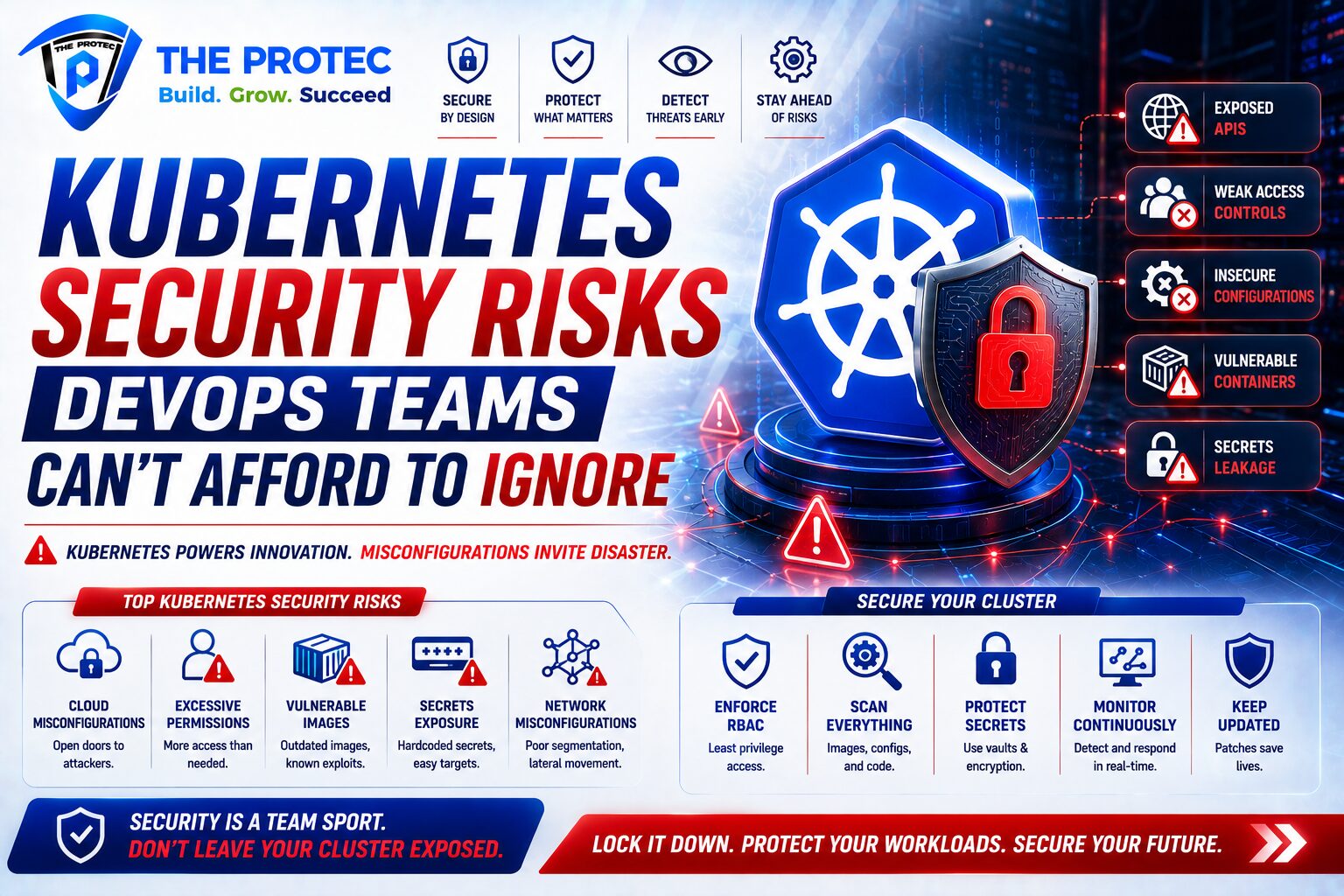
For DevOps teams, the challenge is not just deploying fast. It is securing a distributed system that changes constantly, spans multiple environments, and depends on layers of automation. Misconfigured RBAC, overly permissive service accounts, insecure images, weak secrets handling, and exposed control planes remain common. At the same time, container security threats are evolving quickly, with supply chain attacks, runtime escapes, and identity abuse becoming more common in real-world breaches.
The good news is that most Kubernetes risks are fixable. The better news is that the teams that address them early can dramatically reduce attack surface without slowing delivery. This article breaks down the biggest Kubernetes security risks DevOps teams must fix, what attackers are targeting, and how enterprises can build stronger cloud-native defenses.
The New Kubernetes Threat Landscape
Kubernetes environments are attractive targets because they centralize orchestration, credentials, networking, and deployment logic. A single compromise can affect many workloads at once. Recent security research and incident response trends continue to show attackers targeting cloud identity, exposed management interfaces, poisoned images, and weak admission controls. In other words, the cluster itself is often less the victim than the gateway to everything running inside it.
One reason the risk is increasing is operational complexity. Teams now use GitOps, ephemeral environments, service mesh, CI/CD automation, and dozens of supporting controllers. Each integration adds another trust boundary. If those boundaries are not explicitly secured, attackers can move laterally across namespaces, steal tokens, or deploy malicious containers using legitimate automation paths.
For an overview of Kubernetes architecture and security considerations, the official Kubernetes security documentation remains a useful baseline. But enterprises need more than baseline guidance. They need a practical strategy that addresses identity, configuration, software supply chain, runtime monitoring, and policy enforcement together.
1. Identity and Access Sprawl
Identity is the most abused layer in Kubernetes security. If an attacker gets a valid token, service account credential, or cloud IAM role attached to a cluster component, they may not need to exploit a technical vulnerability at all. They simply use the permissions already granted.
Common identity failures include:
- Overly broad Kubernetes RBAC roles
- Service accounts reused across workloads
- Cluster-admin permissions assigned for convenience
- Long-lived credentials stored in CI/CD systems
- Cloud IAM roles mapped too broadly to nodes or controllers
These issues are especially dangerous in mature DevOps environments because access tends to accumulate over time. Teams add permissions to unblock deployments, then forget to remove them. The result is privilege sprawl that attackers can exploit after compromising a single pod, build job, or developer laptop.
How to fix it
- Apply least privilege to every service account and user role.
- Audit RBAC bindings regularly and remove unused access.
- Use short-lived credentials and workload identity where possible.
- Separate human access from machine-to-machine permissions.
- Map cloud IAM and Kubernetes RBAC together so permissions are not duplicated unintentionally.
Identity governance is no longer just an IAM problem. In Kubernetes, it is the foundation of DevOps security.
2. Exposed Control Planes and Weak API Security
The Kubernetes API server is one of the most sensitive assets in the entire stack. If it is exposed without strong authentication, network controls, and audit visibility, attackers may enumerate resources, change workloads, or extract secrets. Even when the API is not directly exposed to the internet, weak network segmentation or compromised internal access can make it reachable.
Control plane risk is amplified in hybrid and multi-cloud deployments, where teams may use different security defaults across environments. Some clusters are hardened well; others are left with permissive security groups, outdated authentication settings, or management endpoints reachable from too many networks.
Attackers often look for:
- Publicly reachable API servers
- Weak or legacy authentication paths
- Misconfigured etcd access
- Lack of audit logging
- Insecure admin tools and dashboards
How to fix it
- Restrict API access to approved management networks and VPN paths.
- Enable and review audit logs for sensitive actions.
- Protect etcd with strong network segmentation and encryption.
- Use strong authentication, preferably tied to centralized identity.
- Continuously scan for exposed Kubernetes endpoints.
For enterprises, API security should be treated like production banking infrastructure: tightly controlled, fully logged, and constantly monitored.
3. Container Image and Supply Chain Attacks
Container security is now inseparable from software supply chain security. A Kubernetes cluster can be perfectly configured and still be compromised by a malicious image, a poisoned dependency, or a compromised build pipeline. This is one of the biggest shifts in modern cloud security: attackers no longer need to break into the runtime if they can enter through the software delivery path.
Supply chain risks include vulnerable base images, unverified artifacts, dependency confusion, compromised registries, and poisoned CI/CD outputs. These threats are especially hard to detect because the malicious code often arrives through trusted automation. By the time it reaches the cluster, it may already have passed through tests and approvals.
Enterprises should also pay attention to image provenance. More teams now require signed artifacts, SBOMs, and policy checks before deployment. That is a positive trend, but many organizations still rely on informal trust rather than verifiable assurance.
How to fix it
- Use minimal, hardened base images.
- Scan images for vulnerabilities before deployment and continuously in registries.
- Require image signing and verification at admission time.
- Generate and store SBOMs for production workloads.
- Lock down CI/CD runners and secrets so build systems cannot be hijacked.
For practical guidance on software supply chain protections, the NIST supply chain risk management resources are a strong reference point. The key lesson is simple: if you do not trust the artifact, you cannot trust the cluster.
4. Overly Permissive Network Policies
Kubernetes networking is flexible, but flexibility can become a liability. Many environments still run with flat east-west communication, meaning once an attacker lands in one pod, they can laterally move to others with little resistance. This is one of the most common weaknesses in container security because teams focus on north-south traffic and forget that most real movement happens inside the cluster.
Without strict network policies, compromised workloads can reach databases, internal APIs, metadata services, and control components that should never be directly accessible. In multi-tenant environments, missing segmentation can also allow one application team’s workload to probe another team’s namespace.
Network policy failures often happen because teams assume service meshes or cloud firewalls are enough. They are not. Kubernetes-native policy enforcement is still needed to define exactly which pods can talk to which services and on what ports.
How to fix it
- Adopt default-deny network policies in every namespace.
- Allow only the specific pod-to-pod and pod-to-service paths required.
- Restrict access to metadata endpoints and internal admin services.
- Test network policies as part of deployment pipelines.
- Review policies after every major application or topology change.
Strong network segmentation limits blast radius and gives defenders a chance to contain compromise before it turns into a full cluster incident.
5. Secrets Exposure and Poor Credential Hygiene
Secrets remain one of the most frequent sources of Kubernetes compromise. API keys, database passwords, certificates, and tokens are often stored in Kubernetes Secrets, environment variables, CI/CD systems, or mounted files. Although Secrets are better than hardcoding credentials in source code, they are not magic. If access controls are weak, secrets can still be read, copied, logged, or exfiltrated.
A common mistake is assuming that base64-encoded data is protected. It is not. Another is leaving secrets in plaintext in manifests or Helm values, where they may be exposed in repositories, logs, or deployment history. In mature environments, secret sprawl often grows quietly because each application team uses its own method.
How to fix it
- Use external secret managers with dynamic or short-lived credentials.
- Avoid plaintext secrets in manifests, charts, or pipelines.
- Encrypt secrets at rest and control access rigorously.
- Rotate credentials regularly and after every incident.
- Prevent secrets from being logged by applications and build systems.
Good secret hygiene reduces the payoff for attackers. Even if a pod is compromised, the stolen credential should have limited lifetime and limited scope.
6. Misconfigured Admission and Policy Controls
Admission control is where organizations can stop risky workloads before they ever run. Yet many clusters still allow privileged containers, hostPath mounts, untrusted registries, or excessive capabilities because policy enforcement was never fully implemented. This is a major gap in DevOps security: teams rely on developer discipline where policy automation should exist.
As Kubernetes environments grow, policy drift becomes harder to spot. A secure baseline may exist on paper, but new namespaces, temporary exceptions, and rushed deployments slowly weaken enforcement. Attackers benefit from this inconsistency because one unsafe deployment can open the door to persistence or privilege escalation.
How to fix it
- Enforce admission policies for images, privileges, capabilities, and volume types.
- Block privileged pods unless there is a documented exception process.
- Require approved registries and signed artifacts.
- Use policy-as-code so rules are versioned and reviewed.
- Continuously test policies to catch regression and drift.
Modern clusters need guardrails that are automatic, consistent, and visible. Manual review alone does not scale.
7. Runtime Threats and Container Escape Attempts
Even with strong prevention controls, runtime defense is still essential. Kubernetes workloads are dynamic, and attackers increasingly try to exploit application vulnerabilities, steal tokens in memory, or abuse misconfigured Linux capabilities once inside a container. In some cases, a successful container escape can expose the underlying node and any workloads sharing it.
Runtime threats include suspicious shell activity, unexpected network connections, cryptomining, filesystem tampering, privilege escalation, and abuse of mounted host paths. These behaviors are difficult to detect with static scanning alone because they happen after deployment.
Enterprises need runtime visibility across containers, nodes, and orchestration events. That means correlating process behavior, file access, network activity, and Kubernetes audit data. The goal is not to alert on everything. It is to detect abnormal behavior early enough to contain it.
How to fix it
- Deploy runtime detection for suspicious container behavior.
- Use seccomp, AppArmor, and capability restrictions where possible.
- Avoid privileged containers and host namespace sharing.
- Monitor for unusual outbound connections and process execution.
- Isolate sensitive workloads on dedicated nodes or node pools.
Runtime protection is the last line of defense when preventive controls fail, and in modern Kubernetes environments, failure assumptions are realistic.
8. Cloud Metadata and Node-Level Abuse
Node security is often overlooked because teams focus on pods and namespaces. But if an attacker reaches a node, they may be able to access cloud metadata services, node credentials, kernel interfaces, or mounted secrets. In cloud environments, that can lead to broader platform compromise.
Metadata service abuse remains a serious issue because stolen node identity can sometimes be used to query cloud APIs or obtain temporary credentials. Similarly, weak node hardening can expose SSH access, insecure kubelet settings, or local admin paths that were never meant to be reachable from workloads.
How to fix it
- Harden node images and keep them patched.
- Restrict access to metadata services and use modern identity protections.
- Limit host-level access and disable unnecessary services.
- Separate critical workloads onto dedicated nodes.
- Continuously inventory node configurations for drift.
Kubernetes security is only as strong as its weakest node. If the host is compromised, container boundaries become much easier to bypass.
What Strong Kubernetes Security Looks Like
High-performing DevOps teams do not rely on a single control. They build layered defenses across the full lifecycle of a workload. That means secure build pipelines, verified images, least-privilege access, restricted networking, policy enforcement, runtime monitoring, and a hardened node layer. It also means treating security as code, so controls can be reviewed, tested, and automated alongside application changes.
The best programs also align security ownership across platform engineering, DevOps, and security operations. If one team owns the cluster, another owns the CI/CD pipeline, and a third owns incident response, the handoffs must be explicit. Otherwise, attackers will find the gaps faster than the teams can coordinate.
- Build security into delivery pipelines instead of bolting it on later.
- Use policy enforcement to prevent risky deployments.
- Continuously validate identity, network, image, and runtime controls.
- Measure drift and remediate misconfigurations quickly.
- Assume compromise and design for blast-radius reduction.
Practical Kubernetes Security Checklist for DevOps Teams
If your organization is prioritizing Kubernetes security right now, start with these high-impact actions:
- Audit RBAC and remove cluster-admin from non-essential users and services.
- Enforce default-deny network policies in all production namespaces.
- Require signed images and approved registries in admission controls.
- Move secrets to a dedicated secret manager with rotation.
- Turn on audit logging and review sensitive API activity.
- Harden nodes, restrict metadata access, and patch aggressively.
- Deploy runtime detection for suspicious process and network behavior.
- Test security controls in CI/CD and after every platform change.
This checklist will not eliminate every risk, but it will close the most common paths attackers use to compromise clusters.
FAQ
What is the biggest Kubernetes security risk today?
Identity and access sprawl is one of the biggest risks because stolen tokens, overly broad RBAC, and weak service account controls can give attackers legitimate access without exploiting a vulnerability.
Is Kubernetes secure by default?
No. Kubernetes provides powerful primitives, but many security controls must be configured manually. Secure defaults still require hardening, policy enforcement, and ongoing monitoring.
How does container security differ from Kubernetes security?
Container security focuses on the image, runtime, and isolation of individual containers. Kubernetes security includes those controls plus cluster access, network policy, admission control, node hardening, and orchestration-layer risks.
What should DevOps teams fix first?
Start with least-privilege access, exposed API reduction, secret management, and admission policies. These four areas often remove the easiest paths attackers use to gain and maintain access.
Final Thoughts
Kubernetes has changed how enterprises build and scale applications, but it has also changed the attack surface. The biggest risks are no longer limited to vulnerable containers. They now include identity abuse, exposed APIs, supply chain compromise, poor segmentation, runtime attacks, and weak node protections. For DevOps teams, the challenge is to secure the entire delivery and execution chain without slowing innovation.
The organizations that succeed will treat Kubernetes security as an operational discipline, not a one-time project. They will automate policy, verify artifacts, minimize privileges, and monitor behavior continuously. In a world where cloud-native infrastructure moves quickly, that is the only sustainable path to strong DevOps security and resilient container security.