








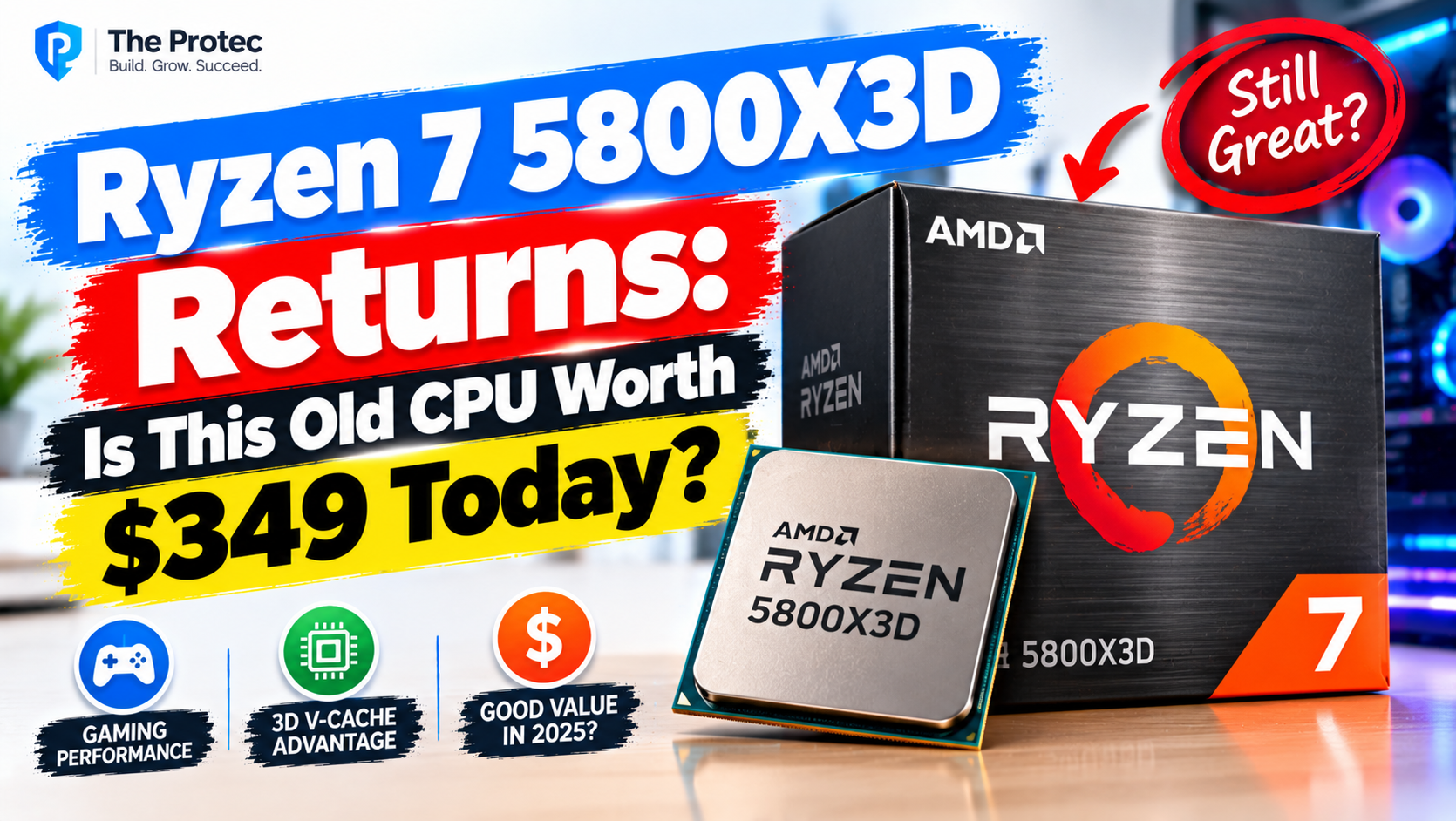
The Ryzen 7 5800X3D refuses to disappear. Years after redefining what AMD’s AM4 platform could deliver in games, the processor has reportedly returned as an AMD Ryzen 7 5800X3D 10th Anniversary Edition carrying a $349 price. That creates an unusual buying decision: should AM4 owners pay a premium for one of the platform’s fastest gaming chips, choose a less expensive Ryzen 7 5700X3D, or put the money toward AM5?
The answer depends less on the processor’s age than on the PC surrounding it. For someone who already owns a compatible motherboard and DDR4 memory, the 5800X3D can deliver a substantial gaming uplift without triggering a platform replacement. For a new builder, however, $349 is difficult to justify for a socket with no meaningful future CPU upgrade path.
There is also an important verification issue. AMD’s official product information confirms the original Ryzen 7 5800X3D and its specifications, but buyers should not assume anniversary branding represents a revised processor. Unless AMD publishes a separate product page or announcement identifying a new SKU, the reported edition should be treated as a relaunch or commemorative package—not new silicon with improved performance.
What Is the Ryzen 7 5800X3D 10th Anniversary Edition?
The reported anniversary release appears to bring the familiar 5800X3D back to market at $349. At publication, the significant facts are the listed price and renewed availability; there is no verified indication that AMD has changed the architecture, cache capacity, clock speeds, or power specification.
That distinction matters because limited-edition packaging does not make an older processor faster. Retail listings can also appear before an official announcement, differ by region, or represent retailer-specific inventory. Buyers should confirm the seller, warranty coverage, return policy, and exact part number rather than paying extra based on a product name alone.
The original processor is documented on AMD’s Ryzen 7 5800X3D product page. If the anniversary model matches those specifications, its value rests entirely on AM4 compatibility, gaming performance, availability, and price.
Ryzen 7 5800X3D Specifications Still Make Sense for Gaming
The Ryzen 7 5800X3D uses eight Zen 3 cores and 16 threads, with a 3.4GHz base clock and boost frequency of up to 4.5GHz. Its defining feature is 96MB of L3 cache, created by adding 64MB of stacked 3D V-Cache to the 32MB available on the underlying chiplet.
- Cores and threads: 8 cores and 16 threads
- Architecture: Zen 3
- Base and boost clocks: 3.4GHz and up to 4.5GHz
- L3 cache: 96MB
- Default TDP: 105 watts
- Socket: AM4
- Memory support: DDR4-3200 officially
- PCI Express: PCIe 4.0 on supported motherboards
- Included cooler: None
The large cache reduces how frequently the CPU must retrieve game data from comparatively slow system memory. That is why Ryzen 7 5800X3D gaming performance can remain competitive even against processors with newer cores and higher frequencies. The extra cache is not equally valuable in every application, however. Rendering, encoding, and heavily threaded productivity workloads often favor newer architectures with stronger per-core performance.
Ryzen 7 5800X3D Gaming Benchmarks: What to Expect
Recent comparative testing continues to show the same broad pattern established at launch. At 1080p with a high-end GPU, the 5800X3D performs especially well in simulation games, strategy titles, large multiplayer environments, and engines that benefit from additional cache. It can also improve frame-time consistency and one-percent-low frame rates, making a game feel smoother even when the average frame-rate increase is modest.
At 1440p, differences between modern gaming CPUs generally become smaller because more work shifts to the graphics card. At 4K, many systems are almost entirely GPU-limited. A Radeon RX 6600 or GeForce RTX 3060-class card, for example, is unlikely to expose the full difference between the 5800X3D and a cheaper six- or eight-core AM4 processor at demanding settings.
For a fair Ryzen 7 5800X3D review, benchmark results should use the same graphics card, game version, memory configuration, quality preset, and operating-system environment. Cross-review averages should not be combined as though they came from one test platform. Consistent testing such as TechPowerUp’s Ryzen 7 5700X3D review shows why resolution matters: the 5800X3D’s advantage is clearest in CPU-limited 1080p testing and contracts as the GPU becomes the bottleneck at 1440p.
Game selection matters just as much. Cache-sensitive titles can produce an impressive uplift over a standard Ryzen 5000 chip, while other games may show only a small difference. Buyers should prioritize benchmarks for the games they actually play instead of relying on one headline average.
Ryzen 7 5800X3D vs 5700X3D: The Crucial AM4 Comparison
The Ryzen 7 5700X3D is a real, officially released AM4 processor with eight Zen 3 cores, 16 threads, and 96MB of L3 cache. Its lower clock speeds make it somewhat slower than the 5800X3D, but gaming differences are normally modest because both chips have the same core count and cache capacity.
This makes price the deciding factor. If a new 5700X3D is available with a valid warranty for $50 or more below the Ryzen 7 5800X3D price, it is usually the smarter AM4 gaming purchase. Paying $349 for the 5800X3D to gain a relatively small frame-rate advantage is poor value unless the 5700X3D is unavailable, unusually expensive, or sold only through questionable marketplace vendors.
A price gap below roughly $30 is easier to defend for buyers who want the best gaming CPU for an AM4 motherboard. Even then, the difference will be hard to notice when playing at 1440p or 4K with a GPU-bound configuration. Used chips may lower the cost further, although buyers give up some warranty protection and should inspect seller history carefully.
There Is No Official Ryzen 7 7700X3D
A purported Ryzen 7 5800X3D vs 7700X3D comparison creates a factual problem: AMD has not officially released a processor named Ryzen 7 7700X3D. Specifications or benchmark results attributed to that name should not be treated as legitimate unless AMD announces such a product.
The likely intended comparison is the Ryzen 7 7700X, an official AM5 processor with eight Zen 4 cores, 16 threads, DDR5 support, and no 3D V-Cache. The Ryzen 7 5800X3D vs Ryzen 7 7700X contest varies by game. The 5800X3D can remain close or occasionally lead in cache-sensitive titles, while the 7700X offers higher clock speeds, stronger general-purpose performance, integrated graphics for troubleshooting, and access to the newer AM5 platform.
Official AM5 X3D alternatives include processors such as the Ryzen 7 7800X3D and Ryzen 7 9800X3D, subject to current regional availability and pricing. Those are more appropriate comparisons for buyers seeking premium gaming performance, although their total platform cost is higher for someone who already owns an AM4 system.
Is the Ryzen 7 5800X3D Worth $349?
At $349, the processor occupies an uncomfortable position. It may be the best AM4 gaming CPU at stock settings, but platform value cannot be measured by CPU performance alone. A current AM4 owner can keep an existing motherboard, DDR4 kit, Windows installation, and possibly the same cooler. That makes $349 close to the complete upgrade cost, assuming the motherboard has a compatible BIOS.
Moving to AM5 requires a processor, an AM5 motherboard, and DDR5 memory. Depending on features and local promotions, a mainstream board and 32GB DDR5 kit can add a meaningful amount to the bill. Installation time and the possibility of operating-system reactivation also matter. This total-cost advantage is the strongest argument for the Ryzen 7 5800X3D $349 offer.
That does not automatically make it a bargain. Spending the same amount on a cheaper 5700X3D plus a larger SSD, better cooler, or future GPU fund may improve the overall system more. An AM5 bundle can also narrow the platform-cost gap, particularly when retailers discount motherboards and memory together.
DDR4 vs DDR5 gaming PC upgrade calculations should use live prices rather than assumptions. DDR5 has become mainstream, while DDR4 can fluctuate as manufacturers shift production toward newer standards. Existing DDR4 is effectively a sunk cost, but buying a premium DDR4 kit for a fresh build may no longer save much money. Compare the entire cart on the day of purchase.
Who Should Buy It?
Existing AM4 Owners Seeking a Final Gaming Upgrade
This is the strongest buyer profile. Someone using a Ryzen 5 3600, Ryzen 7 3700X, or another earlier AM4 processor can gain better average frame rates and substantially stronger lows while retaining the rest of the platform. The 5800X3D can extend the useful life of a well-equipped B450, X470, B550, or X570 system, provided the manufacturer offers the required BIOS.
Buy it at $349 only if the 5700X3D is unavailable or priced close enough that the faster model makes sense. Otherwise, the cheaper X3D chip is usually the best CPU upgrade for Ryzen 5000 users and earlier AM4 owners focused on value.
Users With Older or Lower-Tier Ryzen Systems
Owners of first-generation Ryzen systems and entry-level boards need extra caution. Confirm BIOS support, CPU power delivery, cooler clearance, and memory stability before ordering. Some older boards support the chip after an update, but BIOS flashing may require the existing processor to remain installed until the update is complete.
The upgrade is most worthwhile when paired with a graphics card fast enough to reveal a CPU bottleneck. If the GPU is already operating near 100 percent utilization, allocating $349 toward a graphics upgrade may produce a larger improvement.
People Building a New PC From Scratch
New builders should generally choose AM5. AM4 remains capable, but its upgrade path effectively ends with the 5800X3D and 5700X3D. AM5 offers newer CPU architectures, DDR5, updated connectivity, and the possibility of replacing the processor later without rebuilding the entire platform.
A discounted AM4 bundle can still make sense for a strict budget, but a $349 legacy CPU weakens that argument. Compare complete systems rather than CPU prices: processor, motherboard, memory, cooler, storage connectivity, and likely upgrade lifespan.
Limitations to Consider Before Buying
- Aging platform: AM4 has no meaningful next-generation CPU upgrade beyond its existing high-end options.
- Game-dependent gains: Not every engine benefits equally from 3D V-Cache.
- GPU bottlenecks: CPU differences shrink at higher resolutions and demanding graphics settings.
- Cooling cost: No cooler is included. A quality tower cooler or capable liquid cooler is recommended.
- Restricted tuning: The original 5800X3D does not offer conventional multiplier overclocking.
- Productivity performance: Newer architectures are generally better for mixed gaming and content-creation workloads.
Final Verdict
The Ryzen 7 5800X3D is still a remarkably effective gaming processor, but the reported 10th-anniversary price asks buyers to pay for scarcity and platform convenience. At $349, it is worth considering only as a drop-in final upgrade for a strong existing AM4 system—especially when replacing an older Ryzen chip and avoiding the cost of an AM5 motherboard and DDR5 memory.
For most value-focused AM4 owners, the 5700X3D is the better alternative when it is meaningfully cheaper. For anyone assembling a new computer, AM5 is the more sensible long-term investment. The 5800X3D remains excellent; the problem is not performance, but how much AMD and retailers are asking buyers to pay for old hardware.
Frequently Asked Questions
Is the Ryzen 7 5800X3D worth it at $349?
It can be worth $349 for an existing AM4 owner who wants a major gaming upgrade without replacing a motherboard and DDR4 memory. It is difficult to recommend at that price when the 5700X3D is substantially cheaper or when an affordable AM5 bundle is available.
Is the Ryzen 7 5800X3D faster than the 5700X3D?
Yes. The 5800X3D has higher clock speeds and is generally a few percentage points faster in CPU-limited gaming. Both have eight Zen 3 cores, 16 threads, and 96MB of L3 cache, so the real-world difference is usually modest.
Does the Ryzen 7 7700X3D exist?
No official AMD processor currently carries the Ryzen 7 7700X3D name. The Ryzen 7 7700X is a real Zen 4 AM5 processor, while official eight-core AM5 models with 3D V-Cache include the Ryzen 7 7800X3D and Ryzen 7 9800X3D.
Do I need a new motherboard for the Ryzen 7 5800X3D?
Not necessarily. Many 400-series and 500-series AM4 motherboards support it after a BIOS update. Check the exact motherboard model’s CPU-support list before purchasing, and install the required BIOS while the old processor is still available.
Should I upgrade from AM4 to AM5 instead?
Choose AM5 when building a new PC, seeking stronger productivity performance, or prioritizing future CPU upgrades. Staying on AM4 makes more sense when you already own a suitable motherboard and DDR4 kit and want the lowest-disruption path to faster gaming.