






A web application can execute a simple query in milliseconds yet still struggle under load because of everything that happens before the query begins. Opening a database connection may involve a network handshake, authentication, encryption negotiation, session initialization, and memory allocation on the database server. Repeating that work for every application request creates avoidable latency and can overwhelm the server long before CPU-intensive queries do.
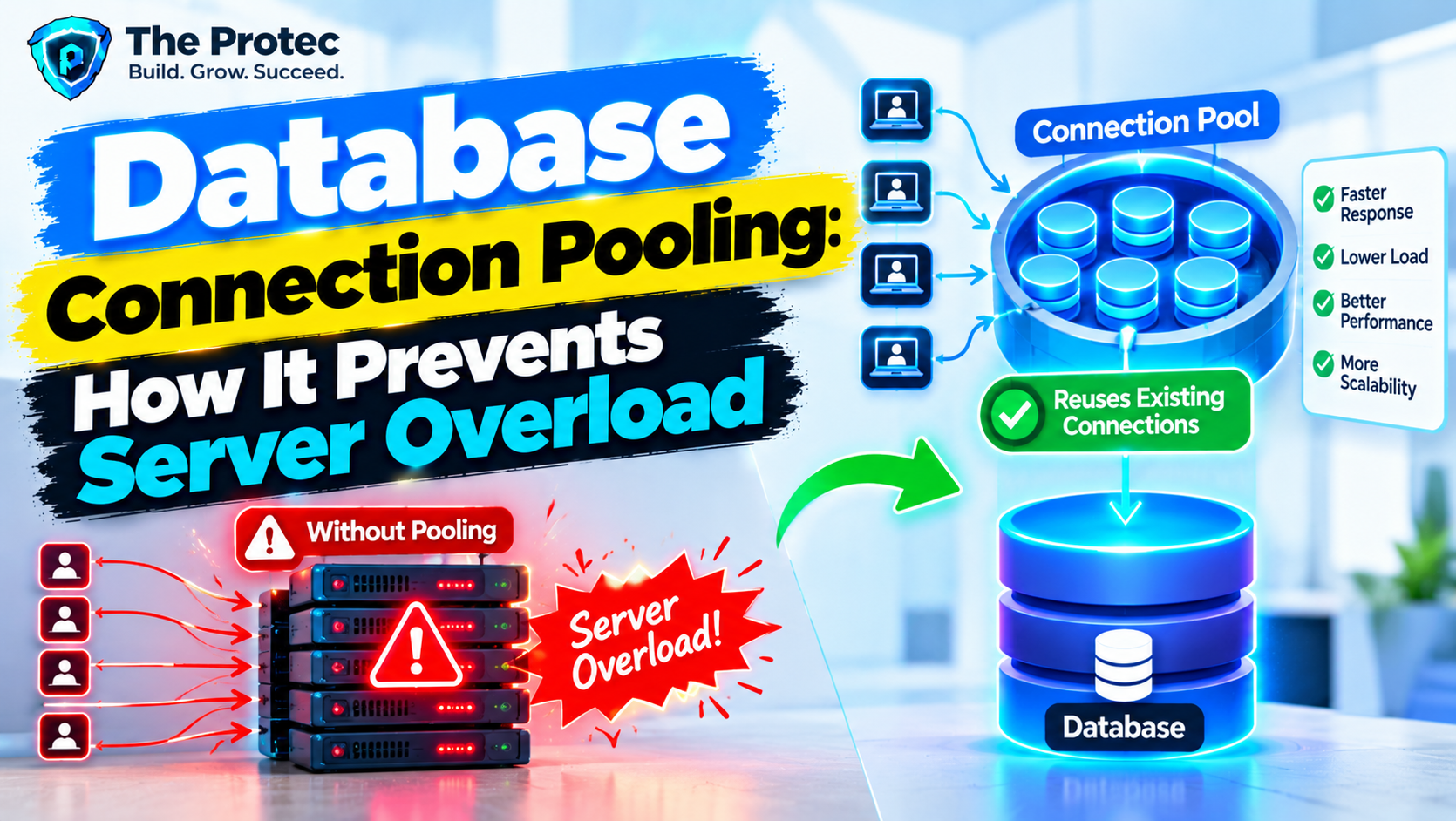
Database connection pooling addresses this problem by maintaining a managed set of reusable connections. Instead of opening and closing a physical connection for every request, the application temporarily borrows one, performs its database work, and returns it to the pool. Done correctly, pooling reduces database connection overhead, enforces connection limits, and improves application scalability. Done poorly, it can create long queues, stale sessions, connection leaks, and database pool exhaustion.
What Is Database Connection Pooling?
Database connection pooling is a database connection management technique in which an application, driver, proxy, or dedicated pooler keeps a limited number of database connections open for reuse. Application code requests a connection from the database connection pool rather than creating a new physical session each time.
The distinction between logical and physical connections is important. To application code, acquiring and releasing a pooled connection can resemble opening and closing a normal connection. Underneath, however, releasing usually returns the session to an idle pool. The physical network connection remains available for another request until it expires, becomes unhealthy, or the pool shuts down.
Pooling provides three primary benefits:
- It avoids repeated authentication, TLS, and session setup costs.
- It places a controlled ceiling on concurrent database connections.
- It absorbs short traffic bursts by placing requests in a bounded wait queue.
Pooling does not make inefficient queries inherently faster. Its purpose is to reduce connection churn and regulate concurrency so the database receives a workload it can sustain.
Why Per-Request Database Connections Become Expensive
Creating and closing database connections for every request may work for a low-traffic website. At scale, the pattern becomes costly. A burst of 500 application requests can trigger hundreds of simultaneous connection attempts, each consuming server memory, file descriptors, authentication work, and scheduling capacity.
Autoscaling can amplify the problem. If a Kubernetes deployment grows from 10 to 50 replicas and every replica can open 20 connections, the theoretical demand rises from 200 to 1,000 connections. The database usually cannot scale at the same speed as stateless application instances. Serverless functions can produce an even sharper connection storm because many short-lived runtimes may initialize concurrently.
Databases impose connection limits to protect themselves. Once that limit is reached, new clients are rejected or forced to wait. Even below the hard limit, excessive sessions can increase memory use, context switching, lock contention, and tail latency. A pool converts uncontrolled connection creation into a measurable concurrency budget.
How Connection Pooling Works: The Connection Lifecycle
Although implementations differ, a pooled connection normally follows a predictable lifecycle:
- Initialization: The pool creates a minimum number of physical connections immediately or opens them lazily when traffic arrives.
- Acquisition: An application request asks the pool for a connection. If an idle connection is available, the pool lends it to the request.
- Creation or waiting: If every connection is busy, the pool may create another one up to its configured maximum. At the maximum, the request enters a wait queue.
- Use: The application runs queries or a transaction while holding the connection. It should keep this period as short as practical.
- Reset and release: After use, the application commits or rolls back its transaction and releases the connection. A safe pool clears transaction state and other session changes before reuse.
- Validation and retirement: Idle, expired, or unhealthy connections are tested and replaced according to lifetime, health-check, and idle-timeout settings.
The release step is essential. Returning a connection with an open transaction, modified search path, temporary table, session variable, or advisory lock can affect the next borrower. Mature poolers provide reset behavior, but applications must still close result sets, finish transactions, and avoid relying on undocumented session state.
Choosing the Right Connection Pool Size
A larger connection pool size is not automatically better. The goal is to provide enough concurrency for useful database work without flooding the database with more active queries than its CPU, storage, and lock manager can process. Beyond that point, extra connections often increase latency rather than throughput.
Capacity planning must consider the entire deployment. A pool of 20 connections across 40 application replicas creates a potential total of 800. Add background workers, administrative tools, migrations, monitoring, and failover capacity before comparing that figure with the database connection limit. Always reserve headroom for operations and recovery.
Begin with measured concurrency rather than request volume alone. Observe query duration, transaction duration, database CPU, I/O latency, lock waits, and pool utilization during representative load. Then tune these controls together:
- Minimum connections: Connections kept ready even during quiet periods.
- Maximum connections: The hard limit each pool can open.
- Acquisition timeout: How long a request waits for a connection.
- Idle timeout: How long unused connections remain open.
- Maximum lifetime: When connections are recycled to avoid stale sessions.
- Queue limit: How many waiting requests the application will tolerate.
In autoscaled systems, the maximum pool size may need to shrink as replica count grows. Some platforms also use a centralized database proxy so application scaling does not translate directly into backend session growth.
Wait Queues, Connection Leaks, and Pool Exhaustion
When every pooled connection is busy, new borrowers wait. A short wait queue can smooth a brief spike, but an unbounded queue merely moves the overload into application memory and produces very slow responses. Acquisition timeouts should fail requests predictably before upstream HTTP timeouts trigger cascading retries.
Database pool exhaustion commonly results from slow queries, long transactions, a pool that is too small, or a connection leak. A leak occurs when code acquires a connection but fails to release it on every execution path. Exceptions, early returns, abandoned streams, and missing transaction cleanup are frequent causes.
Applications should release connections in guaranteed cleanup blocks or framework-managed scopes. Useful telemetry includes active and idle connections, queue depth, acquisition latency, timeout count, transaction duration, and leak warnings. When exhaustion occurs, investigate what is holding connections before simply enlarging the pool. Increasing the limit can hide the symptom while sending even more work to an already saturated database.
Overload handling also requires restraint. Use bounded queues, sensible timeouts, circuit breakers, and retry policies with exponential backoff and jitter. Blindly retrying every timeout can turn a temporary slowdown into a sustained outage.
Connection Pooling vs. Persistent Connections
Persistent database connections and connection pooling both reuse physical sessions, but they are not synonymous. A persistent connection is often attached to a particular process or worker and reused by later requests handled by that worker. It may not provide a shared queue, a global maximum, health management, or fair distribution across the application.
A true pool actively manages a collection of connections and coordinates borrowers. It can enforce acquisition timeouts, validate sessions, retire old connections, expose metrics, and limit concurrency. This makes it more predictable for scalable backend application performance.
The difference matters in process-based environments. If 100 workers each retain one or more persistent database connections, the server may receive 100 or more sessions even when traffic is modest. Persistent connections reduce handshake costs, but without fleet-wide limits they can still overload the database.
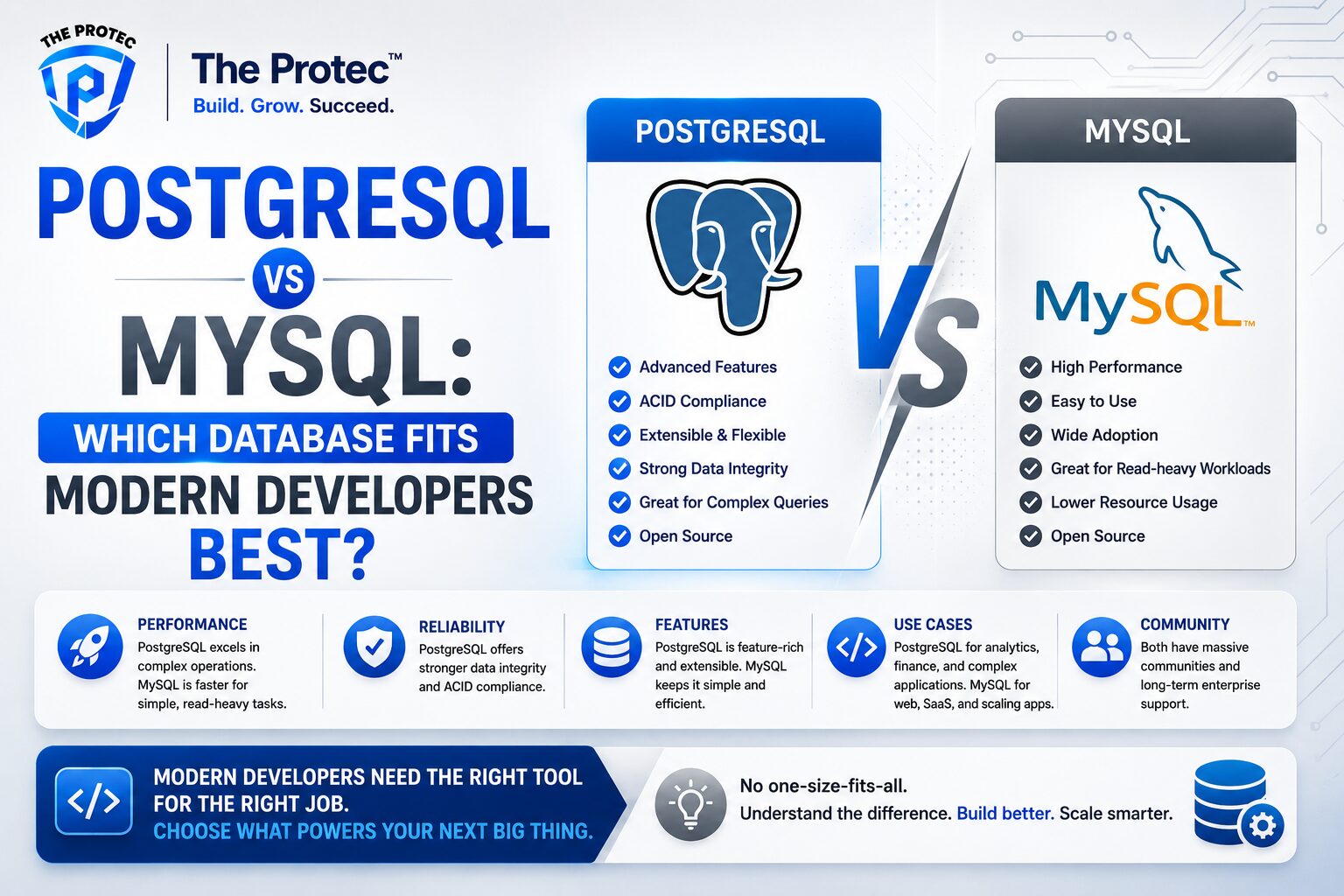
PostgreSQL and MySQL Connection Pooling
PostgreSQL PgBouncer
PostgreSQL uses a process-oriented connection model, so large numbers of client sessions can consume meaningful resources. PostgreSQL PgBouncer is a lightweight external pooler that accepts many client connections while maintaining a smaller set of PostgreSQL server connections.
PgBouncer supports session, transaction, and statement pooling modes. Transaction pooling offers high reuse because a server connection returns to the pool after each transaction. However, applications cannot assume that consecutive transactions use the same backend session. Session-scoped features, temporary objects, advisory locks, and prepared-statement behavior must be evaluated carefully. Session pooling offers stronger compatibility but achieves less multiplexing.
PgBouncer is especially useful for PostgreSQL workloads with many application instances, short transactions, serverless traffic, or strict backend connection budgets. Managed cloud database proxies provide similar benefits, although behavior and feature support vary.
MySQL Connection Pooling
MySQL connection pooling is commonly implemented inside application drivers, framework runtimes, or proxies such as ProxySQL and managed database services. MySQL can support many sessions, but every connection still has memory, thread-management, authentication, and scheduling costs. The server’s configured MySQL connection limits should be treated as a protective boundary, not a target for normal operation.
For both MySQL and PostgreSQL connection pooling, monitor active queries rather than focusing only on open connections. Hundreds of mostly idle pooled sessions may be manageable, while a much smaller number of expensive concurrent queries can saturate the server.
Practical Architectures for PHP, Laravel, and Backend Services
PHP Database Connections
Traditional PHP-FPM applications usually run request code in separate worker processes. Standard PHP database connections often close at the end of a request, while PDO persistent connections may survive inside an individual worker. Those persistent sessions are not automatically shared across all workers, hosts, or containers. Teams must multiply potential connections by the PHP-FPM worker count and the number of replicas.
For large PHP fleets, an external proxy can provide centralized control that per-worker persistence cannot. Low-traffic PHP applications may be better served by ordinary short-lived connections, particularly when the database is nearby and connection setup is inexpensive.
Laravel Database Connection Pooling
In a conventional PHP-FPM deployment, Laravel database connection pooling is not equivalent to the in-process pools found in long-running Java, Go, or Node.js services. Laravel typically uses configured PDO connections within the request lifecycle. Enabling persistent PDO connections requires careful capacity planning because each worker can retain its own session.
Long-running Laravel Octane workers change the lifecycle: workers remain alive across requests, so stale connections and leaked state require attention. Applications should use framework-supported reconnection and cleanup behavior, avoid carrying transaction state between requests, and test database failover. For high concurrency, PgBouncer, a MySQL-compatible proxy, or a managed database proxy can create a safer boundary between Laravel workers and the database.
Scalable Backend Services
Long-lived services commonly maintain one pool per process. In Kubernetes, total capacity equals the per-process pool multiplied by process and pod counts. Background consumers need separate budgets because a surge in jobs should not starve interactive traffic. Serverless platforms often benefit from a database proxy, although modern drivers and platform integrations may also coordinate connection reuse.
A sound architecture applies backpressure near the application, keeps transactions short, separates latency-sensitive and batch workloads where necessary, and aligns autoscaling policies with database capacity. Scaling application replicas without adjusting pools can reduce reliability rather than improve it.
When Pooling Is Not Automatically Beneficial
Pooling adds state, configuration, and another potential bottleneck. It may provide little value for low-traffic applications, command-line jobs that run infrequently, embedded databases such as SQLite, or deployments where a managed data API already handles connection multiplexing. An incorrectly sized pool can also keep unnecessary sessions open or conceal slow-query problems.
Transaction-level proxies may be incompatible with applications that depend heavily on session state. Short-lived compute can discard local pools before they deliver meaningful reuse. Evaluate connection setup latency, concurrency, runtime lifetime, database limits, and application semantics before choosing in-process pooling, persistent connections, an external proxy, or no pool at all.
Database Connection Management Checklist
- Calculate connection demand across every replica, worker, and background service.
- Reserve database capacity for administration, monitoring, migrations, and failover.
- Bound pool size, queue length, and acquisition time.
- Release connections and finish transactions on every code path.
- Recycle stale connections and test database restarts and failovers.
- Monitor pool utilization, wait time, leaks, query latency, and timeouts.
- Load-test autoscaling behavior instead of testing a single application instance.
Frequently Asked Questions
Does database connection pooling reduce query execution time?
It primarily reduces connection setup latency and controls concurrency. It does not optimize SQL, indexes, locking, or storage access. Query tuning remains necessary, although a well-sized pool can improve overall response time by avoiding repeated handshakes and preventing excessive simultaneous work.
What happens when a database connection pool is exhausted?
Requests normally enter a wait queue until a connection is returned. If none becomes available before the acquisition timeout, the application receives an error. Unbounded waiting is dangerous because it increases memory use and tail latency. Pool exhaustion should trigger investigation into slow queries, long transactions, leaks, and capacity.
How large should a database connection pool be?
There is no universal number. Size the pool according to measured database concurrency, query duration, replica count, and server capacity. A modest pool that keeps the database productively busy is usually better than a large pool that creates contention. Always calculate the fleet-wide total.
Is PgBouncer required for PostgreSQL?
No. Small or stable applications may operate well with direct connections or driver-level pools. PgBouncer becomes valuable when many clients compete for a limited PostgreSQL connection budget, especially with short transactions, autoscaling services, or serverless workloads. Its pooling mode must match the application’s use of session state.