








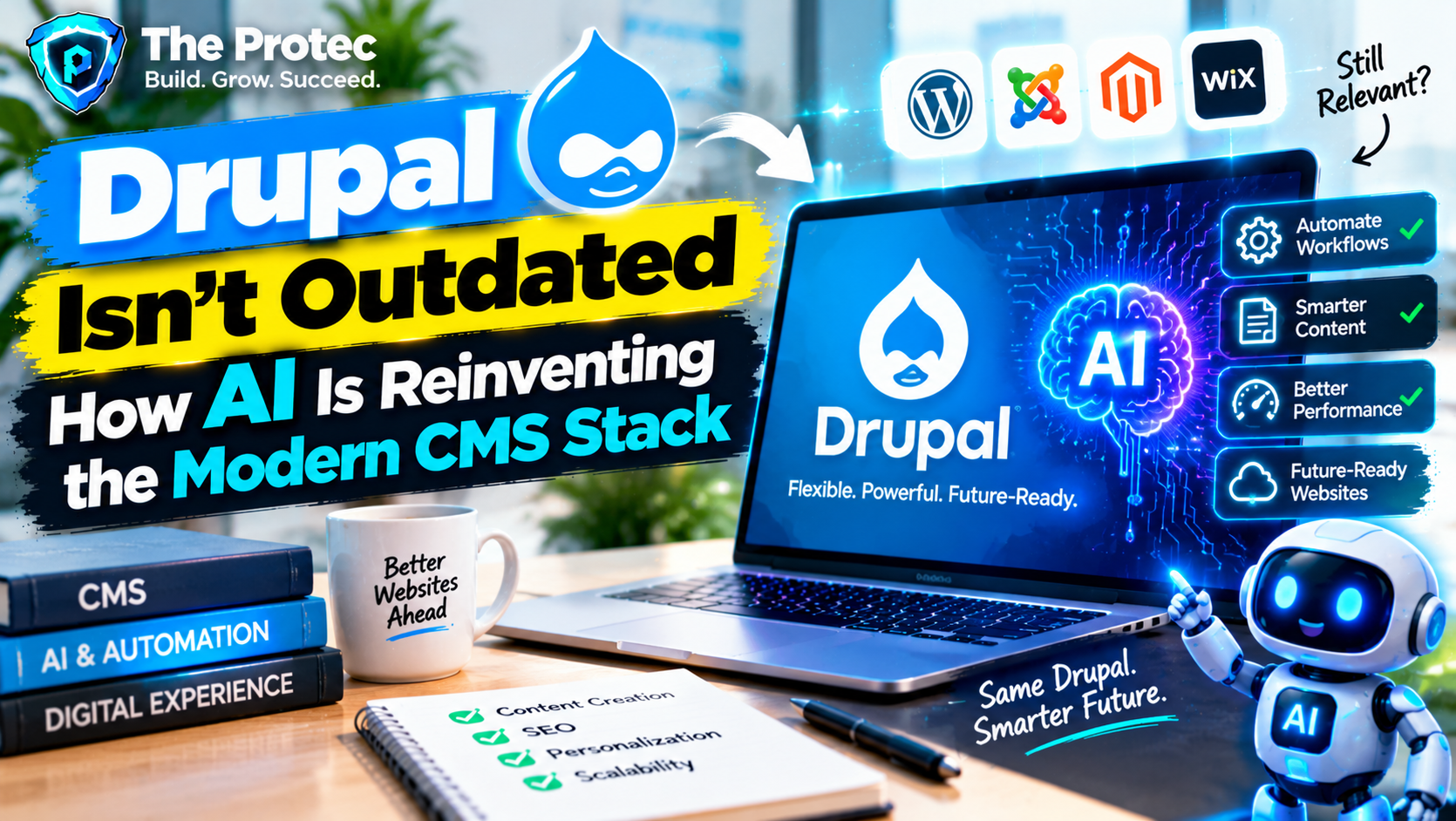
For years, Drupal has been known as a powerful, secure, and flexible content management system, but one with a steep learning curve and a reputation for being difficult for nontechnical teams to use. While modern CMS platforms increasingly embrace visual editing and AI-powered tools, Drupal’s traditional development approach often required extensive configuration, custom theming, and specialist expertise to create polished digital experiences.
But judging today’s Drupal content management system by those experiences misses an important shift. Drupal CMS 2.2, the Drupal Canvas page builder, improved multilingual workflows, mature headless options, and a fast-growing ecosystem of AI integrations are changing how teams can create and manage digital experiences.
This does not mean Drupal has eliminated its learning curve or transformed every AI experiment into a production-ready feature. Many Drupal AI capabilities come from contributed modules rather than Drupal core, while Model Context Protocol integrations and autonomous agents remain emerging technologies. The more accurate conclusion is that modern Drupal development is moving decisively toward a more approachable, composable, and AI-ready platform.
Drupal CMS 2.2 Is More Than a Renamed Version of Drupal Core
One common source of confusion is the distinction between Drupal core and Drupal CMS. Drupal core remains the underlying open-source framework. Drupal CMS is a ready-to-use product built on that foundation, combining core with carefully selected modules, configuration, recipes, and opinionated defaults.
Drupal CMS 2.2 continues that product-focused approach. Instead of asking every organization to assemble essential publishing capabilities from scratch, it provides a more practical starting point for common requirements such as content creation, media handling, search optimization, forms, accessibility, and editorial workflows. Drupal Recipes make it possible to add predefined capabilities without treating an entire site as an inflexible distribution.
The result is not a one-click website platform for every scenario. Site architecture, design systems, integrations, hosting, and governance can still require experienced Drupal website development teams. However, Drupal CMS 2.2 reduces the amount of repetitive setup needed before editors receive a useful publishing environment.
The official Drupal CMS documentation should remain the source of truth for supported functionality, installation requirements, and release changes. Drupal CMS has its own release lifecycle, and a feature included in the product should not automatically be described as part of Drupal core.
Drupal Canvas Brings Visual Page Building to Content Teams
The Drupal Canvas page builder directly addresses one of Drupal’s most persistent usability criticisms. It gives editors a visual environment for assembling pages from reusable components rather than forcing them to understand templates, administrative forms, or theme internals.
A marketing editor could build a campaign page by arranging an approved hero, testimonial block, product grid, call to action, and FAQ component. The editor sees the page in context, while the organization retains control over which components are available and how they behave. This is a more structured approach than unrestricted visual design.
That distinction matters. A Drupal visual page builder is most valuable when it balances freedom with governance. Developers and designers can create accessible, brand-compliant components; editors can then compose pages without rewriting HTML or requesting a deployment for every layout adjustment.
Canvas also supports the broader direction of modern Drupal frontend development: component-based design systems, reusable interface elements, and clearer separation between content, presentation, and business logic. Its project status, compatible releases, known limitations, and active development are documented on the official Drupal Canvas project page.
Canvas should not be presented as magic. A successful implementation still requires component planning, responsive testing, accessibility validation, permissions, and editorial training. Teams should also confirm whether a particular Canvas feature is stable and supported before making it central to a production workflow. A Drupal Canvas tutorial can explain drag-and-drop mechanics, but governance determines whether the resulting site remains consistent and maintainable.
Drupal AI Capabilities Extend the Editorial Workflow
The Drupal AI CMS story is primarily an ecosystem story. Drupal’s contributed AI module and related projects provide frameworks for connecting external model providers and adding AI-assisted actions to administrative workflows. Depending on the installed modules and provider, those actions may include summarization, taxonomy suggestions, alternative text drafts, translation assistance, semantic search, content analysis, or generation of an initial draft.
These Drupal AI tools do not mean a language model should publish directly to a live website. A safer workflow keeps AI output inside Drupal’s existing permissions, moderation, revision, and approval systems.
A practical AI-assisted publishing example
Consider a public institution publishing a new policy page. An editor writes the approved source content, then uses an AI action to propose a plain-language summary, relevant taxonomy terms, and a meta description. The suggestions are saved in a draft revision. A subject-matter expert verifies factual accuracy, an accessibility reviewer checks the reading experience, and an authorized publisher gives final approval.
For an uploaded image, AI might suggest alternative text, but the editor must confirm whether the description communicates the image’s purpose. For multilingual content, a model might create a first-pass translation, but a qualified reviewer should validate terminology and cultural context before publication.
This is AI-powered content management without surrendering editorial responsibility. The model accelerates repetitive work; Drupal controls access, revision history, workflow state, and publication.
What Is Stable, Contributed, or Still Experimental?
Discussions about Drupal AI tools can blur important product boundaries. Organizations evaluating Drupal AI capabilities should separate features into clear categories:
- Stable platform capabilities: Drupal’s structured content, roles, permissions, revisions, moderation, APIs, multilingual foundations, and extensibility are established features. These provide the governance layer around AI-assisted work.
- Documented Drupal CMS features: Capabilities packaged and supported in the current Drupal CMS 2.2 release should be evaluated against its official documentation and release notes.
- Contributed AI integrations: The Drupal AI module and provider connectors are community projects with their own maintenance status, dependencies, security coverage, and release maturity. They are not automatically built into core.
- Experimental features: Agent frameworks, novel Canvas integrations, and automated multistep content operations may be useful for prototypes but require technical review before production use.
- Roadmap items: Announced goals and demonstrations are signals of direction, not guarantees that a capability is available, stable, or supported on a particular date.
This distinction is essential when discussing Drupal 2026 new features. A compelling demonstration can show where the ecosystem is heading without proving that every organization should deploy the same technology immediately.
Drupal MCP Integration Could Connect AI Agents to CMS Tools
Model Context Protocol, commonly called MCP, is an emerging standard for connecting AI applications to tools and contextual data through defined interfaces. A Drupal MCP integration could allow an approved AI agent to discover structured CMS operations rather than relying on screen scraping or unrestricted database access.
For example, an agent might be permitted to locate outdated draft content, retrieve selected metadata, create a new revision, or recommend related pages. Drupal’s content model and permissions make it a natural candidate for controlled tool access because content types, fields, workflows, and user capabilities are already explicitly defined.
However, Drupal Model Context Protocol support should currently be treated as an emerging ecosystem capability, not a universal core feature. MCP servers, contributed modules, and agent experiments can differ significantly in maturity. Security teams must review authentication, authorization, logging, data exposure, prompt-injection risks, and the exact operations an agent can execute.
AI agents for content management should begin with narrow, reversible tasks. Creating a draft revision is safer than publishing. Reading public metadata is safer than accessing embargoed content. Human approval and audit logs remain necessary even when an integration works as designed.
Multilingual Drupal Remains a Major Advantage
Drupal multilingual websites have long benefited from language handling across content, configuration, interfaces, and structured fields. The modern Drupal CMS experience is making those capabilities easier to configure and combine with editorial workflows, visual components, and translation services.
A global publisher can model an article once, translate individual fields, assign locale-specific reviewers, and control when each translation becomes public. A government website can maintain language variants while preserving revisions and permissions. A business can reuse the same structured product information across regional websites without flattening everything into disconnected pages.
Recent Drupal multilingual improvements are less about replacing professional translation and more about reducing friction. AI-assisted translation can help produce a first draft, terminology tools can improve consistency, and workflows can route content to the correct reviewer. Drupal still provides the governance layer that determines which translation is authoritative.
Headless Drupal Separates Content From the Frontend
A Drupal headless CMS uses Drupal for content modeling, governance, and APIs while a separate frontend renders the experience. Drupal core’s JSON:API support gives developers a standardized way to expose entities and fields, while contributed technologies can support other API and integration patterns.
This Drupal headless architecture works well when an organization needs to deliver structured content to a website, mobile application, kiosk, digital signage system, or conversational interface. Frontend developers can use their preferred framework while editors continue working in Drupal.
Headless is not automatically better. It introduces separate deployments, preview complexity, caching decisions, API security, and additional maintenance. Traditional or progressively decoupled Drupal can be simpler when editorial preview and tightly integrated page building are priorities. Canvas may also make a coupled implementation more attractive for teams that want visual control.
The important Drupal website development trend is choice. Organizations can use a conventional Drupal frontend, a fully decoupled application, or a hybrid model based on actual business requirements.
Drupal vs WordPress Is a Trade-Off, Not a Universal Contest
A Drupal CMS vs WordPress comparison should begin with the project, not brand loyalty. WordPress generally offers a faster learning path, an enormous theme and plugin market, and abundant commodity hosting. It is often an efficient choice for straightforward marketing sites, blogs, and small teams.
Drupal typically provides deeper structured-content modeling, granular permissions, complex workflow support, multilingual architecture, and flexible API-driven development. Those advantages become valuable when a website behaves more like a content platform than a collection of pages.
- Ease of use: WordPress is usually easier initially. Drupal CMS and Canvas narrow the gap, but Drupal still rewards deliberate architecture and training.
- Customization: Both are extensible. Drupal is particularly strong when requirements involve relationships among content, roles, workflows, and multiple channels.
- Security practices: Both can be operated securely. Risk depends on updates, modules or plugins, hosting, configuration, and operational discipline—not the platform name alone.
- Hosting: WordPress has more low-cost options. Drupal hosting is widely available, but complex implementations often need stronger infrastructure expertise.
- Developer skills: Drupal commonly requires knowledge of its entity system, configuration management, Composer, and Symfony-based patterns.
- Long-term maintenance: WordPress can be economical for simpler sites. Drupal’s structured approach can reduce long-term friction when content and governance requirements are inherently complex.
Who Benefits Most From Modern Drupal?
Drupal enterprise CMS features remain compelling for multilingual publishers, universities, public institutions, healthcare organizations, associations, and complex content-driven businesses. These organizations often need granular roles, approval chains, structured data, accessibility standards, multiple sites, and integrations with internal systems.
Drupal is no longer relevant only to the largest enterprises, however. A midsized organization may benefit when its content model is complex, when several departments share publishing responsibilities, or when content must be distributed through multiple channels. Conversely, a small brochure site with one editor may not need Drupal’s depth.
Advocacy Is Part of Drupal’s Modernization Strategy
Dries Buytaert’s announced Drupal Advocacy Program reflects a broader effort to help developers, agencies, and organizations demonstrate what the platform can do through credible examples and public participation. It is an advocacy initiative rather than a Drupal core feature, commercial certification, or guarantee about the product roadmap.
Its significance lies in perception. Drupal’s technical progress will have limited impact if buyers and developers continue evaluating it through decade-old experiences. The program encourages the community to explain modern use cases, show working implementations, and make Drupal’s capabilities more visible. Its activities and participation details should be checked against current official announcements because community programs can evolve independently of software releases.
Is Drupal Still Relevant?
Yes, but not because it suddenly became effortless or because AI erased every weakness. Drupal is relevant because its established strengths—structured content, governance, multilingual support, security processes, and extensibility—fit naturally with visual composition, headless delivery, and controlled AI workflows.
Drupal CMS 2.2 and Canvas make the platform more approachable. Contributed AI integrations can improve editorial productivity. MCP experiments suggest a future in which authorized agents interact with CMS tools and structured content. None of those developments removes the need for skilled implementation, human review, accessibility testing, or careful maintenance.
Drupal is not trying to become a simpler copy of another CMS. It is becoming a more usable version of what it has always done best: manage complex content with structure and control.
Frequently Asked Questions
Are Drupal AI features built into Drupal core?
Not all of them. Drupal core supplies foundational capabilities such as structured content, permissions, revisions, workflows, and APIs. Many direct model integrations and generative AI tools come from contributed modules and external services with separate maturity and maintenance considerations.
Is Drupal Canvas production-ready?
Canvas is an active Drupal visual page-building project, but teams should verify the supported release, stable feature set, compatibility, and known limitations in official documentation before production adoption. Individual integrations or advanced capabilities may mature at different rates.
Can AI publish Drupal content automatically?
Technically, integrations may be configured to perform publishing actions, but direct autonomous publication creates accuracy, security, and governance risks. A safer design limits AI to suggestions or draft revisions and requires authorized human approval.
Is Drupal better than WordPress?
Neither platform is universally better. WordPress often suits simpler websites and teams prioritizing rapid setup. Drupal is frequently stronger for complex structured content, multilingual publishing, granular permissions, advanced workflows, and multichannel delivery.