







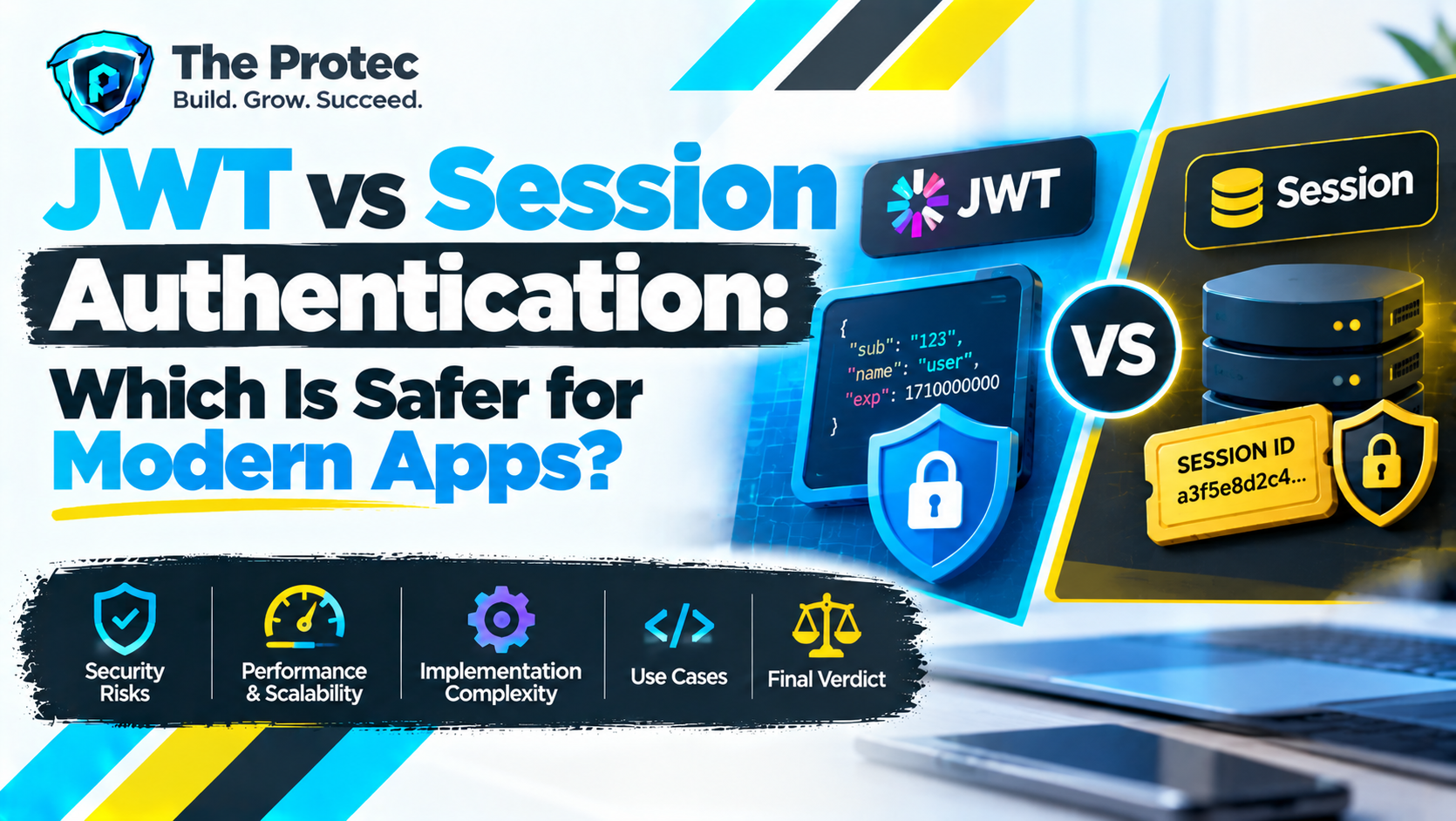
Choosing between JWT and session authentication is often framed as a contest between an old, stateful model and a modern, stateless one. That framing is misleading. A poorly protected JSON Web Token can be far easier to steal and harder to revoke than a conventional session, while a weak session implementation can expose users to fixation, hijacking, and cross-site request forgery.
The more useful question is not simply whether JWT vs session authentication is more secure. It is which architecture matches the application’s clients, deployment model, logout requirements, and threat profile. A server-rendered Laravel website, a browser-based SPA, a native mobile app, and a distributed API platform do not have identical authentication needs.
This comparison follows the full authentication lifecycle: where credentials and state live, how each request is verified, what happens during horizontal scaling, and how systems handle expiration, revocation, refresh tokens, CSRF, XSS, and logout.
How session-based authentication works
With session-based authentication, a user submits credentials over HTTPS. The application verifies the password against a securely hashed value, then creates a server-side session record. The browser receives a random session identifier, normally in a cookie.
On later requests, the browser sends that cookie automatically. The server looks up the identifier in a session store and retrieves information such as the user ID, authorization context, login time, and recent security events. The cookie is a reference, not the session data itself.
Sessions can be stored in memory, a database, Redis, or another shared cache. A secure session identifier must be unpredictable and should contain no meaningful user information. The cookie should generally use Secure, HttpOnly, and an appropriate SameSite setting, with a narrow domain and path.
Because the server controls the session record, it can terminate access immediately. Deleting the record invalidates the session even if an attacker still possesses the cookie. This centralized control is one of the strongest benefits of traditional session management.
How JWT authentication works
In JWT authentication, the server issues a signed token after verifying the user. A JWT usually contains claims identifying the subject, issuer, audience, issue time, and expiration. The signature allows a service to verify that the claims were created by a trusted issuer and have not been modified.
A JWT is commonly used as an access token in an Authorization: Bearer header. Unlike a session ID, it may contain enough information for an API to authenticate a request without querying a central session store. This is stateless authentication from the resource server’s perspective.
Stateless does not mean state-free. The system still manages signing keys, users, refresh tokens, disabled accounts, device records, consent, and possibly revocation data. JWTs also provide integrity, not secrecy: their payload is normally encoded rather than encrypted. Sensitive credentials, secrets, and unnecessary personal data do not belong in the payload.
JWT vs cookies compares two different concepts. JWT is a token format; a cookie is a browser storage and transport mechanism. A session ID can be carried in a cookie, and a JWT can also be carried in a cookie. Alternatively, a JWT can be stored in memory or browser storage and sent in an authorization header.
The storage and transport choice changes the security profile. Cookies are automatically attached to matching requests, creating a potential CSRF concern. JavaScript-readable storage avoids that automatic behavior but makes bearer tokens directly accessible to injected scripts. Selecting JWT does not automatically eliminate either threat.
Scenario one: a traditional server-rendered website
For an online store, publishing platform, or business portal rendered primarily by PHP, sessions are usually the safer and simpler default. The browser needs one opaque cookie, the server can revoke access instantly, and authorization data remains under server control.
Horizontal scaling does not require JWTs. Multiple PHP or Laravel instances can share sessions through Redis or a database while a load balancer distributes requests. This adds a fast lookup, but it also enables administrators to terminate sessions, enforce inactivity timeouts, and inspect active devices centrally.
A secure implementation should regenerate the session ID after login and privilege changes, preventing session fixation. It should also invalidate the session after a password reset, account suspension, or other high-risk event. For browser forms and state-changing requests, use framework-provided CSRF protection.
Scenario two: a same-origin single-page application
Teams often assume every SPA requires JWTs. When the frontend and backend operate under the same parent site, an HttpOnly session cookie is frequently a better fit. The SPA can call the backend with credentials while JavaScript never receives a reusable bearer token.
This architecture still needs CSRF defenses because the browser sends cookies automatically. SameSite cookies, CSRF tokens, strict origin validation, and careful cross-origin resource sharing policies work together. SameSite is a valuable boundary, but it should not be treated as the only defense for sensitive operations.
An HttpOnly cookie limits XSS token theft, although it does not make XSS harmless. Malicious JavaScript running in the trusted origin may still issue requests as the user or alter page content. Content Security Policy, output encoding, dependency hygiene, and avoiding unsafe DOM APIs remain essential.
Scenario three: native mobile apps and third-party clients
Native mobile applications cannot rely on browser cookie behavior in the same way as a conventional website. Short-lived access tokens combined with carefully protected refresh tokens are often appropriate. Tokens should be stored using platform-backed secure storage, not plain preferences, local files, or logs.
The access token should have a narrow audience and limited privileges. A refresh token can obtain new access tokens without asking the user to enter credentials repeatedly. For public clients, authorization code flow with PKCE is preferable to flows that expose long-lived credentials to the application.
Logout should revoke the refresh token or its token family and remove local credentials. The current access token may remain valid until it expires, so high-risk systems may also check a revocation signal or current account status at sensitive endpoints.
Scenario four: distributed APIs and microservices
JWT access tokens are useful when several APIs need to validate requests independently. Services can verify signatures using a trusted public key without calling the authentication service on every request. This reduces coupling and can improve resilience across regions.
However, broad, long-lived JWTs increase the impact of theft. Distributed systems should use short expiration times, explicit audiences, minimal scopes, and centralized key rotation. Internal services must reject unexpected issuers, algorithms, and token types rather than trusting any token with a valid-looking signature.
For highly sensitive operations, a gateway or policy service can combine local JWT verification with current authorization checks. This hybrid architecture keeps routine validation efficient while allowing rapid responses to account suspension, permission changes, or suspected compromise.
JWT token expiration, revocation, and immediate logout
JWT token expiration limits how long a stolen access token remains useful, but it does not revoke the token immediately. A self-contained JWT generally stays valid until its exp time unless resource servers consult additional state.
Common JWT revocation strategies include:
- Keeping access tokens short-lived and revoking only refresh tokens.
- Maintaining a denylist keyed by token ID until each token expires.
- Tracking a per-user token version or security timestamp.
- Using token introspection for operations requiring current status.
- Rotating signing keys during a major incident, with the understanding that this may invalidate many users at once.
Each strategy reintroduces some state, which is not a failure. It is an engineering trade-off. If immediate logout is a hard requirement, opaque sessions or centrally checked tokens are often clearer than pretending a fully stateless JWT can offer instant revocation.
Refresh-token rotation reduces replay risk
Refresh tokens should be treated as high-value credentials because they can extend a login beyond the access token’s lifetime. Modern secure login systems use refresh-token rotation: each successful refresh invalidates the old token and returns a new one.
If an invalidated token is presented again, the server can detect probable replay and revoke the entire token family. Store refresh-token secrets hashed where practical, bind records to a client or device context, limit lifetime, and record enough metadata to investigate abuse. Rotation is not a substitute for secure client storage, but it reduces the useful life of a copied credential.
Persisting access or refresh tokens in localStorage is convenient, but any successful script injection can read and export them. The attacker can then replay those bearer tokens from another machine. sessionStorage shortens persistence but remains accessible to JavaScript.
An HttpOnly cookie prevents JavaScript from directly reading the credential. Add Secure, choose SameSite=Lax or Strict where workflows permit, and avoid overly broad cookie domains. Cross-site deployments may require SameSite=None; Secure, making explicit CSRF and origin controls especially important.
A practical browser pattern is to keep access tokens only in memory and place a refresh credential in a tightly scoped HttpOnly cookie. Another is to use a backend-for-frontend that manages tokens server-side and exposes only a session cookie to the browser. This reduces token exposure while preserving an API-oriented backend.
Comparing the main security risks
- CSRF: Primarily affects credentials sent automatically by the browser, including session cookies and JWT cookies. Use CSRF tokens, SameSite settings, and origin checks.
- XSS: Can directly steal tokens from browser storage. HttpOnly cookies prevent direct extraction but cannot stop malicious same-origin actions.
- Session fixation: Occurs when an attacker controls a victim’s pre-login session ID. Rotate identifiers after authentication and privilege elevation.
- Token replay: Stolen bearer tokens can be reused by whoever possesses them. Short lifetimes, narrow audiences, rotation, and sender-constrained designs reduce exposure.
- JWT validation errors: Services must pin acceptable algorithms, verify signatures, and validate issuer, audience, expiration, and token purpose. The JWT Best Current Practices document details common implementation failures.
- Weak session handling: Predictable identifiers, missing cookie flags, excessive idle time, and failure to rotate sessions can undermine otherwise sound session-based authentication. The OWASP Session Management Cheat Sheet provides implementation guidance.
Laravel authentication architecture recommendations
For a conventional Laravel application, framework sessions with secure cookies are generally the best starting point. Use a Redis or database session driver when multiple application instances need shared state. Regenerate the session after login, invalidate it during logout, regenerate the CSRF token, and configure cookie security consistently across environments.
For a first-party SPA, Laravel Sanctum’s stateful cookie authentication often provides a cleaner security model than exposing JWTs to frontend JavaScript. It uses Laravel’s session and CSRF protections while supporting SPA requests.
For native apps or third-party API consumers, use scoped API tokens or a standards-based OAuth authorization server when delegated access is required. Laravel Passport may be appropriate for OAuth scenarios, but adding OAuth or JWT solely to appear modern creates unnecessary complexity. Authentication methods should follow client and trust boundaries, not fashion.
Which secure authentication architecture should you choose?
- Traditional website: Prefer server-side sessions in Secure, HttpOnly cookies, with CSRF protection and session ID rotation.
- First-party same-origin SPA: Prefer cookie-based sessions or a backend-for-frontend unless independent bearer tokens are genuinely required.
- Native mobile app: Use short-lived access tokens and rotated refresh tokens stored in platform-secure storage.
- Third-party integrations: Use OAuth-based access tokens with explicit scopes, audiences, and revocation controls.
- Distributed APIs: JWTs can support local verification, but keep claims minimal, lifetimes short, and key management centralized.
- Immediate logout or rapid permission changes: Favor server-controlled sessions, token introspection, or a hybrid revocation check.
The central distinction in access tokens vs sessions is control. Sessions make current server state authoritative. Self-contained access tokens favor decentralized verification but accept a window in which previously issued claims may remain valid. Neither model is universally more secure; the safer choice is the one whose failure modes your application can reliably control.
Frequently asked questions
Are JWTs more secure than sessions?
No. JWTs offer portability and decentralized verification, while sessions provide simpler revocation and centralized control. Security depends on storage, transport, expiration, validation, key management, and the application’s actual requirements.
Should a SPA store JWTs in localStorage?
Usually not when safer alternatives are available. Tokens in localStorage are directly exposed to successful XSS. A secure HttpOnly cookie, in-memory access token, or backend-for-frontend architecture usually offers better protection against token extraction.
Can JWT authentication support immediate logout?
Yes, but not through expiration alone. Immediate logout requires a denylist, token-version check, introspection service, or another server-side revocation mechanism. Refresh tokens should also be revoked so the client cannot obtain new access tokens.
No. The Secure flag only restricts cookies to HTTPS, and HttpOnly blocks JavaScript access. SameSite helps limit cross-site sending, but sensitive cookie-authenticated applications should still use appropriate CSRF tokens and origin validation.
Is JWT required for horizontally scaled Laravel applications?
No. Laravel instances can share session state through Redis or a database. JWTs may reduce session lookups for distributed APIs, but shared sessions often provide easier logout, auditing, and account control for browser applications.