








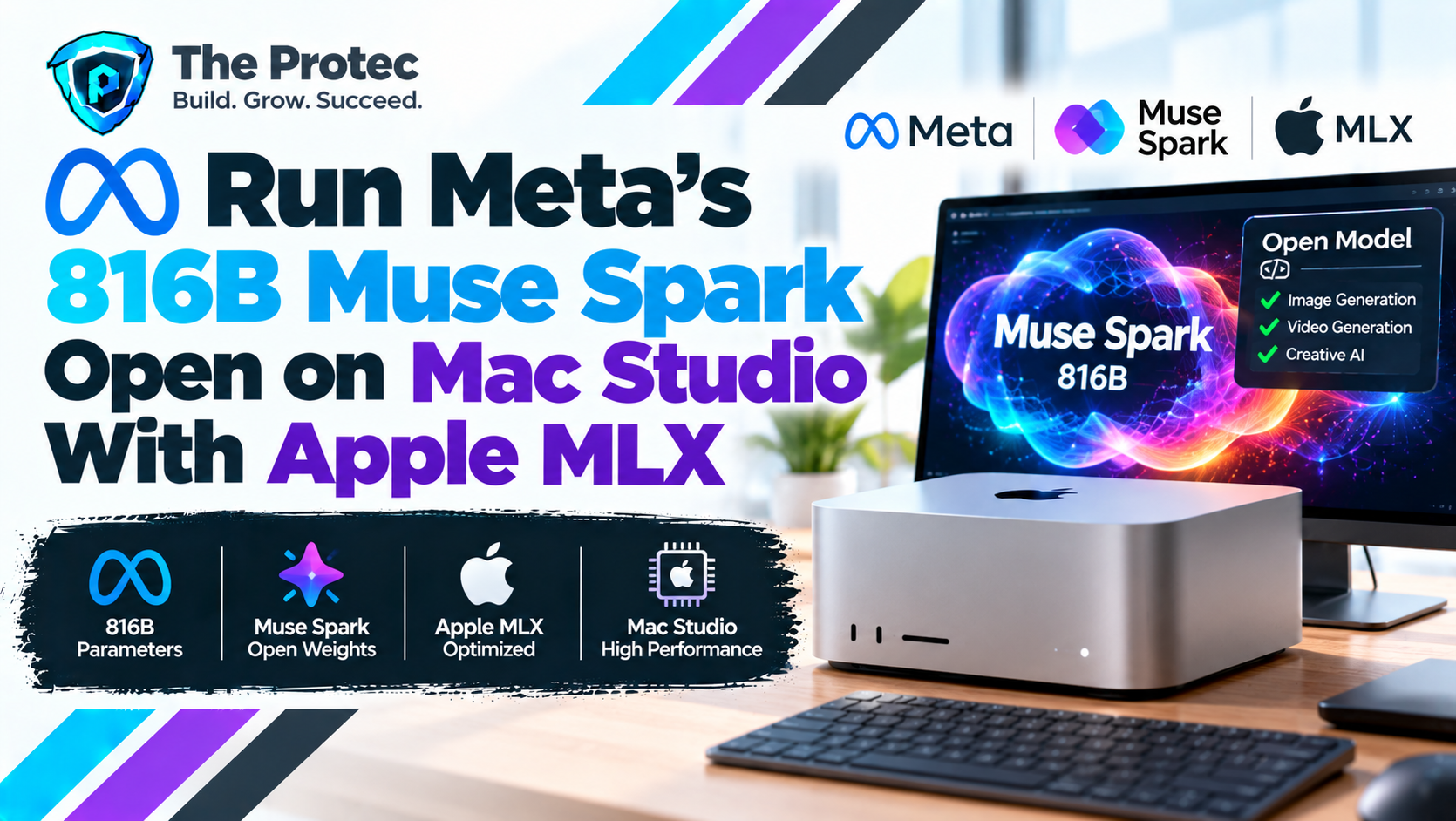
Downloading an open-weight model is not the same as being able to run it on an ordinary computer. Meta Muse Spark Open makes that distinction impossible to ignore. The multimodal mixture-of-experts model has 816 billion total parameters, 42 billion active parameters per inference step, and a context window extending to one million tokens. Its weights may be accessible, but its scale places it far beyond a typical laptop or single desktop.
Apple and Meta have nevertheless demonstrated that Muse Spark Open can run locally across multiple high-memory Mac Studio systems using Apple MLX. The configuration turns a cluster of M5 Ultra Mac Studios into a distributed inference platform, with direct Thunderbolt 5 connections carrying data between machines. Apple reports that a four-node setup can exceed 36 generated tokens per second under its benchmark conditions.
That result does not mean every developer can download an 816 billion parameter AI model and immediately reproduce cloud-class performance. It depends on expensive hardware, quantized weights, current software, careful networking, and workload-specific optimization. Even so, the project is a significant example of how Apple Silicon AI models are moving beyond small desktop assistants and into distributed, workstation-scale inference.
What Is Meta Muse Spark Open?
Meta Muse Spark Open is an open-weight multimodal model designed for demanding reasoning, coding, long-context, and mixed-media workflows. Its mixture-of-experts architecture contains 816 billion parameters in total, but only about 42 billion are activated for each token. A routing system selects the relevant experts rather than evaluating the entire network during every forward pass.
This sparse design reduces computation compared with a dense 816B model, but it does not eliminate the memory problem. The complete expert weight set must remain available so the router can call different experts as needed. Model weights, key-value caches, runtime buffers, communication overhead, and multimodal inputs all compete for memory.
The one-million-token context window is particularly notable for software engineering. In principle, a local AI coding agent could analyze large repositories, documentation, issue histories, logs, and test output within one session. In practice, maximum context consumes substantial memory and may reduce throughput. A published context limit describes capability, not a promise that every deployment will process one million tokens efficiently.
Meta distributes the model weights through approved platforms including Hugging Face. However, Muse Spark Open should be described as a Meta open-weight AI model rather than unrestricted open-source software. Its Muse Model License includes conditions and limited commercial terms. Organizations should review the current license, acceptable-use requirements, and redistribution rules before building a product around it.
Why Muse Spark Open Needs Multiple Mac Studios
Native BF16 storage would require roughly two bytes per parameter before accounting for metadata or runtime memory. At 816 billion parameters, that implies a raw weight footprint of approximately 1.63 terabytes. A single Mac Studio cannot hold that model in unified memory while also reserving space for inference.
The demonstrated Muse Spark Open Mac Studio deployment therefore uses NVFP4 quantization and distributed inference. NVFP4 represents weights at approximately four-bit precision using a format designed for neural-network workloads. In simple terms, quantization compresses the weight data and lowers memory bandwidth requirements compared with BF16. An idealized four-bit representation of 816 billion parameters is about 408GB, although actual checkpoints are larger because scales, metadata, alignment, and some higher-precision tensors add overhead.
Quantization does not make every part of inference four-bit. Activations, routing operations, attention calculations, key-value caches, and other intermediate data may use higher precision. Long prompts can make context memory a major part of the resource budget. This is why the practical Muse Spark Open hardware requirements remain substantial even after NVFP4 compression.
Why Apple Silicon and Unified Memory Matter
Apple Silicon uses a unified memory architecture shared by the CPU, GPU, and Neural Engine. The GPU can address a large memory pool without copying tensors between separate system RAM and discrete GPU VRAM. For local AI inference on Apple Silicon, this provides capacity that is difficult to obtain from a conventional workstation with one or two consumer GPUs.
A Mac Studio with 512GB unified memory can hold large model shards while leaving room for the MLX runtime, caches, and operating system. High memory bandwidth is equally important. Autoregressive token generation repeatedly reads weights, and mixture-of-experts models must quickly access the experts selected by the router. Capacity determines whether the model fits; bandwidth strongly influences how quickly it runs.
MLX is Apple’s array and machine-learning framework for Apple Silicon. It provides lazy evaluation, unified-memory integration, quantization support, and distributed primitives. Apple and Meta optimized the model layout, expert execution, and communication path so that the workload can be divided among several machines instead of treating each Mac as an isolated inference server.
How MLX Distributed Inference Uses Thunderbolt 5
MLX distributed inference assigns portions of the model’s computation to separate Mac Studio nodes. Each machine holds the tensors or model shards required for its role, performs local calculations, and exchanges intermediate results with its peers. The nodes must stay synchronized because generating one token can depend on work performed across the cluster.
Communication latency can erase the benefit of adding computers if tensors move through a slow network stack. Apple’s setup uses remote direct memory access, or RDMA, over direct Thunderbolt 5 links. RDMA allows data to move between machines with less CPU involvement and fewer software-layer copies than a conventional socket-based transfer.
Thunderbolt 5 is not a substitute for unlimited interconnect bandwidth, and cluster topology still matters. Direct, verified cables and the prescribed port arrangement are essential. Wi-Fi or ordinary office Ethernet cannot be assumed to deliver equivalent latency. Apple’s benchmark is therefore a result for a tightly configured Mac cluster, not for any collection of Macs connected to the same network.
Muse Spark Open Hardware and Software Requirements
The official setup should be treated as the baseline rather than a flexible suggestion. Exact supported configurations may change as MLX and the model checkpoint evolve, but the demonstrated installation requires:
- Multiple compatible M5 Ultra Mac Studio systems with sufficient unified memory, including high-memory 512GB configurations for the reported deployment.
- macOS 26.2 or later on every node, with matching updates and compatible system settings.
- MLX 0.30.1 or later and a compatible release of mlx-lm installed consistently across the cluster.
- Direct Thunderbolt 5 connections using the topology and cables specified by Apple.
- Working SSH access between nodes for distributed process launch and administration.
- Enough fast local storage on each machine for the downloaded checkpoint, tokenizer, caches, and temporary files.
- Access to the NVFP4 Muse Spark Open model download after accepting Meta’s license terms on the distribution platform.
Four Mac Studio computers also create practical infrastructure needs. Operators must plan for purchase cost, desk or rack space, power delivery, heat, cable management, backups, access control, and software consistency. A node with a mismatched package version or an interrupted Thunderbolt path can prevent the distributed job from starting correctly.
Muse Spark Open Tutorial: The High-Level Workflow
1. Prepare every Mac Studio
Update all nodes to macOS 26.2 or newer, assign stable hostnames, and confirm that each system can reach the others through SSH. Apply consistent shell environments, Python versions, permissions, and storage paths. Test the Thunderbolt 5 topology before attempting to load hundreds of gigabytes of weights.
2. Install MLX and mlx-lm
Install MLX 0.30.1 or later along with the supported mlx-lm package on every node. The mlx-lm project supplies model-loading, quantization, generation, serving, and distributed-launch tools built around MLX. Administrators should pin known-compatible versions rather than allowing one machine to receive an untested upgrade.
3. Configure the distributed host file
Create the host file expected by the MLX launcher. It identifies participating machines and tells the framework where to start worker processes. Confirm SSH key authentication and run a small distributed test first. Host ordering and connection topology should follow Apple’s official setup guide rather than an improvised layout.
4. Download the NVFP4 checkpoint
Request access where necessary, accept the Muse Model License, and download the official NVFP4 weights from the authorized Muse Spark Open Hugging Face repository or another Meta-approved source. Verify available disk space and checkpoint integrity. Do not assume a community quantization has the same accuracy, tensor layout, or compatibility as the jointly optimized release.
5. Start the inference server
Launch the distributed mlx-lm server with the host configuration, model path, and supported generation settings. The server can expose an OpenAI-compatible API, allowing existing clients to submit chat-style requests without being rewritten around a proprietary interface. API compatibility does not mean every hosted-provider feature or parameter behaves identically, so applications should test tool calling, multimodal inputs, streaming, and context limits.
Apple maintains technical material through its Machine Learning Research portal, while current MLX language-model tooling and documentation are available in the official mlx-lm repository. Meta’s model announcement, Apple’s research post, and the versioned setup guide should remain the primary references because commands and compatibility requirements can change.
Understanding Apple’s 36-Token-Per-Second Result
Apple reports that four suitably configured Mac Studios can generate more than 36 tokens per second with Muse Spark Open. That is an impressive result for a model with 816 billion total parameters, especially when the cluster operates as an on-premises development system rather than a remote GPU service.
The number is vendor-reported and should not be treated as guaranteed application performance. Throughput varies with prompt length, generated sequence length, batch size, active experts, multimodal content, sampling settings, context-cache pressure, software versions, and cluster health. Time to first token can also matter more than steady-state generation speed when processing a very long prompt.
Teams evaluating the setup should benchmark their own coding repositories, document sets, images, agent tools, and concurrency levels. A single-stream tokens-per-second result does not reveal how the cluster behaves with several users or a near-million-token context.
Where a Local 816B Model Could Be Useful
- Local AI coding agents: Analyze proprietary repositories, propose coordinated changes, run tests, and inspect build output without sending source code to a hosted model by default.
- Long-context engineering: Combine architecture documents, code, tickets, API specifications, and incident records in one working context.
- Multimodal workflows: Process text and supported visual inputs for interface analysis, technical documentation, design review, or research.
- Private experimentation: Evaluate prompts, agents, retrieval systems, and model behavior on controlled infrastructure.
- Research and adaptation: Explore inference techniques or supported fine-tuning workflows, potentially preparing data and experiments with PyTorch before converting compatible artifacts for MLX.
Local execution can improve control, but it does not automatically guarantee AI model privacy. Agent tools may call external search services, telemetry systems, package registries, hosted vector databases, or third-party APIs. Prompts may also appear in logs and backups. Private local AI development requires network controls, telemetry review, encryption, authentication, retention policies, and auditing around the entire application.
Local Mac Cluster vs Smaller Models and Cloud AI
A smaller local LLM on Apple Silicon is the sensible option for most developers. Models that fit on one Mac are cheaper, simpler, quieter, and easier to update. They may deliver better latency for focused coding, summarization, retrieval, or offline assistance even if their broad reasoning capability and context capacity are lower.
Cloud GPUs avoid the upfront cost of four premium Mac Studios and can scale up or down with demand. They also provide mature orchestration and access to faster accelerator interconnects. The tradeoffs are recurring rental charges, data-governance concerns, provisioning limits, and the operational risk of leaving expensive instances running.
Hosted inference APIs remove most infrastructure management and offer rapid access to optimized models. However, usage-based pricing can grow quickly, customization may be limited, and sensitive inputs leave local systems. By comparison, a Mac Studio AI development cluster offers predictable ownership and local control, but owners absorb power consumption, maintenance, depreciation, model downloads, and scaling constraints.
Frequently Asked Questions
Can Muse Spark Open run on one Mac Studio?
Not in the configuration described by Apple and Meta. Despite having only 42 billion active parameters per token, all 816 billion parameters contribute to the model’s available experts. The demonstrated solution distributes quantized weights and computation across multiple high-memory M5 Ultra Mac Studios.
Does NVFP4 make an 816B model equivalent to a small model?
No. NVFP4 greatly reduces weight storage and bandwidth compared with BF16, but the checkpoint remains enormous. Runtime buffers, activations, routing, and long-context caches continue to demand substantial memory and compute resources.
Is Muse Spark Open fully open source?
It is an open-weight model distributed under Meta’s Muse Model License. That license includes conditions and limited commercial terms, so it should not be presented as unrestricted open-source licensing. Review the current legal text before commercial deployment or redistribution.
Does running the model locally keep every prompt private?
Only if the complete workflow remains local and is configured securely. Connected agents, telemetry, external APIs, cloud storage, and logs can still transmit or retain sensitive information.
Who Should Attempt This Setup?
This deployment is best suited to well-funded AI laboratories, platform teams, privacy-sensitive enterprises, universities, and developers who specifically need extreme context capacity or an 816B open-weight model on premises. They should also have the skills to manage distributed systems, model licensing, storage, networking, security, and performance testing.
Most developers will get a better cost-to-value ratio from a smaller local model, cloud GPU rental, or a hosted API. Yet Muse Spark Open remains an important technology milestone. The collaboration shows that unified memory, aggressive quantization, high-bandwidth desktop chips, and MLX distributed inference can turn multiple Mac Studios into a credible large-model platform. Desktop AI is no longer limited to running compact assistants on one machine—even if running the largest models still requires a desktop cluster rather than an ordinary consumer Mac.