









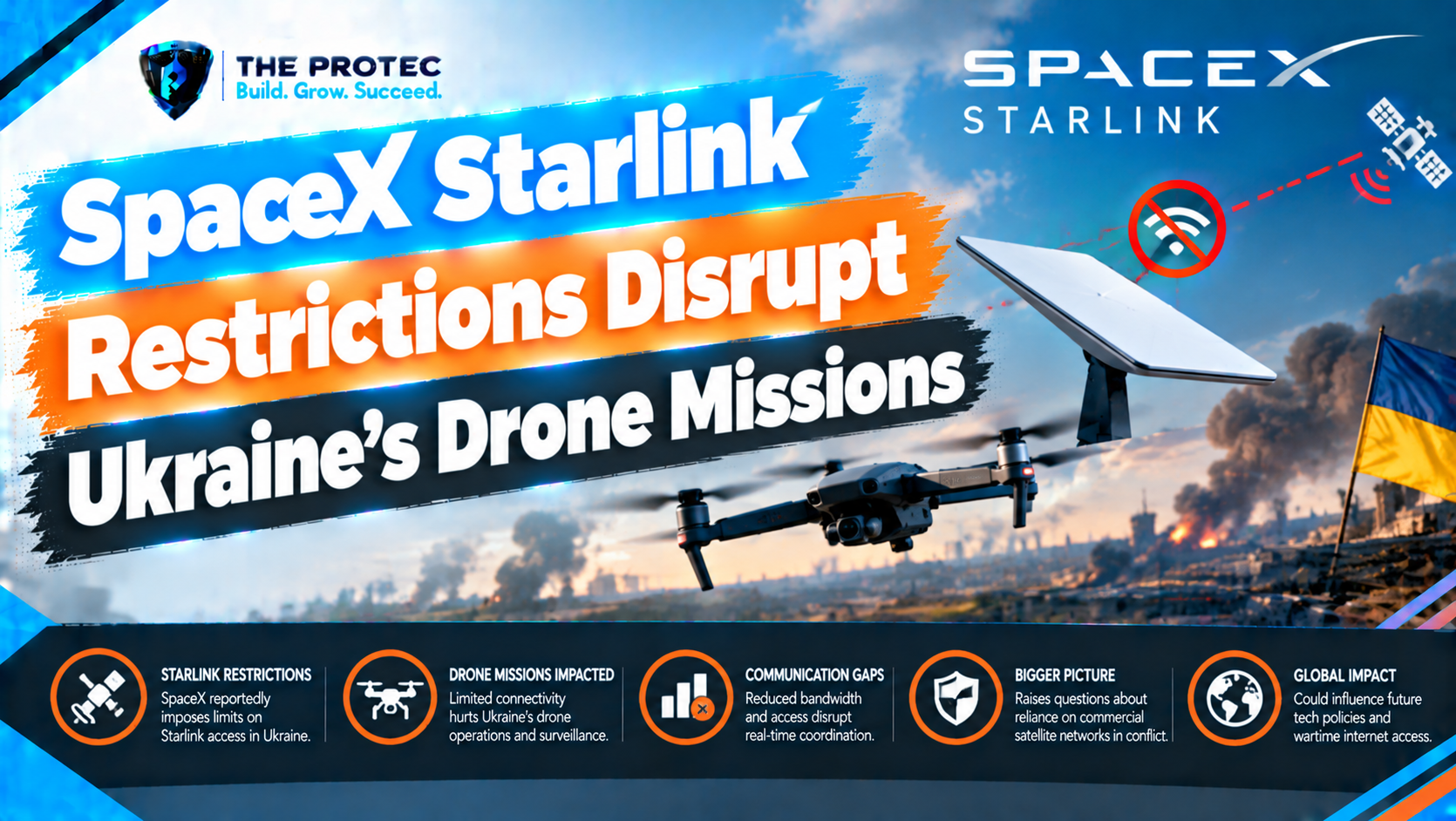
Reports that SpaceX has tightened access to Starlink in Ukraine have renewed a difficult debate about who controls the digital infrastructure behind modern warfare. According to accounts from Ukrainian operators and defense-technology observers, connectivity changes—including enforcement aimed at terminals moving at high speed—have interrupted some missions involving unmanned aircraft. The reported Starlink drone disruption does not mean Ukraine’s entire military communications network has gone offline. It does, however, expose a critical vulnerability: selected battlefield systems can depend on a commercial satellite service whose technical rules, coverage controls and acceptable-use policies remain under private management.
Starlink satellite internet has supported Ukrainian communications since the early weeks of Russia’s full-scale invasion. Its terminals have helped military units, hospitals, emergency services, government offices and civilians stay connected when terrestrial networks were damaged or jammed. Ukrainian forces also integrated the service into parts of their command, coordination and drone ecosystem. That success made SpaceX Starlink Ukraine connectivity strategically important—but it also created dependence on infrastructure that Ukraine does not own.
As of mid-October 2026, the public record still leaves important questions unanswered. Reports indicate that some Ukraine military drone missions were affected, but SpaceX has not publicly provided a comprehensive technical account tying every reported interruption to a single Ukraine-specific speed limit. Explanations involving unauthorized terminals, anti-abuse controls and attempts to stop Russian exploitation are plausible and consistent with previously acknowledged policies, yet not every operational claim has been independently verified.
How Ukraine Came to Rely on Starlink Battlefield Connectivity
Starlink uses a large constellation of satellites in low Earth orbit to deliver broadband service through compact ground terminals. Compared with conventional geostationary satellite systems, its lower orbital altitude can reduce latency, making the network more suitable for time-sensitive communications. Terminals can also be deployed faster than fiber or cellular infrastructure can be repaired near an active front.
For Ukrainian forces, those features turned Starlink battlefield connectivity into a practical communications layer. Units have used satellite links to exchange messages, transmit imagery, update digital maps, coordinate movements and connect command posts. When radio channels are jammed or cellular towers are destroyed, a satellite terminal can provide an alternative path to the internet and cloud-based operational tools.
Starlink is not the only component of Ukraine military communications. The country uses radio systems, terrestrial networks, other satellite services and specialized military links. Nor does every Ukrainian drone depend on Starlink. Many small first-person-view aircraft use direct radio links, while other unmanned systems employ cellular connections, mesh networking, proprietary datalinks or preprogrammed navigation. The significance of the restrictions lies in their effect on particular configurations and missions, not in the elimination of Ukraine’s entire communications capability.
Why Starlink Restrictions Can Disrupt Fast-Moving Drones
A satellite terminal must continuously calculate its position, establish links with overhead satellites and transfer the connection as those satellites move across the sky. Mobility is therefore not merely a billing detail. It is a network-management issue involving terminal authorization, geographic boundaries, service plans, radio performance and anti-abuse controls.
Reports from Ukrainian operators suggest that certain terminals used on fast-moving unmanned platforms lost connectivity or became unreliable after stricter mobility enforcement. If a network identifies a terminal as traveling outside an authorized operating profile, it can limit service, reject the connection or require a different service tier. Even a short interruption may be consequential during Ukraine drone operations.
A high-speed unmanned aircraft may use connectivity to relay sensor data, transmit video, receive updated routing information or maintain a link with an operator beyond the reach of conventional radio. Losing that connection does not always destroy the aircraft; some drones can continue autonomously, return home or switch to another link. However, the interruption can prevent real-time targeting, situational awareness or mission changes.
This is why Starlink speed restrictions can have an outsized operational effect. A policy designed to distinguish ordinary ground use from unauthorized high-speed mobility may interact very differently with a terminal attached to a boat, vehicle or unmanned aircraft. The faster the platform and the more time-sensitive the mission, the less tolerance there is for reconnecting, troubleshooting or switching networks.
What Has Been Confirmed—and What Remains an Allegation
Several facts are established. SpaceX supplied Starlink access to Ukraine, while the United States and other partners later funded portions of the service. Starlink has been widely used for civilian resilience and military communications. SpaceX executives have also acknowledged imposing limits intended to prevent the service from being used as an offensive weapon.
In 2023, SpaceX President Gwynne Shotwell said the company had taken steps to restrict Ukraine’s ability to use Starlink for certain drone operations, stating that the service was not intended to be weaponized. That position was documented by Reuters. The company’s distinction between general communications and offensive military use has remained central to arguments over SpaceX military technology.
More recent reports allege that connectivity controls affecting high-speed terminals have disrupted additional Ukrainian missions. Those accounts are operationally credible, but important details remain unconfirmed publicly. SpaceX has not released a complete list of affected terminal models, accounts, locations, flight profiles or enforcement thresholds. It is therefore premature to conclude that every failed drone link resulted from a deliberate, Ukraine-wide restriction.
Other possible causes include electronic warfare, damaged equipment, obstructed antennas, account problems, exhausted data allocations, interference, coverage changes or improper service configurations. Battlefield evidence is especially difficult to verify because military units avoid disclosing technical details that could help an adversary.
The reported restrictions also need to be understood in the context of unauthorized access. Ukrainian officials and independent investigators have repeatedly raised concerns that Russian forces obtained Starlink terminals through intermediaries despite the service not being officially available in Russia. A terminal acquired in one country can potentially be transported elsewhere, although activation, account status, geographic controls and network enforcement determine whether it works.
SpaceX and government partners have incentives to identify suspicious accounts and disable terminals believed to be operated by unauthorized users. Potential controls include geofencing, identity and payment verification, device blacklisting, location analysis and detection of abnormal mobility patterns. The challenge is that broad anti-abuse rules may also catch legitimate Ukrainian equipment operating under battlefield conditions.
A terminal moving rapidly near a contested area could represent a Ukrainian drone, a Russian platform, a maritime system or equipment configured under the wrong service plan. Automated controls do not inherently understand military intent. If network enforcement prioritizes blocking unauthorized movement, false positives can disrupt friendly operations. If it is too permissive, the adversary may exploit the same Starlink satellite internet infrastructure.
Claims that a specific restriction was introduced solely to hinder Ukraine should consequently be treated with caution unless supported by company documentation or government confirmation. Efforts to limit Russian access, comply with export rules, control unauthorized accounts and enforce product policies may overlap. The operational result can still be damaging to Ukraine, even when Ukraine was not the intended target.
Commercial Infrastructure Creates a Military Dependency
The SpaceX Ukraine conflict illustrates a fundamental tension in satellite internet military use. A private network can be deployed quickly and upgraded at a pace traditional defense procurement rarely matches. At the same time, military users do not have unrestricted control over its architecture.
SpaceX manages satellites, software, account permissions, service availability and many security controls. It can update terminal firmware or network policies remotely. Governments may fund service and negotiate contracts, but access can still depend on contractual language, licensing obligations and company decisions. For commanders, that creates several operational risks:
Policy risk: Acceptable-use rules may prohibit or restrict certain offensive applications.
Technical risk: Software updates or mobility controls can change how equipment behaves in the field.
Supply-chain risk: Terminals, subscriptions and replacement parts depend on external providers.
Governance risk: Disputes can arise over whether a company, customer government or battlefield commander authorizes a mission.
Concentration risk: Heavy reliance on one provider creates a potential single point of operational failure.
These concerns do not make commercial satellite networks unsuitable for defense. They show why militaries need clear contracts, technical visibility and alternatives. Mission-critical access should not depend on assumptions about consumer service plans or informal understandings with a technology company.
Elon Musk, SpaceX and Decisions With Strategic Consequences
The role of Elon Musk in Starlink Ukraine policy has drawn extraordinary attention because decisions made by SpaceX can produce effects normally associated with state power. Public controversy intensified after accounts that Starlink coverage was not enabled for a planned Ukrainian operation near Crimea. Musk said he declined a request to activate service because he feared SpaceX would become explicitly involved in a major act of war.
That episode and later disputes demonstrate the blurred line between providing general communications and supporting weapons. SpaceX maintains that Starlink was built for peaceful and civilian use, while Ukraine argues that reliable communications are indispensable to defending its territory. Governments funding access may have different expectations from the company operating the network.
The central issue is larger than one executive. Any commercial provider serving a war zone must interpret laws, sanctions, export controls and contractual obligations while managing escalation risks. The unusual scale of Starlink simply makes those decisions more visible—and more strategically consequential.
What the Incident Means for Ukraine Drone Warfare
Drones now perform reconnaissance, strike, resupply, communications relay and electronic-warfare missions across the Russian-Ukraine war. Their effectiveness depends not only on airframes and explosives but also on software, navigation, data links and access to reliable networks. Ukraine defense technology has advanced rapidly because operators can test systems in combat and modify them within weeks.
The reported Starlink high-speed restrictions show that communications architecture must be treated as part of the weapon system. A drone may be aerodynamically sound and successfully launched yet still fail if its network authentication changes during flight. Engineers must therefore design for degraded connectivity rather than assume permanent broadband access.
Likely responses include greater use of autonomous navigation, multi-network modems, frequency-hopping radios, directional antennas and alternative satellite providers. Some systems may carry several communications options and switch among them. Ukraine may also seek dedicated government or defense agreements that explicitly cover high-mobility platforms instead of adapting commercial subscriptions to military tasks.
Redundancy carries costs. Extra antennas, batteries and modems add weight to an aircraft, while integrating multiple providers complicates security and training. Nevertheless, resilient Ukraine drone warfare requires systems that can continue operating when one link is jammed, denied or administratively restricted.
Lessons for Governments and Satellite Providers
The latest Starlink Ukraine news offers lessons extending far beyond this conflict. Commercial satellite networks are becoming essential infrastructure for emergency response and national defense, but their responsibilities remain unsettled. Governments cannot assume that buying connectivity gives them unlimited authority to use it for every military purpose. Providers, meanwhile, cannot treat wartime service changes as ordinary product updates when lives and national security may be affected.
More durable arrangements should define approved use cases, mobility requirements, geographic limits, escalation procedures and notice periods for technical changes. Governments also need secure channels through which providers can identify suspicious devices without publicly exposing operational information. Where possible, restrictions should target verified unauthorized terminals rather than broad categories of movement.
Most importantly, defense planners should avoid designing critical missions around one commercial network. Starlink remains exceptionally valuable, but resilience comes from layered communications: military satellites, commercial constellations, radio, fiber, cellular systems and autonomous capabilities working together.
Frequently Asked Questions
Has SpaceX disabled all Starlink service for Ukraine’s military?
No. Reports concern restrictions or interruptions affecting certain uses, accounts or high-mobility operations. They do not establish that all Ukrainian military communications or every Starlink terminal in Ukraine has been disabled. Starlink continues to serve broader communications and resilience functions.
Why would speed restrictions affect military drones?
A network may apply different authorization rules to stationary, portable and high-speed terminals. If a drone moves beyond the profile allowed for its account or hardware, service may be limited. That can interrupt live video, remote control, sensor transmission or mission updates.
Did SpaceX impose the restrictions specifically to help Russia?
There is no verified public evidence establishing that conclusion. Reported explanations include preventing weaponization, enforcing service rules and blocking unauthorized use—including possible Russian exploitation. The lack of full technical disclosure makes the precise cause of individual interruptions difficult to confirm.
Can Ukraine replace Starlink for drone operations?
Ukraine can reduce dependence through military radios, cellular links, alternative satellite services, autonomous navigation and multi-network systems. No single substitute offers the same combination of coverage, capacity and rapid deployment, so a layered approach is more realistic than a complete replacement.
A Warning About the Future of Connected Warfare
The SpaceX Starlink Ukraine dispute is not simply a story about internet availability. It is a warning about how software policies, commercial contracts and automated network controls can shape battlefield outcomes. Starlink gave Ukraine a resilient communications option when conventional infrastructure was under attack, but its value encouraged military adaptations that exceeded the service’s original civilian purpose.
Reported disruptions to military drones Ukraine operates underline the need for clearer agreements and greater redundancy. They also show why confirmed facts must be separated from battlefield allegations: some missions appear to have been affected, but the evidence does not support claims of a total shutdown. As drones and satellite networks become more tightly connected, control over bandwidth, mobility and authorization will increasingly become an instrument of strategic power.