









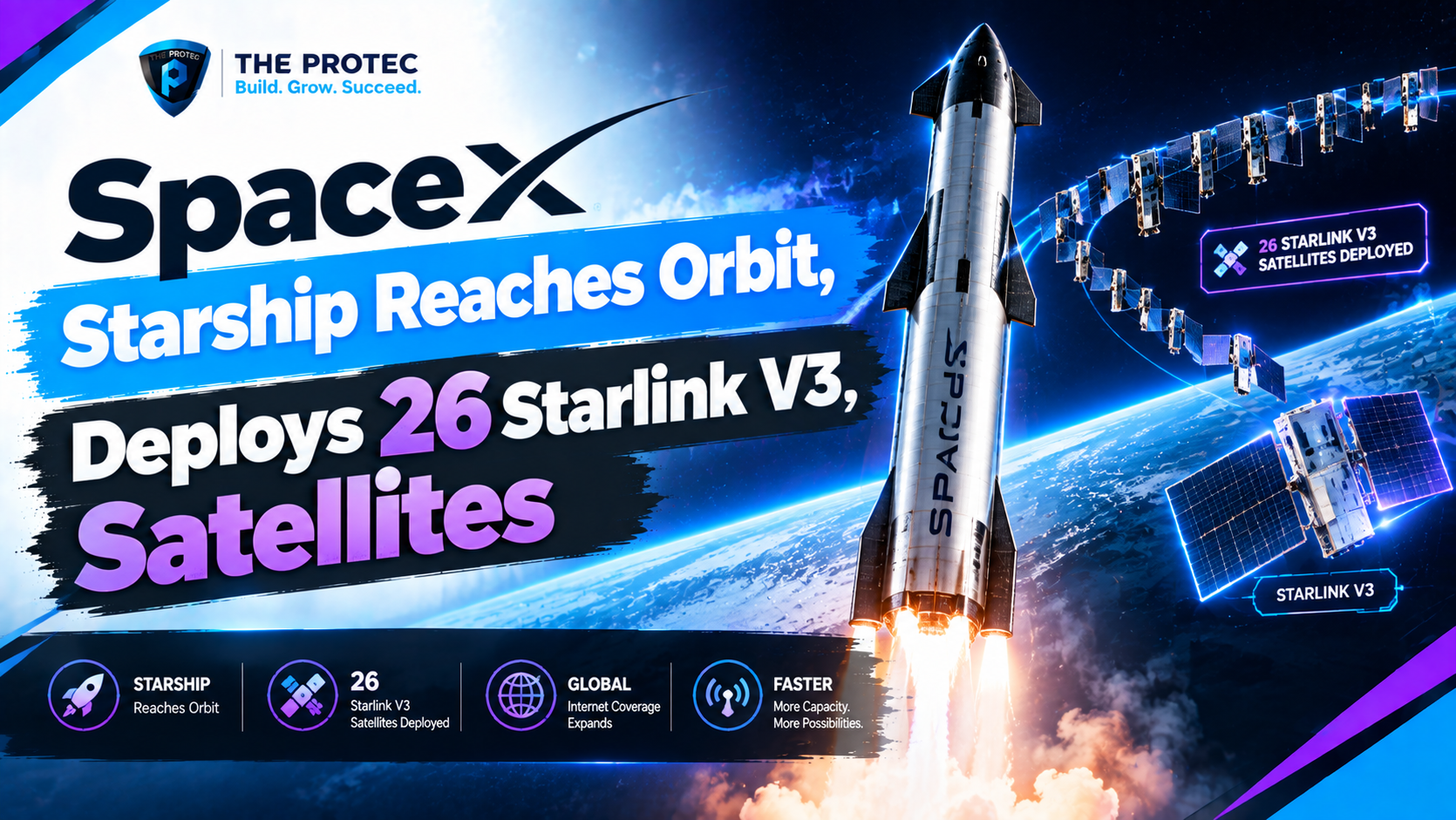
SpaceX has crossed one of the most important thresholds in the Starship program. During Flight 14, Starship reaches Earth orbit for the first time and successfully deployed all 26 Starlink V3 satellites aboard the vehicle. The achievement transformed Starship from an experimental system that had approached orbital conditions into a rocket that demonstrated an end-to-end orbital satellite mission.
The flight was not flawless. One of the upper stage’s engines shut down before orbital insertion, forcing Starship to continue the climb with reduced propulsion. The vehicle recovered, completed the burn with its remaining engines and entered the planned orbit. SpaceX then deployed the full satellite payload before bringing the upper stage down earlier than originally intended.
That combination of success and adversity makes SpaceX Starship Flight 14 especially significant. It validated orbital performance, payload deployment and fault tolerance during a single test while also exposing issues that SpaceX must address before Starship can fly routinely. For a program designed to launch next-generation Starlink spacecraft, transport lunar hardware and eventually support missions beyond Earth, reaching orbit is the milestone on which nearly everything else depends.
What Happened During Starship Flight 14?
Flight 14 began with the full Starship Super Heavy stack lifting off under the power of the booster’s Raptor engines. After the initial climb, the stages separated and continued on different trajectories. Super Heavy performed its return sequence and ended the flight with a controlled splashdown rather than a recovery at the launch site.
The upper stage continued toward orbit, but the ascent became more challenging when one engine shut down before orbital insertion was complete. Starship’s guidance and propulsion systems compensated for the loss, allowing the operating engines to finish the critical burn. The spacecraft subsequently achieved Earth orbit—the defining accomplishment of the mission.
Once orbital conditions were established, Starship opened its payload system and released 26 Starlink V3 satellites. All 26 were deployed, giving Flight 14 a genuine operational payload objective rather than limiting the mission to a simulated deployment.
- Starship completed its first successful orbital insertion.
- The upper stage overcame an engine shutdown during ascent.
- All 26 Starlink V3 satellites were deployed.
- Super Heavy concluded its return with a splashdown.
- The upper stage was brought down early instead of completing the original longer flight plan.
The outcome was therefore more nuanced than a perfect mission or a simple test failure. Flight 14 achieved its most consequential objectives while producing valuable data about engine reliability, vehicle autonomy and off-nominal mission management.
Why Starship’s First Orbit Is Such a Major Milestone
Previous Starship tests demonstrated increasingly demanding portions of flight, including stage separation, long-distance upper-stage trajectories, high-speed atmospheric reentry and controlled booster maneuvers. Some of those missions operated close to orbital velocity or followed deliberately suborbital trajectories that covered much of the globe. Reaching a stable Earth orbit, however, requires the vehicle to complete orbital insertion with the necessary altitude, velocity and trajectory.
The distinction is more than terminology. A suborbital spacecraft eventually returns to Earth because its path intersects the planet. An orbital spacecraft travels fast enough to continue falling around Earth. Achieving that condition requires precise propulsion, navigation and control throughout ascent.
Starship’s first orbital flight confirms that the integrated system can deliver an upper stage and meaningful payload to orbit. That is central to the rocket’s commercial purpose. A launcher cannot expand Starlink, deliver large spacecraft or support in-space logistics until it can repeatedly place payloads in useful orbits.
The Starship orbital launch also provides SpaceX with data that ground tests cannot fully reproduce. Engineers can now evaluate the vehicle’s behavior in sustained microgravity, the operation of payload hardware in orbit and the performance of systems after a complete insertion burn. SpaceX describes the architecture on its official Starship vehicle page.
How Starship Recovered From an Upper-Stage Engine Shutdown
The Starship engine failure was the flight’s clearest technical warning. Losing an engine before orbital insertion can leave a vehicle short of the velocity required to remain in orbit. It can also introduce asymmetric thrust, alter propellant margins and force the flight computer to revise steering commands in real time.
Flight 14 showed that Starship had enough performance and control authority to absorb the shutdown. The guidance system adjusted for the unavailable engine while the remaining propulsion completed the insertion burn. This capability is often described as engine-out tolerance: a multi-engine rocket continues its mission after losing one engine, provided the failure occurs under conditions the vehicle can manage.
Engine-out performance is not a substitute for reliability. SpaceX will need to determine why the engine stopped, whether the shutdown was commanded by protective software and what changes are necessary before the next launch. Nevertheless, the recovery matters. Large launch vehicles must be designed so that a single problem does not automatically become a total mission loss.
Starship’s response also demonstrated the value of autonomous decision-making. During ascent, events unfold too quickly for ground controllers to manually fly the rocket through a propulsion anomaly. The vehicle must identify changing conditions, maintain stability and pursue a safe mission outcome on its own. Flight 14 provided a real-world test of those systems under orbital stakes.
Starship Deploys 26 Starlink V3 Satellites
The deployment of 26 satellites turned Flight 14 into more than a Starship orbital test. It demonstrated the launch system’s ability to carry, sequence and release a large group of next-generation spacecraft after reaching orbit.
Deploying multiple satellites requires careful timing. The spacecraft must separate cleanly, avoid contact with the launch vehicle and create enough distance from one another for safe commissioning. Starship’s payload system also must preserve the satellites through launch vibration, acceleration and the thermal environment of ascent.
By deploying every spacecraft, Flight 14 validated several parts of the mission chain at once: payload integration, orbital delivery, deployment commands and the physical release mechanism. It also gave SpaceX an opportunity to begin operating V3 satellites launched on the vehicle for which they were designed.
The role of the 26 satellites extends beyond adding another batch to the constellation. They represent a shift toward a Starlink architecture that relies on fewer launches to add substantially more network capability. That relationship between the rocket and its payload is one of the main reasons the mission is a SpaceX Starship milestone.
Why Starlink V3 Satellites Matter for Network Capacity
Starlink V3 satellites are larger and more capable than the spacecraft SpaceX has historically launched on Falcon 9. Their scale is tied directly to Starship’s greater payload volume and mass capacity. Instead of designing every satellite around the limitations of an existing rocket, SpaceX can optimize the V3 generation for a much larger launch vehicle.
The expected benefit is greater communications capacity per satellite. Higher-capacity spacecraft can serve more data, support denser areas and help SpaceX respond to rising demand without increasing the constellation at the same rate as customer growth. Improvements in antennas, onboard processing and inter-satellite connectivity can also make the network more flexible.
This is particularly important as Starlink expands beyond residential broadband. The network increasingly serves aviation, maritime users, enterprises, remote infrastructure and mobile connectivity. Larger satellites can carry more capable communications payloads for these markets while strengthening coverage in regions where demand is concentrated.
Starlink V3 capacity is therefore one of Starship’s strongest near-term business cases. Falcon 9 remains a proven launch platform, but it cannot carry V3 satellites in the same quantity and configuration envisioned for Starship. Routine Starship flights could add network capacity at a faster pace and potentially lower the launch cost per unit of delivered bandwidth. More information about the network’s design is available through Starlink’s official technology overview.
Why the Super Heavy Splashdown Still Mattered
While the upper stage captured most of the attention, the Super Heavy booster completed an important part of the test. After separation, it followed its return profile and performed a controlled splashdown.
A splashdown allows SpaceX to test descent guidance, engine relights and terminal control without adding the constraints of a launch-tower catch. Data from the maneuver can be used to refine future booster recoveries, including the accuracy required to return Super Heavy safely to ground infrastructure.
The long-term economics of the SpaceX reusable rocket depend on recovering both major stages. Super Heavy is intended to return to the launch site, be inspected and fly again instead of being discarded after one use. Flight 14 did not complete that entire reuse cycle, but its controlled ocean descent advanced the booster side of the program while Starship handled the orbital mission.
Why SpaceX Shortened the Mission
Flight 14 was a test flight, and it did not follow the original extended plan through every phase. After the engine shutdown and successful satellite deployment, SpaceX brought the upper stage down earlier rather than continuing the longer orbital profile.
Ending the mission early reduced exposure after the primary objectives had been achieved. It also allowed the team to prioritize a controlled disposal of the vehicle instead of extending operations with altered propulsion margins or unresolved engine data. The decision illustrates how test missions balance ambition with risk management.
The shortened timeline should not be confused with a routine operational flight. Starship still needs to demonstrate consistent engine performance, predictable reentry behavior, upper-stage recovery and rapid reuse. Flight 14 proved that the vehicle could reach orbit and deploy satellites, but it did not close every technical challenge associated with the complete Starship architecture.
What Flight 14 Demonstrates About Starship’s Future
The immediate implication is that Starship now has a credible path toward routine satellite launches. Future flights can build on a mission that has already performed orbital insertion and payload deployment instead of treating those capabilities as theoretical goals.
For Starlink, this could lead to frequent launches carrying larger V3 satellites and far more network capacity per mission. Operational cadence will depend on vehicle reliability, regulatory approvals, launch infrastructure and the ability to process hardware rapidly between flights. Reusability will be crucial: Starship’s economic promise rests on flying its stages repeatedly rather than manufacturing a new vehicle for every payload.
The flight also matters for future lunar missions. NASA’s lunar landing architecture requires a Starship-derived vehicle to operate beyond low Earth orbit. Before that can happen, SpaceX must master repeated orbital launches, long-duration operations, cryogenic propellant management and in-space refueling. Flight 14 did not demonstrate those advanced capabilities, but reaching orbit is the prerequisite for testing them.
Successive missions will need to show that Starship can launch reliably, remain healthy in orbit and eventually transfer propellant between vehicles. Upper-stage recovery is another major hurdle. Bringing Starship through reentry and returning it for reuse will be far more demanding than disposing of a test vehicle after payload deployment.
What Comes After Starship’s First Orbital Flight?
SpaceX is likely to focus on the cause of the engine shutdown, the accuracy of orbital insertion and the performance of the satellite deployment system. Engineers will also analyze Super Heavy’s descent and the upper stage’s early return.
The next measure of progress will be repeatability. One successful Starship first orbit establishes capability; consecutive successful missions establish confidence. Launch customers, regulators and lunar-program partners will want evidence that the rocket can deliver payloads on schedule while maintaining acceptable risk.
Flight 14 supplied an unusually valuable dataset because it combined a major success with a recoverable anomaly. SpaceX can use that information to improve engine protection, fault detection, mission planning and operational procedures before Starship begins carrying payloads more frequently.
A Turning Point for Starship and Starlink
SpaceX Starship reaches orbit is no longer a future objective—it is a demonstrated result. Flight 14 placed the upper stage in Earth orbit, deployed all 26 Starlink V3 satellites and continued the mission despite an engine shutdown. Super Heavy completed its splashdown, while the upper stage was deliberately brought down early after the mission’s central goals were met.
The flight was not the finished version of Starship’s reusable transportation system. It was, however, the clearest demonstration yet that Starship can become an orbital launch platform. If SpaceX can turn this milestone into reliable, repeatable operations, the vehicle could reshape satellite deployment, accelerate Starlink’s expansion and provide the foundation for more ambitious lunar missions.
Frequently Asked Questions
Did Starship reach orbit for the first time on Flight 14?
Yes. Starship Flight 14 completed the program’s first successful insertion into Earth orbit. Earlier tests demonstrated near-orbital speeds and long suborbital trajectories, but Flight 14 achieved the orbital conditions required to deploy its satellite payload.
How many Starlink V3 satellites did Starship deploy?
Starship deployed all 26 Starlink V3 satellites carried on the mission. The successful release validated the upper stage’s ability to transport and deploy a batch of larger next-generation Starlink spacecraft.
Did an engine fail during the Starship orbital launch?
One upper-stage engine shut down before orbital insertion was complete. Starship compensated with its remaining propulsion and successfully reached orbit. SpaceX must still investigate the shutdown, but the recovery demonstrated valuable engine-out capability.
Why was the Starship mission ended early?
Flight 14 was a test mission, and SpaceX shortened the upper stage’s flight after achieving orbital insertion and satellite deployment. The vehicle was brought down early rather than completing the original longer plan, allowing SpaceX to conclude the mission after its primary objectives had been accomplished.
Why are Starlink V3 satellites important?
Starlink V3 satellites are larger spacecraft designed to provide more network capacity than earlier generations. Starship’s payload capability allows SpaceX to launch them in useful batches, potentially increasing the amount of broadband capacity added during each mission.