







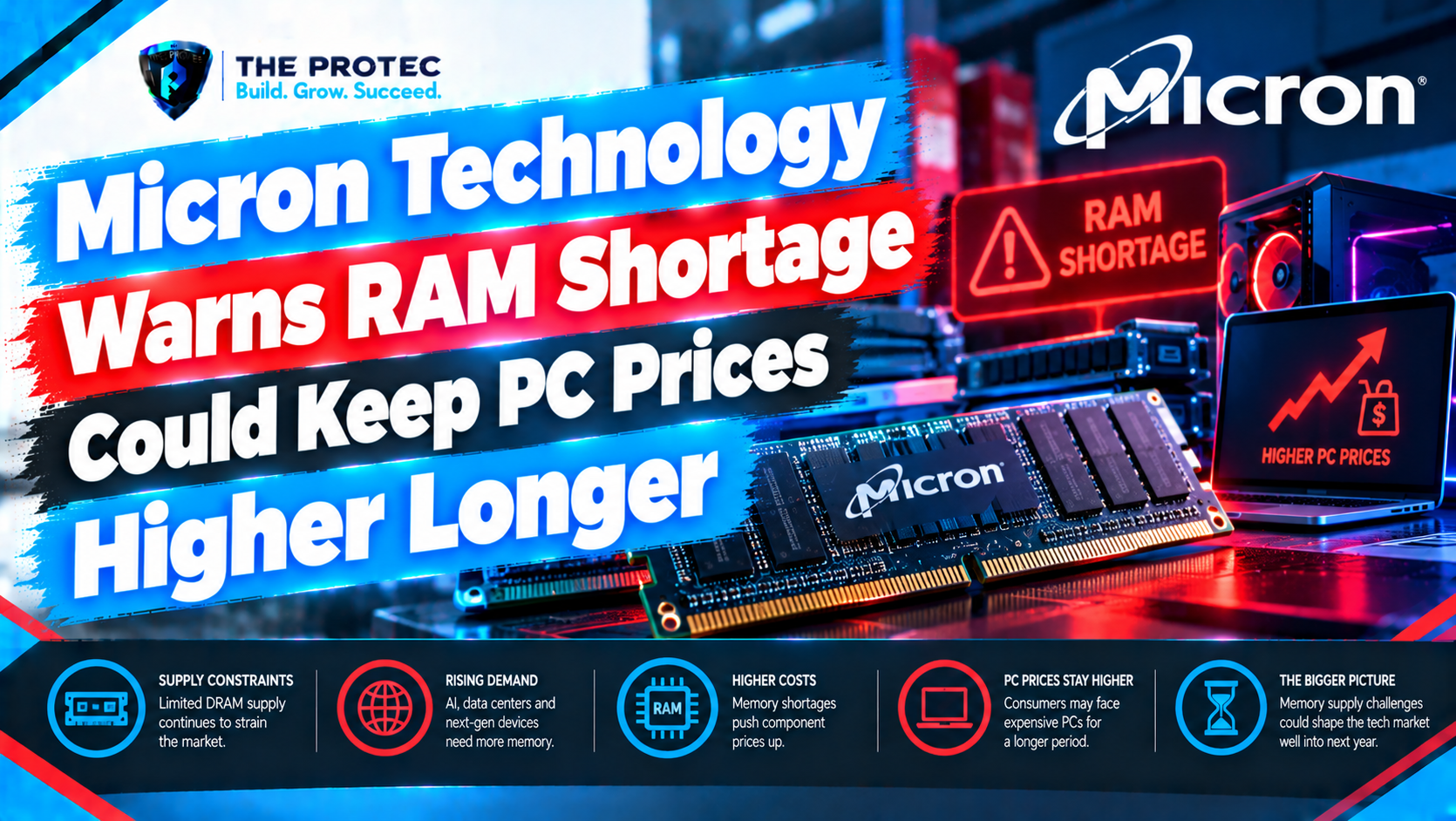
Micron Technology has delivered an unusually long warning for computer buyers: the memory market may remain undersupplied for years, not quarters. In its October 2026 outlook, CEO Sanjay Mehrotra said demand is expected to exceed available supply in both 2027 and 2028. He also said Micron Technology cannot yet identify when the market will return to balance.
That does not guarantee uninterrupted price increases, nor does it mean every RAM kit, laptop, or SSD will become more expensive at the same time. It does suggest that the Micron Technology RAM shortage is part of a broader structural squeeze driven by artificial intelligence infrastructure, limited manufacturing capacity, and the growing amount of memory required per server.
For consumers and businesses, the central question is no longer simply whether memory will cost more next quarter. It is how a prolonged DRAM shortage could influence PC configurations, upgrade timing, and hardware budgets through 2028.
What Micron Technology Actually Said About the Memory Shortage
Micron Technology’s October comments were forward-looking statements about anticipated supply and demand. They should be distinguished from the company’s confirmed fiscal 2026 results, which describe revenue and earnings already recorded. Strong historical results can demonstrate favorable market conditions, but they do not prove that a shortage will last for a particular period.
Micron Technology’s official fiscal 2026 earnings release and earnings-call materials provide the primary source for its reported financial performance, guidance, and management remarks. The company outlook indicates that Micron Technology 2027 memory supply may not expand quickly enough to satisfy demand, with the imbalance potentially becoming even tighter in 2027 and 2028.
The important distinction is that Micron Technology’s fiscal 2026 revenue and earnings are confirmed financial results, while statements about future demand, supply, and Micron memory chip prices are guidance. Likewise, third-party projections for RAM prices in 2026, DRAM prices in 2027, or a NAND flash shortage through 2028 remain forecasts rather than confirmed future prices.
AI Data Centers Are Absorbing More Memory Capacity
AI data center memory demand is the biggest force reshaping the market. Training and operating large AI models requires far more than graphics processors. Each system also needs high-bandwidth memory, server DRAM, storage, networking equipment, and data-center SSDs capable of moving large datasets quickly.
High bandwidth memory demand is especially important because HBM is installed alongside AI accelerators to provide extremely fast data access. A high-end AI server can use multiple HBM stacks plus substantial conventional DRAM. As cloud providers and technology companies deploy larger clusters, memory demand rises across several product categories at once.
HBM vs. DDR5 Memory Production
HBM and DDR5 are both forms of DRAM, but they are not equally demanding to manufacture. HBM uses larger dies, through-silicon vias, advanced packaging, and vertically stacked layers. Producing a given amount of HBM capacity therefore consumes substantially more wafer capacity than producing the same number of bits as conventional DRAM.
This creates an indirect effect on consumer products. When Micron and competing manufacturers allocate more wafers, equipment, and engineering resources to higher-value HBM, fewer resources may be available for PC and mobile memory. The result is not that DDR5 production stops, but that AI infrastructure memory demand competes with consumer markets for a limited manufacturing base.
AI accelerators are often described as the center of the AI chip supply shortage. In practice, memory and storage can also become bottlenecks, raising total AI data center hardware costs and encouraging suppliers to prioritize products covered by long-term enterprise agreements.
Why Semiconductor Capacity Cannot Expand Quickly
Memory manufacturers cannot respond to higher demand by simply turning on another production line. Semiconductor cleanrooms require specialized buildings, tightly controlled environments, advanced lithography and processing equipment, reliable utilities, and highly trained personnel. Construction and equipment installation can take years.
Even after a fabrication facility is physically complete, production must be qualified. Manufacturers need time to improve yields, reduce defects, certify products with customers, and ramp output without compromising reliability. HBM adds packaging and stacking constraints beyond wafer fabrication.
New factories and process improvements should gradually add supply, but the benefits arrive in stages. Some additional output may also be absorbed immediately by AI customers. These realities explain why Micron cannot provide a firm answer about when memory chip supply constraints will end, despite investing in additional manufacturing capacity.
What the Shortage Could Mean for Consumer Electronics
A computer memory price increase does not pass directly or uniformly from chip suppliers to store shelves. Device manufacturers negotiate contracts, maintain inventory, adjust product configurations, and sometimes absorb higher component costs. Retail promotions, exchange rates, tariffs, regional supply, and competition also affect final prices.
DDR5 RAM and Custom PC Builds
DDR5 RAM prices are likely to be more sensitive when channel inventories are low or when manufacturers prioritize server products. Popular capacities and performance tiers may move differently. A mainstream 32GB kit could remain competitive while premium, high-speed, or high-capacity kits become more expensive.
For anyone calculating PC building cost in 2026, memory is only one variable. Graphics cards, processors, motherboards, cooling, and power supplies still account for much of a system’s price. However, an increase in both RAM and SSD costs can remove the savings that builders usually expect from assembling a PC themselves.
Prebuilt PCs, Gaming Systems, and Laptops
Prebuilt vendors have several ways to manage higher component costs. They can increase prices, reduce discounts, use smaller memory configurations, select lower-speed modules, or keep advertised prices stable while changing other specifications. Gaming systems may continue offering attractive headline prices but ship with less RAM or storage.
Laptop prices and RAM shortages have an additional complication: many modern notebooks use soldered memory. Buyers cannot assume they can purchase a low-memory model and upgrade it later. If manufacturers make 16GB the standard configuration while charging more for 32GB, the shortage may appear as a larger configuration premium rather than a universal laptop price increase.
Will PC prices increase in 2027? Some models could, especially if component contracts reset at higher levels. Others may remain stable because manufacturers have inventory, accept lower margins, or simplify configurations. Broad claims that all computers will rise by a fixed percentage should be treated as forecasts, not facts.
SSDs and NAND Flash Memory Prices
SSDs use NAND flash rather than DRAM for primary storage, although some drives also include a DRAM cache. NAND has its own supply cycle, and manufacturers can reduce or expand output in response to market conditions. Data-center SSD demand adds pressure because AI systems need fast storage for training data, checkpoints, and retrieval workloads.
SSD prices in 2026 and any SSD price forecast for 2027 therefore depend on NAND production discipline, enterprise demand, inventories, and drive capacity. A DRAM shortage does not automatically produce an identical NAND shortage, but the same AI investment cycle can tighten both markets.
Micron Technology’s Crucial Exit Does Not Mean It Stopped Making Memory
Micron Technology’s decision to exit its Crucial consumer memory business can easily be misunderstood. Crucial was a retail-facing brand for RAM and storage products. Leaving that business does not mean Micron has stopped producing DRAM or NAND.
Micron Technology Inc. continues supplying memory and storage to enterprise customers, data centers, device manufacturers, and original equipment manufacturers. The change reflects where Micron wants to sell its output, not the disappearance of its underlying manufacturing operations. It may, however, reduce one familiar retail option and increase the importance of competing consumer brands.
Should PC Builders Buy RAM or SSDs Now?
There is no universal reason to panic-buy. Buyers should base decisions on actual needs, current prices, and the risk of delaying a project rather than assuming every product will become steadily more expensive.
- Buy now when the upgrade is already necessary. If insufficient RAM or storage is limiting work, gaming, or reliability, waiting for an uncertain market recovery may cost more in lost productivity than a modest component saving.
- Prioritize capacity over premium specifications. A reliable 32GB DDR5 kit at a standard speed may offer more practical value than paying heavily for small performance gains.
- Track complete system prices. A discounted prebuilt can be cheaper than buying each component separately, even if its individual RAM or SSD is not at a historic low.
- Avoid buying years ahead without a plan. Warranty periods, compatibility, and changing standards can reduce the value of stockpiling components.
- Compare regional retailers. Inventory levels and promotions can create meaningful differences even when wholesale memory prices are increasing.
Independent market research, including TrendForce memory market forecasts, can help identify contract-price direction. However, forecasts should not be confused with guaranteed retail outcomes. Reuters and other financial reporting on Micron’s outlook also emphasize that AI-related demand and capacity allocation are central to the current imbalance.
How Businesses Can Control Hardware Costs
Businesses should not automatically freeze purchasing until 2028. Extending refresh cycles can make sense for systems that remain secure, supported, and fast enough, but keeping unreliable hardware in service can increase downtime and cybersecurity risk.
A stronger strategy is to segment the fleet. Organizations can replace mission-critical or unsupported devices first, redeploy capable systems to lighter roles, standardize configurations, and negotiate multi-quarter purchasing agreements. They should also assess whether additional RAM or storage can extend a computer’s useful life before replacing the entire machine.
Budget planners may want a contingency for higher PC upgrade costs while avoiding a single aggressive inflation assumption. Business hardware prices will depend on supplier contracts, system design, local currency, tariffs, and the timing of inventory purchases—not only the spot price of memory chips.
When Will RAM Prices Drop?
The honest answer is that no one currently knows. Micron’s warning that demand could exceed supply through 2028 does not make 2028 a guaranteed recovery date. It means the company cannot yet see a clear point at which available supply catches up.
Meaningful relief will depend on new fabrication and packaging capacity, manufacturing yields, the pace of AI infrastructure investment, customer inventories, and broader economic demand. A slowdown in AI spending could ease pressure, while faster adoption of memory-intensive systems could extend it.
Prices can also fall temporarily during an overall constrained period. Retailers may discount older kits, manufacturers may clear inventory, and particular NAND or DRAM categories may become oversupplied even while others remain tight. The memory market outlook through 2028 is therefore better understood as elevated risk and volatility, not a straight upward price line.
Frequently Asked Questions
Is the Micron RAM shortage expected to last until 2028?
Micron Technology expects memory demand to exceed available supply in 2027 and 2028, but it has not declared 2028 the definitive end of the shortage. The Micron Technology memory shortage 2028 outlook is a forward-looking assessment that can change as demand, investment, and manufacturing yields evolve.
Will DDR5 RAM prices keep increasing?
DDR5 RAM prices could face upward pressure if consumer supply remains constrained, but increases are unlikely to be uniform. Capacity, speed, brand, retailer inventory, and regional conditions can produce different outcomes. Any Micron RAM price forecast or third-party price projection should be treated as a forecast rather than a guaranteed retail price.
Does HBM production reduce the supply of desktop RAM?
It can indirectly constrain conventional DRAM supply. HBM consumes more wafer capacity per bit and requires complex packaging. As manufacturers prioritize HBM for AI accelerators, they have less flexibility to rapidly expand DDR5 and other DRAM products using the same production resources.
Should businesses extend PC refresh cycles?
Selective extensions can reduce near-term spending when devices remain secure, supported, and productive. Businesses should not retain failing or unsupported equipment solely to avoid a possible price increase. Phased replacements, targeted upgrades, and negotiated purchasing agreements are generally safer than postponing every refresh.
Could SSD prices rise even though SSDs use NAND?
Yes. DRAM and NAND are different memory markets, but both are affected by AI data center growth, factory investment, inventory management, and enterprise demand. NAND flash memory prices could rise independently if data-center SSD demand outpaces supply.
A Shortage Warning, Not a Guaranteed Price Path
Micron’s outlook is significant because it places the potential supply imbalance well beyond the normal short-term memory cycle. AI demand for HBM, server DRAM, and enterprise SSDs is colliding with semiconductor capacity that takes years to build and qualify.
Consumers and businesses should prepare for volatility, fewer exceptional bargains, and possible premiums on higher-capacity configurations. They should not assume every PC, laptop, RAM kit, or SSD will rise together. As of October 2026, the most realistic answer to when DRAM prices will fall is that relief depends on supply expansion, AI demand, production yields, and market conditions—and 2028 is not a promised finish line.