








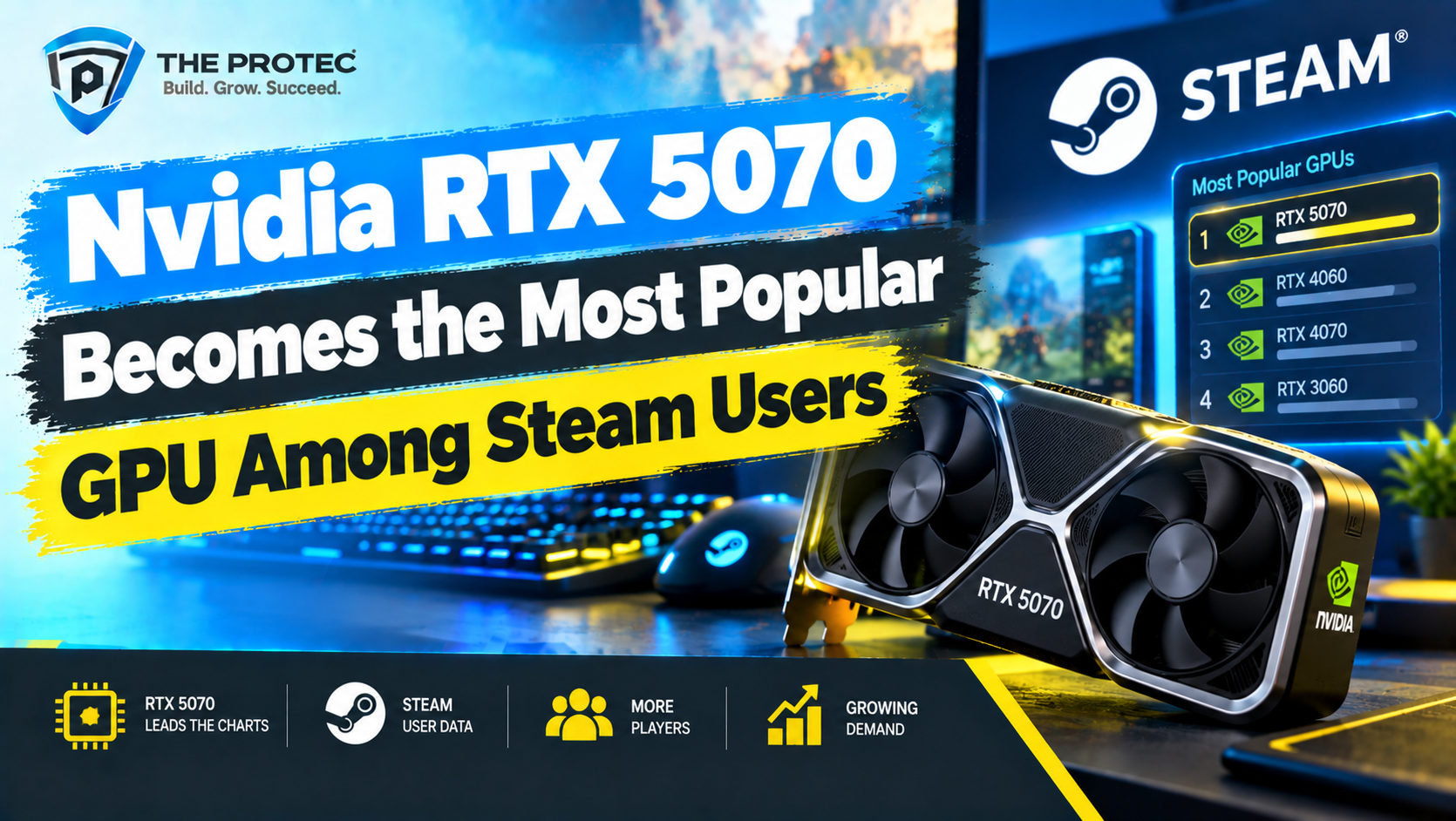
The Nvidia RTX 5070 has reached a significant milestone: it is now the most widely reported graphics card in Valve’s latest Steam Hardware & Software Survey. The September 2026 results put the Blackwell-based card ahead of established favorites such as the GeForce RTX 4060 Laptop GPU, desktop RTX 4060 and RTX 3060.
That result reflects more than the rise of one graphics card. It offers a snapshot of how quickly active PC gamers are moving toward newer Nvidia hardware, as well as the growing relevance of ray tracing, AI-assisted rendering and DLSS in mainstream gaming systems. It also shows how a well-positioned upper-midrange product can overtake older, heavily installed GPUs without being the cheapest or fastest option available.
However, the RTX 5070 Steam ranking requires context. Steam’s figures describe participating Steam users, not every PC owner, graphics-card shipment or retail sale. Becoming the RTX 5070 most popular GPU on Steam therefore does not make it objectively the best graphics card, nor does it establish its share of the worldwide GPU market.
What the September Steam Hardware Survey Shows
Valve’s September 2026 survey lists the GeForce RTX 5070 with approximately 5% of reported graphics configurations. The precise percentage may change slightly when Valve updates or revises its public table, but the important development is its first-place position among individually identified GPU models.
At the time the results were published, the leading entries were tightly grouped:
- The desktop Nvidia RTX 5070 held approximately 5% of the reported share.
- The GeForce RTX 4060 Laptop GPU remained close behind at roughly 4.6%.
- The desktop RTX 4060 accounted for about 4.4%.
- The long-serving RTX 3060 stood near 4.2%.
- Older cards, including the GTX 1650 and RTX 2060, continued to retain meaningful shares despite their age.
The ranking is notable because the RTX 5070 is a newer and more expensive class of product than several of the GPUs surrounding it. Steam gaming hardware statistics have historically favored affordable cards, laptop GPUs and older models that accumulated large installed bases over many years.
Readers can view the current results on Valve’s official Steam Hardware & Software Survey page. Because the page normally displays the latest monthly survey, its figures may no longer match the September snapshot after a subsequent report is released.
How Steam Collects Its GPU Statistics
The Steam Hardware Survey is an opt-in measurement offered to a sample of Steam accounts. Participating users allow the client to detect information such as operating system, processor, memory, display resolution and graphics hardware. Valve then publishes aggregated percentages rather than personal system details.
This methodology makes the survey useful for tracking Steam hardware trends, but it is not a complete census. Participation can vary from month to month, and changes to sampling, device identification or regional representation may produce noticeable swings. A user with several computers can also be represented differently from a household with one shared gaming PC.
GPU labels require additional care. Steam generally reports desktop and laptop variants separately when it can identify them, while broad entries such as “AMD Radeon Graphics” may combine multiple integrated products. Comparing one precisely named discrete card with a generic hardware category is not always an apples-to-apples exercise.
How the RTX 5070 Moved Ahead of Previous Leaders
The latest RTX 5070 Steam Hardware Survey result follows a sustained climb rather than a single isolated spike. Across recent survey periods, the card advanced through the upper portion of the table while the shares of the RTX 4060 family and RTX 3060 remained relatively stable or gradually declined.
That pattern matters. Older GPUs do not have to disappear for a new model to take first place. The leading Steam GPU categories are close enough that several tenths of a percentage point can alter the order. New RTX 5070 systems entering the survey, combined with upgrades from cards such as the RTX 2060, RTX 3060 and GTX 1660 series, were sufficient to push the newer model into the lead.
The RTX 4060 Laptop GPU remains especially important because notebooks represent a large part of the Steam population. The desktop RTX 4060 also benefits from lower-cost gaming PCs and prebuilts. Meanwhile, the RTX 3060 demonstrates the durability of a value-oriented card with a substantial installed base. The RTX 5070 passing those products is therefore a meaningful adoption milestone, even though its lead is narrow rather than overwhelming.
How Nvidia and AMD Compare on Steam
Nvidia continues to dominate the individually listed GPUs near the top of Steam’s table. Its advantage comes from broad coverage across gaming laptops, prebuilt desktops and retail upgrades, as well as the cumulative presence of several generations of GeForce hardware.
AMD remains visible through generic Radeon categories, integrated graphics and individual cards such as the Radeon RX 6600 and other RX 6000- and RX 7000-series models. However, no single identified AMD discrete GPU approaches the reported share of the leading GeForce models in the September survey.
This does not mean AMD lacks competitive PC gaming graphics cards. Instead, AMD’s Steam presence is distributed among multiple generations and naming categories, while Nvidia has several specific SKUs concentrated near the top. Intel also appears through integrated graphics and Arc products, but its discrete GPUs hold much smaller individual shares.
The result reinforces Nvidia’s strong position among Steam users, yet it should not be interpreted as a universal Nvidia GPU market-share figure. Broader estimates can include professional workstations, business computers, systems without Steam, integrated graphics and products sold into channels that the survey never measures.
Why RTX 5070 Adoption Has Accelerated
A Strategic Position in the RTX 50-Series Lineup
The Nvidia RTX 5070 occupies a commercially important place in the RTX 50 series. It offers more performance than entry-level and lower-tier options while avoiding the substantially higher cost, power requirements and physical size associated with flagship cards. That balance makes it attractive to enthusiasts who want a meaningful upgrade without building around an RTX 5080 or RTX 5090.
Nvidia launched the card with a $549 suggested starting price in the United States, although real retail pricing has varied by model, region, inventory and demand. The official Nvidia RTX 5070 product page details its Blackwell architecture, GDDR7 memory and supported rendering technologies.
Strong 1440p Gaming Performance
RTX 5070 gaming performance is particularly well suited to high-refresh 1440p displays, a popular upgrade target for players moving beyond 1080p. It can also handle many games at 4K when settings are optimized or upscaling is enabled, although demanding ray-traced titles may require compromises.
The card is not automatically the best value in every region. Competing products can offer more memory, stronger performance in selected rasterized games or lower prices. Its 12GB memory capacity may also concern buyers planning for extremely demanding texture settings over a long ownership period. Steam popularity measures adoption, not the outcome of every benchmark or purchasing decision.
DLSS, Frame Generation and Ray Tracing
The RTX 5070 supports Nvidia’s newer DLSS capabilities, including transformer-based image reconstruction and Multi Frame Generation in compatible games. These features can produce large displayed-frame-rate gains, especially when conventional rendering is limited by heavy ray-tracing workloads.
They do not replace native performance, and generated frames can introduce trade-offs involving latency or image artifacts. Even so, a growing catalog of supported games strengthens the practical appeal of RTX 50-series hardware. Buyers may increasingly evaluate a GPU as a platform for rendering features rather than solely by traditional rasterization results.
Availability and Prebuilt Systems
Adoption can accelerate once supply becomes consistent and more system integrators add a card to standard configurations. The RTX 5070 is suitable for premium mainstream gaming desktops, making it a natural choice for prebuilts sold to users who do not install their own components.
Pricing and availability still differ significantly among markets. Steam’s data does not reveal whether participants purchased cards at launch, bought discounted systems or upgraded during promotions. It only indicates that more surveyed systems are reporting the hardware.
The distinction between RTX 5070 GPU market share on Steam and the global graphics market is essential. A 5% Steam survey share means approximately 5% of the measured participant configurations reported that GPU during the relevant survey period. It does not mean the RTX 5070 represents 5% of all graphics cards sold or installed worldwide.
Worldwide market estimates may measure quarterly shipments from manufacturers, retail sales, add-in boards or every graphics processor in use. Those categories can include office PCs, data-center products, consoles and integrated GPUs owned by people who never use Steam.
The Steam population also has a gaming-oriented bias. High-performance Nvidia cards are likely to be better represented among active Steam users than among the total population of personal computers. For that reason, the survey is most valuable as a view of active PC gaming hardware adoption, not as a substitute for industry shipment reports.
What the Shift Means for PC Game Developers
Developers can use Steam GPU statistics to understand the hardware commonly found in their potential audience. The RTX 5070 reaching first place suggests that a growing portion of active players has access to modern ray-tracing acceleration, AI upscaling and frame-generation technology.
That could encourage studios to invest more heavily in scalable ray-traced lighting, reflections and global illumination. It may also make DLSS an increasingly important part of performance planning, particularly for graphically demanding releases.
However, developers should not treat the new leader as a minimum specification. A card with about 5% share still represents only a small fraction of surveyed systems by itself. The Steam audience remains fragmented across older GeForce cards, AMD hardware, integrated graphics and gaming laptops with varied power limits.
A sensible development strategy therefore includes:
- Scalable graphics presets covering older and current GPU generations.
- Support for multiple upscaling technologies rather than one proprietary option.
- Ray tracing that can be reduced or disabled on less capable hardware.
- Clear separation between minimum, recommended and high-end specifications.
- Testing on popular older GPUs as well as current RTX 50-series products.
The larger message is not that every Steam gamer owns an RTX 5070. It is that modern rendering features are moving deeper into the commonly reported hardware base, giving developers more room to use them while retaining fallback paths.
Frequently Asked Questions
Is the Nvidia RTX 5070 really Steam’s most popular GPU?
Yes. In Valve’s September 2026 Steam Hardware & Software Survey, the desktop RTX 5070 was the most widely reported individually identified GPU. Monthly rankings can change as new survey data is published.
Does first place mean the RTX 5070 is the best graphics card?
No. The ranking measures reported adoption among participating Steam users. It does not evaluate value, benchmark performance, memory capacity, efficiency or suitability for a particular game and budget.
No. Steam measures a sample of participating users running its client. Global market-share reports may use sales, shipments or the installed base across gaming and non-gaming computers.
Why has RTX 5070 popularity grown so quickly?
Likely contributors include its position below Nvidia’s flagship cards, strong 1440p performance, support for DLSS and ray tracing, broader retail availability and inclusion in prebuilt gaming systems. Steam does not disclose which factor motivated each user.
Will the RTX 5070 remain Steam’s leading GPU?
Not necessarily. The gap among leading cards is relatively small, and monthly sampling can change the order. Future discounts, laptop sales and new GPU releases could produce another leader.
A Milestone for Modern PC Gaming Hardware
The Nvidia RTX 5070 becoming Steam’s most reported GPU marks a clear shift toward newer PC gaming graphics cards. Its lead remains modest, and the survey cannot be translated directly into global sales or installed-base figures. Even so, the result shows that Blackwell hardware and features such as DLSS and advanced ray tracing are becoming increasingly relevant to active Steam gamers—and to the developers building games for them.