







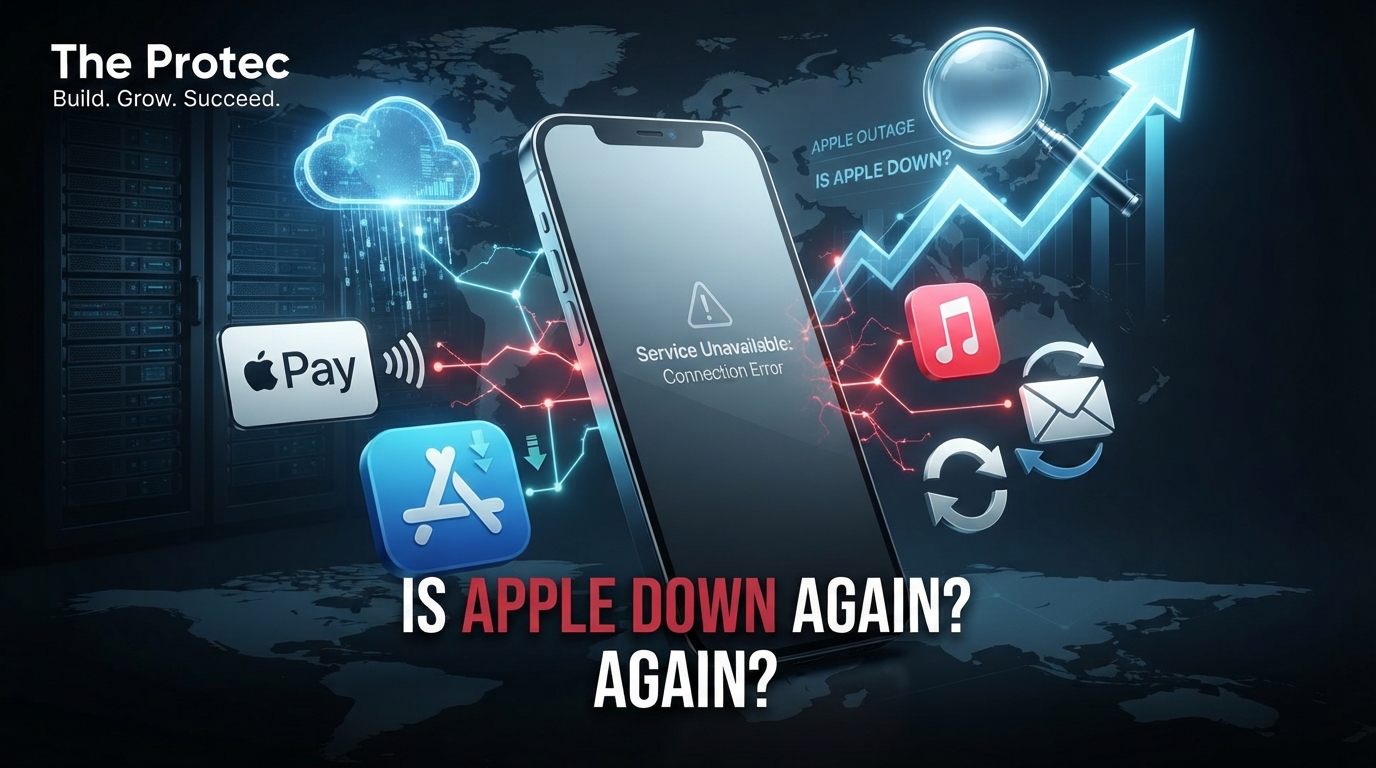
Searches for “apple outage” surged on November 17 as people encountered unexpected errors across iCloud, the App Store and other Apple services. Apple officially acknowledged several disruptions, while users separately reported trouble with Apple Pay, Apple Support, device activation, Apple News and developer tools. The Associated Press later reported that Apple blamed an internal update and said many affected systems had been restored.
The incident explains why questions such as “Is Apple down right now?”, “Is iCloud down?” and “Is the App Store down?” began appearing at the same time. However, not every complaint tracked by third-party outage monitors represented a service that Apple officially confirmed as unavailable. Here is what is known, what remains less certain and what affected users can do.
Apple outage: What happened on November 17?
Apple’s problems appeared across multiple internet-based services rather than as a failure of every iPhone, Mac or Apple server. Users reported failed sign-in attempts, inaccessible cloud data, stalled downloads and account verification errors. Those symptoms can overlap because many Apple products rely on a shared Apple Account and related authentication systems.
Apple’s system reporting confirmed disruptions involving core services, including iCloud account access and sign-in, the App Store, Apple Music and AppleCare. According to the Associated Press, Apple subsequently attributed the outages to an internal update. The company also said many systems had been restored, indicating an operational problem within Apple’s infrastructure rather than a confirmed external attack.
That distinction matters. An internal update can cause dependencies between authentication, account management, storefront and support systems to fail even when individual devices and local internet connections remain functional. Apple had not, at the time of this developing report, published a detailed technical postmortem explaining exactly how the update triggered the disruption.
Which Apple services were affected?
The disruption had two layers: services acknowledged through official Apple reporting and additional problems described by users on platforms such as Downdetector. Those categories should not be treated as identical.
Services Apple acknowledged as disrupted
- iCloud account access and sign-in: Some users could not complete an iCloud login, verify an Apple Account or access cloud-connected features.
- App Store: Customers reported difficulty opening the store, downloading apps, installing updates or completing store transactions.
- Apple Music: The interruption affected access for at least some listeners, although locally downloaded music could remain playable.
- AppleCare: Service disruption could interfere with support-related tools or access to coverage information.
Additional problems reported by users
Downdetector and social media complaints also pointed to possible Apple issues involving Apple Pay, Apple Support, Apple News, device activation and developer services. These reports are useful for identifying patterns, but they do not independently prove that each underlying Apple service experienced a platform-wide outage.
For example, a failed device activation could result from an Apple Account verification problem, while an Apple Pay complaint might originate with a bank, card network, merchant website or payment terminal. A cluster of reports shows that users are having trouble; Apple’s status information is the better source for determining whether the company has acknowledged a specific service incident.
Is Apple down right now?
Apple was down for some users and services on November 17, but that does not mean every Apple product was offline everywhere. Large cloud platforms commonly experience partial outages that differ by service, account, region or device.
The most reliable place to check current conditions is Apple’s official System Status page. Look for the individual service you are trying to use rather than relying only on a general search for “Apple down.” The Apple status page may show whether an issue is ongoing, resolved or limited to certain users.
Third-party “Apple down detector” reports can provide an earlier indication of widespread complaints, but they rely heavily on user submissions. A spike may include several related symptoms, duplicate reports or problems caused by local networks and outside providers.
Is iCloud down, or is it an account problem?
An iCloud outage can produce errors across Photos, Drive, backups, Mail and account settings. In this incident, Apple’s acknowledged account access and sign-in disruption made iCloud login failures especially relevant.
If Apple iCloud is still not working for you after the status page shows restoration, determine whether the failure affects every device. A single-device problem may involve an expired session, outdated software, incorrect date and time settings, a VPN or a network filter. If multiple devices and networks reject the same Apple sign-in, the problem is more likely to involve the account or Apple’s systems.
Avoid repeatedly changing your password during a confirmed outage. Doing so can add verification delays or leave other devices using old credentials. Also reject unsolicited calls, messages or websites offering to “restore” iCloud access; outages often create opportunities for phishing.
Is Apple Pay down or simply not working for one payment?
Reports of Apple Pay not working do not automatically establish a confirmed Apple Pay outage. Payments involve several parties: Apple, the card issuer, the card network, the merchant, the payment processor and, for online purchases, the merchant’s app or website.
It is also important to distinguish online Apple Pay from contactless payments at physical stores. An online payment can fail because account authentication or a merchant checkout service is unavailable. In-store contactless payment uses credentials stored securely on the device and may continue working even when another Apple service has problems. Conversely, one store’s terminal or network may fail while Apple Pay works elsewhere.
Before removing a card, try another terminal or merchant, check whether the physical card works and ask the bank whether it declined the transaction. Removing and re-adding a card during an outage can create unnecessary verification work. If Apple’s status page does not list Apple Pay, describe the report as a payment problem rather than assuming a confirmed Apple Pay outage.
What to do if Apple services are down
- Check the official status: Review Apple System Status and find the exact service—such as iCloud Account & Sign In, App Store or Apple Music. Refresh later because official notices can appear after complaints begin.
- Confirm your internet connection: Open a non-Apple website and, if possible, switch between Wi-Fi and cellular data. Restarting a router may help a local connection, but it will not fix Apple servers down at the provider level.
- Test another device or browser: This helps separate an account-wide failure from a problem with one app, device or cached browser session.
- Pause repeated login attempts: If Apple sign-in or verification keeps failing during a confirmed incident, wait before trying again. Repeated attempts can trigger security checks without resolving the underlying outage.
- Do not sign out unnecessarily: Signing out of an Apple Account can remove convenient access to already synchronized data and require fresh authentication when systems remain unstable.
- Delay nonessential downloads and activation: If the App Store is down or device activation fails, keep the device connected and try again after Apple marks the service restored.
- Use another payment method: For an urgent purchase, use a physical card or another accepted option. Never retry a payment rapidly without checking whether the first attempt produced a pending charge.
- Contact Apple Support after restoration: If the official incident is closed but your Apple login, account verification or purchases still fail, gather screenshots, error messages and approximate times before contacting support.
Gmail and Google reports appeared at the same time
Users also searched for “Gmail down,” “Gmail outage,” “Google down” and “Google outage” as reports involving Google’s services circulated. There is no confirmed connection between those complaints and the internal update that Apple reportedly identified as the cause of its own disruption.
Simultaneous outages today can look related because millions of people use Apple, Google and Microsoft products together. A Gmail problem may surface in Apple’s Mail app, for example, but that does not make it an iCloud issue. Shared timing alone is not evidence of a common technical cause, cyberattack or coordinated event.
How this fits a wider run of major service outages
The Apple issues followed heightened public attention around recent Microsoft 365 disruptions and outages affecting banking services. These incidents underline how authentication, cloud platforms and payment systems have become essential infrastructure. A failure in one dependency can affect many customer-facing features at once.
Still, the events should not be grouped together without evidence. Nothing in Apple’s reported explanation established a connection to Microsoft, banking providers or Google. Apple’s attribution to an internal update points to its own operational change, not a shared cause.
Has the Apple outage been fully resolved?
Apple said many systems had been restored, according to the Associated Press, but restoration can be gradual. Some users may continue seeing cached errors, delayed synchronization or queued downloads after a status indicator returns to normal.
Check the timestamp and details for each service on the Apple status page. If Apple publishes a fuller explanation or confirms complete restoration, that official update should take precedence over earlier user reports. Until then, the most accurate conclusion is that Apple confirmed multiple disruptions, attributed them to an internal update and restored many affected systems, while some additional complaints remained user-reported rather than officially verified.
Frequently asked questions
Is Apple down today?
Apple confirmed disruptions affecting multiple services on November 17, including account access, the App Store, Apple Music and AppleCare. Availability may vary by service and user, so check Apple System Status for the latest information.
Is the App Store down?
The App Store was among the services affected. If downloads or updates still fail after restoration, restart the App Store, test another network and confirm that your Apple Account can sign in before changing account settings.
Is iCloud down?
Apple acknowledged account access and sign-in problems that could prevent an iCloud login or access to connected features. Check the specific iCloud entries on Apple’s status page because Photos, Drive, Mail and backup services can have different conditions.
Is Apple Pay down?
Users reported payment trouble, but reports alone do not confirm a platform-wide Apple Pay outage. Check Apple’s official status, your bank and the merchant. Online Apple Pay and in-store contactless payments may behave differently.
Are Apple servers down if only one device has problems?
Not necessarily. A single-device error can come from software, network, VPN, cached credentials or time settings. If the same account fails across multiple devices and networks while Apple’s status page shows an incident, a server-side problem is more likely.