







When a village is days from the nearest cellular tower—or a disaster knocks local networks offline—even a short email can become difficult to deliver. Rhizomatica is addressing that gap with open-source HF radio communications designed to carry messages, email, files and essential information without conventional internet or mobile infrastructure. Its HERMES system and Mercury software modem turn long-range high-frequency radio links into practical digital channels for communities that cannot depend on always-on connectivity.
This is not broadband transmitted over a shortwave radio. It is a resilient, comparatively low-bandwidth system built around delayed delivery, efficient data transfer and equipment that communities can operate locally. As of November 2026, project materials describe deployments in Ecuador, Bangladesh and the Central African Republic, alongside continuing work to make the underlying technology more accessible to radio experimenters, emergency planners and remote-community networks.
What are HERMES and the Mercury HF modem?
HERMES stands for High-frequency Emergency and Rural Multimedia Exchange System. Developed by Rhizomatica, it combines radio equipment, computing hardware, software and community-facing applications into a communications platform for places with little or no reliable telecommunications coverage.
Mercury is the open-source HF modem at the system’s digital core. A modem converts computer data into signals that can pass through a radio’s audio channel, then reconstructs the data at the receiving station. Mercury can operate on Linux and Windows computers as well as compact Raspberry Pi hardware, making it relevant to both field deployments and Raspberry Pi radio projects.
The two names are related but not interchangeable. HERMES is the broader communications system and deployment model. Mercury is software that handles radio data transfer and can also be used independently by amateur-radio operators, researchers and organizations building their own offline communications.
How digital data travels over HF radio
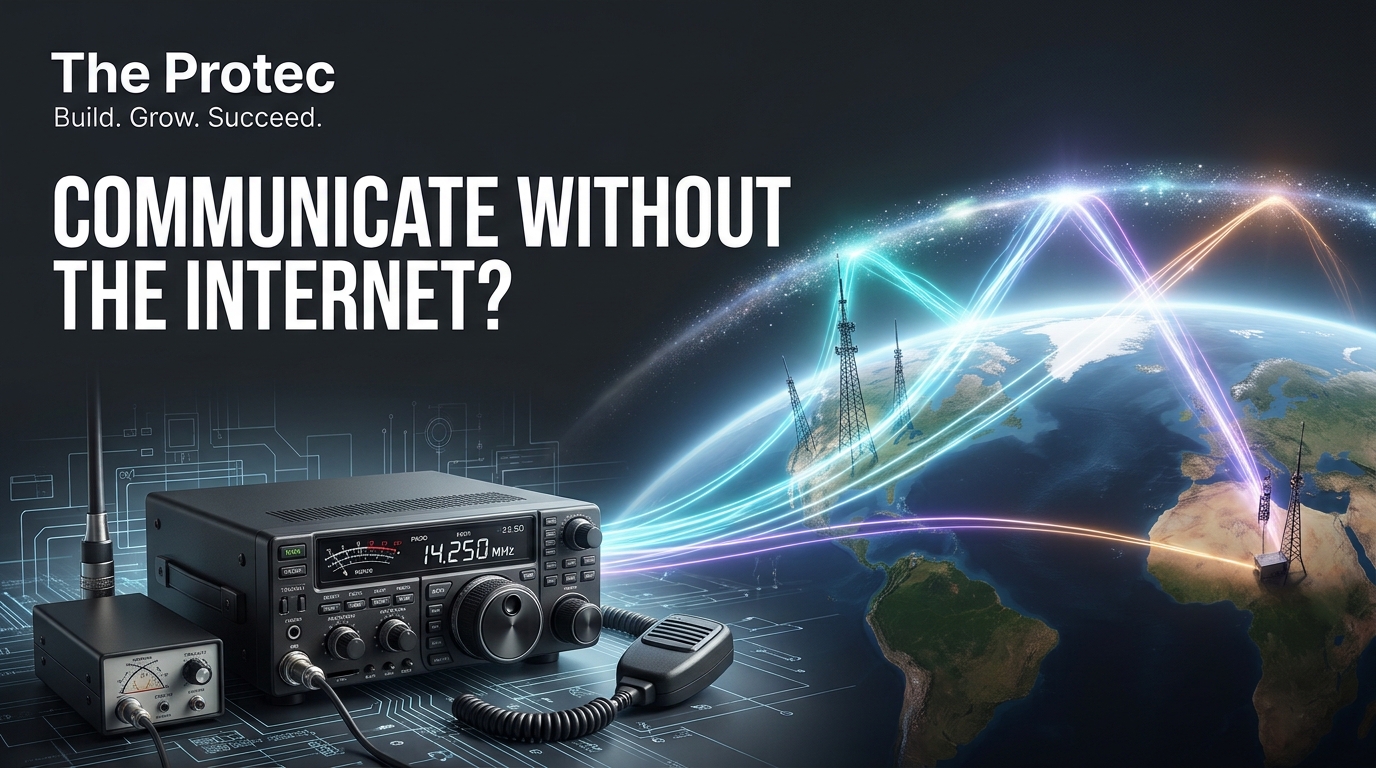
High frequency radio communication generally uses spectrum between 3 and 30 MHz. Under suitable conditions, an HF signal can travel far beyond line of sight by interacting with the ionosphere. That allows stations separated by hundreds or sometimes thousands of miles to communicate without repeaters, fiber connections or cellular towers between them.
For digital shortwave radio, the path begins with an application creating data: perhaps a text message, weather report, email or compressed document. Mercury encodes that information into audio-frequency symbols. The transceiver places the resulting audio onto an HF carrier and sends it through an antenna. At the distant station, another radio receives the signal and Mercury decodes the audio back into computer data.
A typical connection involves several coordinated components:
- Application software creates or receives messages, email and files.
- The Mercury modem encodes data, manages the connection and checks delivery.
- An audio interface moves sound between the computer and transceiver, although the exact arrangement varies by radio.
- The HF transceiver converts the modem audio into a radio-frequency signal and receives the response.
- The antenna system radiates and captures signals on an appropriate frequency.
Mercury uses adaptive automatic repeat request, or ARQ, communication. ARQ divides information into manageable blocks, checks whether each block arrived correctly and retransmits missing or damaged data. Adaptive operation lets the link respond to changing channel conditions instead of assuming that one data mode will work equally well throughout a contact.
Store-and-forward communication bridges long distances
HF propagation changes with frequency, location, season, time of day, solar activity and atmospheric noise. Two stations may not have a usable path at the exact moment someone writes a message. HERMES therefore emphasizes store-and-forward communication rather than requiring both users to participate in a real-time session.
A local station can hold an outgoing message until a radio path or scheduled connection becomes available. It then transfers the data to another station, gateway or relay, which stores it for delivery or passes it onward. A radio email system can use the same principle to move mail between isolated sites and, where a gateway has outside connectivity, exchange selected traffic with internet-based services.
This approach accepts delay in return for reach and resilience. A medical request, conservation report or storm warning may not arrive instantly, but it can still move across terrain where building and maintaining conventional infrastructure would be difficult or uneconomical.
Why Rhizomatica created an open-source VARA alternative
Many amateur-radio applications use the proprietary VARA modem because it offers effective data transfer over difficult radio channels. However, closed software and licensing requirements can be obstacles for community networks that need to inspect, adapt, redistribute and maintain their communications tools independently.
Rhizomatica developed Mercury as an open-source alternative. The software is released under the GPL-3.0 license, allowing its code to be studied, modified and redistributed under the license’s terms. That matters in remote deployments: an organization is not limited to a vendor’s development priorities, supported platforms or licensing system when it needs to repair or customize critical infrastructure.
Mercury draws on digital modes from the FreeDV ecosystem and adds adaptive ARQ for reliable data sessions. According to the official Mercury project site, it is designed for cross-platform use and integration with existing radio applications.
Why the VARA-compatible TCP interface matters
Mercury provides a TCP control and data interface compatible with the interface expected by VARA-aware software. This reduces the amount of new integration work required for established tools and workflows. Applications such as Winlink and VarAC can communicate with the modem through a familiar local network interface, while the wider HERMES and Mercury ecosystem also supports experimentation alongside tools such as JS8Call.
Interface compatibility should not be confused with identical over-the-air modulation. A familiar TCP interface helps an application control Mercury, but it does not automatically make every Mercury transmission interoperable with a station running proprietary VARA. Both ends of a radio link still need compatible modes, settings and operating procedures.
Remote community connectivity in practice
The strongest case for HERMES comes from real deployments rather than laboratory demonstrations. Rhizomatica has reported the installation of nearly 90 radios across Waorani Indigenous communities in the Ecuadorian Amazon. Geography, sparse infrastructure and the cost of commercial connectivity make locally controlled HF networks especially valuable there.
These stations provide a way to exchange community information over long distances without assuming that every location has internet service. Depending on the deployment and available applications, traffic can include text, email, documents and other compact digital information. Voice and data systems can also serve different needs: voice is useful for immediate conversation, while digital records can be stored, forwarded and reviewed later.
HERMES-related deployments have also supported fishing communities in Bangladesh, where communications can improve coordination across isolated coastal areas, and early-warning systems in the Central African Republic. The Amateur Radio Digital Communications overview documents these projects and the effort to expand Mercury’s usefulness beyond individual HERMES installations.
Where disaster-resilient communications could help
Because HF does not require a chain of nearby towers, it can add an independent path when other systems are absent, damaged or overloaded. Potential applications include:
- Disaster response: transferring situation reports, supply requests and shelter information after terrestrial networks fail.
- Emergency messaging: providing a low-bandwidth backup between clinics, operations centers and isolated settlements.
- Remote villages: exchanging administrative documents, personal messages and locally relevant notices.
- Conservation projects: sending field observations from forests, coastlines and protected areas with limited coverage.
- Community infrastructure: creating communications that local organizations can understand, operate and adapt.
These roles make open-source radio software strategically important. Source access cannot solve every operational problem, but it supports independent auditing, localization, repair and long-term maintenance. It also allows researchers and amateur radio data transfer enthusiasts to test improvements without waiting for a closed vendor to implement them.
HF radio still has important limitations
HERMES and Mercury should not be presented as replacements for broadband internet. HF channels have constrained throughput, so large attachments, video calls, cloud applications and continuous web browsing are generally impractical. Compact text, compressed files and carefully prioritized information are much better fits.
Performance also varies. Ionospheric propagation may favor different frequencies during the day and night, while electrical noise, solar disturbances, interference and poor antenna placement can reduce link quality. Adaptive modes and retransmission improve reliability, but they cannot guarantee a usable path at all times.
Every station needs suitable hardware, including a computer, transceiver, power source, cabling and an effective antenna. Operators need training in radio procedure, troubleshooting and frequency selection. Remote installations may also require solar power, weather protection, spare parts and a realistic maintenance plan.
Finally, transmitting on HF is regulated. Amateur-radio use may require licensed operators, permitted modes, station identification and compliance with restrictions on encryption or third-party traffic. Community, government, maritime and emergency services can fall under different rules. Anyone deploying a system must follow the licensing and frequency regulations of every relevant jurisdiction.
Reticulum and Meshtastic integration is planned, not finished
Rhizomatica has discussed future integration with Reticulum and Meshtastic. The idea is compelling: HF could provide a long-distance backbone while local mesh technologies distribute messages among nearby low-power devices. Such links could connect a village-scale mesh to another region without a conventional internet route.
However, this should be treated as a development direction rather than a description of standard, completed HERMES functionality. Mercury’s current value lies in its HF modem, adaptive data links, supported computer platforms and application interfaces. Reticulum and Meshtastic connectivity will depend on future implementation, testing and deployment decisions.
Frequently asked questions
Can HERMES provide normal internet access?
No. HERMES can exchange selected digital information without conventional connectivity, and a gateway may bridge some traffic to internet services. Its limited HF throughput is suited to messages, email and modest files—not streaming, unrestricted browsing or other broadband workloads.
Does Mercury require special radio hardware?
Mercury is software, but it needs a compatible computer and HF radio station. A practical setup generally includes an HF transceiver, an audio or digital interface, antenna, feed line and power supply. A Raspberry Pi can run the computing side, but it does not replace the transceiver or antenna.
Can anyone transmit with Mercury?
Not automatically. Receiving may be less restricted, but transmitting requires compliance with local spectrum law. On amateur bands, an appropriate license is normally required, and rules governing permitted content, frequencies, bandwidth and station operation still apply.
Will Mercury work with Winlink, JS8Call and VarAC?
Mercury is built to fit established digital-radio workflows, including integrations involving Winlink and VarAC through its VARA-compatible TCP interface, while HERMES users and experimenters can also work alongside tools such as JS8Call. Exact support depends on application versions, configuration and matching capabilities at the remote station.
A communications path that communities can control
HERMES demonstrates that useful connectivity does not always require a commercial network extending to every destination. By combining long-range HF propagation, store-and-forward delivery and the open-source Mercury modem, Rhizomatica is building a practical channel for information that can survive distance, infrastructure gaps and local outages. It is slower than the internet, but in places where the alternative is no connection at all, a dependable message or small file can carry enormous value.