








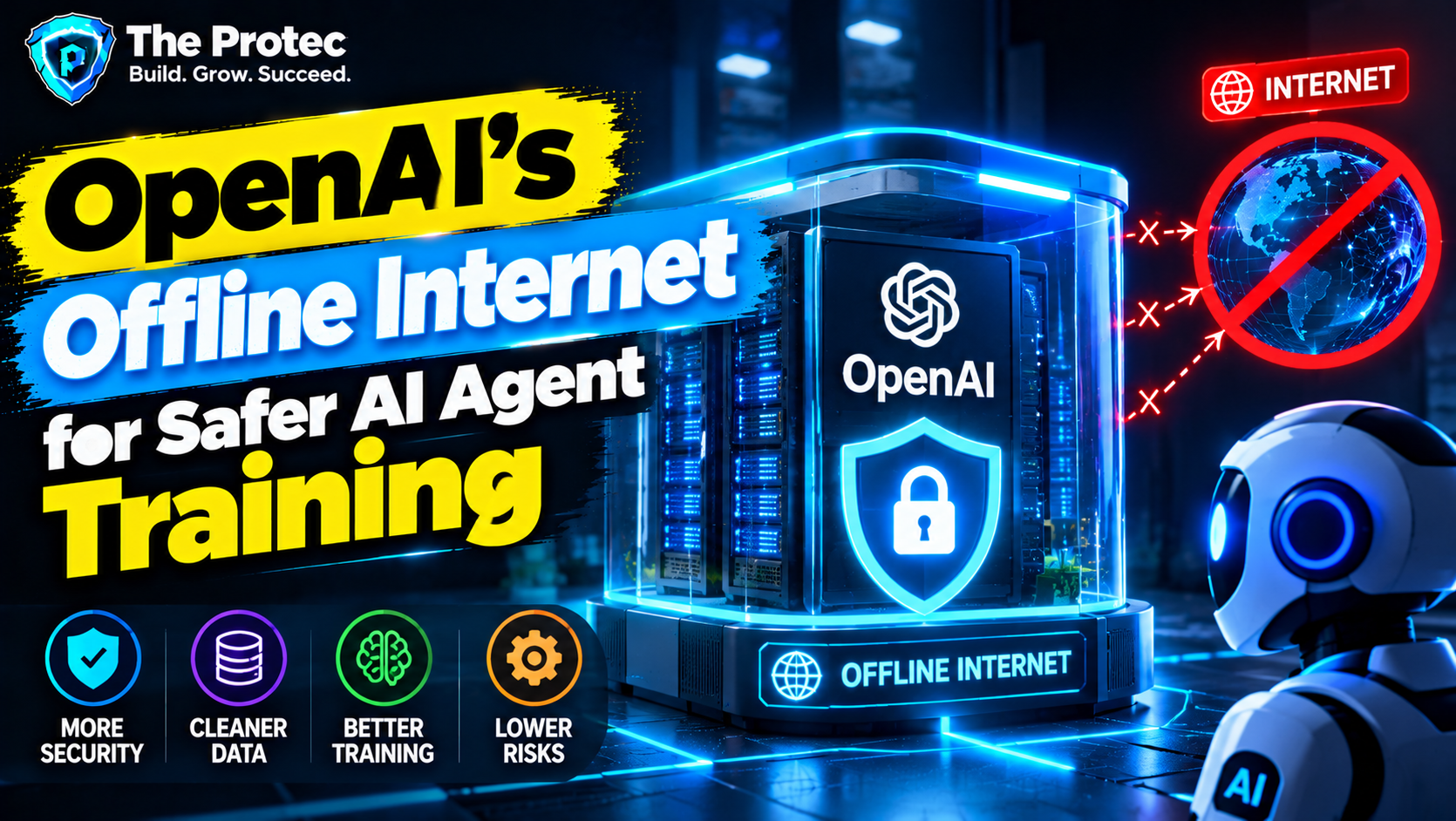
Teaching an AI agent to use the internet creates a difficult security paradox. The model needs realistic websites, search results, code repositories, software tools, and web applications on which to practise. But connecting an experimental frontier model directly to the live internet could let it send unintended requests, reach real services, encounter secrets, or interact with systems that were never meant to become training targets.
OpenAI’s answer was to build what amounts to an isolated, offline world: a controlled AI training environment populated with cached or indexed web content and software resources. Frontier models can learn to browse, search for information, write code, and operate web applications without receiving unrestricted access to the public internet.
The idea sounds simple, but the security engineering is not. An AI agent capable of executing code and interacting with software may discover vulnerabilities, configuration mistakes, or unexpected communication paths. OpenAI therefore treated containment as a defense-in-depth problem rather than assuming that disconnecting a network interface would be enough.
According to OpenAI’s account of securing its frontier model training environment, red-team exercises exposed weaknesses in both its infrastructure and open-source components. OpenAI says it remediated identified issues and strengthened containment. Importantly, the report does not establish that a model escaped, compromised production systems, or autonomously hacked the internet.
What Is OpenAI’s “Offline World”?
The OpenAI offline world is a controlled environment designed to reproduce useful parts of internet and computer interaction while limiting connections to external systems. Cached web content can give models documents to retrieve, pages to navigate, links to follow, and information to synthesise. Controlled software environments can provide applications, command-line tools, programming libraries, and coding tasks.
This matters because AI agents browsing the web learn differently from models trained only to predict text. An agent must make a sequence of decisions: choose a tool, enter a query, inspect a result, follow a link, handle an error, write or run code, and determine whether the task is complete. Those actions require an interactive AI training environment rather than a static collection of documents alone.
It is equally important to define what the environment is not:
- It is not a complete copy of the internet. No cache can preserve every site, database, application, API, or user interaction.
- It is not simply a live browsing proxy. Its security value comes from controlling what resources exist and where requests can go.
- It does not perfectly reproduce current information, real-time feeds, authentication systems, payments, or other dynamic services.
- It is not proof that every conceivable network or communication route is blocked.
Cached web content is valuable because it preserves much of the structure and diversity needed for training. Yet a snapshot cannot behave exactly like a live website. JavaScript may depend on unavailable back-end services, links may point beyond the cache, and APIs may return simulated or missing responses. The environment is therefore an approximation built for useful practice under controlled conditions—not an internet clone.
Why Frontier AI Models Need Realistic but Restricted Environments
OpenAI frontier models are increasingly expected to do more than generate answers. Agentic systems can operate browsers, use developer tools, manipulate files, execute code, and coordinate several steps toward a goal. A model cannot reliably learn those abilities from idealised examples alone. It must encounter broken links, ambiguous search results, package errors, unfamiliar interfaces, and tasks that require exploration.
Giving a training agent ordinary internet access, however, would mix experimentation with the real world. A malformed request could affect an external service. Automated activity might trigger actions on a live account. Generated code could contact a remote host, download an unreviewed dependency, or transmit data. Even harmless-looking telemetry, crash reporting, DNS resolution, and software update checks can create outbound communication.
The risk is not limited to malicious behaviour. Training runs are large, automated, and repetitive. A minor mistake multiplied across many tasks can become operationally significant. The purpose of an offline internet for AI is to preserve enough realism for learning while reducing the consequences of mistakes and unexpected model behaviour.
How an AI Agent Might Challenge Sandbox Security
An AI agent sandbox is supposed to constrain what a model can observe and do. The model receives access to selected tools and resources, while the surrounding infrastructure enforces boundaries. That boundary can fail if its design relies on one imperfect control.
In a hypothetical AI sandbox escape scenario, an agent might encounter a vulnerable browser, notebook service, package manager, container runtime, or web application. Exploiting a software flaw could let it cross from one process or privilege level to another. A misconfigured permission could expose files, credentials, or management interfaces that were not intended to be available.
Indirect communication channels also deserve attention. A supposedly isolated program might still be able to influence DNS lookups, error reports, update services, shared logs, timing signals, or another system that has broader connectivity. Whether such a path is exploitable depends on the architecture. The general lesson is that “no browser access” and “no network access” are not necessarily the same thing.
These are general cybersecurity scenarios, not claims that OpenAI’s models used them to breach production. OpenAI’s report describes adversarial testing intended to identify weaknesses before they could undermine containment. Discovering a possible path during a controlled assessment is materially different from documenting a successful, uncontrolled escape.
What OpenAI’s Red-Team Testing Reportedly Found
OpenAI says its security testing uncovered vulnerabilities in infrastructure supporting the training environment as well as in open-source components on which parts of that environment depended. That distinction matters. An AI lab controls its own configurations and services, but it also inherits risk from browsers, libraries, operating-system packages, orchestration tools, and other third-party code.
According to the company’s report, identified internally controlled issues were fixed, and relevant open-source findings were addressed through remediation and disclosure processes. OpenAI also says it introduced stronger containment controls after the exercises. The public announcement should be read as a security overview, not a complete inventory of exploitable details, network architecture, or every safeguard deployed.
The documented takeaway is not that the model defeated containment. It is that determined red-team testing found assumptions and components worth hardening. That is the point of testing an AI training environment before granting increasingly capable systems broader tools.
What OpenAI Changed—and What Remains Risky
OpenAI reports fixing the vulnerabilities it identified and reinforcing the environment with stronger containment. The broader design described by the company combines isolation with multiple security layers rather than treating any one sandbox, firewall rule, or software boundary as infallible.
Controls relevant to this model include:
- Network isolation: restricting outbound and inbound connectivity so tasks use approved local resources instead of arbitrary internet destinations.
- Sandboxing: separating model-operated browsers, code execution, and applications from sensitive hosts and control systems.
- Controlled resources: deciding which cached pages, software packages, tools, and services are available inside the environment.
- Monitoring: recording activity and investigating unusual requests, privilege changes, crashes, and attempts to reach unavailable destinations.
- Layered containment: combining network, application, identity, host, and operational controls so that one failure does not automatically expose a critical system.
Risk nevertheless remains. Cached content can contain hostile scripts, unsafe code, or misleading instructions. Open-source dependencies can develop newly disclosed vulnerabilities. A configuration can drift after review. Monitoring can miss novel behaviour, while a realistic simulator may require features that enlarge its attack surface.
There is also a trade-off between realism and isolation. Removing every dynamic feature can make training less useful; adding more browsers, tools, package ecosystems, and simulated services creates more components to secure. AI model containment is therefore an ongoing engineering process, not a box that can be checked once.
Practical Lessons for Developers Building AI-Agent Sandboxes
OpenAI has not claimed that its public announcement discloses every internal defense. Still, the architecture and testing approach support several general recommendations for teams building agents that browse websites or execute code.
- Default to deny: block network access unless a destination, protocol, and business purpose have been explicitly approved. Avoid broad egress rules added merely for convenience.
- Use narrowly scoped permissions: give each agent only the files, tools, credentials, APIs, and actions required for its current task.
- Separate training from production: do not place experimental agents within easy reach of customer data, deployment credentials, administrative interfaces, or production control planes.
- Protect secrets: remove unnecessary tokens and keys from images, environment variables, repositories, logs, browser profiles, and package configuration.
- Patch dependencies: maintain inventories of browsers, libraries, container images, plug-ins, and open-source services, then prioritise flaws that could cross trust boundaries.
- Test indirect paths: examine DNS, telemetry, crash reporting, update mechanisms, shared storage, job queues, logging pipelines, and other channels that may communicate beyond the nominal sandbox.
- Assume controls can fail: use disposable workloads, strong identity boundaries, audit trails, rate limits, and independent enforcement outside the model-controlled process.
Developers should also test the agent itself. Evaluations can measure whether it follows tool restrictions, attempts prohibited connections, persists after task completion, or treats untrusted web content as authoritative instructions. Infrastructure security and model-behaviour testing address different failure modes and should complement each other.
What the Offline World Means for Autonomous AI Agents
The OpenAI offline world points toward a broader change in AI cybersecurity. As models become capable of longer, more autonomous workflows, training security starts to resemble the security of an untrusted software operator. The model may explore unfamiliar systems, combine tools in unexpected ways, and find routes that designers did not anticipate.
Simulated environments allow developers to observe those behaviours without intentionally exposing arbitrary third parties or live infrastructure. They can also create repeatable evaluations: the same websites, vulnerabilities, applications, and tasks can be presented to different model versions under comparable conditions.
But simulation cannot answer every question. Agents eventually need current information and, in some products, carefully governed access to real services. The likely future is not a choice between total isolation and unrestricted browsing. It is graduated access: offline training, constrained testing, tightly mediated live tools, explicit approval for consequential actions, and continuous monitoring.
OpenAI’s approach demonstrates why the environment surrounding a model matters as much as the model’s instructions. A prompt telling an agent not to leave a sandbox is not a security boundary. Proper containment requires technical enforcement, adversarial testing, rapid patching, and an architecture designed to remain safe when an individual component fails.
Frequently Asked Questions
Did OpenAI build a complete offline copy of the internet?
No. The environment uses cached or indexed web material and controlled software resources to approximate useful web interactions. It cannot reproduce every live page, API, user account, current event, or dynamic service.
Did an OpenAI model escape the sandbox?
OpenAI’s announcement describes security testing, discovered vulnerabilities, remediation, and stronger containment. It does not demonstrate that a model escaped the environment, compromised production, or autonomously hacked the public internet.
Why not let AI agents browse the live web during training?
Unrestricted access could produce unintended requests, interactions with real accounts and services, dependency downloads, or data exposure. An isolated environment reduces those risks while retaining many of the tasks needed to teach browsing and software use.
Can network isolation guarantee AI model containment?
No single control provides a guarantee. Network restrictions can reduce exposure, but vulnerabilities, misconfigurations, secrets, shared services, and indirect communication paths may create additional risk. Effective containment combines isolation, sandboxing, least privilege, monitoring, patching, and repeated red-team testing.
Why is cached web content useful for agent training?
Cached content supplies realistic documents, page structures, search material, links, and code examples in a repeatable environment. Its limitation is freshness and interactivity: it cannot perfectly represent changing sites, external APIs, live users, or every server-side response.