







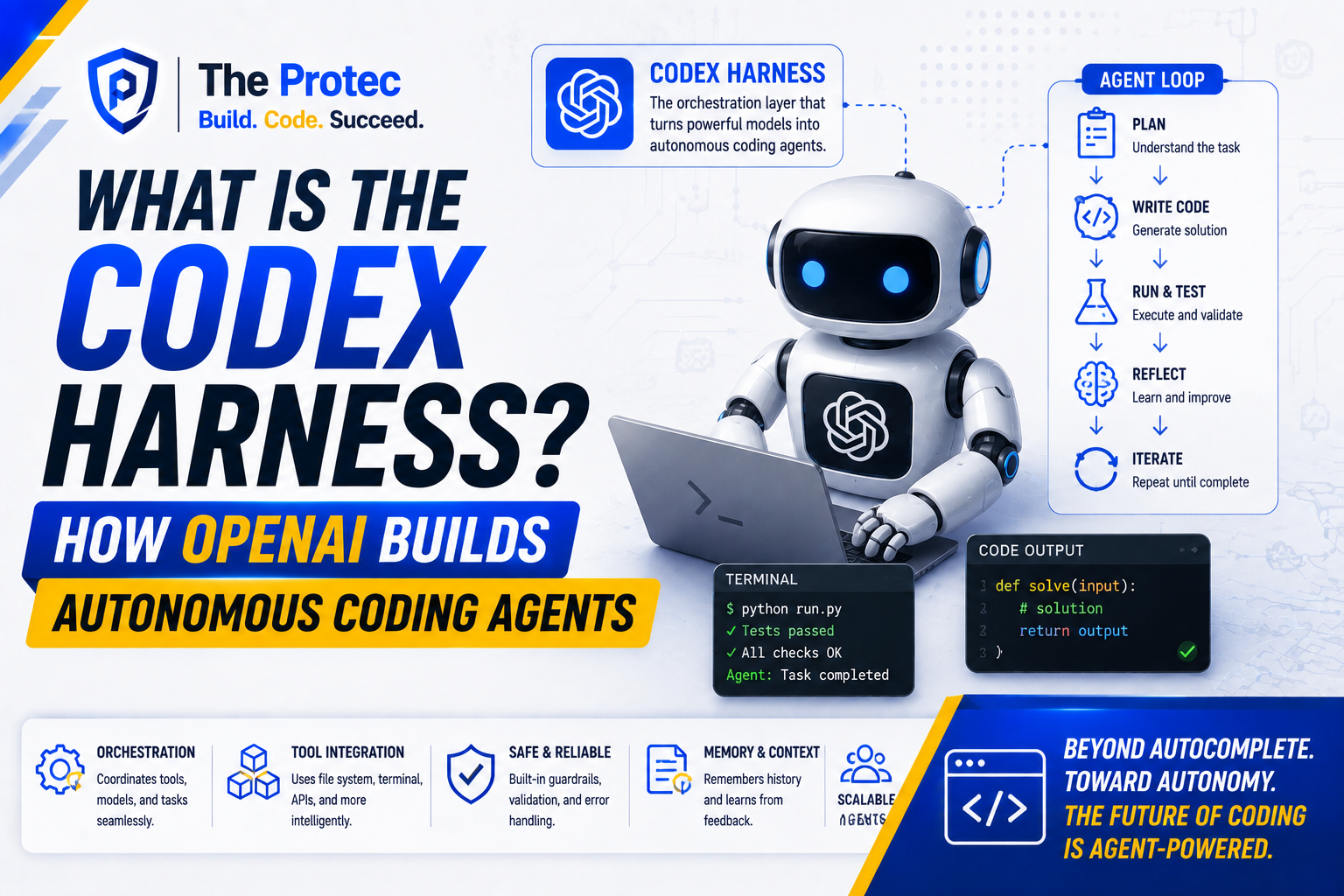
A language model can explain a stack trace, draft a function, or suggest a refactor. A coding agent must do considerably more: inspect an unfamiliar repository, decide which files matter, edit them safely, run commands, interpret failures, revise its approach, and report what changed. The system that enables that transition is commonly called the Codex harness.
The harness is the operational layer around an OpenAI model. It connects the model’s reasoning and code-generation abilities to real development tools, while controlling what the model can see and do. Without that layer, even a highly capable coding model remains largely a text generator. With it, the model can participate in a structured, multi-step engineering workflow.
Understanding the OpenAI Codex harness is therefore essential to understanding modern AI coding agents. The model matters, but the surrounding environment, tools, permissions, context management, and verification loop often determine whether an agent produces a useful patch or an expensive mistake.
What Is the Codex Harness?
The term Codex harness describes the software framework that places an AI model inside a controlled coding environment. It receives a developer’s request, gives the model relevant repository context, exposes approved tools, executes requested actions, returns the results, and repeats that cycle until the task is complete or requires human input.
It is useful to distinguish the architectural term from a single branded component. OpenAI offers Codex experiences across terminal, editor, and cloud-based workflows, while the implementation can evolve. The harness is the broader runtime and orchestration concept underlying those experiences. Developers can review OpenAI’s current product information on the official Codex page and inspect the open-source terminal agent in the OpenAI Codex repository.
In practical terms, the harness acts as an interpreter between two very different worlds. The model works with tokens, instructions, and structured tool requests. The development environment works with files, processes, permissions, test runners, version control, and network policies. The harness translates between them.
A Coding Model Is Not the Same as a Coding Agent
A model has learned patterns from source code, documentation, technical discussions, and other training data. It can predict useful code and reason about programming problems, but it does not automatically know the current state of a private repository. Nor can it independently open a file, execute a test, or inspect a Git diff.
A Codex coding agent combines that model with an action loop. The agent can observe its environment, select a tool, receive the tool’s output, update its understanding, and take another action. This difference resembles the gap between a developer who can describe a solution from memory and one who has access to the repository, terminal, debugger, and continuous integration results.
The model provides intelligence; the harness provides agency. Neither is sufficient on its own for reliable autonomous software work.
Core Components of the OpenAI Codex Harness
Repository and File Access
The harness lets the model inspect directory structures, search symbols, read source files, and write targeted changes. This access is normally scoped to a workspace rather than the entire machine. Efficient file discovery is important because loading a whole repository into the model’s context would be costly and often counterproductive.
Project-level instruction files can also tell the agent how the repository is organized, which commands to use, and which conventions to follow. These instructions help turn general coding capability into behavior appropriate for a specific codebase.
Terminal and Shell Tools
Terminal access allows the agent to run linters, compilers, test suites, package managers, search utilities, and version-control commands. The model does not directly operate a shell. It proposes a command through a tool interface, and the harness decides whether and how to run it.
The result—including standard output, errors, exit status, and possible timeouts—is returned to the model as a new observation. That feedback enables the agent to diagnose failures instead of merely guessing whether generated code will work.
Code Editing and Patch Application
A mature harness provides controlled editing mechanisms rather than encouraging the model to rewrite large files unnecessarily. It may support patch-based changes, file creation, formatting, and diff inspection. Small, reviewable edits reduce accidental damage and make it easier for both automated checks and human reviewers to understand the result.
Execution and Sandboxing
Generated code can fail, consume excessive resources, access sensitive data, or execute dangerous operations. The harness therefore runs commands within defined boundaries. Depending on the configuration, those boundaries can restrict filesystem access, network connectivity, environment variables, process creation, or commands that alter the system.
Sandboxing and harnessing are related but not identical. The harness coordinates the work; the sandbox enforces technical limits. Approval policies add another layer by requiring a person to authorize higher-risk operations.
Context and State Management
Long coding tasks generate substantial information: file contents, command output, test failures, implementation decisions, and earlier instructions. The harness must decide what to preserve, summarize, or discard so the model receives useful context without becoming overwhelmed by stale details.
This is one of the least visible but most consequential parts of AI coding agents. A strong model with poor context management may repeatedly inspect the same files, forget a requirement, or fix one test while breaking another.
How the Codex Agent Loop Works
A typical task begins with a request such as fixing an authentication bug or adding an API endpoint. The Codex harness then supports an iterative workflow:
- Interpret the goal: The model identifies requirements, constraints, and missing information.
- Explore the repository: It searches for relevant files, dependencies, tests, and local instructions.
- Form a working plan: It chooses a likely implementation path and determines which tools are needed.
- Take an action: The model requests a file read, code edit, terminal command, or another approved operation.
- Observe the result: The harness returns file contents, command output, errors, or policy decisions.
- Revise and verify: The model updates the code, reruns checks, and inspects the resulting diff.
- Report completion: The agent summarizes changes, tests performed, and any unresolved risks.
This observe-act-verify cycle is what makes agentic coding fundamentally different from one-shot code completion. A failed test is not necessarily the end of the task; it becomes evidence for the next step.
How the Harness Connects Codex to Development Workflows
Real engineering work extends beyond writing source code. The OpenAI Codex harness can place the agent inside workflows involving Git branches, isolated worktrees, dependency installation, build systems, test frameworks, code review, and issue descriptions. Cloud environments can allow longer tasks to run in the background, while local tools keep the agent close to a developer’s active workspace.
Modern harnesses also increasingly support external tool connectors and standardized interfaces for accessing documentation, databases, observability systems, and other approved services. The important principle is controlled expansion: each added tool gives the agent more useful capability, but also increases the permission and security surface that teams must manage.
Parallelism is another important development. Multiple coding agents can investigate separate tasks or alternative solutions in isolated environments. A harness must keep those workspaces separate, track their outputs, and present changes in a form developers can evaluate without creating merge chaos.
Why the Harness Layer Is Crucial
Model benchmarks often emphasize code generation or problem solving, but production usefulness depends heavily on the harness. It determines whether the agent sees the right files, uses the correct test command, recognizes an error, and stops before performing an unsafe action.
The harness also turns broad model intelligence into reproducible process. A developer can define repository instructions, tool permissions, validation commands, and approval requirements. Those controls make behavior more consistent across tasks and team members.
Most importantly, the harness creates a feedback loop grounded in actual execution. Source code that looks plausible can still contain type errors, broken imports, incorrect assumptions, or hidden regressions. Running the code and feeding the results back to the model gives the agent an opportunity to correct those problems before presenting its work.
Security and Governance for AI Coding Agents
Giving an AI system access to development tools requires deliberate safeguards. Repositories may contain secrets, untrusted instructions, deployment scripts, or code designed to manipulate an automated agent. Documentation and issue text can also contain prompt-injection attempts that encourage the model to ignore its rules or expose sensitive data.
A secure Codex harness should apply least-privilege access. Agents should receive only the files, network destinations, credentials, and commands needed for a task. Sensitive operations should require explicit approval, and important actions should be logged for review.
Teams should also treat test success as evidence, not proof. An agent can optimize for visible tests while missing security, performance, accessibility, or architectural concerns. Human review remains important for high-impact changes, especially those involving authentication, payments, infrastructure, privacy, or production data.
Codex Harness Trends Shaping Agentic Development
As of August 2026, the direction of AI-assisted development is moving from isolated code suggestions toward delegated tasks with verifiable outputs. Terminal agents, editor integrations, background cloud workers, automated review agents, and multi-agent workflows increasingly share the same basic harness pattern.
At the same time, teams are demanding stronger controls: configurable sandboxes, clearer approval modes, better provenance, durable task state, structured project instructions, and detailed execution logs. Model quality still advances, but improvements to context retrieval, tool reliability, and verification can create equally meaningful gains.
The result is a more realistic view of autonomy. The goal is not an unrestricted agent that can do anything. It is a capable agent that can complete bounded engineering work within observable, enforceable limits.
How to Evaluate a Codex Coding Agent
Organizations evaluating AI coding agents should look beyond how impressive the first generated patch appears. Useful measures include task completion rate, test pass rate, regression frequency, review time, tool-call efficiency, permission violations, and how often the agent needs human clarification.
Evaluation should use representative internal tasks rather than only synthetic coding exercises. A harness that performs well on a small algorithm may still struggle with monorepo navigation, unusual build commands, legacy dependencies, or organization-specific conventions. The best system is the one that works reliably within the team’s real workflow and risk tolerance.
Frequently Asked Questions
Is the Codex harness an AI model?
No. The harness is the runtime and orchestration layer around a model. It supplies context, exposes tools, executes approved actions, manages state, and returns results. OpenAI Codex models provide coding intelligence, while the harness enables that intelligence to interact with a development environment.
Does the Codex harness execute code directly?
The model requests an execution action, but the harness manages it. Commands typically run in a controlled local or cloud environment with configured filesystem, network, and approval policies. The output is then returned to the model for analysis.
Why can a coding agent outperform a model in a chat window?
A chat model may only see the snippets a user provides. A coding agent can explore the repository, inspect dependencies, edit files, run tests, and respond to failures. The advantage comes from the iterative workflow and access to grounded evidence, not simply from generating more code.
Can the OpenAI Codex harness replace developers?
It can automate substantial portions of well-scoped engineering work, but it does not remove the need for technical judgment. Developers still define goals, design systems, manage risk, review consequential changes, and resolve ambiguous product requirements. The harness is best understood as leverage for engineering teams rather than a substitute for ownership.
Is a harness the same as a sandbox?
No. A sandbox limits what code and commands can access. A harness coordinates the overall agent loop, including context, tools, edits, execution, state, and reporting. Sandboxing is one safety mechanism within a broader harness architecture.
The Model Writes Code; the Harness Makes It an Agent
The Codex harness is the bridge between language-model capability and practical software engineering. By connecting OpenAI Codex to repositories, terminals, execution environments, tests, and controlled workflows, it enables the model to act, learn from results, and verify its work.
That orchestration layer is not secondary infrastructure. It is a central part of the product. As AI coding agents become more capable, the quality of their harnesses—especially their context management, tool design, security controls, and verification loops—will determine how safely and effectively they contribute to real codebases.