








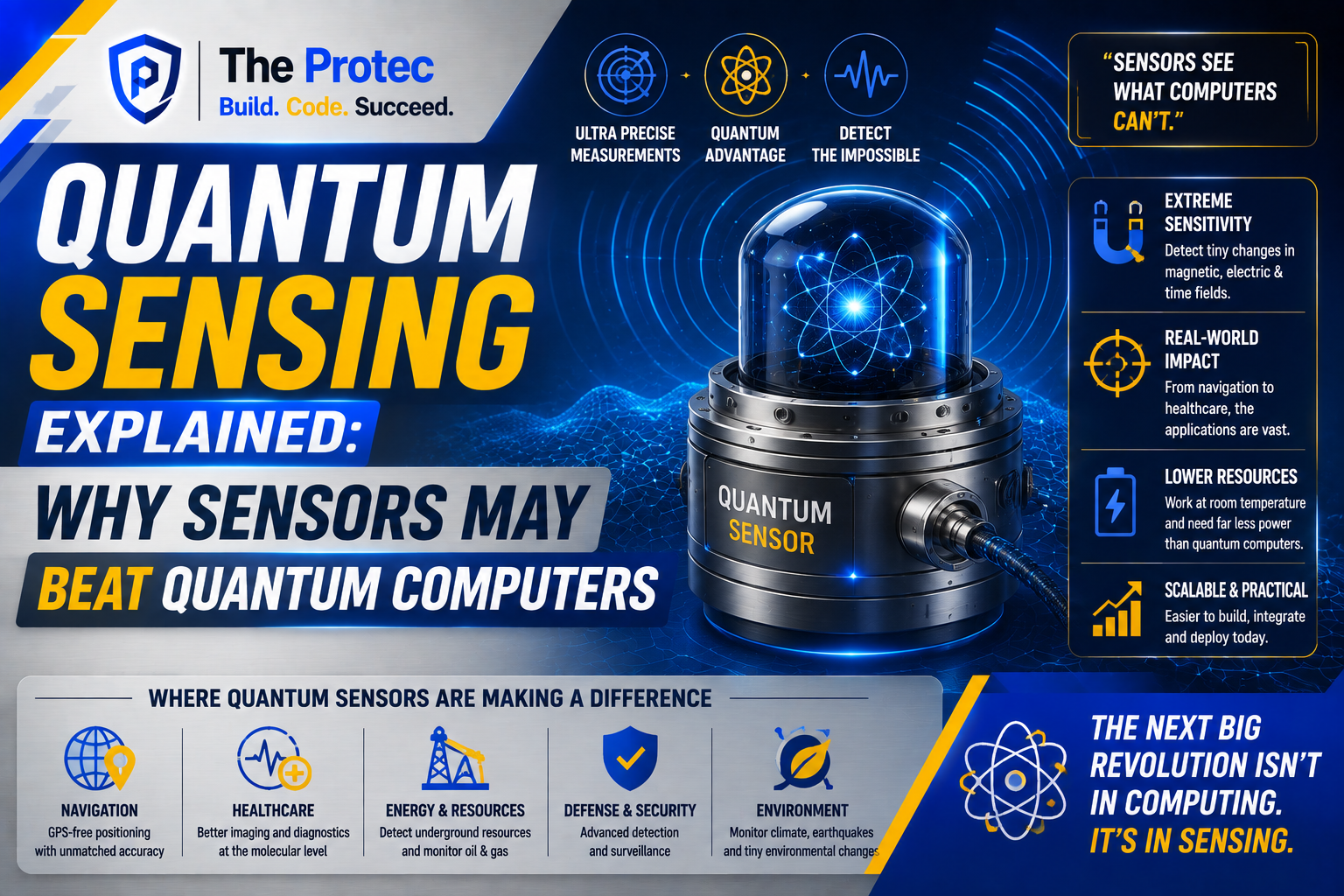
Quantum computers tend to dominate conversations about quantum technology, but another branch of the field may have a faster route into everyday use. Quantum sensing turns effects normally associated with subatomic physics into extraordinarily precise measurements of time, gravity, motion, magnetic fields, temperature and electromagnetic radiation.
Some quantum sensors are already established. Atomic clocks help synchronize communications networks and satellite navigation, while quantum effects improve instruments used in advanced research. The next wave is focused on making these capabilities smaller, tougher and practical outside controlled laboratories. That matters because a useful quantum sensor does not need to become a universal computer. It only needs to measure one physical quantity better than the available alternative.
What Is Quantum Sensing?
Quantum sensing is the use of quantum systems to detect or measure changes in the physical world. These systems can include atoms, ions, photons, electron spins and superconducting circuits. Researchers prepare them in carefully controlled quantum states, allow an external signal to affect those states, and then read the resulting change.
Imagine a perfectly balanced compass needle that responds to the faintest magnetic disturbance. A quantum sensor works on a related principle, but its “needle” might be the spin of an electron or the energy level of an atom. A magnetic field, gravitational pull or tiny acceleration changes that quantum state in a predictable way. By measuring the change, the instrument estimates the signal that caused it.
Several quantum properties can provide an advantage. Superposition allows a system to occupy a combination of states. Entanglement creates correlations between particles that cannot be reproduced classically. Quantum coherence preserves the phase relationships needed for sensitive measurements. Squeezed states can reduce uncertainty in one measurement variable, improving precision where it matters most.
Major Types of Quantum Sensors
- Atomic clocks use stable atomic transitions as exceptionally precise frequency references.
- Atom interferometers measure acceleration, rotation and gravity by tracking matter-wave interference.
- Quantum magnetometers detect weak magnetic fields using atomic vapors, superconducting devices or solid-state spins.
- Diamond sensors use nitrogen-vacancy defects in diamond to measure magnetic fields, temperature and other local conditions.
- Rydberg-atom sensors use highly excited atoms to detect radio-frequency and microwave electric fields.
- Quantum optical sensors use individual photons, entangled light or squeezed light for imaging and precision measurement.
Why Quantum Sensors Could Arrive Before Quantum Computers
The comparison is not between simple and difficult technology; both fields face serious engineering challenges. The difference is the scale of the task. A general-purpose quantum computer must control many qubits, perform long sequences of gates and suppress errors throughout a calculation. Fault-tolerant machines also require error correction, which can consume many physical qubits for each dependable logical qubit.
A quantum sensor can be narrower and more forgiving. It may use one atom, a cloud of identical atoms, a single defect in a material or a compact optical system. Instead of executing a complicated algorithm, it exposes a quantum state to the quantity being measured and produces a classical reading. A sensor can therefore deliver value even if it performs only one specialized job.
Quantum sensing also fits more easily into hybrid systems. A quantum accelerometer can work alongside conventional inertial sensors, while classical electronics handle calibration and data processing. This allows developers to introduce quantum capability as a component rather than replace an entire platform.
There is an important qualification: quantum sensors are not automatically superior. Heat, vibration, stray electromagnetic fields and material imperfections can destroy coherence or overwhelm the desired signal. The practical race is therefore about usable sensitivity per unit of cost, size, power and operating complexity—not laboratory precision alone.
Leading Quantum Sensing Applications
The strongest opportunities are generally found where existing instruments drift, cannot see through obstacles or lack the sensitivity required to identify a valuable signal.
Aircraft, ships, submarines and autonomous systems rely heavily on global navigation satellite systems. Those signals can be blocked, jammed or spoofed. Quantum accelerometers and gyroscopes could help inertial navigation systems track motion for longer periods with less drift. Quantum gravimeters and magnetometers may also compare local gravity or magnetic measurements with previously mapped terrain.
These instruments are unlikely to become a universal replacement for GPS. Instead, they could provide resilient positioning as part of a layered navigation system combining satellite, visual, radio and inertial data.
Medicine and Biomedical Imaging
The human body produces extremely weak magnetic signals. Optically pumped magnetometers can detect brain activity without some of the cryogenic equipment required by traditional superconducting detectors. This has supported research into more flexible magnetoencephalography systems, including wearable arrangements that allow a patient to move during a scan.
Diamond quantum sensors are also being investigated for nanoscale studies of cells, proteins and chemical reactions. Longer term, quantum-enhanced magnetic sensing could contribute to more sensitive diagnostics, but medical applications must still demonstrate repeatability, clinical usefulness and regulatory compliance.
Defense and Security
Defense agencies are exploring quantum sensing for positioning in GPS-denied environments, magnetic anomaly detection, precision timing and radio-frequency monitoring. Rydberg sensors are particularly interesting because atoms respond to defined electromagnetic frequencies and can act as traceable RF receivers across wide frequency ranges.
Quantum sensors are not magical detectors capable of seeing everything. Range, environmental noise, deployment conditions and countermeasures still apply. Their potential advantage is the ability to identify signals that conventional equipment may measure less accurately or only with larger systems.
Infrastructure and Underground Mapping
Gravity changes slightly above tunnels, cavities, buried structures and variations in groundwater. Sensitive atom-based gravimeters could help surveyors inspect underground conditions without drilling into every suspected location. Potential quantum sensing applications include identifying sinkhole risks, mapping old mine workings, monitoring reservoirs and assessing construction sites.
The main challenge is field performance. Traffic, machinery, wind and ground vibration can hide subtle gravity signals, so practical instruments need effective isolation, rapid measurements and reliable interpretation software.
Scientific Research
Quantum sensors give researchers new ways to test fundamental physics and observe systems at smaller scales. Networks of atomic clocks can compare time across locations, magnetometers can search for unusual fields, and atom interferometers can test gravity with high precision. Quantum-enhanced instruments are also being studied for dark-matter searches and improved astronomical observation.
The broader research landscape is documented by organizations such as the National Institute of Standards and Technology, which develops quantum measurement science, standards and enabling technologies.
Ultra-Precise Measurement and Timing
Atomic clocks are among the clearest examples of successful quantum technology. Better clocks improve telecommunications, financial timestamping, navigation and distributed computing. Optical clocks are now so sensitive that they can detect gravitational time differences associated with small changes in elevation, creating possibilities for relativistic geodesy and monitoring changes in Earth’s gravitational potential.
Precision measurement also supports manufacturing and calibration. A quantum sensor tied to atomic properties may provide a stable reference that does not depend on a mechanically manufactured artifact.
What Is Driving the Current Momentum?
As of August 2026, the focus has shifted noticeably from proving that quantum sensing works to proving that it works reliably in the field. Research teams and technology companies are concentrating on photonic integration, chip-scale vapor cells, compact lasers, improved diamond materials, rugged packaging and automated calibration.
Another trend is the move toward sensor fusion. Rather than waiting for a standalone quantum device to outperform every classical instrument, developers combine quantum measurements with mature sensors and machine-learning-assisted signal processing. The quantum component can periodically correct drift, while conventional hardware supplies fast, continuous readings.
Governments are also funding testbeds and procurement programs in navigation, geophysics, healthcare and defense. Initiatives including the European Quantum Flagship reflect the wider effort to connect quantum research with industrial systems, standards and commercial supply chains.
Barriers Between Laboratory Results and Real Products
- Environmental noise: Vibration, temperature changes and electromagnetic interference can obscure the tiny effect a sensor is designed to measure.
- Size and power: Laboratory systems may need lasers, vacuum equipment, magnetic shielding or cryogenic cooling. Portable products must reduce that burden.
- Calibration and validation: High sensitivity is useful only when measurements remain accurate, traceable and repeatable across operating conditions.
- Cost and manufacturing: Specialized optics and materials can be expensive. Commercial adoption depends on scalable production and dependable component suppliers.
- Operational value: A quantum sensor must offer enough improvement to justify new training, maintenance and integration requirements.
These constraints explain why deployment will be gradual. Early adoption is most likely in markets where a small measurement improvement has substantial economic, scientific or strategic value.
The Likely Path Ahead
Quantum sensing will probably arrive as a collection of specialized instruments rather than one dramatic consumer breakthrough. Precision clocks, medical magnetometers, navigation aids and gravity sensors will mature at different speeds. Many will operate invisibly inside larger systems, with users receiving an ordinary data stream from an extraordinary measurement process.
That practical, focused model is exactly why quantum sensors may become widespread before fault-tolerant quantum computers. They do not need to solve every problem. They need to measure one important thing exceptionally well.
Frequently Asked Questions About Quantum Sensing
Do quantum sensors already exist?
Yes. Atomic clocks, superconducting magnetometers and other quantum-based instruments are already used in navigation, research and medicine. The emerging phase involves making newer sensor types portable, affordable and robust enough for broader field deployment.
Will quantum sensors replace GPS?
Not by themselves. Quantum accelerometers, gyroscopes, clocks and gravimeters could reduce dependence on satellite signals, especially when GPS is unavailable or unreliable. They are more likely to complement GPS within resilient navigation systems.
Are quantum sensors the same as quantum computers?
No. A quantum computer processes information using qubits and quantum algorithms. A quantum sensor uses a controlled quantum system to measure an external physical quantity. The technologies share scientific principles but have different architectures, requirements and purposes.
When will quantum sensing become widely available?
Availability depends on the application. Precision timing is already mature, while wearable medical sensing, field-ready gravimetry and advanced quantum navigation remain in various stages of trials and commercialization. Specialized industrial and government uses are likely to expand before mass-market consumer adoption.