







On the night of August 27–28, the Moon will slide almost completely into Earth’s dark central shadow, creating one of the year’s most photogenic sky events. The lunar eclipse August 2026 is technically a partial eclipse, but with roughly 96% of the lunar disk entering the umbra, it will look remarkably close to total. Most of the Moon may turn copper, rust or deep red while a narrow, bright edge remains exposed.
This is also an eclipse made for technology. Astronomy apps can place every phase on your local timeline, augmented-reality tools can show where the Moon will clear nearby buildings, and live satellite imagery can reveal whether clouds are likely to spoil the view. Modern smartphone cameras, computational photography and compact tracking mounts also make detailed eclipse images accessible without professional observatory equipment.
Whether your calendar calls it a lunar eclipse or uses the label eclipse lunar, the key is to prepare before the Moon begins entering Earth’s shadow. Here is how to combine accurate timing, visibility forecasts and practical camera techniques for the best possible experience.
Lunar Eclipse August 2026: Date and UTC Timing
The eclipse occurs globally at the same moment, although local clocks and calendar dates differ. In Universal Time, the event unfolds on August 28. For observers across much of the Americas, it begins during the evening of August 27.
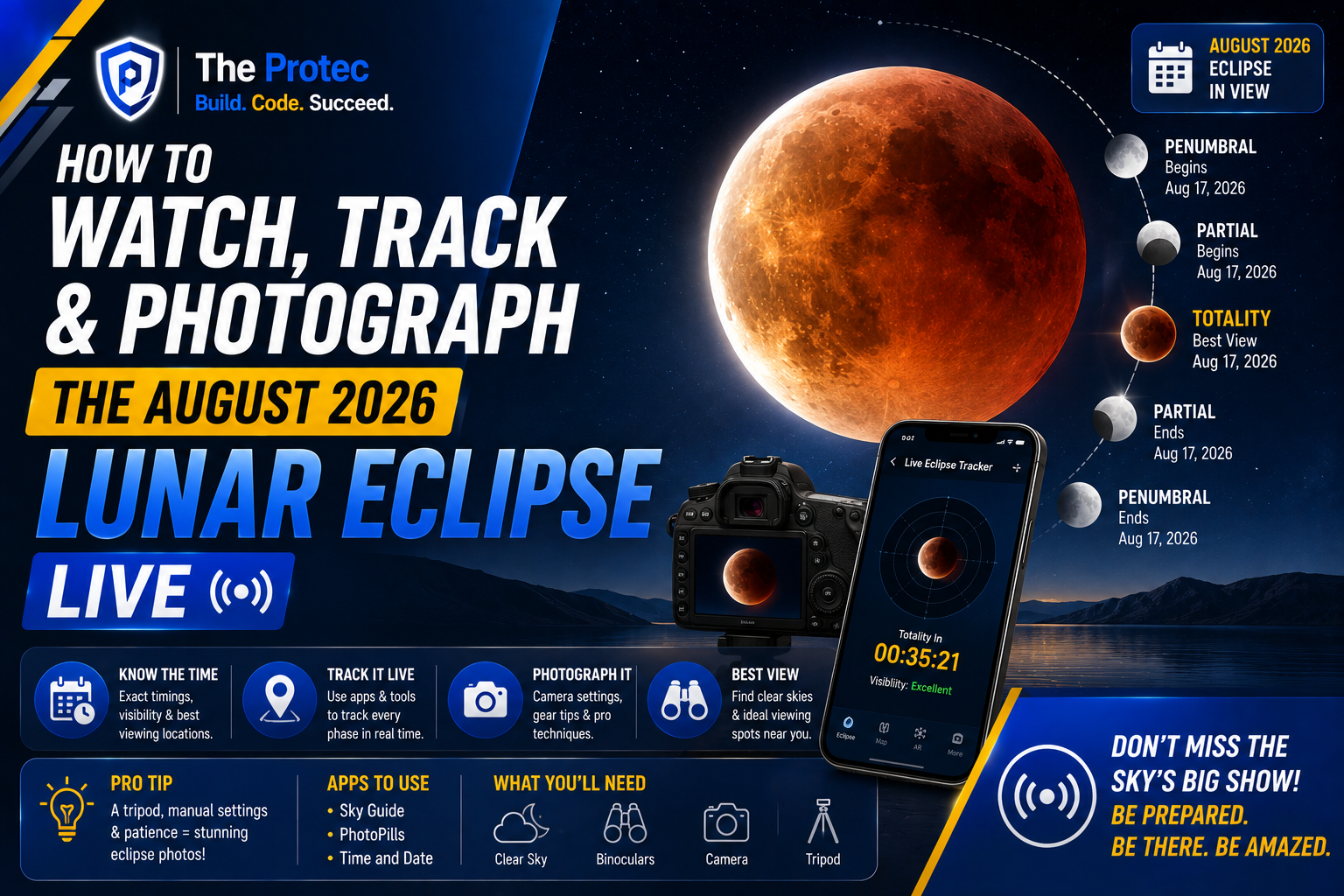
- Penumbral eclipse begins: approximately 01:24 UTC
- Partial eclipse begins: approximately 02:34 UTC
- Greatest eclipse: approximately 04:13 UTC
- Partial eclipse ends: approximately 05:52 UTC
- Penumbral eclipse ends: approximately 07:02 UTC
The early penumbral stage is subtle. Earth’s faint outer shadow initially produces only a gentle gray shading that can be difficult to recognize. The event becomes obvious after 02:34 UTC, when the umbra starts carving a dark, curved notch into the Moon. At maximum eclipse, about 96% of the disk will be inside that deeper shadow.
Timings can vary by several seconds among eclipse tables because different models account for Earth’s atmosphere and shadow size slightly differently. Check the NASA lunar eclipse resources and your chosen astronomy app shortly before the event. For ordinary viewing and photography, minute-level timing is more than sufficient.
Near-Total Lunar Eclipse Visibility by Region
Lunar eclipse visibility depends on whether the Moon is above your horizon during each phase. Unlike a solar eclipse, there is no narrow path of totality: anyone on the nighttime side of Earth can watch, subject to the local horizon and weather.
North and South America are especially well positioned. Much of the eastern and central Americas can follow the eclipse from the penumbral opening through maximum and beyond. On the West Coast, the earliest stage may occur around moonrise, but the dramatic partial phases should be accessible where the eastern horizon is clear.
Observers in western Europe and western Africa can see portions of the eclipse before dawn, although the Moon will become progressively lower. In some locations it will set during or shortly after maximum eclipse. Much of Asia and Australia will be on the daylight side of Earth during the main event, limiting or eliminating the view.
Do not rely on a continent-level map alone. Hills, buildings, trees and haze matter when the eclipsed Moon is low. In Stellarium or Sky Tonight, enter your exact coordinates, enable the landscape or horizon view, and move the clock through the eclipse. The simulation will show the Moon’s altitude and compass direction during every stage.
Track the Eclipse With Stellarium and Sky Tonight
Stellarium is one of the most useful tools for planning. Its desktop, web and mobile versions simulate the sky from a chosen location and time. Search for the Moon, advance to 04:13 UTC, and note its altitude and azimuth. The desktop application also supports detailed eyepiece and camera-field simulations, helping telescope users predict how much of the frame the Moon will occupy.
Sky Tonight offers a more mobile-focused workflow. Its event calendar, visibility index, reminders and augmented-reality sky overlay are convenient when scouting a location. Hold the phone toward the expected moonrise or moonset direction to identify potential obstructions, but calibrate the compass first and remember that magnetic interference can shift an AR marker.
For reliable tracking, configure apps before leaving home:
- Allow precise location access or enter coordinates manually.
- Confirm the displayed time zone and daylight-saving setting.
- Download sky data or maps for offline use.
- Create alerts for the partial phase and maximum eclipse.
- Reduce screen brightness and use a red interface to preserve night vision.
- Compare at least two sources if a local moonrise time looks unusual.
A phone’s GPS provides location, while network time keeps its clock closely synchronized. If you plan a time-lapse, disable automatic battery-saving features that might stop the camera or tracking app during the three-hour partial phase.
Use Weather Apps and Satellite Observations
Lunar eclipse weather is often less predictable than eclipse geometry. Start checking broad forecasts several days ahead, but make final decisions using short-range cloud models, radar and satellite observations on the day of the event.
General weather apps are useful for temperature, wind and precipitation, while astronomy-oriented services such as Clear Outside and Astrospheric emphasize cloud layers, transparency and atmospheric seeing. Windy can compare forecast models and display cloud cover at different altitudes. A low-cloud forecast may be less threatening from an elevated location, whereas extensive high cirrus can soften contrast across an entire region.
Geostationary weather satellites provide the most immediate reality check. GOES imagery covers the Americas, while Meteosat monitors Europe, Africa and the Atlantic. Animated infrared images reveal cloud movement after dark and can help determine whether a clearing is approaching. Compare several frames rather than trusting one snapshot; the direction and speed of the cloud deck matter more than its current position.
Prepare a backup observing site 30 to 90 minutes away, ideally in the direction of clearer skies. Download maps in advance, check overnight access rules and avoid making unsafe last-minute drives based on a single forecast update.
How to Photograph the Eclipse With a Smartphone
Smartphones can capture the eclipse, but the Moon is a small, bright and moving subject. The best results come from optical magnification, stable support and manual exposure—not from maximum digital zoom.
Stabilize and focus the camera
Mount the phone on a tripod using a secure clamp. Select the longest true optical telephoto camera available, then keep additional digital zoom moderate. Tap the Moon to focus and lock both autofocus and exposure if the camera app permits it. Use a timer, Bluetooth shutter or voice control to avoid shaking the phone.
Control exposure manually
During the bright partial stages, begin near ISO 50–200 with a shutter speed between 1/250 and 1/100 second. As the Moon darkens and reddens, exposures may need to lengthen to roughly 1/30 second or slower, with ISO increasing to 400–1600. These are starting points, not universal settings; lens aperture, haze, altitude and the phone’s sensor processing all affect the result.
Watch the histogram and preserve highlights in the remaining bright crescent. Standard night mode can produce blur because it combines several long exposures while the Moon moves. A Pro or Manual mode is usually better. If supported, record RAW or computational RAW files alongside JPEG or HEIF images, giving you more flexibility to recover color and shadow detail.
Bracket and build a sequence
The illuminated sliver and red shadow have a huge brightness difference near maximum eclipse. Capture exposure brackets rather than expecting one frame to hold everything. For a time-lapse, use consistent framing and shoot every two to five minutes. Lock white balance around daylight values so the color does not jump between frames.
A phone alone will show the Moon as relatively small. For close detail, attach it to a telescope eyepiece with a rigid smartphone adapter. Align the camera carefully to avoid a dark circular edge, and test the setup on the Moon several nights before the eclipse.
Telescopes, Binoculars and Tracking Mounts
No eye protection or solar filter is required for a lunar eclipse. The Moon is safe to observe directly, through binoculars or through a telescope. A solar filter would only make the eclipsed Moon unnecessarily dim.
Binoculars in the 8×42 to 10×50 range reveal the curved edge of Earth’s umbra and the changing color across lunar maria. A telescope with a low-power eyepiece provides a complete-disk view, while higher magnification highlights the shadow moving over craters.
An equatorial or computerized alt-azimuth mount can keep the Moon centered for video and time-lapse work. Select lunar tracking speed if available. Tracking does not freeze atmospheric turbulence, so planetary-style video can help: record many short frames, then align and stack the sharpest ones. Avoid aggressive sharpening, which can create false rims along the shadow boundary.
How Orbital Calculations Predict Lunar Eclipses
A full Moon does not produce an eclipse every month because the Moon’s orbit is tilted about five degrees relative to Earth’s path around the Sun. An eclipse occurs only when a full Moon passes near an orbital node, where those two planes intersect.
Modern ephemerides calculate the positions of the Sun, Earth and Moon with extraordinary precision. Software combines orbital models with Earth rotation, observer coordinates, atmospheric refraction and lunar parallax to predict contact times and local altitude. That is why an app can tell you not only when maximum eclipse occurs, but whether the Moon will be hidden behind your western horizon at that instant.
Navigation satellites help phones establish accurate location and time, while weather satellites address the remaining uncertainty: clouds. The celestial mechanics are predictable decades ahead; the atmosphere is the variable that still requires live observation.
Will This Be a Total Lunar Eclipse Blood Moon?
Not technically. A total lunar eclipse Blood Moon occurs when the entire lunar disk enters Earth’s umbra. In August, a very narrow portion of the Moon remains outside the umbra at maximum, so the official classification is a partial lunar eclipse.
Nevertheless, the shadowed majority may develop a pronounced red or copper tone. Sunlight passing through Earth’s atmosphere is filtered and bent into the shadow. Shorter blue wavelengths are scattered more efficiently, while red and orange light continues through the atmosphere and reaches the Moon. It is similar to sending the combined glow of every sunrise and sunset around Earth onto the lunar surface.
The exact color depends on global atmospheric conditions. Dust, wildfire smoke, volcanic aerosols and cloud distribution can make the umbra brighter, darker or browner. The exposed sliver will also be much brighter than the red portion, making the visual effect and camera exposure different from a genuinely total Blood Moon.
Final Eclipse Checklist
- Confirm local phase times and Moon altitude in two astronomy apps.
- Scout an unobstructed observing direction before sunset.
- Review cloud models and animated satellite imagery.
- Charge phones, cameras, tracking mounts and power banks.
- Bring a tripod, lens cloth, warm clothing and a dim red light.
- Test focus, RAW capture and interval settings in advance.
- Arrive early enough to adapt when weather or access changes.
Frequently Asked Questions
Is the August lunar eclipse total or partial?
It is a near-total partial lunar eclipse. Roughly 96% of the Moon enters Earth’s umbra at maximum, leaving a thin bright edge outside the darkest shadow. The covered portion can still look red, but the eclipse is not officially total.
What time is the lunar eclipse at its maximum?
Greatest eclipse occurs at approximately 04:13 UTC on August 28. In parts of the Americas, that corresponds to the evening or overnight hours of August 27. Convert UTC carefully and verify the result in an app configured for your exact location.
Can I photograph the eclipse without a telescope?
Yes. A recent smartphone with a genuine telephoto camera can record the color and changing shape, especially when mounted on a tripod. A telescope or long camera lens produces a larger, more detailed lunar image but is not required.
What happens if clouds cover the Moon?
Monitor infrared satellite loops and short-range cloud forecasts, then move to a preselected backup location if conditions and travel safety allow. Even a brief opening near 04:13 UTC may be enough for a clear view or a strong photograph.
Do I need eclipse glasses?
No. Eclipse glasses are required for direct solar viewing, not lunar eclipses. The eclipsed Moon is safe to view with unaided eyes, binoculars and telescopes.