






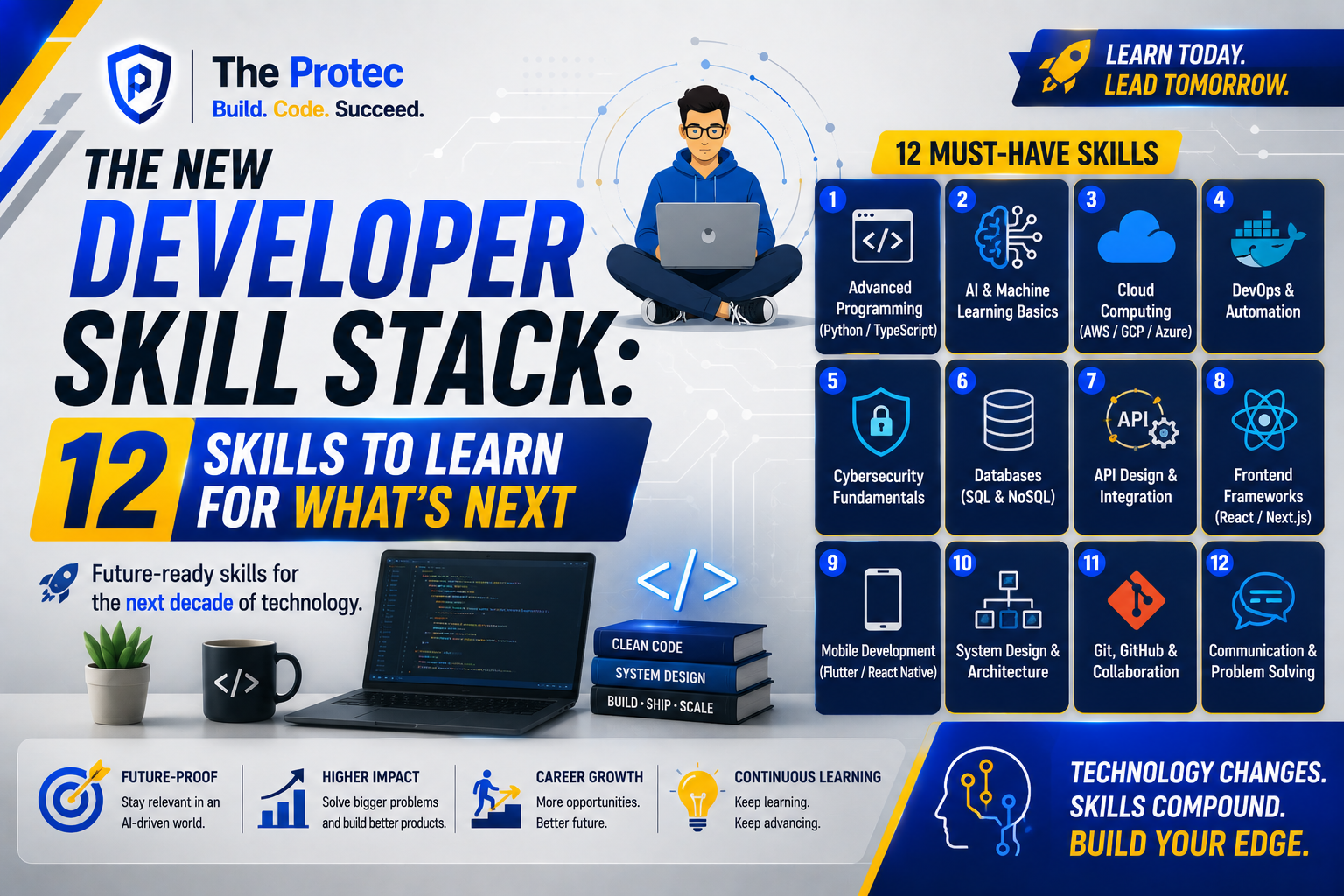
The definition of a capable programmer is expanding. Writing correct code still matters, but employers increasingly need developers who can guide AI tools, design resilient systems, automate delivery, secure software supply chains, and connect technical decisions to measurable outcomes. The strongest engineers are no longer defined by one language or framework. They operate across an interconnected skill stack, and this articles discuss these New Developer Skill Stack.
That shift is accelerating as AI coding agents move from autocomplete to multi-step implementation, cloud platforms become more abstract, and security requirements reach deeper into development workflows. As of August 2026, teams are learning that faster code generation does not automatically create better software. AI can produce more code, but experienced developers must still validate assumptions, manage complexity, protect data, and make sound architectural choices.
This developer skills 2027 roadmap combines durable computer science foundations with the capabilities shaping modern engineering. The goal is not to master every tool. It is to build enough depth across 12 complementary areas to design, deliver, and improve software with confidence.
The developer skills 2027 roadmap: what has changed?
Traditional programming knowledge remains the base, but the value is moving upward. Developers must understand how systems behave beyond a local editor: how models use context, how services fail, how identity crosses boundaries, how deployments are governed, and how users experience the result.
- Fundamentals provide judgment: They help developers detect weak AI-generated solutions.
- Platforms provide leverage: Cloud services, automation, and internal tooling reduce repetitive work.
- Architecture provides resilience: System design keeps rapidly produced software maintainable.
- Product awareness provides direction: It ensures teams solve worthwhile problems.
12 future software developer skills to learn now
1. Deep programming and computer science fundamentals
AI makes foundational knowledge more valuable, not less. Developers need data structures, algorithms, concurrency, networking, memory management, databases, and operating-system concepts to evaluate generated code and diagnose subtle failures. Learn at least one language deeply enough to understand its runtime, type system, error model, package ecosystem, and performance characteristics. Practice reading unfamiliar code, profiling applications, and explaining trade-offs rather than merely producing syntax. These abilities transfer when frameworks and coding tools change.
2. AI-assisted software engineering
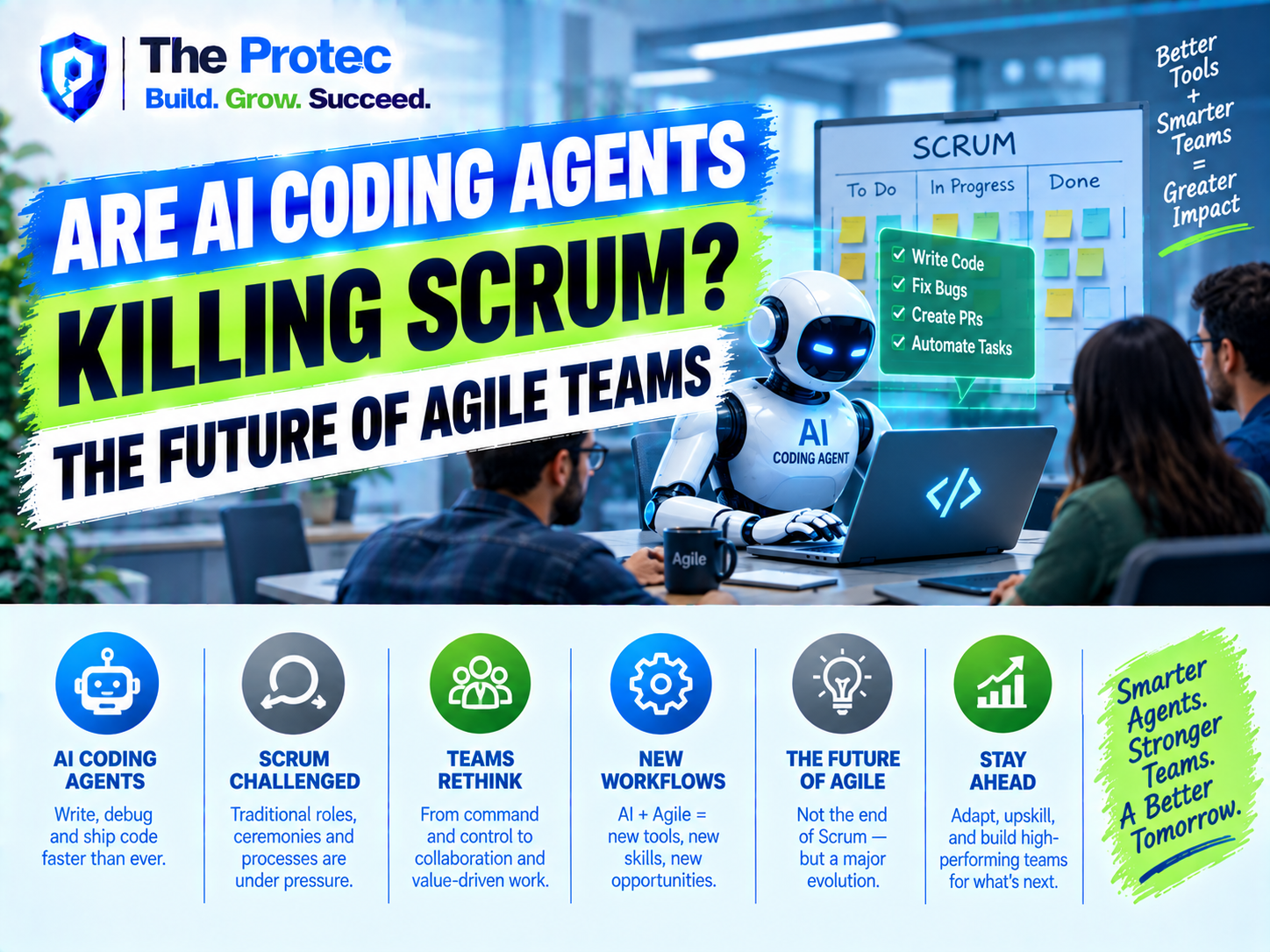
Effective AI use is becoming a standard engineering competency. Go beyond prompting for isolated functions. Learn to give coding agents clear constraints, useful repository context, acceptance criteria, and verification steps. Break large tasks into reviewable units, compare proposed approaches, and inspect every dependency or migration an agent introduces. Developers should also understand context windows, tool permissions, model limitations, and the privacy implications of sharing source code. The objective is supervised acceleration, not uncritical code generation.
3. AI application engineering and evaluation
Building software with language and multimodal models requires more than calling an API. Learn retrieval-augmented generation, embeddings, structured outputs, tool calling, model routing, caching, guardrails, and human approval patterns. Agent interoperability protocols are also becoming relevant as applications connect models to tools and enterprise data. Most importantly, learn evaluation: create representative test sets and measure accuracy, latency, cost, safety, and task completion. Review the OWASP guidance for generative AI security before deploying model-powered features.
4. Distributed system design
System design is one of the most durable programming skills for the future. Study service boundaries, load balancing, caching, replication, partitioning, queues, idempotency, consistency, and failure recovery. Learn when a modular monolith is preferable to microservices and why every network call creates another failure mode. Practice drawing data flows and estimating capacity before choosing infrastructure. Strong designers optimize for understandable operations and incremental change, not fashionable complexity.
5. Cloud-native architecture and platform engineering
Developers should understand containers, orchestration, serverless computing, managed data services, identity, networking, and cost controls across at least one major cloud platform. Kubernetes knowledge remains useful, but operating clusters is not the goal for every team. Platform engineering is shifting complexity into reusable golden paths, self-service environments, and paved-road deployment templates. Learn to consume and contribute to those platforms while recognizing portability, vendor lock-in, regional availability, and operational cost trade-offs.
6. Secure development and software supply chain protection
Security can no longer wait for a final review. Learn threat modeling, least privilege, secure authentication, authorization, encryption, secrets management, dependency scanning, and common web vulnerabilities. Modern developers must also understand software bills of materials, artifact signing, provenance, protected build pipelines, and dependency risks. Treat model outputs and third-party packages as untrusted inputs. A valuable exercise is to map how code travels from a laptop to production and identify where tampering, credential theft, or excessive access could occur.
7. API design and event-driven integration
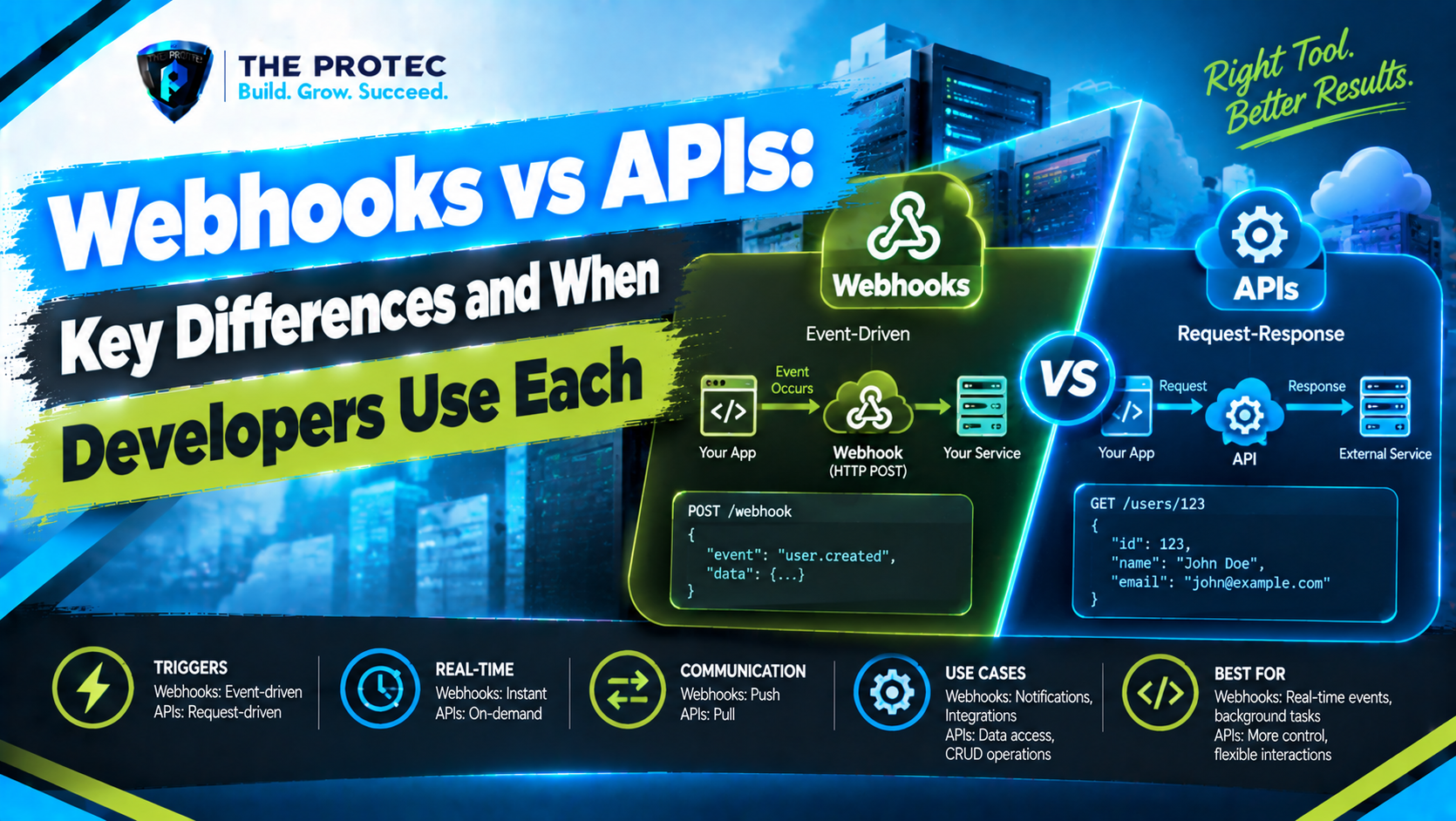
Software increasingly succeeds through integration. Developers should design predictable REST, GraphQL, RPC, webhook, and asynchronous event interfaces while understanding versioning, pagination, authentication, rate limits, and backward compatibility. For message-based systems, study delivery guarantees, schema evolution, dead-letter handling, ordering, and idempotent consumers. Clear contracts matter even more when AI agents invoke tools automatically. Well-designed interfaces reduce coupling and allow services, applications, and automated workflows to evolve independently.
8. Data engineering and data literacy
AI products and conventional applications both depend on trustworthy data. Learn relational modeling, SQL, indexing, transactions, analytical storage, streaming concepts, data quality, lineage, and privacy controls. Understand the differences among operational databases, warehouses, lakehouses, vector stores, and caches rather than treating them as interchangeable. Developers should be able to trace where data originated, how it was transformed, and whether it is suitable for a decision. Data literacy prevents impressive interfaces from being built on unreliable evidence.
9. Infrastructure as code and delivery automation
Manual environments create drift, slow recovery, and hide operational knowledge. Learn infrastructure as code, continuous integration, continuous delivery, GitOps principles, policy as code, and safe release strategies such as canaries and feature flags. Pipelines should run tests, security checks, dependency reviews, and artifact verification consistently. Automation skills also include knowing where approval is necessary. High-performing teams automate routine decisions while preserving human review for destructive changes, sensitive data access, and significant production risk.
10. Modern testing and reliability engineering
As teams generate code faster, verification becomes the bottleneck. Build a balanced testing strategy that includes unit, integration, contract, end-to-end, property-based, performance, and security tests. Learn to use production-like environments without copying sensitive data. Reliability engineering adds service-level indicators, objectives, error budgets, graceful degradation, and incident learning. Tests should protect important behavior rather than inflate coverage percentages. For AI features, account for nondeterminism with evaluation thresholds, regression datasets, and monitored fallback paths.
11. Observability and performance engineering
Logs alone rarely explain a distributed failure. Developers should correlate metrics, traces, logs, profiles, deployments, and user impact. Open standards such as OpenTelemetry make instrumentation more portable across services and vendors. Learn to define useful telemetry during feature design, not after an incident. Performance skills should cover database queries, network latency, memory use, browser rendering, and cloud spend. The key question is not whether a service is running, but whether users are receiving an acceptable experience.
12. Product thinking, communication, and technical leadership
The final skill is what turns technical ability into impact. Developers need to clarify ambiguous requirements, challenge weak assumptions, write concise design documents, explain risk, and collaborate across product, design, security, and operations. Learn to connect architecture choices to customer value, delivery time, and total cost. Seniority increasingly means improving team decisions rather than owning the most code. Clear communication also makes AI-assisted work safer because assumptions, constraints, and acceptance criteria become explicit and reviewable.
How to build the skill stack without learning everything at once
Start with a T-shaped assessment
Choose one area for depth—such as backend engineering, frontend systems, mobile development, data, or cloud infrastructure—then score your familiarity with the other 11 skills. Identify the two gaps most likely to limit your current projects. A frontend specialist might prioritize observability and AI integration, while a backend engineer may need stronger security and product communication.
Build one integrated project
A single realistic project teaches more than disconnected tutorials. Create a small application with an authenticated API, relational database, asynchronous job, AI-powered feature, automated tests, infrastructure code, CI/CD pipeline, telemetry, and a basic threat model. Document architectural decisions and operating costs. The project does not need massive scale; it needs enough moving parts to expose genuine trade-offs.
Use a quarterly learning cycle
- Month one: Study concepts and reproduce small examples.
- Month two: Apply the skill to a project with explicit constraints.
- Month three: Operate, measure, review, and explain the result to another developer.
Repeat the cycle with a new skill while maintaining your area of depth. This approach creates practical evidence of learning and prevents tool collecting from replacing engineering competence.
Frequently asked questions
Which developer skills will be most valuable in 2027?
AI-assisted engineering, system design, cloud architecture, application security, automation, testing, and observability will be especially valuable. However, their usefulness depends on strong programming fundamentals and communication. Employers need developers who can combine these capabilities to deliver reliable outcomes, not candidates who simply list popular tools.
Will AI coding agents replace the need to learn programming?
No. They will reduce the time spent on routine implementation, but they also increase the amount of code that must be evaluated. Developers still need to model problems, select architectures, verify behavior, protect data, and handle failures. Programming knowledge is what allows someone to distinguish a plausible answer from a production-ready solution.
Should developers learn multiple programming languages?
Learn one language deeply, then become comfortable reading and using a second language with a different model or ecosystem. For example, pair TypeScript or Python with Go, Rust, Java, or C#. The goal is not collecting languages. It is understanding which runtime, type system, performance profile, and ecosystem fit a particular problem.
Is cloud certification necessary for the future skill stack?
Certification can provide a structured foundation and help with cloud-focused roles, but practical experience matters more. Developers should be able to deploy an application, configure identity and networking, automate infrastructure, observe behavior, estimate cost, and recover from failure. A small operational project demonstrates those abilities better than memorization alone.
How much cybersecurity should an application developer know?
Every developer should understand secure defaults, authentication, authorization, input handling, secrets, dependency risks, threat modeling, and incident reporting. Specialists will handle deeper security disciplines, but application teams make daily choices that determine exposure. Security literacy is therefore a core engineering responsibility rather than an optional specialization.
Build capabilities that survive tool changes
The new developer skill stack is broad, but it has a clear structure: fundamentals create judgment, AI and automation create leverage, cloud and system design create scale, security and reliability create trust, and product thinking creates value. Developers who strengthen these future software developer skills now will be prepared not only for 2027, but for the platform shifts that follow.