








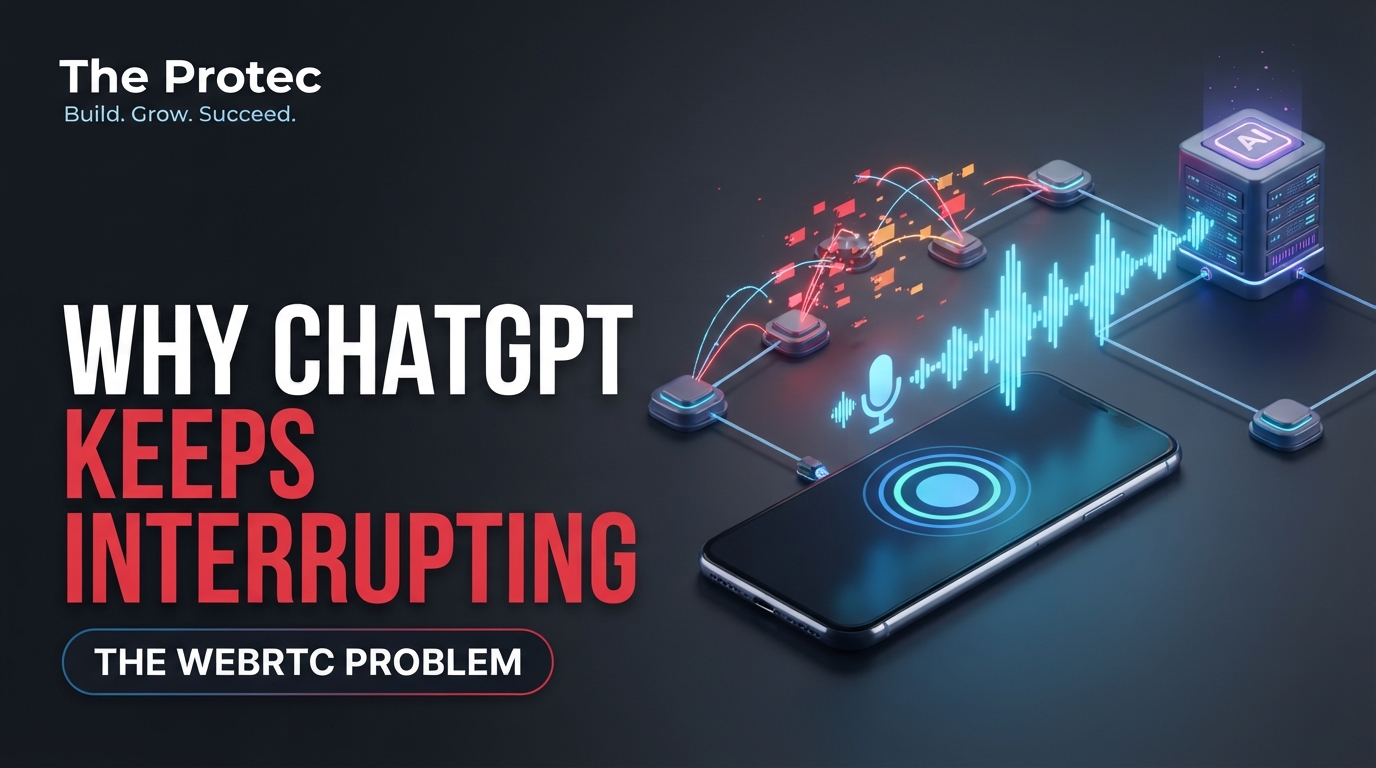
A voice assistant can feel remarkably natural until a syllable disappears, a response starts late, or an interruption fails to stop the speaker. The OpenAI WebRTC problem is the argument that these failures are not merely model issues: they can also reflect a transport stack designed for human video calls rather than stateful conversations with an AI. An October 2026 technical article from the Media over QUIC community sharpened that criticism, proposing MoQ as a better foundation for interactive AI audio. The underlying networking concerns are real, but claims about OpenAI’s production performance require careful qualification.
The short answer is that WebRTC prioritizes timely playback over perfect delivery. That is usually the correct choice for live communication, because audio arriving after its playback deadline has little value. For an AI assistant, however, a lost fragment may contain a name, a negation, a number, or the moment when a user says, “stop.” Small losses can therefore affect recognition, turn-taking, generated speech, and the user’s confidence in the entire conversation.
What the OpenAI WebRTC problem claim actually means
The October article, “OpenAI Still Has a WebRTC Problem”, should be read as a technical argument from MoQ advocates, not as independent proof of a specific defect or outage inside OpenAI’s production network. Its criticism is architectural: conventional WebRTC media handling can make AI voice interruptions, dynamic outputs, and selective reliability harder to express than they would be in a transport built around media objects and priorities.
Public symptoms such as ChatGPT voice latency or interrupted audio do not identify one root cause. Delays can arise from radio congestion, Wi-Fi roaming, cellular handoffs, server load, speech detection, inference, synthesis, device audio processing, or application logic. Without OpenAI telemetry, packet captures, and end-to-end timing data, it is not possible to assign any particular user report to WebRTC packet loss.
What can be established independently is that packet loss, jitter, and late delivery are persistent challenges for every low-latency media system. WebRTC mitigates them effectively for calls, but its choices do not always align with the semantics of real-time AI voice.
How WebRTC handles live audio
A typical WebRTC session discovers a network path with ICE, secures media, and carries encoded audio in timestamped RTP packets, commonly over UDP. Sequence numbers reveal missing packets, while timestamps tell the receiver when audio belongs on the playback timeline. RTCP feedback provides information about reception and network conditions. The broader behavior is defined through standards collected in the W3C WebRTC specification and related IETF documents.
The WebRTC jitter buffer
Packets do not arrive at perfectly even intervals. A jitter buffer temporarily holds them, reorders packets that arrive out of sequence, and releases audio at a steadier rate. A larger buffer can absorb more network variation, but it also increases conversational delay. A smaller buffer reduces latency while making late packets more likely to miss their deadline.
This creates a fundamental trade-off. If the receiver waits for every uncertain packet, ChatGPT voice latency rises and turn-taking feels sluggish. If it plays immediately, more gaps must be concealed. Adaptive buffers change their delay as conditions evolve, but no algorithm can remove the underlying conflict between immediacy and completeness.
Loss concealment, redundancy, and retransmission
When an audio packet is missing, a decoder may use packet-loss concealment to estimate a plausible replacement from nearby sound. Codecs can also employ forward error correction or redundancy, allowing some losses to be recovered without a round trip. These techniques work best for short, isolated gaps; they cannot reliably reconstruct arbitrary words or sustained bursts of missing audio.
Audio packet retransmission is possible in real-time systems, but usefulness depends on timing. A receiver can report a missing packet and request another copy, yet the copy may arrive after that sound should have played. On a long or unstable path, retransmission can either be ignored as too late or force additional buffering. Video can sometimes wait for an important frame. Conversational audio has deadlines measured by human perception.
Why modest packet loss can disrupt an AI conversation
In a human call, listeners use context and ask for repetition. An AI pipeline may make several irreversible decisions before anyone notices a gap. Consider the sentence, “Do not cancel the Tuesday booking.” If loss obscures “not,” automatic speech recognition could receive a materially different instruction. Even when the transcript is correct, missing synthesized audio can make the assistant sound as though it skipped an explanation.
AI voice streaming also includes control events that ordinary calls do not emphasize. A system may detect speech, commit an input turn, begin model generation, stream text and audio, and cancel output when the user barges in. Those events have different priorities. A cancellation signal is more urgent than an old audio segment, while a transcript or tool result may require reliable delivery even if it can tolerate slightly more delay.
ChatGPT voice interruptions are especially demanding because stopping playback is not enough. The client, server, model, and audio queue must agree about which generation is current. If stale audio remains buffered, the assistant may continue speaking after the user interrupts. If speech detection fires too aggressively, normal background noise can cancel a valid response. Transport design cannot solve all of that, but it influences how quickly and clearly those state changes propagate.
Media over QUIC as an alternative
Media over QUIC, usually called MoQ, is an emerging approach for publishing and subscribing to media through QUIC-based transports. Rather than treating a session primarily as fixed call tracks with a continuous playback timeline, MoQ organizes media into named tracks and objects that applications can discover, prioritize, cache, or stop requesting according to their needs.
That model is attractive for AI voice agent architecture. An application could use separate dynamic tracks for microphone audio, synthesized speech, transcripts, control events, or successive model generations. New output could supersede old output. High-priority interruption information could move independently of less useful queued media, while objects that have passed their deadline could be abandoned instead of consuming bandwidth.
QUIC also avoids transport-wide head-of-line blocking across independent streams. Loss on one stream need not prevent unrelated streams from progressing, although ordered data within an individual stream can still wait behind missing bytes. MoQ’s benefits therefore depend on sensible object boundaries, priorities, delivery modes, and application behavior; the word “QUIC” alone does not guarantee lower latency.
WebRTC vs. QUIC and MoQ: an architecture comparison
A conventional WebRTC voice path
- The browser captures and processes microphone audio.
- WebRTC negotiates connectivity, security, codecs, and media transport.
- RTP packets feed a remote speech and model pipeline.
- Generated audio returns as a real-time media stream.
- Jitter buffers and playback queues attempt to keep sound continuous.
- Application data channels or signaling carry events such as turn state and cancellation.
This architecture is mature, broadly supported, and optimized by browser and operating-system vendors. It handles echo cancellation, device permissions, congestion control, NAT traversal, and secure media—capabilities that are difficult and expensive to reproduce.
A possible MoQ-oriented voice path
- The client publishes captured audio as time-sensitive media objects.
- The service subscribes to input and publishes separate output and control tracks.
- Audio, transcripts, and interruption signals receive different priorities and reliability policies.
- A new generation can replace or invalidate objects belonging to an interrupted response.
- Relays can forward objects according to subscribers’ current interests.
The Pipecat MoQ integration discussed by the article demonstrates how this object-oriented approach can be connected to a real-time AI framework. It is evidence that the architecture can be prototyped for AI voice streaming, not proof that it will outperform WebRTC on every network, browser, device, or workload.
Why MoQ is not a drop-in WebRTC replacement
WebRTC is more than a packet format. It includes years of interoperability work, browser APIs, media capture, acoustic processing, security, NAT traversal, codec negotiation, and congestion-control behavior. MoQ focuses on media distribution semantics over QUIC; applications still need capture APIs, audio processing, identity, authorization, session control, playback scheduling, and resilient fallback paths.
Browser compatibility is another practical constraint. WebRTC is available across mainstream browsers without requiring a site to implement an entire media stack. MoQ deployments may depend on WebTransport or other QUIC-facing capabilities, and support can differ by platform, network, and implementation. Enterprise firewalls and restrictive networks may also treat new QUIC traffic differently from established WebRTC or HTTPS paths.
Migration would require more than replacing one connection object. Providers would need new gateways, observability, congestion policies, load testing, fallback behavior, and operational expertise. Hybrid designs are therefore plausible: WebRTC could continue handling capture and widely compatible media sessions, while MoQ-style paths manage AI-specific output, prioritized events, or distribution between services and edge locations.
Latency and reliability must be designed together
The goal is not maximum reliability for every byte. It is delivering the right information before it loses value. A 200-millisecond-old cancellation can remain critical, while an old speech chunk may be harmful because playing it contradicts the current turn. Conversely, final transcripts, tool confirmations, and account actions may require reliable processing even when audio is abandoned.
Good real-time communication protocols expose enough information for applications to make those distinctions. MoQ offers a promising vocabulary through tracks, objects, subscriptions, and priorities. WebRTC offers a proven low-latency media system with enormous deployment reach. Engineers must measure mouth-to-ear delay, interruption response, loss bursts, recovery behavior, and state consistency rather than comparing protocol names in isolation.
Will AI assistants need AI-native transport?
Future voice assistants may benefit from protocols designed around generated speech, replaceable outputs, semantic control messages, and rapidly changing subscriptions rather than the assumptions of a conventional video call. MoQ is a credible direction because it lets applications express more about the value and lifetime of media.
Still, WebRTC audio problems do not make WebRTC obsolete. Its ecosystem remains a major advantage, and many perceived voice failures occur above or below the transport layer. The likely near-term outcome is experimentation and hybrid architecture, followed by evidence from production measurements. The OpenAI WebRTC problem is best understood as an important design debate—not a confirmed single-cause diagnosis of ChatGPT voice quality.
Frequently asked questions
Does WebRTC guarantee that every audio packet arrives?
No. Real-time playback often favors timely delivery over waiting for every packet. Jitter buffers, concealment, error correction, and selective retransmission reduce damage, but packets that arrive after their deadline may be useless.
Can packet loss make ChatGPT misunderstand a user?
It can contribute. Missing audio may affect speech recognition, especially when the lost fragment contains a short but important word. However, recognition errors can also come from noise, microphones, accents, speech detection, or model behavior.
Is MoQ automatically faster than WebRTC?
No. Performance depends on implementation, network conditions, buffering, congestion control, object design, and server placement. MoQ’s advantage is greater flexibility in prioritizing and abandoning data according to application semantics.
Can MoQ fix failed voice interruptions by itself?
No. It can provide cleaner mechanisms for separating generations and prioritizing control information, but interruption quality also depends on voice activity detection, cancellation logic, synthesis, playback queues, and synchronized client-server state.