








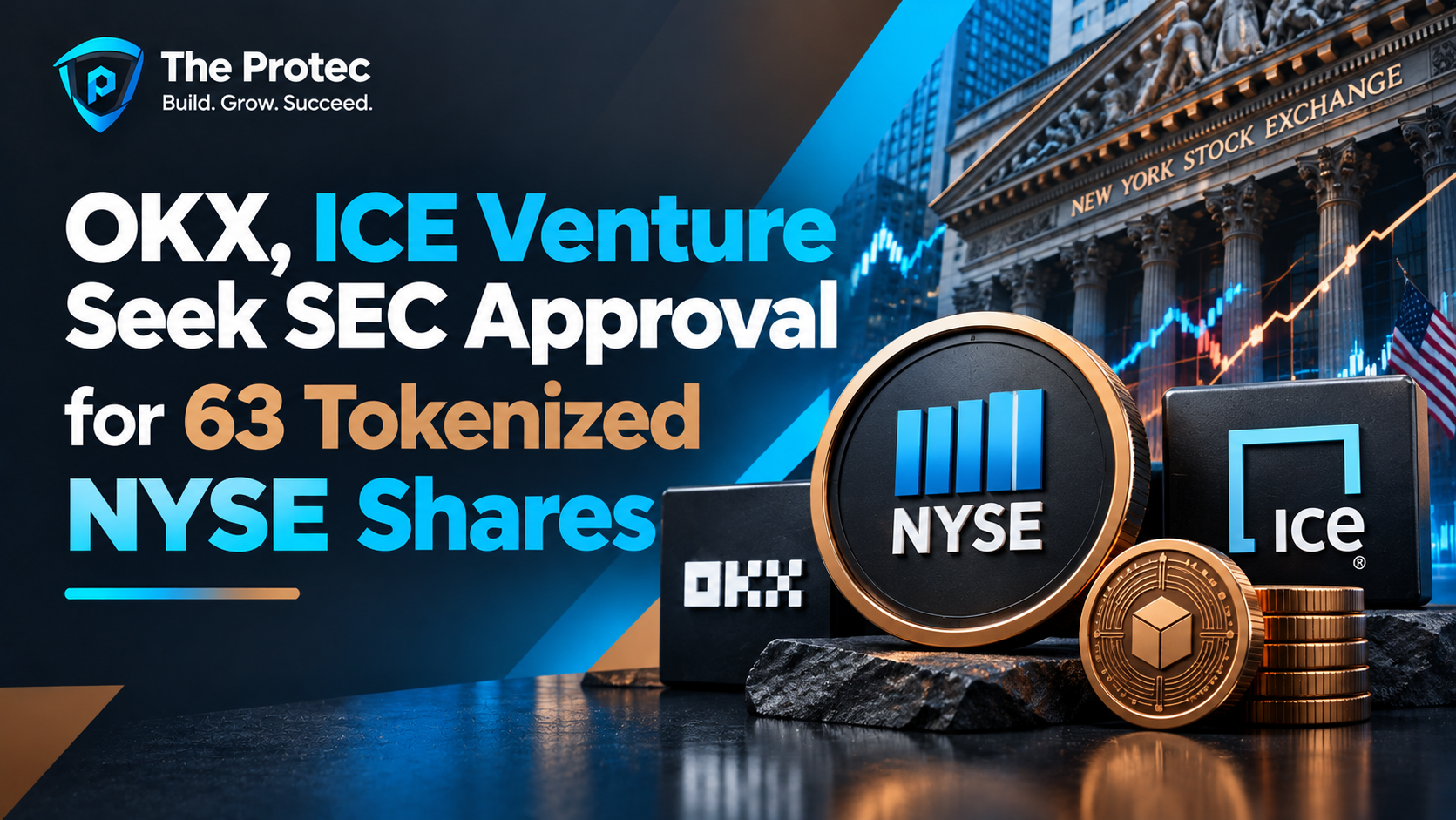
A reported effort involving OKX and a venture backed by Intercontinental Exchange, the parent company of the New York Stock Exchange, is putting tokenized equities back at the center of the digital-asset debate. The initiative is said to seek US Securities and Exchange Commission approval for products tied to shares of 63 NYSE-listed companies.
The proposal matters because it connects two previously distinct markets: conventional US equities traded through regulated exchange infrastructure and blockchain-based assets capable of moving between approved digital wallets. If authorized and properly structured, the products could demonstrate how traditional stocks might operate on blockchain rails without abandoning securities law.
However, seeking SEC approval is not the same as receiving it. The reported OKX SEC application or regulatory initiative should not be interpreted as confirmation that these tokenized shares are authorized, trading or available to US investors. The SEC’s assessment, the legal form of each token and the regulated entities responsible for trading, custody and settlement will determine whether the plan can move forward.
The reported initiative concerns tokenized products tied to 63 companies listed on the NYSE. In simple terms, tokenization would use blockchain-based records to represent an ownership interest, beneficial claim or other economic exposure connected to a conventional share.
That distinction is crucial. A token bearing the name or ticker of a public company is not automatically equivalent to a share recorded through the established US market system. Depending on its structure, it could represent direct legal ownership, a beneficial interest in shares held by a custodian, an interest issued by a special-purpose vehicle or merely a contractual claim tracking the share’s price.
Reports that OKX and an ICE-backed venture are seeking authorization therefore leave several questions open. Regulators and investors would need to know who issues the tokens, what assets back them, where the underlying shares are held, how redemptions work and which legal rights pass to token holders.
The number 63 describes the reported scope of the planned offering. It does not mean 63 NYSE companies have endorsed the project, issued their own blockchain stocks or agreed to replace their conventional shares. Unless an issuer participates directly, tokenization may be performed by a third party using shares acquired and held within a separate custody structure.
How Traditional Stocks Can Be Represented on a Blockchain
Stock tokenization places a digital representation of an equity interest on a distributed ledger. The blockchain can record issuance, transfers and wallet balances, while the underlying legal and custody arrangements connect those records to real securities.
A robust tokenized-equity model could involve several layers:
- Underlying shares: Conventional shares are purchased and held with a qualified or otherwise legally permitted custodian.
- Digital tokens: Blockchain-based units represent defined rights associated with those shares.
- Identity controls: Only verified and eligible investors can hold or transfer the digital securities.
- Transfer restrictions: Smart contracts enforce jurisdictional, sanctions and investor-qualification rules.
- Corporate actions: Dividends, splits, mergers and voting instructions are processed under disclosed procedures.
- Redemption: Eligible holders may be able to convert tokens into cash or, where supported, conventional shares.
The quality of the link between the token and the underlying asset is more important than the blockchain itself. Investors need an enforceable claim, reliable reconciliation and protection if an issuer, platform or custodian fails. Without those elements, traditional stocks on blockchain infrastructure could introduce legal uncertainty rather than remove financial friction.
Why ICE’s Involvement Is Significant
Intercontinental Exchange operates major financial-market infrastructure and owns the NYSE. A venture with ICE backing therefore brings institutional significance to the discussion around NYSE stock tokenization. It suggests that blockchain-based equities are no longer being explored only by crypto-native startups.
ICE backing should not, however, be confused with NYSE approval, SEC authorization or participation by the 63 listed companies. The venture’s precise relationship with ICE, its role in the proposed structure and the entities assuming regulated responsibilities remain important. Even with a major market-infrastructure investor involved, every securities activity must fit within applicable US rules.
For OKX, tokenized US stocks could expand its role beyond cryptocurrency trading. Yet a crypto exchange cannot simply list digital representations of US securities under the same framework used for ordinary crypto assets. Securities brokerage, exchange operation, custody and clearing can trigger separate registration and compliance obligations.
Why Platforms Are Pursuing Tokenized Equities
Financial institutions and digital-asset platforms see tokenized equities as a potential bridge between deep public markets and programmable blockchain networks. The most frequently cited benefits include:
- Faster settlement: Blockchain systems could coordinate the exchange of assets and payment more quickly. US stocks currently settle on a T+1 basis, while an appropriately designed tokenized system could move closer to same-day or atomic settlement.
- Programmable ownership: Smart contracts can automate transfer restrictions, distribution calculations and selected corporate actions.
- Fractional access: Tokens can be divided into smaller units, potentially reducing the amount needed to gain exposure to high-priced shares.
- Unified digital infrastructure: Investors may eventually manage tokenized equities, funds, bonds and cash-like assets through interoperable regulated systems.
- Improved recordkeeping: Shared ledgers can provide participants with a synchronized history of eligible transactions.
- Broader distribution: Subject to local laws, digital infrastructure may help regulated intermediaries serve investors across multiple markets.
These benefits are not automatic. Faster settlement can require investors to prefund trades, potentially reducing capital flexibility. Fractional trading already exists through conventional brokers. Around-the-clock token transfers would also be difficult if liquidity, banking services, price discovery or the underlying NYSE market remained unavailable outside normal hours.
What SEC Approval for Tokenized Stocks Would Require
The phrase SEC approval tokenized stocks can make the process sound like a single application followed by one decision. In practice, the US framework is more complex. Different participants and activities may require separate registrations, exemptions or approvals.
The SEC would likely focus on whether the tokens are securities, how their offer and sale comply with the Securities Act, and whether the trading venue must register as a national securities exchange or operate through a registered alternative trading system. Broker-dealer participation, transfer-agent functions, market surveillance and customer-asset protections may also be relevant.
Key regulatory areas include:
- Accurate disclosures about token-holder rights and the relationship to underlying shares.
- Registration of offers and sales or reliance on a valid exemption.
- Rules governing broker-dealers, exchanges and alternative trading systems.
- Custody standards and segregation of customer securities and cash.
- Anti-money-laundering, sanctions and know-your-customer controls.
- Protection against manipulation, insider trading and misleading pricing.
- Reliable processing of dividends, voting rights and other corporate actions.
Readers can verify public company and securities filings through the SEC’s EDGAR database. The SEC’s investor education portal also provides background on what constitutes a security.
Authorization could also depend on the proposed distribution model. A product limited to institutions or non-US investors presents a different regulatory analysis from one offered broadly to US retail customers. Approval of one participant would not necessarily authorize every part of the ecosystem.
Investor Protection, Custody and Liquidity Questions
The central challenge for ICE tokenized shares is not creating a token. It is ensuring that token holders receive transparent, enforceable and operationally reliable rights.
Investors must know whether they own the underlying stock, a beneficial interest or a claim against an intermediary. Voting rights, dividends and access to issuer information can vary significantly between these structures. Token documentation would need to explain those differences clearly.
A custodian may need to hold one conventional share for every corresponding token in circulation. Independent verification, frequent reconciliation and controls preventing duplicate issuance would be essential. The treatment of assets during bankruptcy would be equally important.
Where Does Liquidity Come From?
A tokenized version of a heavily traded NYSE stock will not necessarily inherit the stock’s liquidity. If tokens trade in a separate venue, prices may diverge because of limited market makers, restricted operating hours or barriers to redemption. A credible mechanism connecting token prices to the underlying market would be necessary.
Can Tokens Move Between Wallets?
Digital securities cannot always circulate like permissionless cryptocurrencies. Wallets may have to be approved, identities verified and transfers blocked when legal requirements are not met. Lost keys, compromised wallets and erroneous transactions also require recovery and dispute-resolution procedures.
What the Initiative Could Mean for US Equity Tokenization
If regulators accept a compliant structure, the proposal could provide a model for bringing tokenized US stocks within existing securities protections. It could also encourage deeper collaboration among exchanges, custodians, transfer agents, broker-dealers and blockchain infrastructure providers.
The longer-term opportunity extends beyond putting familiar shares into digital wrappers. Blockchain-based equities could support programmable collateral, automated compliance and more direct connections between securities and tokenized cash. Regulated systems may eventually reduce reconciliation work across institutions and enable new approaches to settlement.
Still, integration is more likely than wholesale replacement. The existing US market supports enormous liquidity, established investor protections and resilient post-trade infrastructure. Successful tokenization will need to connect with that system rather than assume blockchain alone can replicate it.
What Investors Should Watch Next
Investors should watch for public filings, formal SEC orders and detailed disclosures identifying the issuer, custodian, trading venue and legal rights attached to each token. They should also distinguish pilot programs, exempt offerings and non-US products from a broadly authorized US retail launch.
Until regulators and the parties publish definitive terms, claims that OKX tokenized stocks or the 63 NYSE companies’ tokenized shares are available to US investors should be treated cautiously. A reported request for approval remains a proposal, not a completed authorization.
Frequently Asked Questions
Have OKX and the ICE-backed venture received SEC approval?
The initiative is reported as an effort to seek SEC approval. Seeking authorization does not establish that the SEC has granted it. Investors should rely on formal regulatory records and platform disclosures before assuming any product is legally available in the United States.
No such conclusion should be drawn from the reported application. Availability would depend on regulatory authorization, the investor’s jurisdiction, platform eligibility and the final structure of the products.
Not necessarily. It could represent direct ownership, beneficial ownership through a custodian or another contractual interest. Voting, dividends, redemption and bankruptcy protections depend on the legal documents and custody model.
Why would investors use tokenized equities?
Potential attractions include faster settlement, fractional ownership, programmable compliance and integration with other digital assets. Those benefits must be weighed against custody, technology, liquidity, legal and counterparty risks.
Does ICE backing mean the NYSE supports the offering?
Not automatically. Investment or backing from an ICE-related entity is different from NYSE approval, issuer participation or SEC authorization. The venture’s exact role and regulatory status must be evaluated separately.