








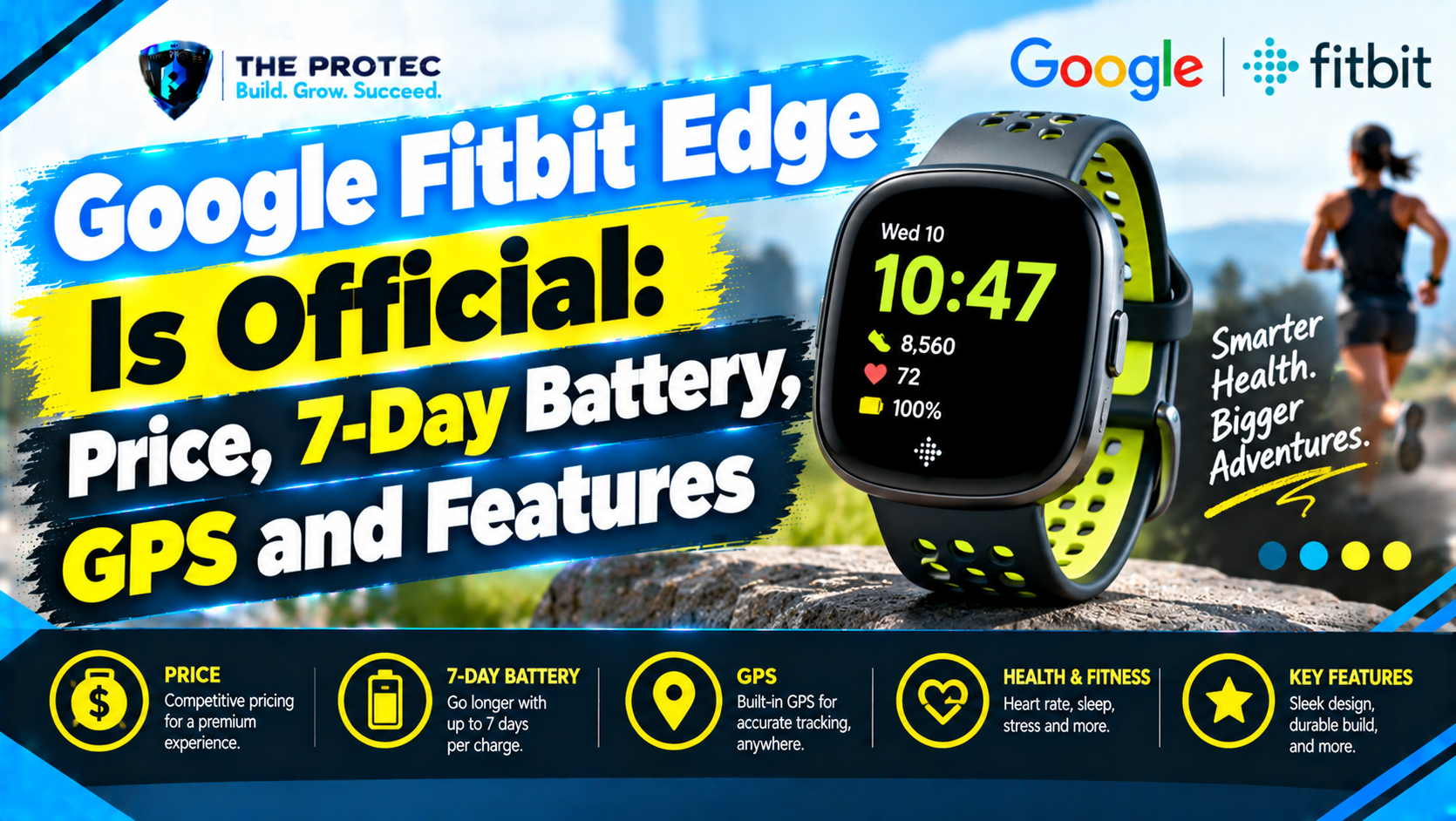
Google has officially unveiled the Google Fitbit Edge, a new fitness tracker designed for people who want a screen, built-in GPS, and advanced health tracking without carrying a full smartwatch on their wrist. Announced on October 12, 2026, the Fitbit Edge sits between the screenless Fitbit Air and the more capable Google Pixel Watch 5.
The new tracker costs $179.99, with preorders available now and retail availability scheduled for October 27. Its headline features include up to seven days of battery life, a replaceable battery, improved GPS accuracy, automatic workout detection, and on-wrist access to Google Health features. However, the device also makes some compromises, including the absence of NFC contactless payments.
Here’s everything you need to know about the Google Fitbit Edge, including its confirmed price, features, battery life, GPS improvements, compatibility, and how it compares with other Google wearables.
Google Fitbit Edge: Price and Release Date
Google Fitbit Edge is priced at $179.99 in the United States. Google opened preorders on October 12, 2026, and says the tracker will be available in stores starting October 27. Buyers receive a three-month Google Health Premium trial with their purchase.
Google is also offering a Stephen Curry Special Edition Fitbit Edge for $219.99. Developed with the basketball star and Google Performance Advisor, this version features a distinctive rye and game-day orange color scheme.
The standard Fitbit Edge comes in four finishes: Obsidian with a matte black case, Fog with a polished silver case, Olive with a satin pyrite case, and Canyon with a warm gold case. Buyers can also choose from interchangeable bands, including Active Sport, Performance Loop, Magnet, and Metal Links options. Some accessories are sold separately.
Google Fitbit Edge Specifications
- Display: Hybrid OLED touchscreen with 46% more viewing area than the Fitbit Charge 6
- Battery life: Up to seven days under Google’s stated test conditions
- Always-on display: Up to two days of battery life
- GPS: Built-in GPS with up to 40% improved tracking accuracy over previous Fitbit trackers
- Workout tracking: More than 50 exercise modes and automatic recognition of up to 100 workouts
- Health sensors: Optical heart-rate monitoring, ECG, and skin-temperature tracking
- Additional sensor: Altimeter for tracking elevation changes
- Water resistance: 5 ATM and IP68 ratings
- Battery design: User-replaceable battery
- Connectivity: Bluetooth, phone notifications, Google Maps directions, and media controls
- Compatibility: Most Android phones running Android 11 or later and iPhones running iOS 16.4 or later
- Price: $179.99 for the standard model and $219.99 for the Stephen Curry Special Edition
- Retail availability: October 27, 2026
Feature availability can vary by country, device, and subscription. Some advanced health and coaching features require Google Health Premium.
A Larger Display With a Redesigned Interface
One of the biggest changes is the Fitbit Edge’s display. Google says it provides 46% more viewing area than previous Fitbit trackers, making it easier to check workout statistics, health metrics, and notifications without repeatedly reaching for a phone.
The redesigned interface uses glanceable tiles and customizable watch faces to display information such as steps, weather, sleep, and heart rate. A physical side button also provides a more direct way to control the tracker, including pausing a workout.
Despite the larger screen, the Edge has a slim profile measuring 11.5mm thick. Its interface takes inspiration from Google’s newer wearable software, but the device is positioned as a focused fitness tracker rather than a full Wear OS smartwatch.
Up to Seven Days of Battery Life
Battery life is one of the Fitbit Edge’s main selling points. Google rates it for up to seven days on a single charge, although actual results depend on settings, usage, and the features enabled. Using the always-on display can reduce the stated maximum to approximately two days.
The tracker also supports fast magnetic charging. According to Google, five minutes of charging can provide up to a day of battery life under its test conditions. A full charge takes longer, and actual charging speed can vary depending on the power adapter, battery condition, and environment.
For people who track sleep and exercise throughout the week, longer battery life can mean fewer interruptions. However, frequent GPS workouts, an always-on display, and other power-intensive features may reduce the time between charges.
The Fitbit Edge Has a Replaceable Battery
Google has made repairability a key part of the Fitbit Edge’s design. The tracker features a user-replaceable battery, allowing owners to replace the battery rather than necessarily retiring the entire device when its capacity declines.
This is an important addition for a wearable intended to be worn during workouts, sleep, and everyday activities. A replaceable battery may help extend the device’s useful life, although replacement procedures, parts availability, and repair costs will influence how practical this is over time.
The battery is not the only consideration when evaluating long-term ownership. Screen wear, charging hardware, software support, and the availability of replacement bands can also affect how long a fitness tracker remains useful.
Improved GPS and Automatic Workout Detection
The Google Fitbit Edge includes built-in GPS for tracking outdoor activities without relying on a connected phone’s GPS receiver. Google claims up to 40% better GPS tracking accuracy compared with previous Fitbit trackers, attributing the improvement to its updated GPS hardware and device design.
The built-in altimeter adds elevation information, which can be useful during hill runs, hikes, stair workouts, and other activities involving changes in altitude. The tracker can also provide turn-by-turn directions through Google Maps when connected to a compatible phone.
Automatic activity detection has received an upgrade as well. Fitbit Edge supports more than 50 exercise modes that users can start from the wrist and can automatically recognize up to 100 types of workouts. This can help record activity when someone forgets to start a session manually, although automatic detection may not capture every workout perfectly.
Google’s updated activity-recognition system also considers context, including workout history and routines, to improve the way activities are categorized. Location-based context may be used with permission. These features are designed to make tracking more convenient, but users should review their settings if they prefer to limit location access.
Health Tracking Features and Google Health Coach
The Fitbit Edge combines continuous optical heart-rate monitoring with ECG assessments, skin-temperature tracking, sleep insights, heart-rate variability metrics, and recovery information. It also includes menstrual-cycle tracking and other wellness features through the Google Health app.
Google is integrating its Health Coach experience into the Edge, providing personalized guidance based on supported health and fitness information. Some coaching tools and advanced insights require a Google Health Premium subscription and an internet connection.
Google has also announced Health Guardian features that can track longer-term patterns related to blood pressure and insulin resistance. These are trend-based wellness insights, not real-time clinical measurements or diagnostic tests. Availability varies by country and device, and Google says these features are intended for general wellness rather than diagnosing or treating medical conditions.
The ECG feature can help users assess heart rhythm, but it does not replace a medical evaluation. Anyone with health concerns should consult a qualified healthcare professional rather than relying on a fitness tracker to make treatment decisions.
Notifications, Google Maps, and Music Controls
The Fitbit Edge offers several everyday features beyond fitness tracking. Users can view call, message, and app notifications, follow turn-by-turn directions from Google Maps, and control music playing on a connected Bluetooth device.
Google also supports quick replies to text messages, although the available options can depend on the connected phone and software configuration. These functions provide some of the convenience associated with a smartwatch without requiring the Edge to offer the same full app experience as a Pixel Watch.
There are important omissions, however. The Fitbit Edge does not include NFC for contactless payments, so it cannot replace a payment-enabled wearable for Google Wallet transactions. It also lacks a microphone and speaker for taking calls directly on the wrist. Buyers who consider these features essential should compare the Edge with a full smartwatch before purchasing.
Google Fitbit Edge vs. Fitbit Air
The Fitbit Edge and Fitbit Air target different preferences. Fitbit Air is a screenless tracker designed for people who want a less noticeable wearable focused on passive activity and health tracking. The Edge adds a display, a physical button, built-in GPS, and more direct access to workout information.
That extra functionality makes the Edge more suitable for people who want to check pace, distance, notifications, and health metrics directly on their wrist. The Air remains an option for people who prefer a minimalist device and do not need a screen during the day.
The Edge costs more, so the decision comes down to whether its display, GPS, and on-device controls justify the price difference. Both devices are part of Google’s broader move toward a connected Google Health experience.
Google Fitbit Edge vs. Pixel Watch 5
The Pixel Watch 5 is the more comprehensive smartwatch, with Wear OS and a broader range of apps and interactive features. The Fitbit Edge focuses more narrowly on fitness tracking, health information, notifications, and everyday essentials.
The Edge’s main advantages are its slim design, replaceable battery, and rated battery life of up to seven days. It may suit people who want to track workouts and sleep without charging a watch every day. The Pixel Watch 5 is a better fit for people who want a more capable smartwatch with a broader app ecosystem and richer wrist-based interactions.
Neither device is the right choice for everyone. Consider how often you use smartwatch apps, whether you need contactless payments, and how important battery life is before deciding.
Should You Buy the Google Fitbit Edge?
The Google Fitbit Edge looks like a meaningful addition to Google’s wearable lineup. It combines a larger display, built-in GPS, improved automatic workout detection, advanced health tracking, and a replaceable battery in a compact design. Its $179.99 price places it between a minimalist tracker and a more expensive smartwatch experience.
However, the missing NFC payments and wrist-call hardware are worth considering. The seven-day battery estimate also depends on how the tracker is used, and some advanced health insights require a paid subscription. Regional feature availability should be checked before buying.
If you want a screen-based fitness tracker with longer battery life and dedicated workout tools, the Fitbit Edge is worth considering. If you need Google Wallet payments, calls from your wrist, or a broad smartwatch app ecosystem, compare it with the Pixel Watch 5 and other smartwatches first.
Frequently Asked Questions
How much does the Google Fitbit Edge cost?
The standard Google Fitbit Edge costs $179.99 in the United States. The Stephen Curry Special Edition costs $219.99. Prices and availability may vary by market.
When will the Fitbit Edge be available?
Google opened preorders on October 12, 2026, and says the tracker will be available in stores starting October 27, 2026.
How long does the Fitbit Edge battery last?
Google rates the battery for up to seven days under its stated test conditions. With the always-on display enabled, the stated maximum falls to approximately two days. Actual battery life varies with usage and settings.
Does the Fitbit Edge have built-in GPS?
Yes. It has built-in GPS for recording outdoor activities without carrying a phone and supports Google Maps turn-by-turn directions when connected to a compatible phone.
Can the Fitbit Edge make contactless payments?
No. The Fitbit Edge lacks NFC, so it does not support contactless payments through Google Wallet.
Does the Fitbit Edge work with iPhones?
Yes. Google says the Fitbit Edge works with most Android phones running Android 11 or later and iPhones running iOS 16.4 or later. A Google Account and the Google Health app are required, and some features vary by platform or region.
Does the Fitbit Edge require Google Health Premium?
Basic tracking is available without the premium subscription, but some advanced health insights and coaching features require Google Health Premium. Check Google’s current feature and subscription details before purchasing.
Bottom line: The Google Fitbit Edge is now official, and its combination of built-in GPS, a replaceable battery, a display, and up to seven days of rated battery life makes it a notable new fitness tracker. Its value will depend on whether you prefer a focused fitness device over a full smartwatch—and whether its missing payment and wrist-call features matter to you.