








Camera-equipped glasses are moving from novelty to everyday technology. That shift has created a difficult privacy question: How can someone know when an ordinary-looking pair of glasses is capturing their face, voice or surroundings?
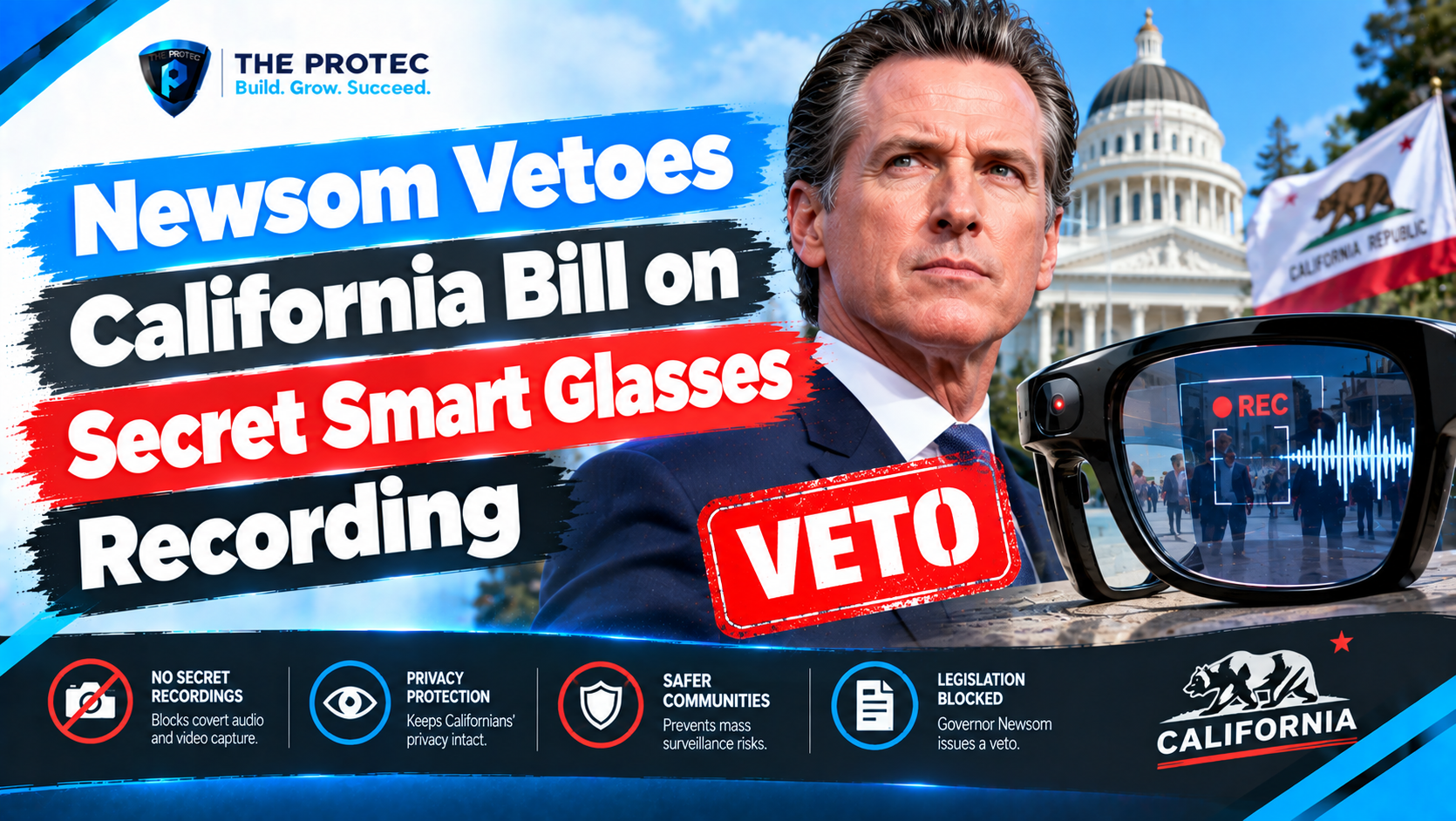
California lawmakers attempted to address that concern with legislation targeting secret recordings made through smart glasses. Governor Gavin Newsom vetoed the measure, leaving its proposed restrictions unenacted and prompting fresh debate over whether existing privacy rules can adequately govern increasingly discreet AI wearables.
The Gavin Newsom smart glasses bill veto does not mean that covert recording is broadly lawful in California. Depending on the circumstances, existing laws governing confidential communications, invasive images, harassment, trespass and intrusion into private spaces may still apply. Instead, the veto means that the proposed smart-glasses-specific rules did not become law.
The distinction matters as products such as Ray-Ban Meta glasses combine cameras, microphones, speakers and artificial intelligence in frames that resemble conventional eyewear. Unlike a raised smartphone, these devices can capture events from the wearer’s first-person perspective without creating an unmistakable visual signal for everyone nearby.
What the California Smart Glasses Recording Bill Targeted
The vetoed measure focused on the risk that wearable cameras can record people without meaningful awareness. Its central approach was to create clearer rules for smart glasses and their recording indicators rather than relying entirely on statutes written before consumer AI eyewear became widely available.
As described in the proposal, the targeted devices were glasses or similar wearable eyewear equipped to capture audio, photographs or video. The measure addressed several closely related practices:
- Using camera-equipped eyewear to make an undisclosed recording of another person under covered circumstances.
- Intentionally disabling, obscuring or interfering with a device’s recording indicator.
- Using altered or concealed indicators to make the recording function less apparent to people nearby.
- Establishing smart-glasses-specific expectations around notice, visibility and consent.
The proposal was therefore narrower than a general ban on wearable cameras. It sought to address conduct associated with concealed capture, particularly where a wearer defeats or hides a light intended to show that the camera is operating.
That focus reflects a practical limitation of current product design. Recording lights are typically small, may be difficult to see in bright conditions and may not be understood by bystanders. Online demonstrations have also shown attempts to cover indicators with tape, dark material or physical modifications. The existence and effectiveness of those methods vary by product, but they have contributed to smart glasses surveillance concerns.
The full legislative history and enrolled measures can be reviewed through the California Legislative Information portal.
Why Gavin Newsom Vetoed the Smart Glasses Bill
Newsom’s veto reasoning centered on the relationship between the proposal and California’s existing privacy and recording framework. The governor’s position was that state law already regulates significant forms of nonconsensual recording and that creating a device-specific offense could produce overlap, ambiguity or unintended consequences.
The veto also reflected concern about writing criminal or privacy rules around one particular form factor. A tiny camera can be built into glasses, a pendant, a button, a helmet, a phone or another wearable device. Legislation centered on eyewear could treat similar conduct differently depending on which hardware performs the recording.
That technology-specific problem is likely to grow. AI wearables are evolving quickly, and a statutory definition drafted for today’s glasses may not fit tomorrow’s contact lenses, earbuds with imaging capabilities or clothing-integrated cameras. From this perspective, regulating harmful conduct may prove more durable than regulating a single product category.
Another concern was breadth. Smart glasses can be used for accessibility, hands-free documentation, personal safety, news gathering and recording public events. A rule framed too broadly around knowledge or consent could affect legitimate capture in places where people ordinarily have limited expectations of visual privacy.
The governor’s reasoning should not be read as a finding that every concern raised by the bill was unfounded. A veto establishes that the governor declined to approve that measure in its presented form. It does not resolve the broader policy question or prevent lawmakers from returning with a narrower California smart glasses privacy law.
What Supporters Said the Bill Would Accomplish
Supporters argued that smart glasses alter the practical balance between recording and awareness. A person holding a phone at eye level usually gives people nearby a recognizable cue. A person wearing camera-enabled glasses may appear to be looking normally at the subject, even while capturing video or issuing a voice command to an AI assistant.
From that viewpoint, existing laws may not deliver enough notice before a privacy violation occurs. A person cannot object, move away or withhold sensitive information if that person does not realize a recording is underway.
Supporters also emphasized that audio and video are not equivalent. Visual recording in an open public space is often treated differently from recording a confidential conversation. Yet smart glasses can capture both streams at once, upload them to connected services and potentially subject the material to automated transcription or AI analysis.
A wearable camera may collect more than a conventional snapshot. Depending on its features and settings, it can preserve voices, names, locations, computer screens, documents, children, medical discussions and the interiors of homes or workplaces. AI systems may then summarize, categorize or search that content. Advocates viewed visible indicators and rules against tampering as basic safeguards against covert collection.
Supporters did not necessarily claim that all smart-glasses recording should require consent. Their argument was that deliberately defeating notice mechanisms, or secretly recording in contexts where privacy is reasonably expected, presents a distinct harm deserving clearer treatment.
Why Opponents Questioned the Proposed Regulation
Opponents and skeptics raised concerns about enforceability, scope and unintended effects. A light on a pair of glasses does not guarantee that everyone can see or interpret it. Conversely, a device may activate an indicator during harmless functions, making the signal an imperfect proxy for prohibited recording.
Questions also arose over how consent would work in crowds, at protests, during sporting events or in other public settings. Requiring affirmative consent from every person incidentally captured could make ordinary documentation impractical. Critics warned that uncertain rules could discourage lawful recording, including evidence of misconduct or dangerous events.
Accessibility was another consideration. People with disabilities may use wearable cameras for navigation, object identification, reading text or receiving descriptions of their surroundings. An overly broad AI glasses privacy law could interfere with tools that provide independence, even where long-term recording is not the user’s primary purpose.
Journalists, witnesses and victims may also have legitimate reasons to document events discreetly. That does not make every secret recording lawful, but opponents argued that exemptions and definitions would need to be drafted carefully.
These arguments do not establish that the proposal would inevitably have caused those outcomes. They illustrate the trade-offs policymakers face when a device can function simultaneously as a camera, microphone, accessibility tool, communications system and AI interface.
How Smart Glasses Record From a First-Person Perspective
Modern smart glasses generally place a camera near the wearer’s eye line. This produces a first-person view that follows whatever direction the wearer faces. Built-in microphones can capture the wearer’s commands as well as surrounding conversations, while speakers allow interaction without taking out a phone.
That design makes recording frictionless. A user may be able to begin capturing content by pressing a small control or speaking a command. Photos and clips can then synchronize with a companion app, be shared to social platforms or be processed through cloud-based AI features.
The same convenience explains the privacy concern. People are accustomed to glasses being passive objects. They may not inspect the corner of another person’s frames for a tiny light, especially during a conversation. Social expectations developed around handheld cameras do not translate cleanly to devices worn continuously on the face.
First-person capture can also reveal information beyond the intended subject. A short clip may include a nearby laptop, house key, access badge, medical document or child’s location. This incidental collection is an important part of the wearable camera privacy laws debate.
Ray-Ban Meta Privacy and the Growth of AI Wearables
Meta’s collaboration with Ray-Ban has made the issue especially visible. Ray-Ban Meta glasses can capture photos and videos, stream content, play audio, make calls and interact with Meta’s AI services. Their familiar frame designs help wearable computing blend into ordinary social environments.
Meta includes a front-facing capture indicator and has taken steps intended to discourage use when that indicator is blocked. Even so, privacy researchers and online users continue to discuss attempts to conceal indicators or make them less noticeable. Those discussions have fueled calls for rules that would penalize deliberate circumvention rather than relying solely on manufacturers’ terms or technical controls.
The Ray-Ban Meta privacy debate is not limited to one company. Other manufacturers are developing AI-enabled eyewear for translation, navigation, workplace assistance and real-time visual analysis. As competition expands, legislators must consider whether protections should apply uniformly across brands and device types.
Privacy risks also extend beyond recording itself. Questions include how long content is stored, whether recordings train AI systems, what metadata is retained, when biometric analysis occurs and how law enforcement might obtain stored information. A law addressing a visible recording light would tackle only part of that larger ecosystem.
California’s Existing Covert Recording and Privacy Laws
California already has substantial privacy protections, but they depend heavily on context. Most importantly, the state generally requires consent from all parties before recording a confidential communication. Whether a conversation is confidential depends on whether participants reasonably expected it not to be overheard or recorded.
A private discussion inside a home, office or other controlled setting may receive stronger protection than a loud exchange on a public sidewalk. The device used to capture the audio is not necessarily decisive; smart glasses can implicate the same rule as a phone or concealed recorder.
California law also addresses invasive visual recordings, including certain images captured in places where a person has a reasonable expectation of privacy. Separate civil claims may apply to intrusion, misuse of private information, harassment or conduct involving private property. Relevant provisions can be reviewed in the official California Penal Code Section 632.
However, California does not impose a universal consent requirement for every photograph or video taken in public. People generally have reduced visual privacy expectations in places open to public view, although additional facts—such as audio capture, stalking, commercial exploitation or invasive positioning—can change the analysis.
Accordingly, the Gavin Newsom veto of the smart glasses bill should not be interpreted as permission to record anyone, anywhere, for any purpose. Existing law remains applicable, and legality depends on the location, content, expectations of the people involved and how the resulting material is used.
What the Veto Means for California Smart Glasses Regulation
The immediate effect is straightforward: the proposed measure did not take effect. It created no new smart-glasses-specific duties or offenses, and Californians remain governed by existing criminal, civil and constitutional privacy principles.
The policy debate, however, is unlikely to end. Future California privacy legislation could take a more technology-neutral approach by regulating concealed wearable recording across multiple devices. Lawmakers might also focus narrowly on intentional indicator tampering, sensitive locations, data retention or mandatory manufacturer disclosures.
Another option would be to establish different rules for audio, video and AI processing rather than treating them as one activity. A device could momentarily analyze a scene for accessibility without storing video, for example, while another might record and upload an entire interaction. Those uses create different risks and may justify different safeguards.
The veto highlights a recurring challenge in technology policy: existing law may cover much of the harmful conduct, yet its application can be difficult for consumers to understand. At the same time, product-specific legislation can become obsolete or create inconsistent treatment as hardware changes.
Frequently Asked Questions
Did Newsom’s veto make secret smart glasses recording legal?
No. The veto prevented the proposed bill from becoming law, but it did not repeal California’s existing recording or privacy statutes. Secret audio recording may still violate the state’s rules for confidential communications, while invasive visual recording and other conduct may trigger separate criminal or civil liability.
Do people need consent to record video in public in California?
Not in every situation. Visual recording of people who are plainly visible in a public place is often lawful, but context matters. Audio, harassment, stalking, invasive images, private property rules and the use of recorded material can produce a different legal result.
Why are smart glasses different from smartphone cameras?
Smart glasses are worn at eye level and can record from a first-person perspective with minimal movement. Because they resemble ordinary eyewear, people nearby may not notice the camera or understand a small indicator light. They can also combine audio, video, cloud storage and AI analysis in one device.
Could California introduce another smart glasses privacy bill?
Yes. A veto applies to the specific measure presented to the governor. Lawmakers may propose revised legislation addressing wearable recording, indicator tampering, sensitive environments or AI processing, potentially with narrower definitions and additional exceptions.
What should smart glasses users do now?
Users should understand the device’s camera and microphone controls, keep recording indicators unobstructed, respect requests not to record and avoid capturing confidential conversations without legally sufficient consent. Extra caution is appropriate in homes, medical settings, workplaces, schools, restrooms and other sensitive environments.
The Larger Challenge for Wearable Technology Law
The dispute over the California smart glasses recording bill is a preview of a much larger regulatory problem. Cameras and microphones are becoming smaller, more persistent and more closely connected to AI. A visible device no longer guarantees visible data collection.
Supporters of new regulation see a widening gap between social expectations and technological capabilities. Opponents question whether device-specific laws can remain precise, enforceable and flexible enough to preserve legitimate uses. Neither position eliminates the need for clear public guidance.
Newsom’s veto leaves the current legal framework in place, but it does not settle the future of smart glasses privacy in California. As AI eyewear becomes more common, lawmakers, manufacturers and users will continue confronting the same basic question: what meaningful notice and consent should look like when the camera is hiding in plain sight.