







AI agents are moving beyond chat windows. They are beginning to coordinate software deployments, investigate support cases, update business systems, process documents and execute tasks that may take minutes, hours or even days. That transition creates an infrastructure problem conventional request-response applications were not designed to solve: what happens when an agent is halfway through a workflow and a process fails?
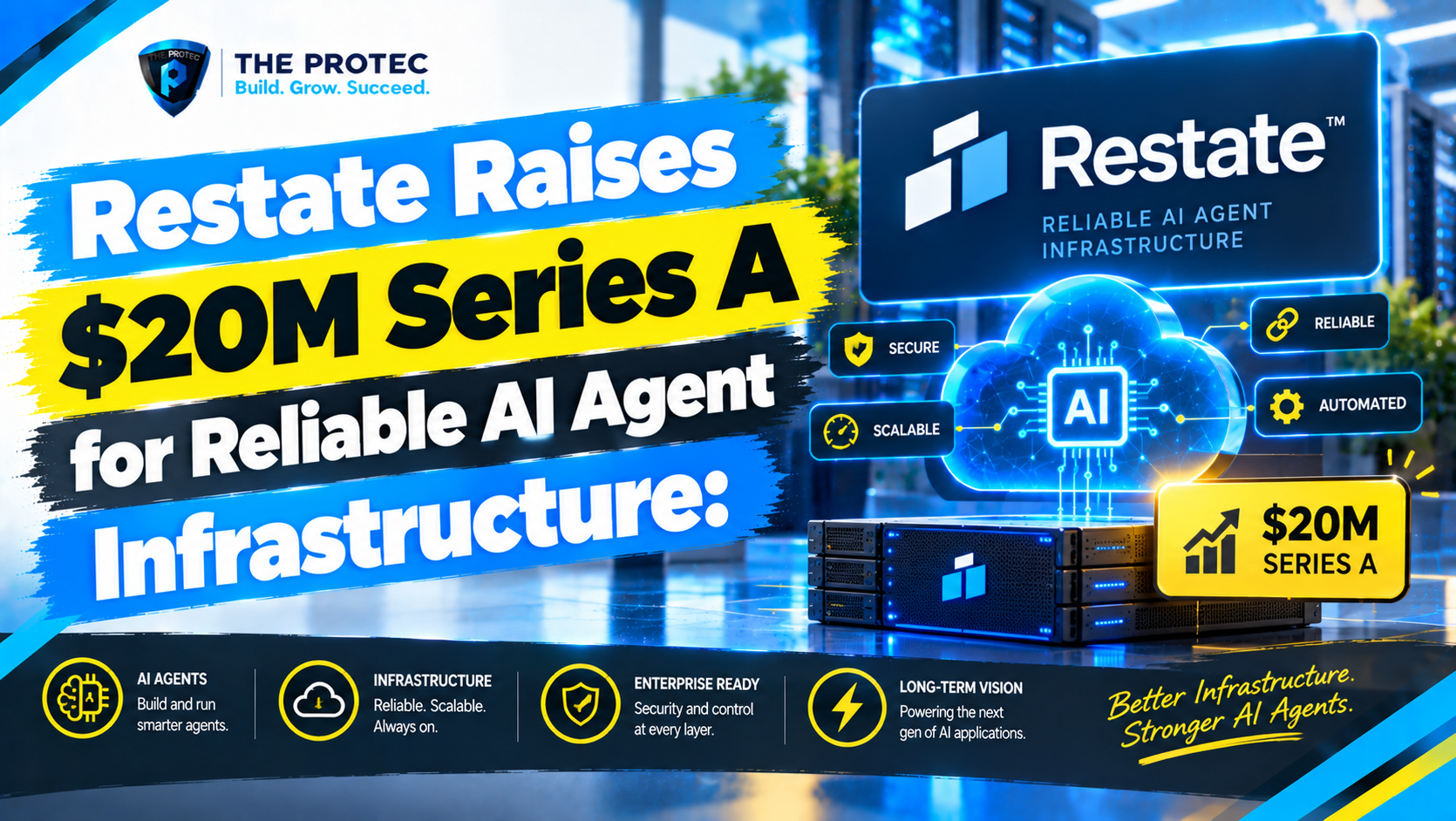
Restate’s $20 million Series A puts that question at the center of the emerging agent economy. The AI infrastructure startup is building a durable execution layer intended to help applications preserve progress, manage state and recover from interruptions without blindly restarting an entire workflow. Its focus is not on creating a new foundation model. Instead, Restate infrastructure sits beneath agent frameworks and application logic, providing capabilities such as persistent state, durable communication, retries, timers and recovery.
The distinction matters. Better reasoning models can improve an agent’s decisions, but they do not automatically make a distributed application resilient to server crashes, dropped network connections or partially completed side effects. As businesses give agents access to real systems, AI agent reliability increasingly depends on the runtime surrounding the model.
Why the Restate $20M Series A Matters
The Restate Series A funding reflects a broader change in how the industry thinks about agents. Early demonstrations typically involved short interactions: a user submitted a prompt, a model called one or two tools, and the application returned an answer. Production agents are much more complicated. They may wait for human approval, call several APIs, delegate work to other services and maintain context across many execution steps.
Every additional step creates another failure point. A payment service can time out after accepting a request. A container can be replaced while an agent is waiting for a response. A workflow can lose its connection to a model provider, or a worker may crash after completing an action but before recording that completion. Simply running the entire process again could duplicate a charge, send the same message twice or overwrite valid data.
Restate funding therefore targets a category that is becoming essential: AI agent production infrastructure. The company’s core proposition is that developers should be able to write agent and service logic while a dedicated runtime records progress and coordinates recovery. More information about the project and its open-source technology is available on the official Restate website.
The Reliability Problem Behind Stateful AI Agents
Traditional web requests are often short-lived and comparatively disposable. If a read-only request fails, a client can usually try again. An autonomous agent may instead execute a long-running, stateful sequence: identify a customer, retrieve account history, classify an issue, request a refund approval, update a CRM record and notify the customer. Restarting from the beginning is neither efficient nor necessarily safe.
Three characteristics make infrastructure for autonomous AI agents especially challenging:
- Long execution times: Agents may pause for external events, human decisions, scheduled work or rate-limit windows.
- External side effects: Tool calls can modify databases, submit orders, open tickets, send emails or trigger other irreversible actions.
- Stateful decisions: Later steps depend on earlier observations, model outputs, approvals and tool results that must remain available after a failure.
Ordinary in-memory state disappears when a process crashes. Saving occasional checkpoints can help, but developers must still determine what was completed, which operations are safe to repeat and how concurrent events should be ordered. This is where durable execution for AI agents becomes valuable.
How Restate Crash-Resistant Infrastructure Works
Restate approaches application code as recoverable execution rather than a disposable process. The runtime records relevant progress so that an interrupted invocation can be reconstructed and continued. Completed steps do not always need to be repeated, while unfinished work can be retried according to application policies.
In practical terms, Restate AI agents can use several related infrastructure capabilities:
- Persistent execution state: Important workflow progress survives the lifetime of an individual worker or container.
- Durable retries: Failed operations can be retried without relying on a process to remain alive or a developer to maintain custom retry loops.
- Durable timers and waits: An agent can pause for a scheduled time, callback or approval without occupying a continuously running worker.
- Recovery journals: Recorded execution results help the runtime reconstruct where work stopped and which completed operations can be reused.
- Stateful coordination: Applications can coordinate work around identities such as a customer, order, ticket or agent session.
- Durable communication: Calls between services can remain tracked across temporary outages and process restarts.
This model separates logical workflow duration from process uptime. A workflow lasting several days does not require one server process to survive for several days. If the worker disappears, another worker can continue using the durable information maintained by the runtime.
Developers can explore concepts including services, workflows, state and durable promises through the Restate documentation. These primitives are relevant beyond generative AI, but agents make the need unusually visible because they combine unpredictable model behavior with conventional distributed-system failures.
What Restate Provides for Developers
Without a durable runtime, engineering teams often assemble reliability from queues, databases, workflow schedulers, cron systems, idempotency tables and bespoke recovery scripts. Those components can work, but the application team must connect them and maintain a consistent model of progress. Recovery logic can eventually become more complex than the business workflow itself.
Restate infrastructure aims to consolidate parts of that machinery behind programming abstractions familiar to application developers. An agent service can retain state, invoke another service, wait for a result and resume later without manually translating every step into queue consumers and database records.
This can improve AI agent orchestration in several ways. A supervisor agent can delegate tasks while preserving the status of each assignment. A research agent can pause for a delayed data source and continue when results arrive. A customer-service agent can wait for an employee’s approval without losing its case state. A coding agent can track a multi-stage test and deployment sequence across temporary worker failures.
Centralized execution records can also support observability. Teams need to know which step failed, what had already happened and why a retry was attempted. Durable history does not explain every model decision, but it provides operational evidence that is difficult to obtain when agent state is scattered across memory, logs and disconnected services.
Restate’s Place in the Emerging AI Agent Stack
The modern AI agent stack contains several distinct layers. Foundation models generate and interpret language or other data. Agent frameworks define prompts, planning loops and tool-selection behavior. Tool interfaces connect agents to databases, APIs and enterprise systems. Evaluation and observability products measure output quality, cost and behavior.
Restate operates at the runtime and coordination layer. Its job is not to decide what an agent should do or to verify whether a model’s conclusion is correct. It helps preserve execution progress and coordinate what happens when the software carrying out those decisions is interrupted.
This role is becoming more important as standardized tool interfaces make it easier for agents to access external capabilities. Easy connectivity increases the number of actions an agent can perform, but it also raises the cost of duplicated or lost work. AI agent reliability infrastructure provides the control plane needed between probabilistic reasoning and deterministic business systems.
Crash Resistance Is Not a Recovery Guarantee
The phrase “crash-resistant” should not be interpreted to mean that an agent will always recover correctly. Durable execution can preserve recorded progress and retry failed work, but it cannot automatically correct flawed application logic, hallucinated instructions or unsafe permissions. It also cannot make every external API exactly-once if that API lacks idempotency or transaction support.
For example, a network failure may occur after an external system accepts an action but before Restate receives the response. The runtime can remember the attempted call, yet the application may still need an idempotency key, reconciliation process or compensating action to determine the real outcome. Some operations are inherently ambiguous across system boundaries.
Reliable production deployments therefore require more than AI agents fault tolerance at the runtime level. Teams still need bounded permissions, validation, audit logs, human approval for sensitive actions, secure credential handling and application-specific recovery policies. Restate can reduce infrastructure failure modes, but it does not eliminate semantic errors or governance risks.
What the New Restate Funding Could Enable
The $20 million Restate funding round gives the company additional resources to compete in a rapidly forming infrastructure market. The capital could support deeper language and framework integrations, managed deployment options, enterprise security features, developer tooling and broader ecosystem adoption. It may also help Restate improve scalability as customers move from experiments to large numbers of concurrent, long-lived executions.
That scalability challenge extends beyond raw request volume. AI agent scalability includes retaining large numbers of workflow states, waking tasks efficiently, handling bursts of callbacks and coordinating operations without introducing duplicate work. Production users will also expect predictable performance, regional availability, access controls and clear operational visibility.
The larger opportunity is to make durable execution a standard component of AI workflow infrastructure rather than a specialist feature that every team rebuilds. If autonomous systems become routine in business operations, recovery semantics may be as fundamental as model selection or retrieval architecture.
Why Reliable Agent Runtimes Are Becoming Essential
Agent applications are becoming less like chatbots and more like distributed software systems. They wait, branch, call services, receive events and modify real-world records. Their infrastructure must account for both probabilistic model behavior and familiar distributed-systems problems.
Restate’s $20 million Series A signals investor confidence in that requirement. By focusing on AI agent state management, durable execution and crash recovery, Restate is addressing the operational gap between an impressive prototype and dependable production automation. Its success will depend on whether developers adopt a dedicated runtime as the simplest way to build resilient agent workflows—and whether the platform can deliver that resilience without adding excessive complexity.
Frequently Asked Questions
What is the Restate $20M Series A funding for?
The round provides capital for Restate to expand its durable application platform and support growing demand for reliable AI agent infrastructure. Potential priorities include product development, integrations, managed services, enterprise capabilities and ecosystem growth.
Does Restate build AI models?
No. Restate is an infrastructure and runtime layer rather than a foundation model provider. Developers can use models from other vendors while Restate helps coordinate execution, persist state, manage retries and recover interrupted workflows.
How does durable execution help AI agents recover from crashes?
Durable execution records workflow progress outside the lifetime of a single process. When a worker, server or network connection fails, the runtime can reconstruct recorded progress, reuse completed results where appropriate and retry unfinished work according to defined policies.
Can Restate guarantee exactly-once agent actions?
No infrastructure can universally guarantee exactly-once effects across every external system. Restate can reduce duplicate execution and support durable coordination, but developers may still need idempotency keys, transactional APIs, reconciliation and compensating actions.
Which agent workloads benefit most from Restate infrastructure?
Long-running and stateful workflows gain the most value, particularly those involving multiple tools, asynchronous events, human approval or consequential side effects. Examples include customer operations, coding workflows, financial processes, document pipelines and multi-agent orchestration.