







AI agents are moving beyond answering questions. They can now retrieve sensitive records, update databases, write and deploy code, approve routine transactions, communicate with other agents, and take action across cloud and software-as-a-service environments. That autonomy creates enormous value, but it also introduces a fundamental security question: who—or what—is making each request? As AI agents gain access to sensitive systems and act on behalf of users and organizations, AI Agent Identity becomes essential for determining which agent is acting, what it is allowed to access, and whether its actions can be trusted.
Many organizations initially connect an agent to business systems through an employee account, shared API key, or broadly privileged service account. This may accelerate a prototype, but it obscures accountability and gives the agent permissions based on a person’s role rather than its own narrowly defined purpose. If the agent is compromised, manipulated, or simply makes a poor decision, the resulting activity can appear indistinguishable from legitimate human behavior.
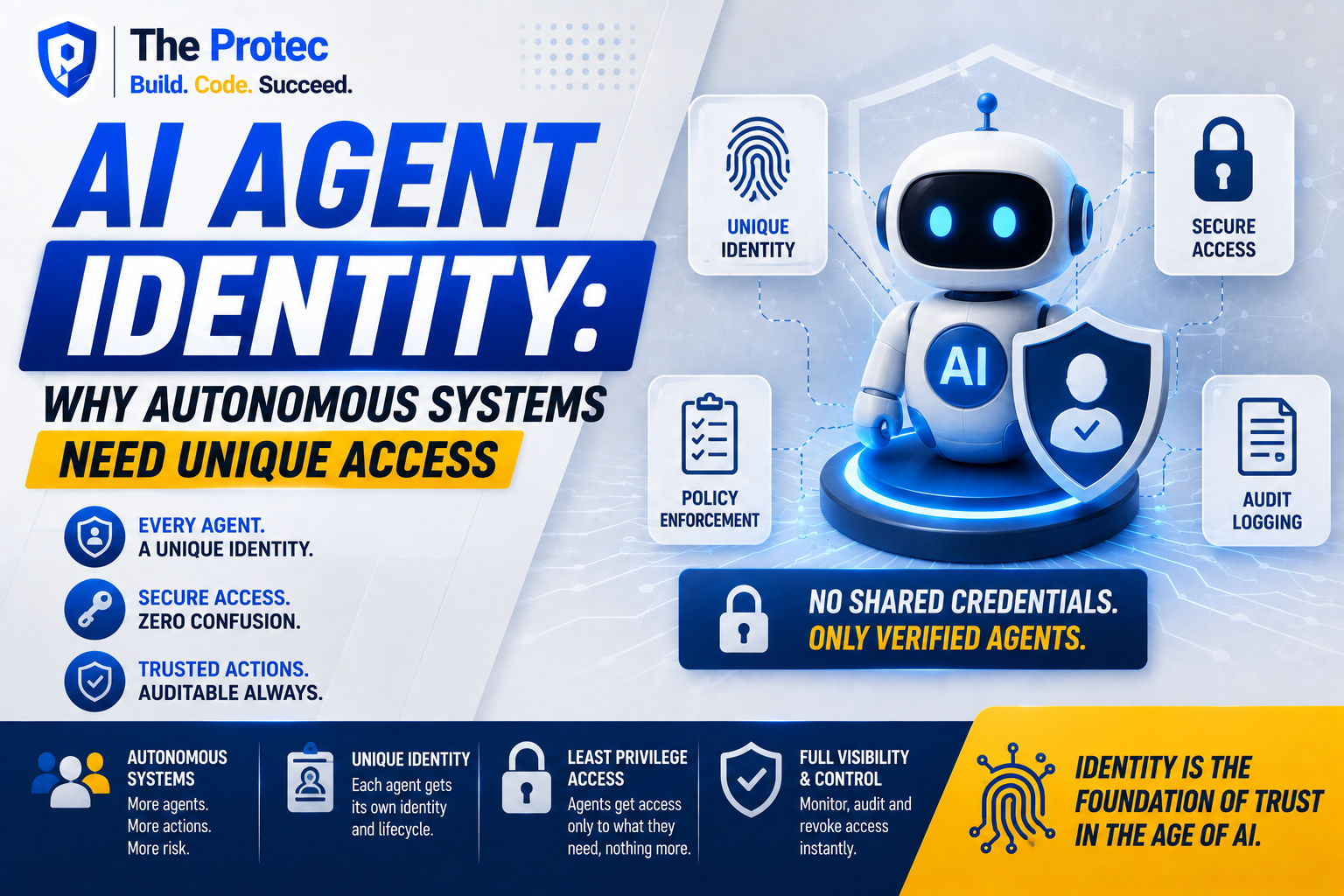
A secure alternative is to treat every autonomous agent as a distinct non-human actor. A dedicated AI agent identity allows the organization to authenticate the agent, issue controlled credentials, enforce least privilege, and preserve an auditable record of its actions. As agentic systems become embedded in operational workflows, this approach is becoming an essential part of machine identity management and AI security.
What Is an AI Agent Identity?
An AI agent identity is a unique, verifiable digital identity assigned to an agent so that systems can recognize it independently of the user, model, application, or infrastructure that supports it. The identity should answer several questions: Which agent is requesting access? Who owns it? What task is it authorized to perform? In which environment may it operate? Which user or workflow initiated the task?
The identity is not the agent’s display name or the name of its underlying language model. It is a security principal represented through mechanisms such as a workload identity, service principal, certificate, cryptographic key, or federated token. It may also include attributes describing the agent’s owner, risk tier, deployment environment, approved tools, and operational scope.
Machine identity management already protects workloads, containers, APIs, devices, and automated processes. AI agents extend that challenge because they can interpret context, choose tools dynamically, generate new action sequences, and operate across multiple systems. Their identity therefore needs both conventional workload controls and policy that accounts for delegated, autonomous behavior.
Why Human Accounts Are the Wrong Foundation
Allowing an agent to operate through a human account creates a dangerous identity mismatch. The target system sees the employee’s permissions, even when the employee did not directly select or review the action. Logs may say that a finance manager changed a payment record when an agent actually performed the update through the manager’s session.
Human accounts also tend to accumulate access over time. An employee may be able to open email, customer files, reporting systems, source code, and administrative consoles. An agent designed only to summarize support cases does not need that entire permission set. Giving it inherited access expands the impact of prompt injection, compromised tools, faulty planning, or credential theft.
Shared accounts are equally problematic. When several agents use one API key or service identity, security teams cannot reliably attribute an action to a specific instance, workflow, version, or owner. Revoking the credential may interrupt every connected process, while leaving it active preserves access for a potentially compromised agent.
Dedicated identities create separation. The employee remains accountable for initiating or approving appropriate work, while the agent is recorded as the actor that executed it. This distinction supports incident response, access reviews, compliance evidence, and clear responsibility without pretending that autonomous activity is human activity.
The Security Controls Every Autonomous Agent Needs
Each production agent should have an identity that is unique at the right operational level. Depending on risk, that may mean one identity per agent application, deployment, tenant, task, or runtime instance. A customer-facing agent and an internal development agent should never share a security principal merely because they use the same model.
The identity must have a named business owner, technical owner, purpose, risk classification, and expiration or review date. These attributes prevent orphaned agents from remaining active after experiments, projects, or teams disappear.
Short-Lived, Protected Credentials
Long-lived API keys embedded in prompts, source code, environment variables, or agent memory are attractive targets. Once exposed, they can be reused outside the agent’s normal controls and may remain valid for months.
Modern machine identity management favors short-lived credentials obtained at runtime through workload identity federation, managed identities, or a trusted identity broker. The agent proves where it is running and receives a token limited by audience, scope, environment, and duration. Secrets that cannot be eliminated should be stored in a dedicated secrets manager, rotated automatically, and kept out of model context, logs, and tool output.
Strong Authentication
Authentication should verify the agent’s workload rather than rely only on a bearer secret. Cloud-native attestation, signed tokens, mutual TLS, certificates, hardware-backed keys, and proof-of-possession mechanisms can bind access to an approved runtime. The objective is to make a stolen token less useful from an unauthorized system.
Agent-to-agent communication also requires authentication. One agent should not trust another because it uses a familiar name or produces convincing language. Every message that can trigger an action should have a verifiable source, protected integrity, and an authorization decision at the receiving boundary.
Least-Privilege Permissions
An agent should receive the smallest set of permissions required for its specific task. Prefer granular operations such as reading selected ticket fields or creating a draft purchase request over broad roles such as database administrator or finance user.
Permissions should also be contextual. Policy can restrict access by time, resource, tenant, transaction value, data classification, network, tool, or initiating user. High-impact actions—including transferring funds, changing production infrastructure, deleting data, or granting access—should require step-up authorization or explicit human approval.
Complete Audit Trails
Reliable audit records must capture more than a final API call. Security teams need to know the agent identity, runtime instance, initiating user or event, model and agent version, requested resource, tool invoked, policy decision, approval state, credential issuer, and result. Sensitive prompt content should be protected or minimized, but enough context must remain to reconstruct the action chain.
Logs should correlate activity across the identity provider, agent platform, tool gateway, API, and target application. Tamper-resistant storage and consistent timestamps help investigators distinguish an expected automated workflow from misuse or compromise.
Delegation Must Be Explicit and Traceable
Many agents act on behalf of a person. That does not mean they should impersonate that person. A stronger pattern records both identities: the agent as the executing actor and the user as the delegating principal. Authorization can then evaluate what the agent is allowed to do, what the user is allowed to delegate, and whether the requested action fits the current task.
Delegation should be narrow and temporary. A user asking an agent to schedule a meeting should not implicitly authorize access to unrelated email archives or permanent control of the calendar. Tokens can be constrained to a particular audience, purpose, resource, and session, preventing the agent from reusing delegated authority elsewhere.
This actor-and-delegator model is especially important in multi-agent systems. If one agent calls another, the identity chain should remain visible rather than collapsing into a shared credential. Downstream services can then enforce policy using the original requester, intermediate agents, and final actor.
AI Security Threats That Identity Controls Reduce
Identity does not solve every AI security problem, but it limits the consequences of several common attack paths. Prompt injection may persuade an agent to call an unauthorized tool, yet least-privilege policy can block the call. A malicious plugin may attempt to reuse a token, but audience restrictions and proof of possession can prevent access to another service. A compromised agent may behave unpredictably, but a unique identity allows defenders to disable it without stopping unrelated automation.
Other risks include agent impersonation, excessive agency, credential leakage, confused-deputy attacks, cross-tenant access, and unauthorized agent-to-agent instructions. These concerns align with broader guidance from the OWASP GenAI Security Project. Identity-centric controls provide enforceable boundaries even when model output itself is uncertain.
Managing the Full AI Agent Identity Lifecycle
Secure identities must be governed from creation through retirement. Before deployment, register the agent in an authoritative inventory and associate it with owners, approved use cases, data classifications, tools, and environments. Provision permissions through policy and infrastructure automation rather than one-off manual grants.
During operation, monitor authentication failures, unusual tool use, new resource access, abnormal transaction volume, and behavior outside the agent’s established purpose. Reassess access when the model, prompt, tools, integrations, owner, or deployment environment changes. A material change can alter risk even if the agent keeps the same name.
Credentials should rotate automatically, while permissions should be reviewed and right-sized using observed activity. Dormant and experimental identities need aggressive expiration. When an agent is retired, revoke its credentials, disable trust relationships, remove permissions, preserve required audit records, and verify that downstream copies of secrets or tokens are no longer valid.
Building an Identity-First Agent Architecture
Identity enforcement should sit outside the model wherever possible. A model can request an action, but it should not decide whether that action is authorized. A trusted orchestration layer, tool gateway, policy engine, or target service should authenticate the workload and evaluate access before execution.
This separation supports zero-trust principles: never assume that an agent is safe because it runs inside a corporate network or uses an approved model. Authenticate every relevant interaction, authorize each sensitive operation, and continuously evaluate context. The NIST AI Risk Management Framework offers a useful foundation for connecting technical safeguards with broader governance and risk management.
By September 2026, this architecture is increasingly important as organizations adopt protocol-based tool connections, multi-agent orchestration, ephemeral cloud runtimes, and agents that operate across organizational boundaries. Static secrets and perimeter trust cannot provide sufficient control in such dynamic environments.
Practical AI Agent Identity Checklist
- Inventory every agent, including pilots, embedded vendor agents, and agent-created subagents.
- Assign a unique identity, accountable owner, documented purpose, and risk classification.
- Separate development, testing, and production identities and credentials.
- Use short-lived, audience-restricted tokens instead of static API keys wherever possible.
- Grant task-specific permissions and deny access by default.
- Record both the agent actor and any user, service, or agent that delegated authority.
- Require human approval or step-up authorization for irreversible and high-impact actions.
- Centralize correlated audit logs while protecting sensitive prompts and business data.
- Monitor behavior continuously and automate credential rotation, access reviews, and expiration.
- Provide a rapid kill switch that revokes one agent without disrupting unrelated services.
Frequently Asked Questions
Is an AI agent identity the same as a service account?
Not necessarily. A service account can represent an agent, but traditional service accounts are often long-lived, shared, and overprivileged. A secure AI agent identity is uniquely attributable, uses short-lived credentials where possible, supports delegated context, and has permissions aligned with the agent’s exact purpose.
Should every agent instance have a separate identity?
The answer depends on risk and architecture. Low-risk replicas may share an application identity while retaining unique instance attributes in tokens and logs. Agents handling sensitive data, separate customers, or high-impact actions may require per-instance or per-task identities to achieve stronger isolation and revocation.
Can authentication prevent prompt injection?
Authentication cannot stop malicious instructions from reaching a model. It can, however, prevent an injected prompt from turning into unrestricted access. Strong authentication, narrow authorization, tool allowlists, transaction limits, and approval gates reduce what a manipulated agent can do.
Who should own AI agent identity management?
Responsibility is typically shared among identity and access management, cybersecurity, platform engineering, AI governance, application owners, and business risk teams. Central standards should define identity, credential, logging, and approval requirements, while each agent must still have accountable business and technical owners.
Identity Is the Control Plane for Agentic AI
Autonomy without identity creates invisible authority. When agents borrow human accounts or share static credentials, organizations lose the ability to separate people from machines, constrain individual workflows, and investigate decisions with confidence.
A dedicated AI agent identity changes that equation. It makes authentication explicit, permissions enforceable, credentials manageable, delegation traceable, and actions auditable. Organizations that establish these foundations before expanding autonomous access will be better positioned to capture the benefits of agentic AI without surrendering control of their systems and data.