









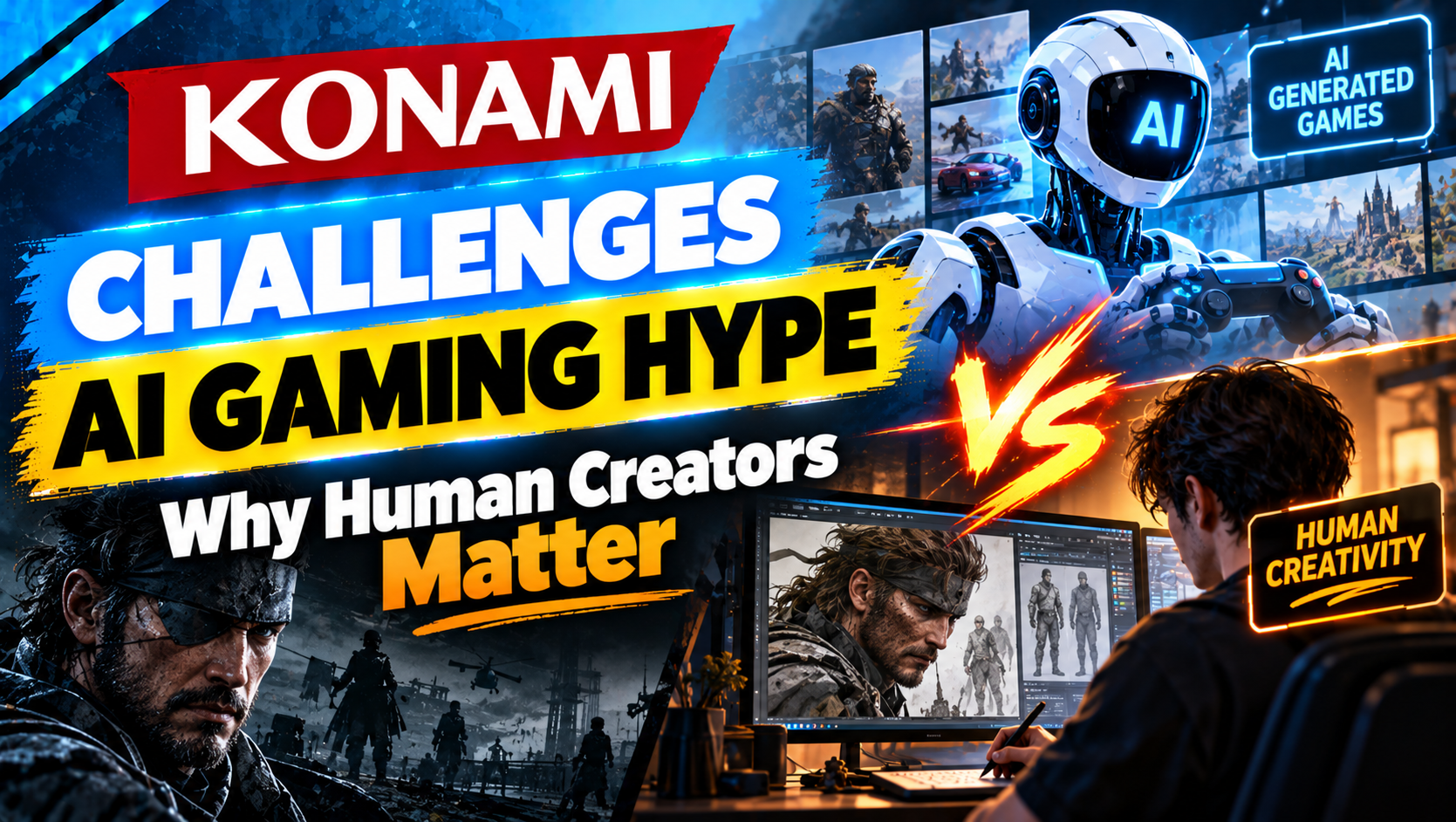
Konami AI market impact stance is a timely counterpoint to one of technology’s loudest predictions: that generative AI will fundamentally reinvent video game development. Hideki Hayakawa, president of Konami Digital Entertainment, has reportedly taken a more measured position. AI may make production faster and more efficient, but that does not mean it will dramatically transform the gaming market—or replace the people whose ideas make games worth playing.
That distinction matters. The conversation around AI in video game development often treats faster asset generation or automated programming as proof that fully AI-made games are close. Hayakawa’s argument challenges that assumption by separating production efficiency from creative and commercial impact. A tool can reduce the time needed to build a prototype, translate dialogue, or locate bugs without solving the harder problem of creating an original, coherent, and emotionally engaging experience.
As gaming industry AI adoption expands, Konami’s perspective offers a useful framework: generative AI could transform many tools used to make games while leaving the fundamental principles of successful game design largely intact.
What Hideki Hayakawa Reportedly Said About Generative AI
The Konami president AI comments were reported in connection with an interview summarized by AUTOMATON WEST. Its English-language coverage presented Hayakawa’s view that generative AI could improve game-development efficiency, but may not have a major effect on the overall video game market.
His reasoning focused on historical context. Game engines, accessible development software, digital distribution, and user-generated content in gaming have already made it significantly easier for more people to create interactive experiences. Yet lowering technical barriers did not automatically produce a complete market upheaval. More games could be made, but commercial success still depended on quality, differentiation, execution, visibility, and player demand.
The wording should be understood as Hayakawa’s reported opinion, not as a blanket rejection of AI or a comprehensive Konami gaming strategy. A senior executive’s assessment of market impact is not necessarily a formal policy covering every Konami studio, production pipeline, or future investment. The comments also leave room for Konami Digital Entertainment AI initiatives that improve workflows without redefining the company’s creative direction.
Why Existing Game Engines Complicate the AI Revolution Narrative
Modern game development was becoming more accessible long before generative AI entered the mainstream. Commercial engines provide rendering, physics, animation, audio, networking, and deployment systems that developers once had to create themselves. Asset stores offer reusable models, interfaces, sound effects, and code. Visual scripting lets creators build mechanics with less traditional programming knowledge.
Platforms with creation systems have lowered barriers even further. Players can design maps, modes, characters, and social spaces without developing a standalone engine. These changes expanded participation and helped independent teams move faster, but they did not eliminate the need for strong ideas or guarantee that every accessible project would find an audience.
Hayakawa’s reported argument suggests that AI game development tools may follow a similar pattern. They can widen access and accelerate execution, but easier production can also increase competition. If thousands of teams can generate acceptable assets and prototypes rapidly, distinctive creative direction becomes more valuable, not less. The market may receive more content without seeing a proportional increase in memorable or commercially viable games.
Where AI in Video Game Development Can Deliver Real Value
Questioning a dramatic Konami AI market impact is not the same as denying practical benefits. Generative AI game development already has several credible applications, particularly when tools operate under human supervision.
- Coding assistance: AI-assisted game programming can suggest functions, explain unfamiliar code, generate routine scripts, and help developers navigate large codebases. Experienced programmers still need to review architecture, security, performance, and platform-specific behavior.
- Concept exploration: Designers and artists can test visual directions, color palettes, silhouettes, or environmental themes before committing production resources. These outputs work best as exploratory references rather than unreviewed final art.
- Asset production: AI-generated game assets may help with background variations, textures, temporary dialogue, animation cleanup, or other repetitive tasks. Provenance, consistency, licensing, and artistic control remain essential.
- Testing and debugging: AI game testing and debugging systems can simulate player behavior, inspect logs, identify unusual states, and prioritize likely defects. Human quality-assurance teams are still needed to judge whether an experience feels fair, readable, and enjoyable.
- Localization: Automated drafts can speed translation across large scripts, especially during development. Native-speaking editors must preserve humor, tone, cultural context, character voice, and terminology.
- Procedural content: AI can support variations in levels, quests, environments, or non-player behavior. Designers must define constraints so generated content serves the intended difficulty curve and narrative.
- Rapid prototyping: AI-assisted game prototyping can produce placeholder code, art, and dialogue, enabling teams to test whether a mechanic is fun before investing in polished production.
These applications can improve AI game development efficiency and reduce some AI game development costs. Their value lies mainly in shortening iteration cycles, removing repetitive work, and giving specialists more time to focus on difficult decisions.
Why Human Creativity in Game Development Remains Essential
The most demanding creative challenges are not simply asset-generation problems. A memorable character needs a recognizable voice, motivation, visual identity, role in the mechanics, and relationship to the wider story. A coherent world requires consistent rules, meaningful details, pacing, and environmental storytelling. Original mechanics must be understandable enough to learn but deep enough to reward mastery.
Gameplay loops are particularly resistant to one-step automation. Developers repeatedly test the relationship between challenge, feedback, movement, reward, and player choice. A system can function correctly and still feel frustrating, weightless, repetitive, or pointless. Recognizing that difference requires human judgment informed by playtesting and a clear creative goal.
Emotional impact is equally difficult to manufacture through volume. Generative systems can produce many dialogue options, character concepts, or level layouts, but abundance is not direction. Creators decide what belongs, what should be removed, when a moment needs silence, and how mechanics can reinforce a theme.
This is the central issue in the human creativity vs AI in gaming debate. AI can imitate patterns and expand possibilities, while people establish meaning, taste, intent, and accountability. The future of video game development is therefore likely to depend less on choosing between AI vs human game developers and more on determining where automation supports creative judgment without weakening it.
Game Development Is a Collaborative Discipline
Successful games rarely emerge from a single skill set. Designers establish systems and progression. Artists define visual language. Programmers turn concepts into reliable software. Writers develop narrative context and dialogue. Audio specialists shape atmosphere, feedback, and emotional rhythm. Producers coordinate schedules, budgets, dependencies, and changing priorities.
AI may alter tasks within each discipline. Programmers could spend less time on boilerplate code, artists could explore more concepts, and producers could summarize production data faster. Writers might use tools to organize branching narratives, while testers examine AI-prioritized problem areas.
None of this removes the need for collaboration. In fact, faster production can create more material to evaluate, increasing the importance of communication and editorial control. Someone must decide whether an AI-generated idea supports the game’s identity, whether an optimization harms visual quality, or whether procedural content breaks narrative continuity. AI and game design innovation still depend on teams making those trade-offs deliberately.
How Smaller Studios Could Benefit—and Why Success Is Not Guaranteed
Independent developers may gain the most immediate advantages from generative AI in gaming. A small studio can use assistance tools to create temporary assets, troubleshoot code, prepare localization drafts, or prototype several ideas before choosing one. That can preserve limited budgets and reduce dependence on expensive early production work.
A solo developer might also use AI to fill knowledge gaps while learning, although generated output must still be verified. For teams without dedicated quality-assurance departments, automated testing can expose edge cases that would otherwise reach players.
Lower costs, however, do not guarantee originality or commercial success. Easier development means more competitors can enter the same storefronts and genres. Discovery becomes harder, and players have little reason to choose a technically competent game that lacks personality. Marketing, community building, polish, platform requirements, and post-launch support remain substantial challenges.
This mirrors Hayakawa’s broader point: democratized tools increase the ability to make games, not necessarily the ability to make games people want to buy, recommend, and remember.
The Wider Gaming Industry AI Debate
Among the most important video game industry trends is a shift from asking whether studios will use AI to asking how they will use it responsibly. The gaming industry AI debate now includes intellectual property, labor conditions, disclosure, data governance, and player trust.
AI-generated game assets can raise copyright and licensing questions when training sources or ownership rights are unclear. Studios need records showing where production material came from and whether it can be distributed commercially. Inconsistent legal standards across markets add further risk.
Labor concerns are equally significant. Developers may welcome tools that eliminate repetitive tasks while resisting deployments intended primarily to reduce headcount or devalue specialist work. The fear of AI replacing game developers is intensified when companies introduce systems without consulting the people expected to use them.
Players also have expectations. Some may accept AI-assisted background processes but object to undisclosed synthetic voices, artwork, or writing. Others judge the result rather than the method, provided creators have appropriate rights and the final game meets a high standard. Transparent policies can help studios explain the difference between assistive tools and unreviewed generated content.
These issues show why the future of AI in video games will be shaped by governance as much as technical capability. A faster tool is not automatically a safe, ethical, or creatively appropriate tool.
Will AI Change the Tools More Than the Creative Principles?
The Konami AI gaming statement attributed to Hayakawa challenges hype without dismissing innovation. Generative AI may become deeply embedded in coding, testing, localization, asset workflows, and prototyping. Those improvements could shorten schedules and let smaller teams attempt more ambitious projects.
But the AI impact on the gaming industry should not be measured only by how quickly content can be produced. Games succeed when mechanics, art, sound, narrative, technology, and player expectations reinforce one another. That alignment requires taste, empathy, experience, collaboration, and the willingness to revise ideas that are technically impressive but simply not fun.
AI is therefore more likely to transform the production toolkit than the enduring creative principles behind successful games. Human creators will use different instruments, but they will still be responsible for deciding what to make, why it matters, and how every element contributes to the player’s experience.
Frequently Asked Questions
Did Konami reject generative AI for game development?
No. Hideki Hayakawa’s reported comments indicate skepticism about generative AI dramatically transforming the gaming market, not a rejection of AI-assisted workflows. The distinction is between improving efficiency and changing the fundamental drivers of market success.
What are the most useful AI tools for game developers?
Practical uses include coding assistance, concept exploration, asset variations, localization drafts, automated testing, bug detection, procedural systems, and rapid prototyping. Human review remains necessary for quality, consistency, legality, and creative direction.
Will AI replace game developers?
AI may automate or reshape specific tasks, but complete game production requires multidisciplinary judgment and accountability. Designers, artists, programmers, writers, audio teams, testers, and producers contribute expertise that cannot be reduced to generating more content.
Why does easier game development not guarantee better games?
Accessible tools can reduce technical and financial barriers, but they do not automatically produce original mechanics, compelling characters, balanced gameplay, or effective marketing. As production becomes easier, competition increases and distinctive human direction becomes even more important.