








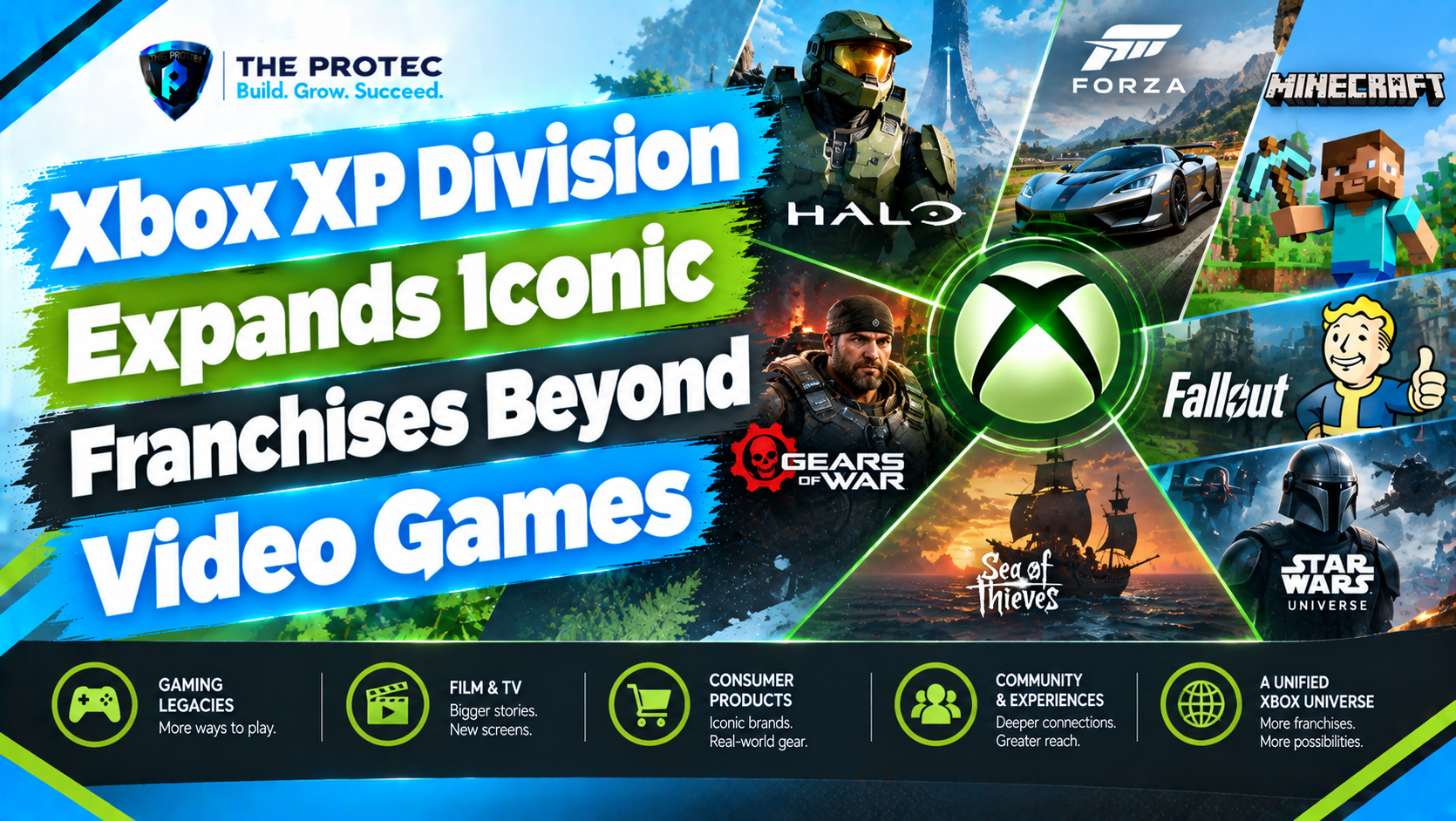
Xbox is no longer thinking about its biggest games only as software sold through consoles, PCs and cloud services. The launch of the Xbox XP division signals a more coordinated effort to develop Microsoft’s gaming intellectual property across film, television, consumer products, live events, licensing and strategic partnerships.
That broader mandate matters because Microsoft now controls one of the industry’s deepest portfolios of recognizable properties. Xbox Game Studios, Bethesda and Activision Blizzard collectively provide access to worlds and characters associated with franchises such as Halo, Fallout, Minecraft, Warcraft, Call of Duty, Doom, The Elder Scrolls and many others. Each has different audiences, creative requirements and commercial possibilities.
The creation of Xbox XP does not mean that every property will become a movie, television series or merchandise line. Nor does the division’s launch confirm adaptations that Microsoft has not formally announced. Its significance lies in the organizational structure: Xbox is building a dedicated operation that can identify suitable opportunities, connect internal stakeholders and manage how gaming brands appear outside their original medium.
What Is the Xbox XP Division?
Xbox XP is intended to support the Xbox entertainment expansion beyond traditional game publishing. Its scope covers areas such as Xbox film and TV, consumer products, events, licensing and brand partnerships. Rather than allowing those activities to operate as isolated projects, a dedicated division can provide a central strategy for selecting opportunities and coordinating the companies involved.
That work may include evaluating proposals from production studios, establishing licensing terms, reviewing creative treatments, coordinating merchandise programs and planning experiences around major releases. It can also involve ensuring that the game studio responsible for an intellectual property has an appropriate voice in how that property is represented.
As of October 2026, the most important distinction is between the division’s stated purpose and individual projects. The existence of Microsoft Xbox XP establishes a business function; it is not evidence that a particular unannounced franchise has a movie or series in development. Confirmed productions should still be judged through official announcements from Microsoft, Xbox or the relevant production partner. Readers can follow verified company updates through Xbox Wire.
Why Microsoft Is Placing More Value on Gaming IP
Microsoft has invested heavily in content, studios and distribution. That investment has created an enormous library of intellectual property whose value can extend beyond individual game launches. A dedicated Xbox entertainment business offers a way to use that library more deliberately without relying entirely on the release schedules of consoles or premium games.
Modern franchises function as networks of audience relationships. A player may discover Fallout through television, encounter Minecraft through a movie or consumer product, attend an Xbox live event and later subscribe to a gaming service. Cross-media exposure can introduce a property to people who do not identify as regular players while giving established fans additional ways to engage.
This strategy also reflects the economics of large-scale game development. Major releases can require long production cycles and substantial budgets. Film, television, merchandise and licensing do not replace games, but they can help keep a franchise visible between releases. They may create additional revenue streams and make Microsoft’s portfolio more valuable to retailers, streaming services, advertisers and entertainment partners.
Microsoft’s broader financial reporting, available through its investor relations portal, has increasingly placed gaming within a larger ecosystem of content, subscriptions, devices and services. Xbox IP expansion fits naturally within that ecosystem.
How Xbox Film and TV Projects Can Expand an Audience
Successful games often contain the basic ingredients sought by film and television producers: distinctive worlds, memorable characters, established communities and recognizable visual identities. Those strengths can reduce the challenge of introducing an entirely unfamiliar entertainment property. They do not, however, guarantee a successful adaptation.
Games and screen productions create engagement in different ways. A player controls decisions and explores a world interactively, while a film or series must guide viewers through a fixed narrative. Effective Xbox movies and television projects therefore need more than accurate costumes or familiar references. They need stories that work for viewers who may never have held a controller.
Microsoft’s catalog has already demonstrated several possible approaches. Properties connected to Xbox’s wider portfolio have appeared in television and cinema, with Fallout, Halo and Minecraft illustrating how differently gaming worlds can be interpreted. These examples provide useful experience, but they should not be read as a template requiring every Microsoft Xbox franchise to follow the same path.
A focused Xbox cross-media strategy can help match each property with the appropriate format. A dense role-playing world may support serialized storytelling, while another game could be better suited to animation, a feature film or no screen adaptation at all. Saying no to an unsuitable proposal can be as valuable as approving one.
Consumer Products Can Make Digital Worlds Tangible
Xbox consumer products offer a different form of franchise growth. Apparel, collectibles, books, toys, tabletop games and limited-edition hardware allow audiences to bring elements of fictional worlds into everyday life. For Microsoft, these categories can keep brands active between major software releases and reach customers through stores that do not traditionally sell games.
The challenge is to avoid treating merchandise as a collection of disconnected logo placements. Strong product programs reflect what audiences value about a franchise. Materials, artwork, packaging and pricing all contribute to the perceived quality of the brand. A premium collectible aimed at longtime fans requires a different strategy from an accessible toy line or mass-market clothing collaboration.
Central coordination through Xbox XP could help licensing teams establish consistent design standards, approval processes and release calendars. It could also prevent competing partners from producing products that overlap, confuse customers or weaken the identity of a franchise.
Xbox Live Events Can Build Community
Live experiences give gaming companies something digital marketing cannot fully reproduce: a shared moment among fans. Xbox products and events could encompass exhibitions, touring attractions, esports-related experiences, concerts, fan celebrations, retail activations and interactive installations. The specific format should depend on the audience and the nature of the underlying property.
Events can also connect multiple parts of Microsoft’s strategy. A well-planned activation might showcase a game, host creators, sell exclusive merchandise and support a television or product launch without reducing the experience to an advertisement. It can generate social coverage while strengthening the community around the brand.
Execution carries practical risks. Venue safety, accessibility, ticket pricing, geographic reach and production quality all affect whether an event feels inclusive or exploitative. Xbox XP will need to balance spectacle with genuine value for attendees, particularly when serving communities that have supported a franchise for decades.
Partnerships and Licensing Require Careful Coordination
Xbox brand partnerships can introduce gaming properties to new markets, but every collaboration also transfers part of a brand’s reputation to an outside company. Selecting a partner therefore involves more than comparing licensing fees. Microsoft must consider product quality, audience fit, distribution, labor practices, regional sensitivities and long-term brand impact.
A centralized group can give Xbox licensing partnerships clearer governance. It can define which visual assets may be used, how stories and characters are portrayed, what approvals are required and how marketing claims are reviewed. These controls become especially important when several partners are working with one property at the same time.
Partnerships may also extend beyond conventional merchandise. Technology demonstrations, location-based entertainment, publishing, music and promotional collaborations can all contribute to Xbox gaming franchise expansion. The best opportunities should feel natural to the property rather than attaching a familiar character to an unrelated product simply for attention.
Maintaining a Consistent Identity Across Media
Cross-media consistency does not require every adaptation to copy its source material scene by scene. It means preserving the essential qualities that make a property recognizable. Tone, themes, character motivations, visual language and audience expectations often matter more than exact plot reproduction.
Xbox XP could act as a bridge between game developers and external entertainment partners. Developers understand a world’s history and design logic, while filmmakers, manufacturers and event producers understand the demands of their respective formats. Neither side benefits when collaboration becomes a contest for total control.
Clear franchise guidelines can establish non-negotiable elements while leaving room for adaptation. Creative freedom is necessary because a television writer, toy designer and event producer solve different problems. At the same time, excessive freedom can produce an experience that uses a recognized name without capturing what audiences liked about it.
This balance is central to any credible Xbox multimedia strategy. Fans tend to accept thoughtful reinterpretation, but they quickly notice when decisions appear driven solely by licensing potential.
Potential Benefits of the Xbox Entertainment Expansion
Broader reach: Film, television and products can introduce Xbox properties to audiences outside gaming.
Longer franchise visibility: Carefully scheduled experiences can sustain interest between game releases.
Diversified revenue: Licensing, products and events can complement software, subscriptions and platform income.
Stronger partner management: One division can coordinate approvals, timelines and quality standards across multiple companies.
Deeper audience engagement: Fans gain more ways to experience the characters and worlds they value.
The Risks of Stretching Xbox Brands Too Far
Cross-media growth can create value, but expansion for its own sake can damage an established property. Too many products, low-quality collaborations or poorly timed releases may create fatigue. Audiences can also become skeptical if a company appears more interested in exploiting nostalgia than supporting the games at the center of a franchise.
Creative control is another persistent challenge. External studios need enough independence to make a compelling production, but Microsoft and the original developers must protect the property’s identity. Slow approval systems can frustrate partners, while weak oversight can lead to inconsistent results.
Audience expectations are especially difficult to manage. Longtime players may want fidelity to specific stories, whereas newcomers need accessible characters and explanations. Changes that improve a film or series can be interpreted as disrespect for the source material if the reasoning is not evident in the finished work.
There is also a strategic risk in selecting projects according to name recognition alone. Not every popular game contains a story suited to passive entertainment, and not every fictional world needs a wide range of merchandise. Disciplined portfolio management will be one of the clearest measures of whether the Xbox XP division is succeeding.
Part of a Wider Gaming Industry Shift
The launch follows a broader movement in which major publishers and platform companies treat games as foundations for entertainment franchises. Successful adaptations based on properties from across the industry have encouraged studios, streaming services and consumer brands to pursue gaming audiences more seriously.
However, the strongest results generally come from collaboration rather than simple intellectual-property recognition. Gaming franchises in film and TV must compete with every other production for attention. Familiar branding may attract initial interest, but storytelling and execution determine whether viewers remain engaged.
Xbox’s advantage is the range of its portfolio. Its challenge is deciding where to focus. A dedicated division can provide institutional expertise, but it cannot make every concept commercially or creatively viable.
What to Watch Next From Microsoft Xbox XP
The most meaningful indicators will be official leadership details, partner announcements and evidence of a selective strategy. Observers should look for how Xbox XP works with individual studios, whether creators retain meaningful input and how Microsoft measures success beyond short-term licensing revenue.
It will also be important to separate confirmed Xbox industry news from speculation. The division’s existence creates possibilities, not an automatic production pipeline for every recognizable series. A measured approach—matching the right franchise with the right medium, partner and audience—would give Microsoft the best chance of turning its gaming portfolio into a durable entertainment network.
Frequently Asked Questions
What is the purpose of the Xbox XP division?
The Xbox XP division is designed to coordinate expansion of Xbox and Microsoft gaming properties into areas such as film, television, consumer products, live events, licensing and partnerships. It gives those activities a more focused organizational home.
Does Xbox XP mean every Xbox game will receive an adaptation?
No. Creating the division does not confirm a movie, series or product line for every franchise. Specific projects require separate official announcements, suitable creative concepts and agreements with production or licensing partners.
Why does Microsoft want to expand Xbox properties beyond games?
Cross-media expansion can reach new audiences, sustain interest between releases and create additional sources of revenue. It can also strengthen the cultural visibility of Microsoft’s gaming portfolio when projects are selected and managed carefully.
What are the biggest challenges for Xbox film and TV projects?
The primary challenges include adapting interactive stories for passive viewing, balancing creative freedom with franchise consistency, meeting fan expectations and selecting partners capable of delivering high-quality productions.
How could Xbox XP protect its franchises from overexposure?
The division can prioritize selective licensing, enforce quality standards, coordinate release calendars and decline opportunities that do not fit a property’s audience or identity. Restraint will be essential to preserving long-term brand value.