








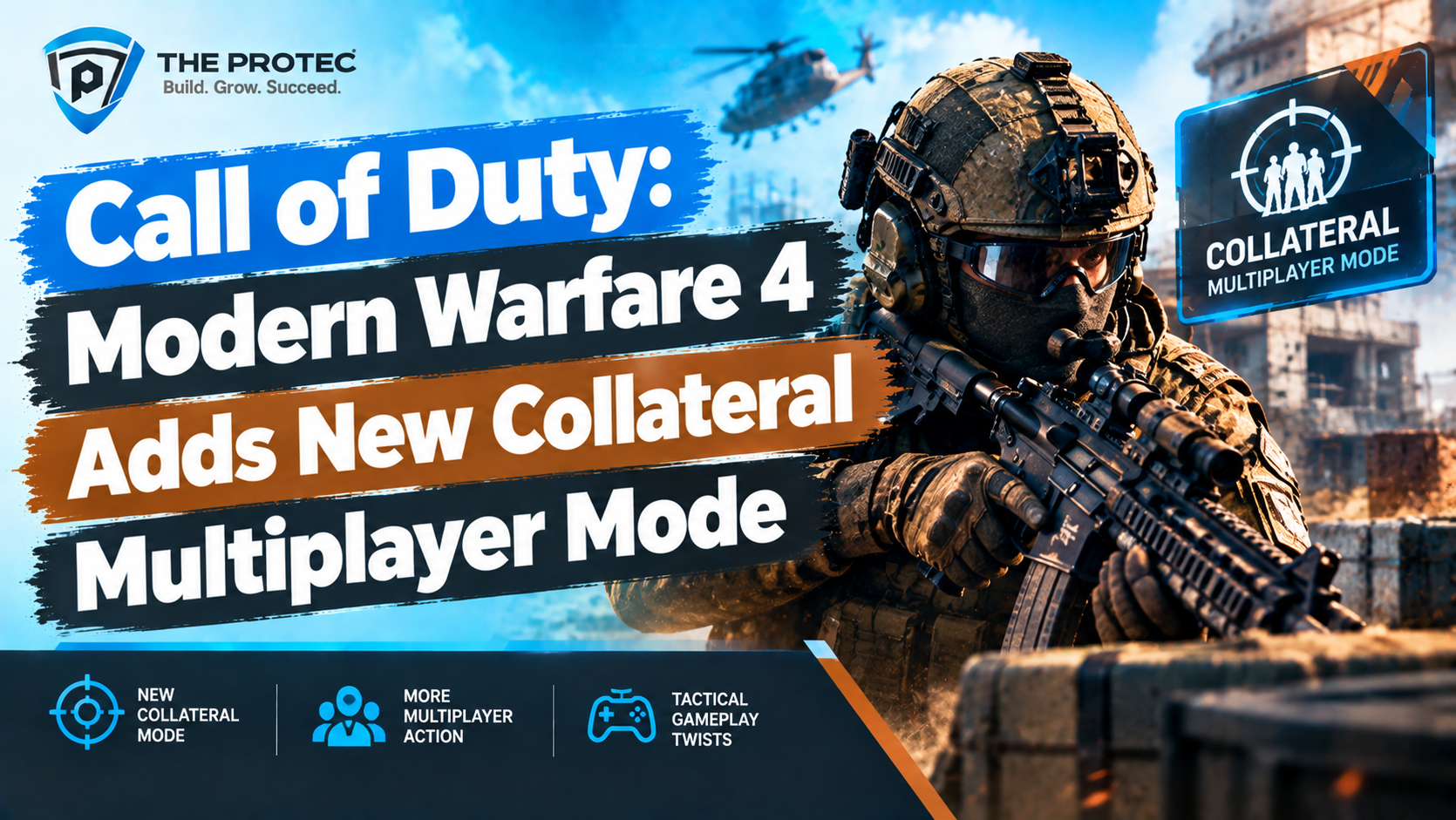
Call of Duty: Modern Warfare 4 is expanding its competitive lineup with Collateral, a new multiplayer mode designed to place more emphasis on coordinated objectives and purposeful engagements. Rather than serving as another variation of Team Deathmatch, the mode encourages players to fight over strategically important areas while balancing objective pressure against the value of eliminations.
The arrival of Modern Warfare 4 Collateral mode is noteworthy because new rule sets can change how familiar weapons, equipment and maps are approached. A location that is only a temporary chokepoint in Team Deathmatch can become the center of an entire Collateral round. Likewise, a loadout built for individual kill streaks may be less useful than one designed to clear, capture or defend contested ground.
Some details surrounding Collateral have been outlined through official multiplayer material and gameplay coverage, while other information circulating online comes from previews, leaks or player interpretation. This breakdown separates those categories and avoids treating unannounced scoring values, team sizes or future content as established facts.
What Is Modern Warfare 4 Collateral Mode?
Collateral is presented as an objective-led team mode within the broader Modern Warfare 4 multiplayer offering. Its central idea is that players must do more than accumulate eliminations: teams are pushed toward designated points of conflict, where objective play and successful combat actions contribute to the match result.
That distinction matters. Standard Team Deathmatch gives every elimination essentially the same strategic purpose—bringing the team closer to its score limit. In Collateral, an elimination can have considerably more tactical value when it removes a defender, interrupts an objective attempt or opens a route for teammates. Players therefore need to consider where and when they engage rather than simply searching for the next opponent.
The official positioning of the mode emphasizes organized team play and recurring objective pressure. However, a complete public rulebook with every numerical score value, overtime condition and playlist variation has not been consistently detailed. Exact figures appearing in unofficial posts should consequently be treated with caution until they are documented through the official Call of Duty blog or visible in the final live playlist.
How Call of Duty Collateral Mode Works
At its core, Collateral directs opposing teams toward active objectives placed around a multiplayer map. Players must establish control, prevent the opposing team from doing the same and use eliminations to create the space needed to complete those tasks. The match is decided by objective progress and the associated team score rather than by raw kill totals alone.
Available descriptions establish several practical principles:
- Teams compete around designated objectives. The important combat zones are defined by the current state of the match rather than by random player movement.
- Objective actions drive the result. Securing, defending or disrupting the relevant area is more important than collecting isolated eliminations elsewhere.
- Eliminations support objective progress. Removing opponents creates windows in which teammates can move, establish control or stop an enemy push.
- Positioning changes as the match develops. Teams cannot rely indefinitely on one protected angle if the active objective or tactical priority shifts.
- Group coordination carries additional value. A coordinated entry, defense or counterattack is generally more effective than several disconnected one-player pushes.
Activision has not publicly clarified every potential playlist modifier or exact scoring threshold in all versions of the mode. Reports that attach highly specific point values, round lengths or alternate win conditions to Collateral may reflect preview builds rather than the final Modern Warfare 4 update. Call of Duty rules can also be tuned after launch, making the live in-game description the most reliable source for current values.
How Players Score and Approach Objectives
The fundamental scoring relationship in Call of Duty MW4 Collateral connects combat performance to objective control. Players still need to win gunfights, but those gunfights are most productive when they directly protect a team action. Defeating an enemy on a distant, inactive side of the map may create a temporary numbers advantage; eliminating a defender overlooking the objective can immediately change possession.
This structure creates distinct roles even if the playlist does not impose formal classes. An entry player can break the first defensive line. A support player can cover an approach with suppressive fire or equipment. A mobile flanker can cut off reinforcements, while an anchor watches the route most likely to be used in a counterattack. Players can move between those jobs as the situation changes.
Objective interaction also introduces a risk calculation. Committing every teammate to the target may speed up control but leave the group exposed to explosives, streaks or a coordinated flank. Staying too far away creates the opposite problem: the team may win several ranged fights while surrendering meaningful progress. Effective squads should maintain enough presence to contest the objective while controlling nearby lanes.
Players should not assume that the word “Collateral” means sniper collateral kills—two enemies defeated by one bullet—are the mode’s primary scoring mechanic. That interpretation has fueled online speculation, but the mode’s documented identity is broader and objective-oriented. Unless Activision explicitly lists multi-target eliminations as a separate scoring rule, they should be viewed as combat opportunities rather than the defining condition.
How Collateral Differs From Existing Multiplayer Modes
Call of Duty already has an extensive history of objective playlists, including Domination, Hardpoint, Headquarters, Control and Search and Destroy. Collateral must therefore be assessed by how it shapes player decisions, not merely by the presence of a capture icon.
Collateral vs. Team Deathmatch
Team Deathmatch rewards direct elimination efficiency and allows combat to spread naturally around the map. Collateral concentrates attention around objectives and gives gunfights contextual value. A player with fewer eliminations may contribute more by protecting access, interrupting enemy progress or enabling repeated team captures.
Collateral vs. Domination
Domination traditionally revolves around holding multiple fixed flags and generating score over time. Collateral places stronger emphasis on the immediate combat relationship surrounding its active objective structure. Without a complete final rules table, it would be premature to claim that every Collateral playlist follows one rotation pattern, but it should not be treated simply as renamed Domination.
Collateral vs. Hardpoint
Hardpoint is built around a timed hill that follows a predictable rotation. Experienced teams memorize those rotations and begin moving before the next location activates. Collateral’s identity puts greater focus on the interaction between objective progress, disruption and team engagements. Rotation knowledge may remain useful, but Activision has not confirmed that Collateral copies Hardpoint’s timing or hill sequence.
Collateral vs. Search and Destroy
Search and Destroy uses single-life rounds, creating a slower information game in which every elimination is permanent until the next round. Collateral supports a more continuous objective battle. That makes recovery, reinforcement routes and repeated counterattacks more central to its flow than they are in a traditional elimination round.
Maps and Team Composition in Collateral
The quality of any Modern Warfare 4 new multiplayer mode depends heavily on map compatibility. Objective placement determines sightlines, travel times and whether teams have realistic opportunities to recover after losing control. Collateral needs spaces that offer more than one viable approach without making the objective impossible to defend.
On compact Modern Warfare 4 maps, players can expect frequent engagements and short reinforcement times. Assault rifles, submachine guns, shotguns and rapidly deployable equipment are likely to be practical choices where corners and short lanes surround an objective. Larger layouts can create more space for marksman rifles, sniper support, long flanks and coordinated use of ranged equipment.
Not every map or playlist configuration has been guaranteed for Collateral. Preview footage, private test references and menu data can reveal possibilities, but those sources do not always reflect the shipping rotation. Maps may be added or removed during balancing, and objective locations can change without altering the underlying environment.
Team size is similarly important. More players increase the number of overlapping threats and make coordinated breaks more difficult, while smaller teams give individual decisions greater weight. Players should rely on the live playlist description for the selected party limit and team count instead of assuming that all Collateral variants use an identical format.
Weapons, Loadouts and Tactical Choices
Collateral draws from the wider selection of Modern Warfare 4 weapons, making loadout construction an extension of objective strategy. There is no reliable basis for claiming that the mode requires a completely separate arsenal or independent weapon progression. Unless a limited-time variant specifies fixed equipment, standard multiplayer unlocks and customization systems remain the relevant foundation.
Versatile assault rifles should suit players who alternate between lane control and close objective support. Submachine guns can help entry players cross confined spaces quickly, while light machine guns may provide sustained pressure against defenders. Sniper rifles and marksman rifles are more situational: they can remove exposed opponents, but a player holding a remote sightline still needs teammates capable of interacting with the objective.
Tactical and lethal equipment can be just as influential as primary weapons. Smoke can block a dangerous line of sight, information tools can expose a defensive setup, and area-denial equipment can slow an enemy push. The best selection will depend on the map, objective position and current balance tuning rather than on one universal “meta” loadout.
Scorestreaks or killstreaks also need to be considered in context. Any streak availability, earning method or restriction should be verified in the final game interface. Claims that Collateral has exclusive streak rules should not be accepted without confirmation from Activision or direct evidence from the public build.
Collateral’s Place in Modern Warfare 4 Multiplayer
Collateral broadens the rhythm of Call of Duty multiplayer gameplay by offering a reason to prioritize coordinated movement over constant solo pursuit. That does not make traditional modes obsolete. Team Deathmatch remains accessible, Search and Destroy delivers high-stakes rounds, and established capture modes reward skills developed across years of Call of Duty releases.
The value of a mechanically distinct mode lies in the alternative decisions it creates. Players must determine when to commit, when to hold an angle, when to rotate and when an elimination is worth abandoning the objective. Those choices can make the same map feel different from one playlist to another.
Collateral may also give weapon and equipment categories different tactical relevance. An item that sees limited use in fast elimination playlists can become useful when teams repeatedly contest one area. This supports variety across the broader progression system without requiring every player to abandon familiar loadouts.
None of that guarantees how popular MW4 Collateral mode will become. Playlist longevity depends on matchmaking health, map selection, balance, clarity and post-launch support. Its significance at launch is that it adds another structured way to play rather than predetermining the community’s response.
Confirmed Information, Reports and Speculation
Discussion around Modern Warfare 4 latest news moves quickly, so separating evidence levels is essential. Official announcements, published patch notes and the public game client should be treated as confirmed. Hands-on preview reports can accurately describe the build that journalists or creators played, but settings and rules may change before release or during seasonal updates.
Datamined names, leaked screenshots and anonymous claims belong in a separate category. They can point toward content under development, but they do not prove that a feature will ship publicly. This applies to claims about exclusive Collateral maps, precise scoring formulas, alternate team sizes and unrevealed progression rewards.
Players seeking current rules should consult official posts and Activision’s Call of Duty support hub. Those sources are more dependable than social posts that combine authentic preview details with assumptions about unfinished content.
Why a New Objective Mode Matters
A strong multiplayer package needs more than a large mode count. Each playlist should create a recognizable style of play. Collateral has the potential to do that by connecting objective interaction, map control and combat outcomes in a way that asks teams to think beyond their individual elimination totals.
It also gives parties a setting in which communication can produce visible advantages. Calling out a flank, timing utility or delaying a push until teammates regroup can change the objective state. Solo players can still contribute by reading the minimap, following team movement and choosing battles that matter to the score.
As part of the Call of Duty MW4 multiplayer update, Collateral represents a measured form of experimentation: it uses the franchise’s established gunplay while reorganizing the reasons players move and fight. Whether it becomes a permanent favorite will depend on execution, but its objective-driven design adds meaningful variety to the multiplayer lineup.
Frequently Asked Questions
What is Collateral mode in Call of Duty: Modern Warfare 4?
Collateral is a team-based objective multiplayer mode. Players fight around designated objectives, using eliminations, positioning and coordinated pushes to create opportunities for their team to score. It is not simply a race to reach an elimination limit.
Is Collateral the same as Hardpoint or Domination?
No. It shares the broader concept of objective control, but its scoring relationship and engagement flow are presented as a distinct rule set. Activision’s live playlist description should be used for exact scoring values and rotation behavior.
Does Collateral reward sniper collateral kills?
A collateral sniper kill may still be possible during normal combat, but there is no confirmed basis for treating two enemies defeated with one shot as the mode’s defining objective. The name should not be interpreted as proof of a special sniper-only scoring system.
Will every Modern Warfare 4 map support Collateral?
A complete permanent map rotation has not been established for every playlist version. Map availability can change as Activision evaluates objective placement, spawn behavior and overall match balance.
Does Collateral have separate weapons or progression?
No independent Collateral arsenal has been confirmed. The mode is tied to the broader Modern Warfare 4 multiplayer ecosystem, although specific limited-time variants could apply loadout restrictions if Activision announces them.
Can Collateral’s rules change after launch?
Yes. As with other online multiplayer modes, scoring, timing, spawns, objective positions and playlist settings may be adjusted through updates. Official patch notes and the in-game rules panel remain the best sources for the latest version.