









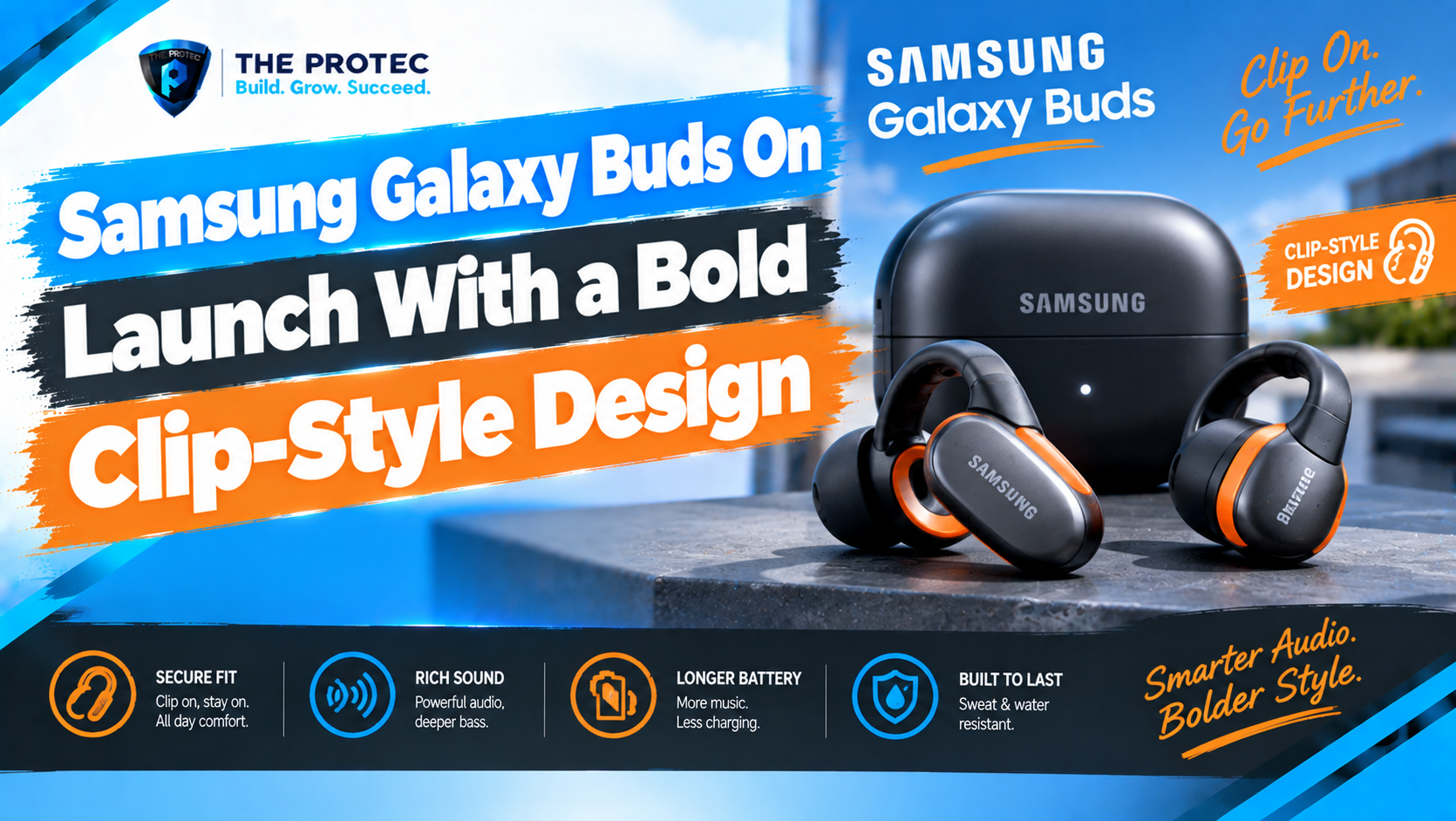
Samsung is taking its wearable audio lineup in a noticeably different direction with the launch of the Samsung Galaxy Buds On. Instead of using the sealed in-ear shape associated with conventional Galaxy Buds, the new model adopts a clip-style design intended to hold each earbud securely without placing a silicone tip deep inside the ear canal.
The change is more than cosmetic. Clip-style wireless earbuds belong to a growing open-ear category built around comfort, stability and awareness of nearby sounds. With the Galaxy Buds On design, Samsung is addressing listeners who may find traditional ear tips uncomfortable, want to remain more aware while commuting or exercising, or simply prefer an earbud that feels less enclosed.
Samsung’s launch information also emphasizes connected audio, integrated controls and Galaxy ecosystem features. However, specifications, supported functions, pricing and sales dates can differ by country. Buyers should therefore separate Samsung’s confirmed product capabilities from regional listings, retailer descriptions and reported details that may not apply everywhere.
How the Samsung Galaxy Buds On clip-style design works
The defining feature of the Galaxy Buds On is the structure that wraps or clips around part of the outer ear. Rather than relying on friction from a tip inside the ear canal, the design distributes contact across the earbud’s speaker section and its rear support. A connecting band keeps those components aligned while applying enough tension to help the earbud remain in place.
This arrangement positions the speaker close to the ear canal without creating the tight acoustic seal of conventional in-ear Galaxy Buds. Samsung describes the form factor as a lightweight, secure alternative for extended listening. The concept is intended to reduce the plugged-ear sensation that some people experience with silicone tips, although comfort and stability will still depend on individual ear shape.
The clip also changes how the earbuds look when worn. Samsung’s established Galaxy Buds models generally sit inside the concha of the ear, with recent versions using either a compact bud or blade-style body. The Samsung clip-on earbuds remain more visible because part of the assembly sits behind or around the outer ear. That visible structure is functional: it helps balance the speaker and provides space for batteries, microphones, antennas and control sensors.
Galaxy Buds On versus conventional in-ear Galaxy Buds
The most important distinction is the absence of a deep, sealed fit. Traditional in-ear earbuds use silicone tips to block some outside noise and direct low-frequency energy into the ear canal. That seal can support stronger perceived bass and improve passive isolation, but it may also create pressure or discomfort for some listeners.
The Galaxy Buds On take a more open approach. Their near-ear speaker allows external sounds to remain audible, making it easier to notice announcements, traffic or conversations without constantly switching an ambient listening mode on and off. This may be useful during office work, casual walking or other situations where awareness matters.
There are trade-offs. An open fit generally allows more environmental noise to compete with music, especially on trains, aircraft or crowded streets. It can also make deep bass more difficult to reproduce consistently because the earbud does not form a sealed acoustic chamber. Samsung’s tuning and signal processing are designed to compensate for the form factor, but software cannot completely duplicate the passive isolation of a correctly fitted in-ear tip.
Fit should not be treated as universal. A clip mechanism may feel stable on one ear and less secure on another. Glasses, earrings and other wearables can also affect positioning. Samsung’s intended result is a secure, lightweight wearing experience, not a guarantee that every user will perceive the pressure or fit in the same way.
Galaxy Buds On specifications and confirmed features
Samsung’s official launch materials establish the Galaxy Buds On as true wireless, open-style earbuds with a clip mechanism, integrated microphones, a rechargeable carrying case and support for compatible Galaxy devices. The company is also promoting audio processing, device connectivity, onboard controls and software features delivered through its wearable ecosystem.
The core areas covered by Samsung include:
- Open-style audio: Drivers are positioned close to the ear canal while leaving the canal unobstructed, with digital processing used to manage clarity, bass and channel balance.
- Wireless connectivity: The earbuds connect over Bluetooth and integrate with supported Samsung phones, tablets and other compatible devices. Available codec support and seamless switching behavior can depend on the connected hardware and software version.
- Microphone system: Built-in microphones support calls, voice commands and sound processing. Call quality can vary with wind, background noise, earbud positioning and the connected device.
- On-ear controls: Users can manage playback, calls and selected listening functions from the earbuds. Control customization is handled through Samsung’s companion software where supported.
- Charging case: The compact case stores and recharges both earbuds. Charging methods and accessories included in the box should be checked on the relevant regional product page.
- Galaxy integration: Features may include quick pairing, device discovery, account-based connections and switching within Samsung’s ecosystem, subject to device compatibility.
Not every specification published by a retailer should be interpreted as a universal Samsung specification. Driver measurements, Bluetooth versions, water-resistance ratings, codec availability and package contents can be presented differently across markets. Samsung’s regional product pages and the company’s official Galaxy Buds website should be treated as the primary references for the version being purchased.
Galaxy Buds On audio and the open-ear challenge
The central engineering challenge for Galaxy Buds On audio is delivering a full sound without an in-ear seal. Open-ear models typically use carefully directed speakers, equalization and dynamic processing to preserve vocal clarity and low-frequency presence. Precise positioning is especially important because even a small change in the distance between the speaker and ear canal can alter perceived volume and bass response.
Samsung’s audio processing is intended to adapt the listening experience to the clip-style hardware. The earbuds are designed for music, podcasts, calls and video, but their presentation should not be assumed to match sealed Galaxy Buds. Open earbuds often prioritize natural awareness and long-term wear over maximum isolation.
Sound leakage is another consideration. Because audio is produced near an unsealed ear, people nearby may hear some content at higher volumes. Directional acoustic design can limit leakage, but it cannot remove it in every environment. Users in quiet offices, libraries or shared rooms may need to keep the volume lower.
Galaxy Buds On battery life and charging
Samsung provides rated listening and total case-assisted battery figures through its launch and regional sales materials. Those figures are measured under defined test conditions, so real-world Galaxy Buds On battery life will vary with volume, call usage, connection quality, processing features and environmental conditions.
Open-ear designs can require additional amplifier power because they do not benefit from a sealed canal. At the same time, their larger external structure can give manufacturers more flexibility when distributing battery components. The practical result depends on Samsung’s final regional configuration and enabled features.
Consumers should check whether a quoted total includes multiple case recharges and whether optional functions were enabled during testing. Charging-case specifications, wireless charging support and the supplied cable may also vary by market. A local Samsung listing is more reliable than converting figures from another country’s retailer page.
Connectivity, controls and Galaxy AI features
The Galaxy Buds On are designed to work most closely with Samsung’s wider device ecosystem. Pairing, battery information, control settings, firmware updates and earbud-finding tools are managed through compatible Galaxy software. Standard Bluetooth functionality remains important for other devices, although some ecosystem features may require a supported Samsung phone or tablet.
Galaxy Buds On AI features should also be understood in context. Some experiences marketed alongside Galaxy AI are processed primarily by the connected Galaxy device rather than entirely inside the earbuds. Depending on the phone, region, language and software version, earbuds may provide the microphones and audio output for functions such as interpretation, transcription assistance or context-aware voice interactions.
These services may require a Samsung account, internet access or a compatible Galaxy device. Language availability and processing methods can differ by feature. Samsung explains new ecosystem capabilities and compatibility changes through its official global newsroom, while local support pages provide market-specific requirements.
Physical or touch-sensitive controls are particularly significant on clip-style earbuds because users need to avoid shifting the speaker while making adjustments. Samsung’s control implementation is designed to let listeners operate playback and calls from an accessible part of the earbud. Available gestures and customization options should be confirmed in the wearable app.
Advantages and trade-offs of Samsung open-ear earbuds
The appeal of Samsung open-ear earbuds rests on a different balance of priorities rather than a universal improvement over in-ear models.
Potential advantages
- Environmental awareness: An unobstructed ear canal can make traffic, announcements and nearby voices easier to notice.
- Reduced in-ear pressure: The design avoids inserting a silicone tip deeply into the canal.
- Secure positioning: The clip is intended to resist movement during walking and everyday activity.
- Lightweight wear: Weight is distributed between the front speaker and rear support rather than concentrated inside the ear.
- No ear-tip sizing: Users do not need to choose among silicone tip sizes, although ear anatomy still affects fit.
Potential trade-offs
- Less passive isolation: Outside noise remains more audible than with sealed earbuds.
- Variable bass response: Low-frequency performance may change with positioning and ear shape.
- Possible sound leakage: Nearby people may hear audio at high playback levels.
- Accessory interaction: Glasses, jewelry or protective headwear may compete for space around the ear.
- Limited suitability for loud travel: Users may be tempted to raise the volume in noisy environments.
Awareness is not the same as safety. Music can still mask important sounds, even with an open fit, and listeners should follow local rules when using earbuds around roads or while cycling.
Galaxy Buds On compared with other clip-style earbuds
The Galaxy Buds On launch places Samsung among brands exploring alternatives to conventional ear tips. Huawei’s FreeClip line uses a C-shaped bridge between an acoustic unit and a rear module. Bose Ultra Open Earbuds use a cuff-like arrangement that holds the speaker near the ear canal, while models such as the Shokz OpenDots One and Soundcore AeroClip apply their own variations of a flexible clip.
These products share an open-ear objective, but they do not use identical acoustic systems, control layouts or software ecosystems. Samsung’s distinguishing approach is its integration with Galaxy phones, wearable software and compatible AI-assisted services. The comparison is therefore less about identifying one universally superior shape and more about understanding how each manufacturer balances pressure, speaker placement, battery distribution and connectivity.
A Galaxy Buds On vs AirPods comparison reveals an even clearer design difference. Standard AirPods use an open-fit body that rests at the entrance to the ear, while AirPods Pro use silicone tips. Neither approach relies on the same outer-ear clip mechanism as the Galaxy Buds On. Platform features also differ because Samsung and Apple reserve some functions for their respective ecosystems.
Galaxy Buds On price and regional availability
There is no single price that should automatically be applied worldwide. The official Galaxy Buds On price is set through Samsung’s regional channels and may be affected by taxes, currency, launch promotions, color availability and retailer bundles. Likewise, a sales date announced for one country does not confirm availability in every other market.
Prospective buyers should verify the local Samsung store listing before ordering, especially when importing. Warranty coverage, supported AI services, app functionality and included accessories may differ between regional versions. Reported prices from leaks or early retailer pages should not be presented as confirmed unless they match Samsung’s final local listing.
What the Galaxy Buds On mean for Samsung wearable audio
The Galaxy Buds On show that Samsung audio products no longer need to follow a single in-ear template. Conventional Galaxy Buds remain relevant for listeners who prioritize isolation and a sealed fit, while the new clip-style model addresses demand for awareness and a less intrusive wearing experience.
That broader choice is the real significance of Samsung’s latest wearable audio launch. The company is not simply changing the exterior of an existing earbud; it is adopting a form factor with different acoustic, ergonomic and practical priorities. Whether those priorities suit a particular listener will depend on ear shape, daily environment and expectations for isolation, bass and ecosystem integration.
Frequently asked questions
Are the Samsung Galaxy Buds On fully open-ear earbuds?
They use an open-style design that places the speaker near the ear canal without sealing it with a silicone tip. This allows more surrounding sound to enter naturally than with conventional in-ear Galaxy Buds.
Do Galaxy Buds On have noise cancellation?
Buyers should check the specification page for their market rather than assuming that processing features operate like active noise cancellation in sealed earbuds. Even when electronic noise processing is available, an open physical design cannot provide the same passive isolation as an in-ear tip.
Will Galaxy Buds On work with non-Samsung phones?
They use Bluetooth for wireless connectivity, but certain settings, seamless device features and Galaxy AI experiences may require compatible Samsung hardware, software or an account. Functionality can differ on other platforms.
Are clip-style earbuds better for exercise?
The clip mechanism is intended to improve stability during movement, but suitability depends on individual fit, activity intensity and the product’s confirmed water-resistance rating. Users should not assume that secure everyday wear makes the earbuds appropriate for every sport.
How should buyers confirm Galaxy Buds On specifications and pricing?
Consult Samsung’s local product page and support documentation. Regional listings are the best sources for final price, battery ratings, colors, water resistance, codec support, package contents and availability.