








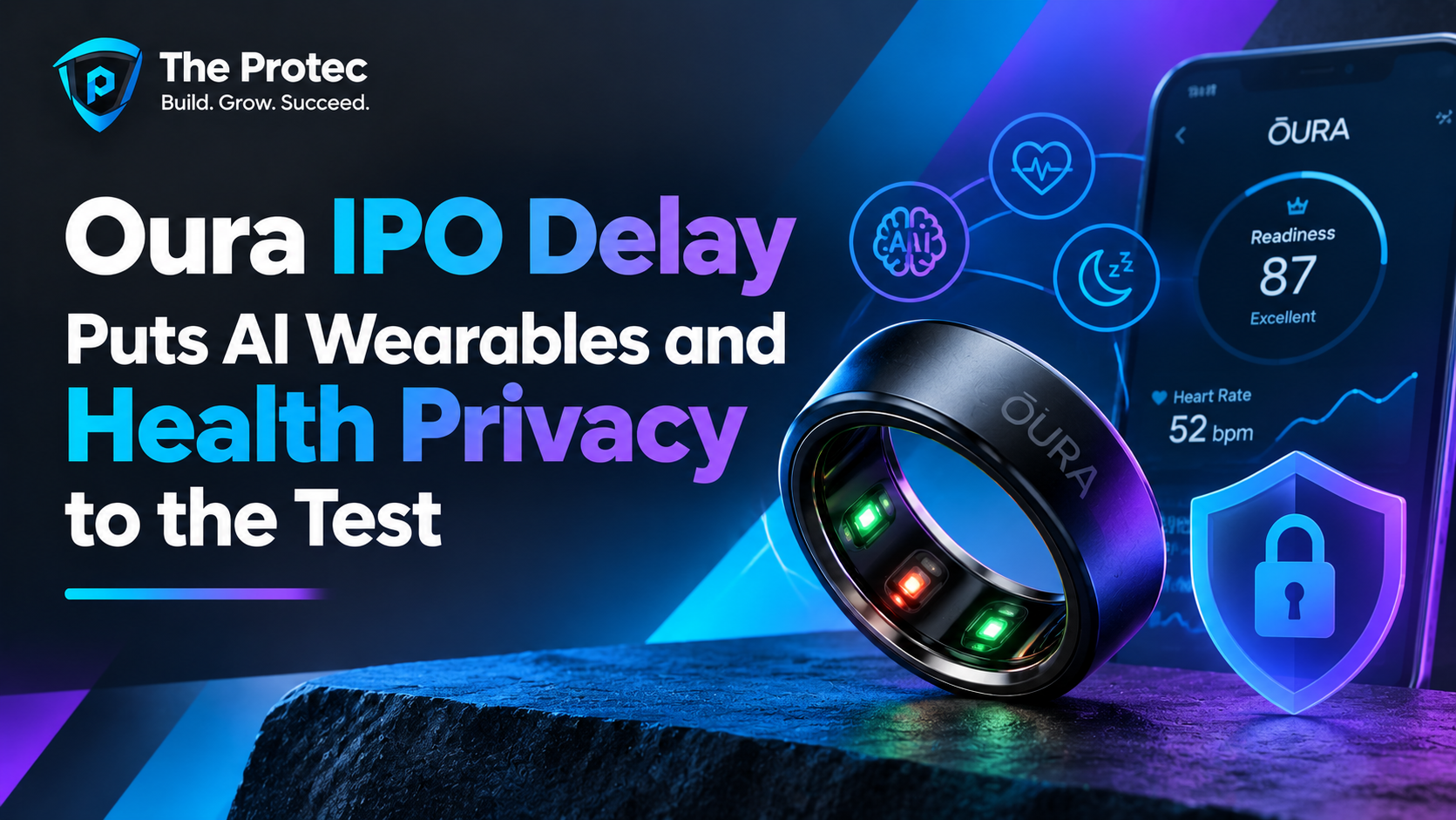
The decision by Oura to postpone its planned U.S. initial public offering (IPO) has landed at a pivotal moment for AI wearables. Smart rings, watches and other AI wearable devices are becoming more capable of interpreting sleep, activity, stress, recovery and reproductive-health signals. At the same time, consumers, regulators and investors are asking harder questions about what happens to the intimate data behind those insights.
That combination makes the Oura IPO delay significant, but it also creates room for a misleading narrative. Oura cited broader uncertainty in the IPO market despite strong demand for its offering. Market volatility, rising bond yields and shifting investor sentiment contributed to the decision. Privacy concerns were not presented as the confirmed reason for the Oura IPO postponement.
Privacy nevertheless matters to the company’s long-term investment story. Oura’s expanding paid membership, the momentum surrounding the Oura Ring 5 and continued interest in wearable health technology all depend on sustained trust. The central question facing the wearable AI market is whether personalized intelligence can remain valuable enough—and private enough—to justify the continuous collection of sensitive biometric information.
Why Was the Oura IPO Delayed?
The planned Oura Health IPO was expected to give public-market investors exposure to one of the best-known companies in the smart ring market. Instead, the company postponed its U.S. listing as financial conditions became less predictable.
The distinction between postponing and abandoning an IPO is important. A company may delay an offering when its business is performing well but market conditions make pricing more difficult. Rising bond yields can draw capital toward lower-risk assets, while stock-market volatility can reduce investors’ willingness to support premium valuations. Changing sentiment toward technology, consumer hardware and subscription businesses can also affect when an offering is likely to receive favorable terms.
Oura indicated that demand remained strong. The Oura IPO delayed decision therefore appears to be a timing judgment rather than a declaration that investors have rejected smart rings or AI health tracking. Companies preparing to list often wait for a more stable market window instead of accepting a lower valuation or a volatile first day of trading.
For anyone following the Oura IPO 2026 story, the most accurate interpretation is straightforward: Oura encountered unfavorable public-market conditions. Broader concerns about data governance may still influence future investor analysis, but they should not be retroactively presented as the official cause of the delay.
Privacy Is a Strategic Issue, Not the Confirmed Trigger
Headlines connecting the postponement directly to AI wearable privacy concerns risk confusing correlation with causation. Privacy is a major industry issue, but Oura did not identify it as the reason for delaying the offering.
The nuance matters because an IPO can be affected by several forces at once. Interest rates, comparable-company valuations, market liquidity and institutional demand influence pricing. Separately, investors evaluating a health-data company will examine cybersecurity, regulatory exposure, user consent and reputational risk. Those privacy questions can shape long-term confidence without being the immediate event that stopped a listing.
It is more useful to view the delay as a test of two different forms of confidence. The first is confidence in financial markets and the availability of capital. The second is confidence that AI wearables can grow without weakening consumer control over health information. Oura explicitly pointed toward the first challenge, while the second remains an important part of the company’s future.
Oura’s Growth Story Extends Beyond Hardware
Oura has helped turn the smart ring from a niche tracker into a mainstream wearable category. Its appeal comes partly from form factor: a ring can collect signals throughout the day and night without requiring users to wear a screen on their wrist. That unobtrusive design supports consistent tracking, which can make trends and personalized recommendations more useful.
The company’s business model has also evolved beyond a one-time device sale. Its paid membership gives users access to deeper analysis, readiness guidance, sleep insights and other software-driven features. Expansion of that membership base strengthens recurring revenue and gives Oura an ongoing relationship with customers after hardware purchases.
The Oura Ring 5 has added momentum to this strategy by reinforcing the role of software and AI-generated interpretation. For users, the product is not simply a collection of sensors. Its value comes from transforming streams of biometric measurements into understandable guidance about recovery, activity and sleep. Continued improvements in battery efficiency, sensing, comfort and personalized analysis can further widen the audience for smart rings.
This combination of hardware, membership revenue and AI health tracking is likely to remain central whenever the company revives its IPO plans. It can be an attractive growth model, but it also means that Oura’s long-term value depends on retaining access to data and maintaining the trust of the people who generate it.
Why Smart Ring Privacy Deserves Close Attention
A smart ring may look less intrusive than a phone or smartwatch, but it can build an unusually detailed record of daily life. Depending on the device and enabled features, wearable health technology may process information related to:
- Sleep duration, timing, interruptions and regularity
- Heart rate, heart-rate variability and respiratory patterns
- Body temperature trends and possible physiological changes
- Daily movement, workouts and periods of inactivity
- Stress, recovery and readiness indicators
- Menstrual-cycle patterns and reproductive-health estimates
- User-entered tags describing illness, medication or personal behavior
Individual readings may appear ordinary, but patterns across weeks or months can reveal sensitive details. Temperature shifts and sleep changes might suggest illness. Location-linked routines can expose when someone is home, at work or traveling. Reproductive-health features may produce information with legal, employment or insurance implications in some jurisdictions.
AI increases both the value and sensitivity of these records. Traditional trackers display measurements; modern AI wearable devices infer conditions, habits and likely outcomes. An inference can feel more invasive than a raw data point because it claims to explain what is happening inside a person’s body or life.
That is why smart ring privacy cannot be reduced to whether a database has been hacked. Meaningful consumer wearable privacy also covers consent, data minimization, retention, third-party sharing, model training, account deletion and the handling of legal requests. Users need to understand not only what a device collects, but why it is collected and how long it remains available.
Oura’s Stated Privacy Protections and Data Practices
Oura has publicly emphasized privacy and security as core responsibilities. Its published privacy policy explains categories of information collected, purposes for processing, circumstances involving service providers and rights that may be available to users. The company also provides account and data-management options and describes safeguards intended to protect personal information.
Those commitments matter, particularly as Oura health data becomes more detailed. However, consumers and investors should evaluate privacy as an operational practice rather than a marketing statement. Policies can change, features can introduce new data flows and acquisitions or partnerships can create additional questions about access.
Key areas to examine include whether data collection is proportionate to a feature, whether optional uses require meaningful consent and whether users can delete information without navigating a complicated process. Companies should also explain whether personal data is used to improve AI systems, what de-identification means in practice and how they respond to government or legal demands.
Regulatory obligations are evolving as well. In the United States, many consumer wellness products do not fit neatly within the same privacy framework that applies to hospitals and doctors. The Federal Trade Commission’s guidance on the Health Breach Notification Rule illustrates how consumer health applications and connected devices may still face breach-related responsibilities even when traditional healthcare rules do not apply.
What the Delay Means for the Wearable AI Market
The Oura IPO postponement is a setback for Oura’s listing schedule, but it is not sufficient evidence of a market-wide collapse. Consumer demand for sleep analysis, fitness guidance and proactive health insights continues to support the wearables industry. Technology companies are also expanding from basic activity tracking into coaching, early-warning indicators and more context-aware recommendations.
What may change is the standard investors apply to the sector. Growth will remain important, but public-market scrutiny is likely to extend to membership retention, hardware upgrade cycles, margins, regulatory compliance and privacy risk. A wearable company that cannot explain its data governance may face a valuation discount even if its products are popular.
Competitors in the smart ring market could benefit from the category awareness Oura has created, but they inherit the same trust problem. Smaller brands must prove that they have adequate security resources. Large technology companies must convince users that health data will not be blended indiscriminately with advertising profiles or other commercial systems.
The strongest companies will treat privacy as part of product quality. Clear controls, limited collection, local processing where practical and transparent AI explanations can become competitive advantages. In a market where several devices offer similar sensors, trust may be one of the few durable ways to stand apart.
The Real Challenge: Proving the Trade-Off Is Worth It
AI wearables ask consumers to participate in a continuous exchange. Users provide intimate, long-term data; companies return personalized analysis and recommendations. That exchange works only when the insights are useful, the limitations are understandable and the handling of information feels proportionate.
Overstated health claims could weaken confidence just as quickly as poor privacy practices. Readiness scores and wellness signals are not always medical diagnoses, and algorithmic outputs can be affected by incomplete data, individual differences or sensor error. Responsible companies must communicate uncertainty rather than presenting every AI-generated interpretation as clinical fact.
Investors will be watching whether Oura can sustain growth while managing these expectations. A successful future offering would demonstrate that the market sees value in subscription-supported health wearables. It would also test whether Oura can present privacy governance, cybersecurity and regulatory readiness as strengths rather than unresolved liabilities.
What to Watch Before Oura Returns to the IPO Market
Several indicators will shape the next phase of the Oura IPO story:
- Stabilization in equity markets and improved conditions for technology listings
- Movement in bond yields and renewed investor appetite for growth companies
- Continued expansion and retention of Oura’s paid membership
- Sales momentum and customer response to the Oura Ring 5
- Greater transparency about AI processing, data retention and user controls
- Regulatory developments affecting biometric and consumer health information
- Evidence that personalized insights lead to durable engagement rather than short-term curiosity
If financial conditions improve, Oura may be able to return without changing the core investment case. If the delay extends, questions about valuation, competition and growth could become more prominent. Either way, the company’s privacy posture will remain part of due diligence even though it was not the stated cause of the postponement.
Frequently Asked Questions
Was the Oura IPO delayed because of privacy concerns?
No confirmed evidence establishes privacy as the reason. Oura cited uncertainty in the broader IPO market despite strong demand, with volatility, higher bond yields and changing investor sentiment contributing to the postponement. Privacy remains a strategic risk for Oura and other AI wearables, but it should not be reported as the official trigger without supporting evidence.
Does the delay mean the AI wearables market is struggling?
Not necessarily. The decision affects the timing of one company’s public offering and does not prove that demand for AI wearables has collapsed. Smart rings and other wearable devices continue to attract interest because of their sleep, activity, recovery and health-tracking capabilities. The delay does show that even fast-growing companies are vulnerable to difficult capital-market conditions.
What privacy risks are associated with an Oura smart ring?
Smart rings can process sleep, heart rate, temperature, activity, stress and reproductive-health information. Risks can involve unauthorized access, excessive retention, unclear consent, third-party sharing, legal demands or unexpected use in AI development. Users should review privacy settings and policies while considering whether each enabled feature provides enough value to justify its data collection.
Could Oura still complete an IPO later?
Yes. A postponement leaves open the possibility that the company will proceed when market conditions become more favorable. The timing may depend on volatility, interest rates, investor demand, company performance and the valuation Oura believes it can achieve.
A Delay, Not a Verdict on AI Wearables
Oura’s postponed listing is meaningful, but it should be interpreted carefully. It reflects an uncertain IPO environment rather than a confirmed rejection driven by health data privacy. Nor does it establish that AI wearables have suffered a broad market setback.
The delay does, however, sharpen the industry’s central challenge. Oura and its competitors must show that continuous biometric tracking can deliver genuinely useful intelligence without asking users to surrender control of their most personal information. If they can make that case through strong products, transparent practices and responsible AI, privacy may become a source of differentiation rather than an obstacle to growth.