






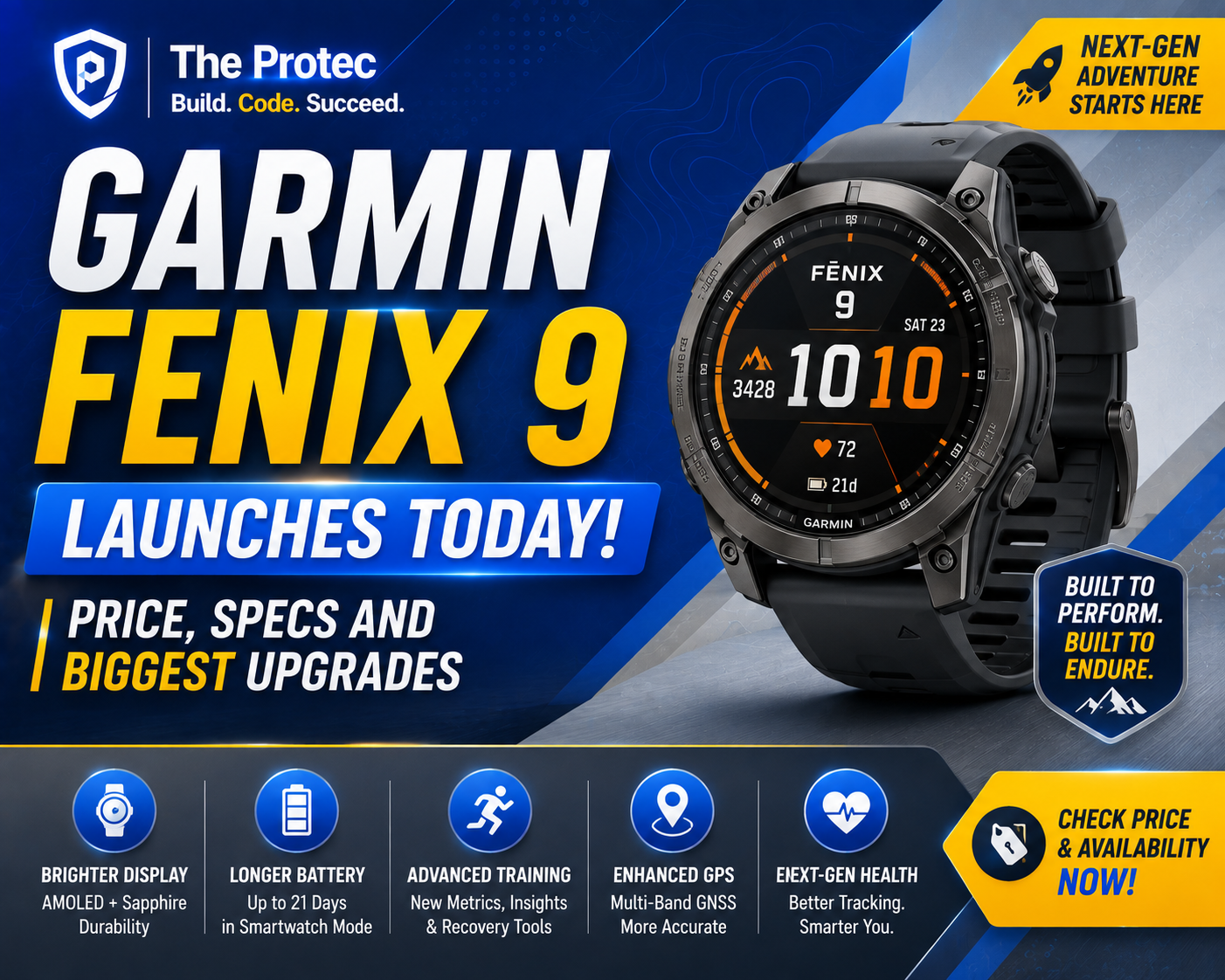
The Garmin Fenix 9 launches today as Garmin’s new flagship multisport smartwatch, bringing meaningful upgrades to connectivity, battery efficiency, navigation, health tracking and outdoor safety. Rather than reinventing the rugged Fenix formula, Garmin has refined the areas that matter most to endurance athletes and adventurers: brighter displays, more capable standalone communication, improved sensor accuracy and longer runtime.
The range remains broad. Buyers can choose between multiple case sizes, premium Garmin Fenix 9 titanium configurations, vivid AMOLED displays and power-focused solar models. The larger Garmin Fenix 9 51mm is once again the battery champion, while smaller versions offer the same core software in a more manageable design.
Here is everything announced on launch day, including the Garmin Fenix 9 price, release date, specifications, LTE and satellite capabilities, battery estimates and the biggest changes from the Fenix 8.
Garmin Fenix 9 release date and availability
The Garmin Fenix 9 release date is August 25, with orders opening today through Garmin and selected authorized retailers. Initial availability covers the United States and several major international markets, although individual colors, case sizes and titanium editions may reach some regions later than the standard models.
Garmin is offering 43mm, 47mm and 51mm case sizes. The company’s launch assortment includes AMOLED models alongside solar-charging versions that retain a memory-in-pixel display for maximum outdoor visibility and battery endurance. Availability depends on size: not every material, color or display combination is offered in all three dimensions.
Current configurations and regional delivery estimates can be checked on the official Garmin adventure smartwatch page. Launch pricing and subscription services can vary by country.
Garmin Fenix 9 price: How much does it cost?
The Garmin Fenix 9 price starts at $1,099.99 in the United States for a standard AMOLED configuration. That places the new watch firmly in the premium wearable category and above many mainstream running watches. Larger cases, sapphire lenses, titanium hardware and integrated communication features increase the final cost.
- Garmin Fenix 9 AMOLED models start at $1,099.99.
- The Garmin Fenix 9 51mm AMOLED starts at $1,199.99.
- Sapphire and Garmin Fenix 9 titanium editions start at $1,199.99.
- Premium 51mm titanium and connected configurations reach $1,299.99 or more.
- LTE and satellite service requires a separate Garmin subscription after any included trial period.
These are advertised U.S. launch prices, and the extensive configuration list means buyers should verify the exact model before ordering. A titanium bezel does not automatically mean every exposed component is titanium, while sapphire editions use a more scratch-resistant lens than standard glass models.
Garmin Fenix 9 specs at a glance
The core Garmin Fenix 9 specs build on the durable platform introduced with the previous generation. All models provide 10 ATM water resistance, physical controls, touchscreen operation, onboard maps, music storage, contactless payments and multi-band satellite positioning.
- Case sizes: 43mm, 47mm and 51mm.
- Display options: AMOLED or solar-charging memory-in-pixel.
- Lens options: strengthened glass or sapphire crystal.
- Materials: stainless steel or titanium, depending on configuration.
- Positioning: multi-band GNSS with SatIQ automatic mode selection.
- Connectivity: Bluetooth, Wi-Fi and connected LTE/satellite options.
- Water rating: 10 ATM, with supported dive and apnea activities.
- Controls: five physical buttons, touchscreen, speaker and microphone.
- Storage: onboard maps, applications, workouts and offline music.
- Sensors: optical heart rate, Pulse Ox, barometric altimeter, compass, gyroscope, accelerometer, thermometer and ambient-light sensor.
Garmin also continues its sealed inductive button design, which reduces the need for openings through the case. That is especially useful for swimming, diving and repeated exposure to rain, dust and saltwater.
Garmin Fenix 9 AMOLED and solar display choices
The Garmin Fenix 9 AMOLED models use a bright, high-contrast display with an optional always-on setting. Maps, charts and notifications are easier to read than on a traditional memory-in-pixel panel, particularly indoors or in low light. Garmin has also improved outdoor brightness management so the screen remains legible in direct sunlight without staying at maximum output unnecessarily.
AMOLED is the best fit for buyers who prioritize richer graphics, sharper text and a polished everyday smartwatch experience. Gesture mode extends battery life by waking the screen when the wrist is raised, while always-on mode trades endurance for constant visibility.
The solar line takes a different approach. Its transflective display becomes clearer under strong sunlight and uses less power when showing a static watch face or activity data. A wider and more efficient solar collection area can add meaningful runtime when the watch receives several hours of bright outdoor exposure. Solar charging slows battery depletion; it should not be treated as a substitute for wired charging.
LTE and satellite connectivity explained
Garmin Fenix 9 LTE and satellite features are among the most important additions to the range. Connected editions can send location updates, exchange short messages and access supported assistance functions when a paired phone is unavailable. LTE handles communication where Garmin’s supported terrestrial coverage exists, while satellite mode is intended for remote areas without cellular service.
The Garmin Fenix 9 satellite system integrates with Garmin’s inReach platform. With an active plan and a clear view of the sky, compatible models can use two-way messaging, location sharing and interactive SOS support. Emergency messages are routed to a response coordination center rather than simply being transmitted to a personal contact.
There are limitations. Garmin Fenix 9 LTE is not necessarily a full replacement for a cellular phone or a carrier-linked smartwatch. Functionality, coverage and voice options differ by region, and satellite messages can take longer to transmit under trees, beside cliffs or between tall buildings. Users should review Garmin’s satellite communicator information before relying on the watch for remote travel.
New Garmin Fenix 9 health and fitness features
The Garmin Fenix 9 features an updated optical sensor package and revised algorithms for heart rate, sleep, stress and recovery analysis. Garmin’s aim is not merely to collect more data, but to connect daily health trends with training recommendations.
A new readiness overview combines sleep quality, recent workload, heart-rate variability, recovery time and travel-related disruption. It can adjust guidance after overnight flights, unusually hot events or several days at altitude. Morning and evening reports summarize upcoming workouts, recovery priorities, weather and key health trends without requiring users to open several widgets.
Strength athletes gain improved automatic set detection, muscle-group summaries and structured plans that adapt around endurance sessions. Runners and cyclists receive refined hill, stamina and pace guidance, while trail users can compare effort across changing elevation more consistently. Dive profiles, open-water swimming metrics, ski resort maps and golf tools also remain part of the package.
Garmin has expanded its ECG and skin-temperature-related insights where regulatory approval permits. These features are wellness tools rather than medical diagnoses, and availability can depend on the user’s country and watch configuration.
Navigation remains a defining Fenix capability. The watch includes routable topographic maps, ski maps, golf courses and points of interest, with Wi-Fi downloads available directly from the device. Multi-band GPS helps reduce errors near reflective buildings, rock walls and dense tree cover.
The latest SatIQ software automatically balances positioning accuracy with energy use. It can activate multi-band tracking in difficult environments and step down to a less demanding mode when conditions improve. The result should be cleaner tracks without forcing users to keep the most power-hungry GPS setting enabled for an entire activity.
Garmin has also improved map rendering and route recalculation. Users can see terrain shading, upcoming climbs and course deviations with fewer screen changes. Dynamic round-trip routing can revise a course during a run or ride while still targeting the requested distance and general return time.
Garmin Fenix 9 battery life
Garmin Fenix 9 battery life varies substantially by case size, display type, satellite use and always-on settings. Garmin’s published estimates place the 43mm AMOLED model at up to approximately 10 days in smartwatch mode, the 47mm at up to 18 days and the Garmin Fenix 9 51mm at up to 30 days when the display is gesture-activated.
Always-on AMOLED mode reduces those figures, as do daily GPS workouts, Pulse Ox monitoring, offline music and frequent LTE or satellite communication. The 51mm version has space for the largest battery and is the logical choice for multiday races or expeditions where charging opportunities are limited.
Solar models can last considerably longer under favorable conditions. Garmin calculates solar estimates using a defined level of daily outdoor exposure, so real-world results will be lower for users training under tree cover, wearing long sleeves or spending most of the day indoors.
One useful change is more transparent battery forecasting. Before starting an activity, the watch estimates remaining hours based on the selected GPS mode, sensors, navigation and accessories. Users can then disable power-intensive functions individually instead of selecting an overly restrictive battery mode.
Garmin Fenix 9 titanium and 51mm models
The Garmin Fenix 9 titanium editions reduce weight while preserving the rugged appearance expected from the series. They are particularly appealing in the 51mm size, where even a modest weight reduction improves comfort during sleep and long-distance events. Titanium can still show cosmetic scratches, but it offers an attractive strength-to-weight balance.
The Garmin Fenix 9 51mm is designed for maximum endurance and screen presence. It offers the longest battery life and is easier to operate at a glance, although the larger footprint may feel cumbersome on narrow wrists. The 43mm model is better suited to smaller wrists, while the 47mm remains the most balanced option for many users.
Fit matters for sensor performance. A watch that moves excessively during intervals can produce weaker optical heart-rate readings, so buyers should not choose the largest model based on battery specifications alone.
Garmin Fenix 9 vs Fenix 8: Biggest upgrades
The Fenix 8 established the current foundation with AMOLED choices, dive support, a speaker and microphone, advanced mapping and redesigned buttons. The Garmin Fenix 9 improves that formula instead of replacing it.
- Broader LTE and satellite integration provides more independence from a smartphone.
- AMOLED displays offer improved brightness control and power efficiency.
- Solar models collect energy more effectively in strong outdoor light.
- Updated health algorithms provide more contextual recovery and travel insights.
- SatIQ and mapping improvements deliver faster rendering and smarter power management.
- Battery estimates are longer, especially for the 51mm model.
- Refined cases and titanium options reduce weight without sacrificing 10 ATM durability.
Fenix 8 owners who mainly use basic GPS tracking, maps and standard training metrics may not need to upgrade immediately. The strongest reason to move to the Fenix 9 is its connected safety package, especially for athletes who frequently leave their phones behind or travel beyond cellular coverage.
Should you buy the Garmin Fenix 9?
The Garmin Fenix 9 is built for runners, cyclists, hikers, triathletes, divers and outdoor users who will benefit from its maps, durability and long battery life. It is less compelling for someone who wants only notifications, step counting and occasional gym tracking; less expensive Garmin models cover those needs.
Choose AMOLED for visual quality and everyday versatility. Choose solar for the longest practical endurance. The 43mm version prioritizes comfort, the 47mm offers the best size-to-battery balance, and the 51mm is aimed at expeditions and ultra-endurance use. Satellite and LTE are worth the additional cost only if the subscription and coverage match how you actually travel.
Garmin Fenix 9 FAQ
When is the Garmin Fenix 9 release date?
The Garmin Fenix 9 launches on August 25, with orders opening through Garmin and participating retailers. Availability of specific sizes, colors, titanium cases and connected editions varies by market.
What is the Garmin Fenix 9 price?
U.S. pricing starts at $1,099.99 for an AMOLED model. The Garmin Fenix 9 51mm, sapphire, titanium, LTE and satellite-equipped configurations cost more, with premium versions reaching $1,299.99 or above.
Does the Garmin Fenix 9 have AMOLED?
Yes. Garmin Fenix 9 AMOLED editions are available in multiple case sizes. Garmin also offers solar models with transflective memory-in-pixel screens for buyers who prioritize outdoor visibility and extended battery life.
Can the Garmin Fenix 9 use satellite communication without a phone?
Compatible connected models can use supported inReach messaging, location sharing and SOS functions without a paired phone. An active service plan is required, and the watch needs a reasonably clear view of the sky for reliable satellite communication.
How long does the Garmin Fenix 9 battery last?
Garmin estimates up to roughly 10 days for the 43mm AMOLED model, 18 days for the 47mm and 30 days for the 51mm under suitable smartwatch settings. Always-on display mode, GPS, music, Pulse Ox, LTE and satellite use reduce runtime.