







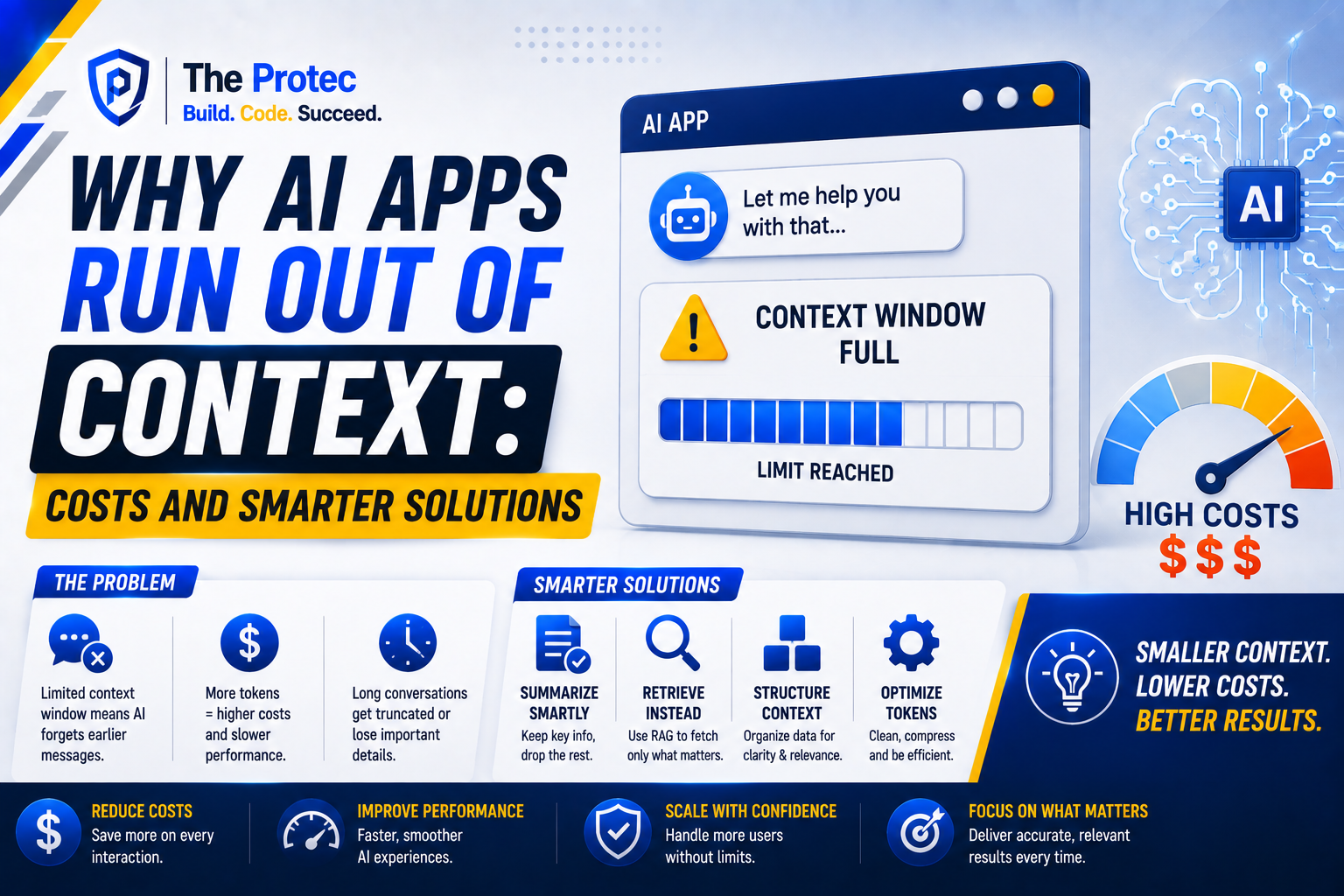
AI applications can analyze large documents, maintain conversations, call tools, and work across complex data. Yet even advanced systems eventually encounter the same constraint: too much information competing for a limited amount of usable context. So, why do AI apps run out of context, and what happens when they reach that limit?
A larger AI context window may appear to solve the problem. Commercial and research models now support windows measured in hundreds of thousands or even millions of tokens. But capacity alone does not guarantee that a model will identify the right detail, reason consistently across the entire input, or produce an answer quickly and affordably. Long prompts increase LLM token costs, consume memory, raise latency, and can bury essential facts beneath irrelevant material.
As of August 2026, the industry is consequently shifting from a “put everything in the prompt” mindset toward context engineering: selecting, compressing, retrieving, and organizing information so the model receives what it needs when it needs it. Understanding that shift starts with understanding what a context window actually does.
What Is an LLM Context Window?
An LLM context window is the maximum amount of tokenized information a model can consider during a request. Tokens are small units derived from text, code, numbers, punctuation, images, audio, or other supported inputs. A token is not the same as a word; the exact ratio varies by language, content type, and tokenizer.
The window typically includes more than the user’s latest message. It may contain:
- System instructions and safety policies
- Conversation history
- Uploaded documents and retrieved passages
- Tool definitions, function schemas, and tool results
- Agent plans, memory records, and intermediate observations
- The model’s generated output
This distinction matters because an advertised window is a shared budget. If an application sends 90,000 input tokens to a model with a 100,000-token limit, it cannot necessarily generate another 20,000 tokens. Some platforms reserve output capacity automatically, while others reject oversized requests or truncate part of the input.
Context is also temporary unless an application deliberately stores it. A model does not inherently remember an earlier session simply because it handled that session before. The application must resend the relevant history, retrieve saved facts, or maintain structured state.
Why AI Apps Keep Running Out of Context
Basic chat interfaces may take many turns to hit their limits. Agentic and enterprise applications can reach them much faster because every component adds material. A coding agent may ingest repository files, terminal output, test results, documentation, and tool instructions. A support assistant may combine account history, product manuals, policies, and a long conversation. Multimodal systems can add tokenized images, transcripts, and video metadata.
Tool-using agents create another problem: context grows during execution. Each search result, API response, failed action, and retry becomes part of the working history. An agent that begins with a compact prompt can accumulate a large, noisy transcript after dozens of steps.
Applications also waste capacity by repeatedly sending information that is not relevant to the current task. Examples include entire manuals when only one section is needed, raw database rows when a summary would work, duplicated tool results, and every message from a conversation whose topic has changed.
When the prompt exceeds the AI context window, an application must either reject the request, remove content, summarize it, or switch to a model with more capacity. Silent truncation is particularly dangerous because it can remove an instruction, disclaimer, or key piece of evidence without making the loss obvious to the user.
How LLM Token Costs Change the Equation
Every token has an operational cost, even when an API’s pricing page makes that cost look small. Providers commonly charge different rates for input tokens, output tokens, and cached input. Reasoning-oriented models may also use internal computation or reasoning tokens that affect billing, latency, or both. Pricing structures change frequently, so architecture decisions should be based on measured workload economics rather than a single advertised rate.
Consider an application that sends a 200,000-token reference set for every question. If only 3,000 tokens are relevant, most of the input cost buys no additional value. Multiply that waste across thousands of users, repeated agent steps, or automated batch jobs, and LLM token costs can dominate the product’s infrastructure budget.
Financial cost is only part of the issue. Long inputs require a substantial prefill phase before the model begins generating a response. They also expand the key-value cache used during inference, placing pressure on accelerator memory and reducing the number of requests that infrastructure can process concurrently. The result may be higher time to first token, lower throughput, and less predictable performance under load.
Output length matters too. An application that asks the model to reproduce large sections of source material pays for that material once as input and again as generated output. Structured, concise responses can therefore reduce both cost and user waiting time.
The Hidden Tradeoffs of Long-Context Models
A bigger LLM context window is valuable. It enables whole-document review, large codebase analysis, long-session continuity, and cross-reference tasks that would otherwise require complicated pipelines. However, maximum capacity and effective capacity are not the same.
Models can overlook evidence located deep inside a long prompt, especially when similar or conflicting details surround it. Research commonly describes this as the “lost in the middle” effect. The influential Lost in the Middle study demonstrated that performance can vary according to where relevant information appears in context. Benchmarks such as LongBench have also highlighted the difference between accepting long input and reasoning reliably over it.
Long prompts introduce several practical tradeoffs:
- Attention dilution: Relevant facts compete with redundant or distracting text.
- Conflicting instructions: Older messages, retrieved documents, or untrusted content may contradict current goals.
- Higher latency: More input must be processed before generation starts.
- Greater cost: Repeatedly transmitting large histories increases token consumption.
- Harder debugging: It becomes difficult to identify which passage influenced an incorrect answer.
- Security exposure: More retrieved content creates more opportunities for prompt injection or accidental data disclosure.
The best model is therefore not always the one with the largest window. A smaller, faster model receiving carefully selected evidence can outperform a larger model given an unfiltered data dump.
Smarter Ways to Handle Large AI Workloads
1. Set an Explicit Context Budget
Applications should treat tokens as a managed resource. Reserve capacity for the final answer, system instructions, tool results, and unexpected expansion. Estimate tokens before sending a request, then apply a clear policy when the input exceeds its budget.
A useful policy prioritizes immutable instructions first, current user intent second, authoritative evidence third, and optional history last. This prevents low-value conversation logs from displacing the information required to complete the task.
2. Use Retrieval-Augmented Generation
Retrieval-augmented generation, or RAG, searches an external knowledge source and places only relevant passages into the prompt. Rather than loading an entire document collection, the application can retrieve a small set of semantically related chunks, rerank them, remove duplicates, and attach source metadata.
Good retrieval depends on more than vector similarity. Hybrid search combines semantic and keyword signals, while metadata filters restrict results by customer, date, product, jurisdiction, or document type. Reranking can then choose passages that directly address the question. The objective is not to retrieve more content; it is to retrieve the smallest sufficient evidence set.
3. Summarize Conversation and Agent History
Rolling summaries can compress old interactions while preserving decisions, user preferences, unresolved questions, and important facts. Recent messages remain verbatim, while earlier turns become a compact memory block.
Summarization is lossy, so it should not be the only record. Applications should retain the original history outside the AI context window and regenerate a summary when needed. Important values such as names, dates, approvals, and constraints are often safer in structured fields than in free-form prose.
4. Store State as Data, Not Transcript
Agents do not need every past thought to continue working. A structured state object can record the current objective, completed steps, verified facts, pending actions, permissions, and error status. The system can discard verbose intermediate reasoning and repeated tool output while retaining what affects the next action.
This approach makes workflows easier to resume, audit, and transfer between models. It also reduces the chance that an old observation will be mistaken for a current instruction.
5. Split Large Jobs Into Stages
Document analysis often works better as a pipeline than as one enormous request. A map-reduce pattern can analyze sections independently, produce standardized findings, and combine those findings in a final synthesis. Hierarchical summarization applies the same idea across chapters, folders, or collections.
For code, the system can first identify relevant symbols and dependencies, then load only the files required for the task. For video or audio, preprocessing can segment content and extract timestamps, speakers, scenes, or topics before involving an expensive model.
6. Cache Stable Prompt Content
Prompt caching can reduce the cost and processing time of repeated prefixes such as policies, tool definitions, templates, and shared documents. Semantic caches can also reuse previous answers when a new request is sufficiently similar and the underlying data has not changed.
Caches need versioning and invalidation rules. Reusing a response after a policy, price, or customer record changes can be worse than making a fresh request. Sensitive cache entries must also be isolated by tenant and access level.
7. Route Tasks to the Right Model
Not every step requires the longest context window or most capable reasoning model. A smaller model may classify a request, extract fields, filter retrieved chunks, or summarize tool output. A larger model can then handle the complex synthesis using a much cleaner prompt.
This model-routing pattern lowers LLM token costs and often improves reliability because each component has a narrow responsibility. Long-context models remain available for cases that genuinely require broad comparison or full-document understanding.
How to Measure Context Efficiency
Teams should monitor more than total token usage. Useful metrics include input tokens per successful task, retrieved tokens actually cited, time to first token, cache hit rate, truncation frequency, answer quality by prompt length, and cost per completed workflow.
Evaluation sets should include evidence at different positions, distracting passages, conflicting sources, and requests near the maximum context limit. Testing only short, clean prompts hides the failure modes that appear in production.
Observability should also show what was removed, summarized, retrieved, and sent to the model. When an answer fails, developers need to determine whether the problem came from retrieval, context assembly, model reasoning, or generation—not simply label it an LLM error.
Frequently Asked Questions
Is a larger AI context window always better?
No. A larger window provides flexibility, but it may increase latency, memory use, and cost. It can also make relevant information harder for the model to identify. The ideal window is large enough for the necessary evidence and output, not necessarily the largest available.
What happens when an LLM context window is exceeded?
The outcome depends on the API and application. The request may fail, older content may be truncated, or the system may summarize or remove material before retrying. Applications should manage this process explicitly because silent truncation can remove critical instructions or evidence.
Does summarization solve context limits?
Summarization helps, but it can omit details or introduce subtle distortions. Strong systems preserve source records, store critical facts in structured form, and retrieve original passages when precision matters. Summaries are best treated as navigation and working memory rather than unquestionable truth.
How can businesses reduce LLM token costs?
Start by removing duplicate content, retrieving only relevant passages, limiting output length, caching stable prefixes, compressing old history, and routing simple tasks to lower-cost models. Measure cost per successful workflow instead of optimizing the price of an isolated API call.
Will unlimited context eliminate the need for RAG?
Unlikely. Even if technical limits continue to grow, organizations still need access controls, fresh data, provenance, predictable latency, and efficient computation. Retrieval determines what information is relevant and authorized; a large context window only determines how much information can be supplied at once.
Context Engineering Is the Real Competitive Advantage
Longer windows are an important capability, but they do not remove the need for careful architecture. The most effective AI applications combine retrieval, structured memory, summarization, caching, staged processing, and model routing to control what enters context.
The goal is not to fill the window. It is to deliver the smallest, clearest, and most trustworthy set of information that allows the model to complete the task. That principle reduces LLM token costs, improves response speed, and makes large AI workloads far more dependable.