







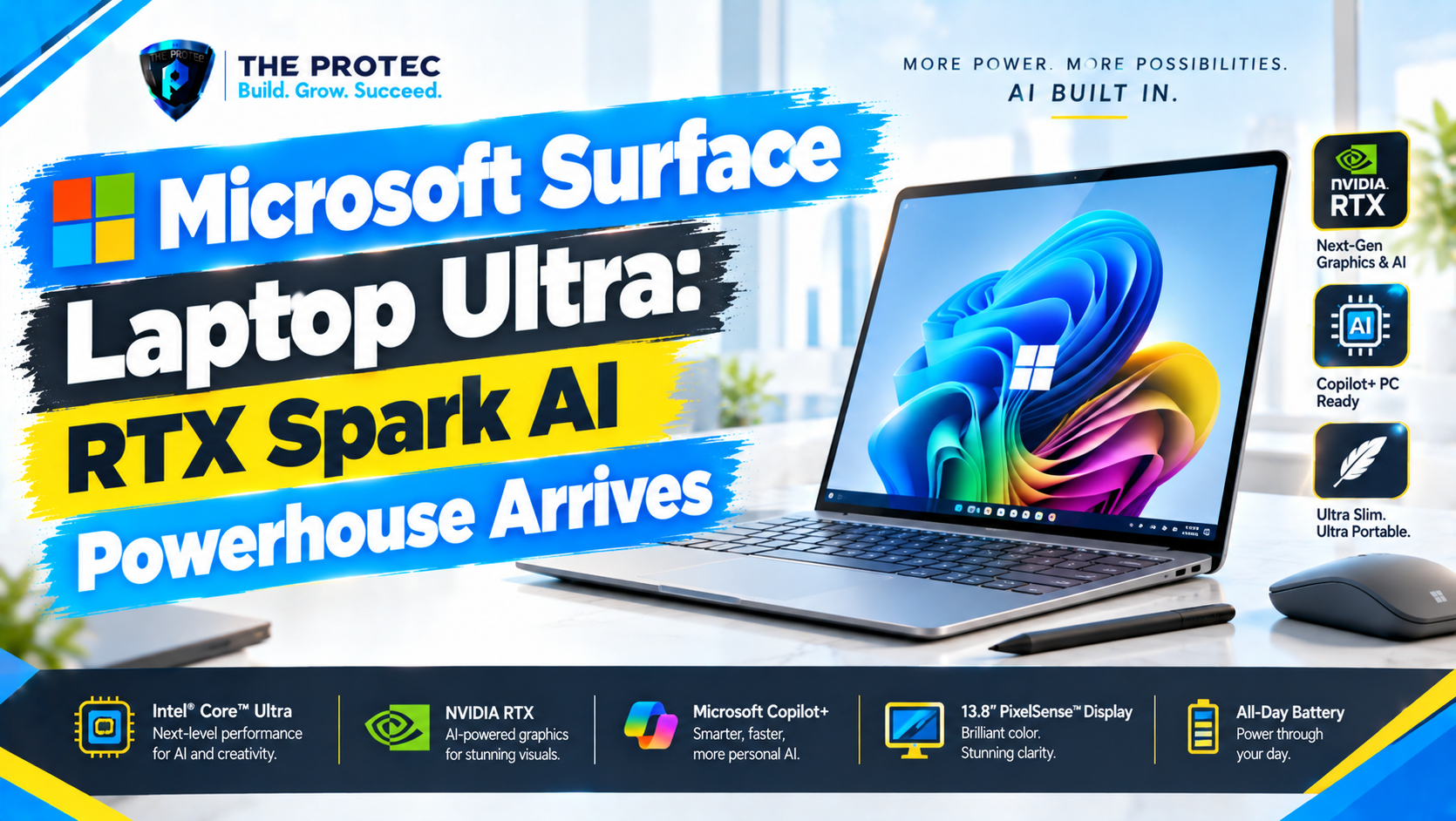
Microsoft has spent years refining Surface laptops into polished Windows flagships. The new Microsoft Surface Laptop Ultra, however, is not simply another thin notebook with a faster processor. Starting at $2,599.99, this 15-inch machine introduces an entirely different class of Surface hardware built around the NVIDIA RTX Spark Superchip, up to 128GB of unified memory and enough local computing power to run AI models exceeding 120 billion parameters.
That combination makes the Surface Laptop Ultra one of the most consequential pieces of Microsoft technology news this year. Microsoft is positioning it as a portable workstation for on-device AI agents, software development, professional creative work, 3D production and gaming—not merely as a premium productivity laptop with a few generative AI features.
Preorders are open now, with the Surface Laptop Ultra release date set for October 16, 2026. Its arrival raises a larger question for the AI PC market: Are personal computers ready to run genuinely capable AI workloads without relying constantly on cloud data centers?
Surface Laptop Ultra specs redefine the Surface category
The defining component is the Surface Laptop Ultra RTX Spark Superchip. It combines a Blackwell-generation RTX GPU with an up-to-20-core NVIDIA Grace CPU and a shared pool of unified memory. The top configuration offers 128GB, giving AI models, graphics workloads and CPU processes access to the same high-capacity memory architecture.
Microsoft’s headline Surface Laptop Ultra specs include:
- NVIDIA RTX Spark Superchip with Blackwell RTX graphics
- Up to a 20-core NVIDIA Grace CPU
- Up to 128GB of unified memory
- Claimed AI performance reaching 1 petaflop
- Support for local AI models exceeding 120 billion parameters
- 15-inch PixelSense Ultra display
- Redesigned thermal architecture for sustained workloads
- Windows on Arm operating platform
- Connectivity intended for workstation accessories and external displays
These specifications place the machine closer to a compact AI workstation than a conventional Surface Laptop. The architecture also reflects the broader direction of NVIDIA’s Blackwell platform, where accelerated computing, high-bandwidth memory access and AI processing are treated as central system capabilities rather than optional additions.
Why RTX Spark matters more than a routine processor upgrade
Most premium laptops divide work among a CPU, a discrete or integrated GPU and system memory. Data often must move between separate memory pools, adding overhead when developers run large language models, render complex scenes or process high-resolution media.
The NVIDIA RTX Spark laptop design takes a different approach. Its Grace CPU and Blackwell RTX GPU work with a large unified memory pool. That does not eliminate every bottleneck, but it can reduce unnecessary data movement and make far more memory available to accelerated workloads than a typical mobile GPU with dedicated VRAM.
The maximum Surface Laptop Ultra 128GB RAM configuration is especially important for AI. Model size, quantization, context length and application overhead all affect memory requirements. A laptop may have excellent raw AI throughput yet still be unable to load a large model because it lacks sufficient accessible memory. Microsoft’s design attempts to address both sides of the equation: computational performance and model capacity.
The company claims up to Surface Laptop Ultra 1 petaflop performance for supported AI operations. As always, a peak figure should not be confused with universal application speed. Real performance will vary by precision, model, framework, cooling, power mode and software optimization. Even so, petaflop-class marketing on a Surface device illustrates how dramatically the definition of a high-end PC has changed.
Local 120B AI models are the real headline
The most striking claim is that the Surface Laptop Ultra can run AI models exceeding 120 billion parameters locally. Parameter count alone does not determine model quality, and running a model is not the same as running it at highly interactive speeds. Quantization will also play a major role. Nevertheless, Surface Laptop Ultra 120B AI models represent a major leap beyond the compact models commonly associated with earlier AI PCs.
This capacity could enable developers and technical professionals to operate sophisticated assistants without uploading proprietary data to a cloud service. Potential uses include analyzing private codebases, searching confidential document collections, generating assets, summarizing research and operating domain-specific models behind a local interface.
Local processing offers three practical benefits:
- Privacy: Sensitive prompts, files and outputs can remain on the device.
- Latency: Users avoid network round trips once the model is loaded.
- Control: Teams can choose models, settings and workflows without depending entirely on a hosted provider.
Local AI is not automatically private, secure or inexpensive. Applications still require sensible permissions, model downloads consume storage, and sustained inference uses substantial power. Cloud systems may also remain faster for the largest frontier models. The significance of the Surface Laptop Ultra local AI proposition is choice: more serious work can happen on the PC when privacy, connectivity or operational control makes cloud inference undesirable.
An AI agent laptop rather than a Copilot-only PC
Microsoft is also emphasizing on-device agent workflows. A conventional chatbot answers prompts. An agent can perform multi-step tasks, call tools, inspect information and make decisions within boundaries established by the user or organization.
An AI agent laptop with high memory capacity could keep a model, retrieval database, development environment and multiple productivity applications active at once. A developer might ask a local agent to examine a repository, identify a defect, propose a patch and run tests. A video professional could use an agent to catalog footage, create transcripts and prepare rough edits while preserving unpublished material on the machine.
This is where the Surface Laptop Ultra AI strategy moves beyond familiar neural processing unit features. Earlier AI PCs focused heavily on background effects, transcription and assistant integration. RTX Spark is designed to tackle much larger models and GPU-accelerated workflows. The result is closer to a mobile personal AI computer than a standard laptop with an AI-branded processor.
PixelSense Ultra display and workstation-focused cooling
The Surface Laptop Ultra 15 inch format gives Microsoft room for its PixelSense Ultra display, a larger cooling system and the connectivity expected by demanding users. The display is intended to serve creators, developers and gamers who need a spacious workspace without moving to a desktop.
The redesigned thermal architecture may prove just as important as the screen. Large AI models, 3D rendering, code compilation and modern games can keep the CPU and GPU under load for extended periods. Peak benchmark numbers mean little if a chassis cannot dissipate heat and sustain them. Microsoft therefore had to design the Ultra around prolonged performance rather than the short bursts common in everyday office work.
That engineering has unavoidable consequences. Buyers should expect a different balance of size, heat, acoustics and battery life than they would from a mainstream ultraportable. Final judgments about Surface Laptop Ultra performance will require independent tests covering sustained inference, unplugged operation, fan noise and throttling.
Creative work, development, 3D and gaming
The Blackwell RTX GPU makes the system relevant beyond language models. GPU acceleration can benefit video effects, image generation, 3D rendering, simulation, denoising and other professional tasks. Developers also gain a portable environment for prototyping applications that may later run on larger NVIDIA infrastructure.
Gaming is part of the pitch as well. RTX technologies can support advanced lighting, upscaling and frame-generation features in compatible titles. The hardware appears formidable, but the software platform introduces an important qualification: this is a Windows on Arm system.
Native Arm applications should offer the best efficiency and performance. Emulation can keep many traditional Windows programs running, but specialized plug-ins, older utilities, anti-cheat systems and hardware drivers may behave differently. Some games may perform extremely well; others could encounter compatibility limitations unrelated to raw GPU power. Prospective buyers should check essential applications and games before ordering.
Microsoft’s emphasis on extensive connectivity is welcome for a workstation-class device. External displays, fast storage, input devices, audio equipment and network adapters are common parts of professional workflows. Buyers should still confirm the ports, display support and expansion options included with their chosen configuration through the official Microsoft Surface site.
Surface Laptop Ultra vs MacBook Pro
The inevitable Surface Laptop Ultra vs MacBook Pro comparison is more nuanced than a simple benchmark contest. Both pursue tightly integrated computing through Arm-based processors and unified memory, but their strengths differ.
Apple’s MacBook Pro line benefits from mature Apple silicon, strong battery efficiency and an established collection of optimized creative applications. Microsoft and NVIDIA are countering with the Windows ecosystem, Blackwell RTX acceleration, broader gaming ambitions and an unusually explicit focus on running very large AI models locally.
The Surface Laptop Ultra may appeal more strongly to developers invested in NVIDIA tools, Windows-based organizations, 3D professionals and users who need CUDA-oriented workflows. A MacBook Pro may remain preferable when battery endurance, silent operation or a specific macOS production environment matters most.
Conventional high-end Windows laptops are another alternative. Many combine x86 processors with discrete NVIDIA GPUs, offering mature compatibility and strong gaming performance. However, their mobile GPUs often have far less dedicated memory than the Surface Laptop Ultra unified memory pool. The Ultra’s advantage is not necessarily winning every traditional benchmark; it is making exceptionally large accelerated workloads possible on one portable device.
Surface Laptop Ultra price and preorder details
The Surface Laptop Ultra price starts at $2,599.99. The system is available for preorder now and is scheduled to become available on October 16, 2026. Higher-memory and storage configurations will cost more, making this a premium purchase even by professional laptop standards.
Anyone considering a Surface Laptop Ultra preorder should evaluate complete configuration pricing rather than focusing only on the entry figure. The 128GB unified-memory model is likely to be the most interesting option for large-model inference, but many creators and developers may not need that capacity.
The ideal buyer is a professional who can translate local compute into saved time, stronger privacy or reduced cloud usage. AI developers, researchers, 3D artists, video teams and technical organizations are the clearest audience. Office users, casual creators and mainstream gamers can obtain excellent performance from less expensive systems.
Does RTX Spark signal the future of the AI PC?
The Surface Laptop Ultra suggests that the next stage of the AI PC 2026 cycle will be defined by model capacity, not merely the presence of an NPU. Future systems will be judged by which models they can load, how quickly they generate results and how effectively they can operate agents across local applications.
Cloud AI will not disappear. Hosted services retain advantages in scale, collaboration and access to the largest models. The more likely future is hybrid computing: private or time-sensitive work runs locally, while exceptionally demanding requests move to the cloud.
As an RTX Spark AI laptop, the Surface Laptop Ultra is an ambitious test of that future. Its value will depend on software optimization, sustained performance and Arm compatibility—not specifications alone. If Microsoft and NVIDIA deliver a polished ecosystem, this device could establish a new category between premium laptops and desktop AI workstations.
Frequently asked questions
What is the Microsoft Surface Laptop Ultra release date?
The Surface Laptop Ultra is scheduled to become available on October 16, 2026. Microsoft is accepting preorders ahead of the release date.
How much does the Surface Laptop Ultra cost?
The Surface Laptop Ultra starts at $2,599.99. Pricing increases with memory, storage and other configuration choices.
Can the Surface Laptop Ultra run 120-billion-parameter models locally?
Microsoft says the laptop can run AI models exceeding 120 billion parameters locally. Actual speed and memory usage will depend on the model, quantization level, context size and software framework.
Does the Surface Laptop Ultra have 128GB of unified memory?
Yes. Top configurations offer up to 128GB of unified memory shared across the Grace CPU and Blackwell RTX GPU, which is particularly valuable for large AI and professional graphics workloads.
Is the Surface Laptop Ultra suitable for gaming?
Its Blackwell RTX GPU gives it substantial gaming potential, including support for modern RTX features. However, buyers should verify individual game, anti-cheat and peripheral compatibility because the laptop runs Windows on Arm.