








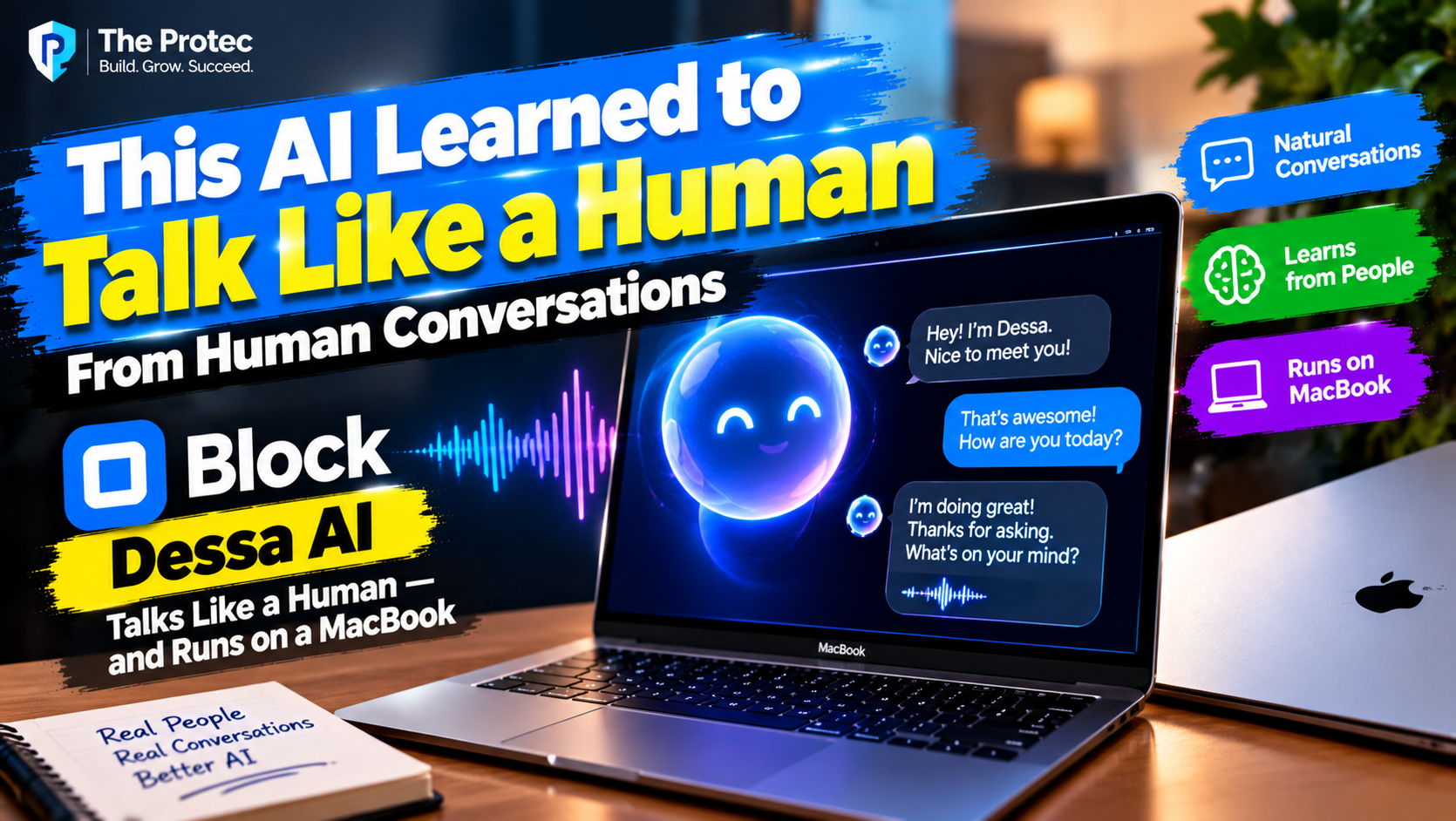
Most voice assistants do not really listen and talk the way people do – Block’s Dessa AI speech model aims to change that by learning from human conversations and generating spoken responses directly, rather than relying on the familiar speech-to-text, text-generation, and text-to-speech pipeline. The pauses between those steps—and the system’s tendency to wait for a cleanly finished question—help explain why talking to a conventional assistant can feel like operating a voice-controlled form.
According to Block’s announcement and technical materials, Dessa learns from human conversations as audio. Its demonstrations include pauses, laughter, interruptions, changes in tone, and even the occasional awkward moment. Block also says the model can operate locally on suitably equipped Apple hardware, with a MacBook Pro M4 Max or newer identified for the research preview.
That combination raises a consequential question: What changes when an AI learns the sound and rhythm of conversation instead of relying primarily on written language? The early answer is not simply “better voice synthesis.” Audio-native training may change how an AI handles timing, emotion-like vocal cues, overlapping speech, and the subtle signals that govern who speaks next. It may also create new safety, privacy, and reliability problems.
The important qualifier is that Dessa remains research, not a finished consumer assistant. Block’s claims describe its own model and demonstrations; they should not be mistaken for independent proof that every conversation will be equally natural or accurate.
The Dessa demos that made people stop and listen
Block’s original demonstration recordings are striking because Dessa does not always sound as if it is reading a polished answer. It hesitates. It leaves small gaps between thoughts, varies its delivery, and produces laughter and other nonverbal sounds. In some exchanges, the system reacts while the other speaker is still talking instead of waiting for a perfectly marked endpoint.
The recordings published through the official Inside Block announcement and research hub are the best primary source for judging those qualities. Listening matters: a transcript cannot capture timing, overlap, pitch, breathiness, or whether a laugh sounds spontaneous or inserted.
The imperfect moments are just as informative. Block’s materials show or acknowledge exchanges in which the model makes an assumption, responds awkwardly, or allows the topic to drift. At times, its confident delivery can make a mistaken interpretation sound more convincing than it is. An interruption may land naturally in one exchange and feel mistimed in another.
Those rough edges help separate a research demonstration from a product-ready AI voice assistant. The demos establish that the system can produce unusually fluid behavior under documented conditions. They do not establish a universal success rate, long-session reliability, or consistent performance across accents, microphones, noisy rooms, languages, and sensitive topics.
What makes the Dessa speech model different?
Conventional assistants commonly use a three-stage pipeline. Automatic speech recognition converts audio into text, a language model generates a written answer, and text-to-speech software reads it aloud. The arrangement is modular and relatively easy to inspect, but it can discard information that never fits neatly into a transcript.
A direct speech-to-speech AI works with audio as both input and output. Instead of treating the voice as packaging around text, it can potentially model words alongside pace, pauses, emphasis, laughter, uncertainty, and conversational overlap.
Traditional pipeline versus direct speech interaction
- Speech-to-text-to-speech: Audio is transcribed, processed as text, and synthesized back into audio. It offers clear intermediate records but may lose vocal context and add latency.
- Direct speech-to-speech: The model processes spoken input and generates spoken output more directly, preserving more timing and acoustic information while making behavior harder to audit through text alone.
- Full-duplex interaction: The system can support listening and speaking at the same time, making overlap, quick acknowledgments, and interruptions possible.
Full duplex is an enabling capability, not a guarantee of humanlike conversation. A model still must decide whether a sound is an interruption, a backchannel such as “mm-hmm,” background noise, or the beginning of a new thought. Getting that decision wrong can cause it to talk over a user, stop too early, or react to irrelevant sounds.
What does learning from human conversations alone mean?
Block says Dessa was trained to learn from human conversation as audio rather than depending primarily on the text-centric approach used by many language models. In practical terms, that means the learning signal can include not only what people say but how and when they say it.
Written dialogue normally strips away overlap, volume, tempo, pitch, hesitation, and many nonverbal reactions. Audio retains those features. A Dessa-style Block AI model can therefore learn statistical patterns connecting speech content with conversational timing and vocal delivery. That may explain why its output can sound less like text being narrated after the fact.
However, the phrase “from human conversations alone” should be interpreted within the boundaries of Block’s disclosure. It does not, by itself, reveal the complete data pipeline or prove that text played no role anywhere in development, filtering, safety work, or evaluation. Block has described an audio-native training approach, but important details remain undisclosed.
Public materials do not provide enough information to independently reconstruct the training set, model size, precise objectives, geographic representation, language coverage, consent procedures, or data-cleaning process. Block also has not published comprehensive public benchmarks that would settle how Dessa compares with other systems on factual accuracy, interruption handling, robustness, or harmful-content evaluations. Until those details or independent tests arrive, performance claims should remain attributed to Block.
How local AI reportedly runs on a MacBook Pro M4 Max
Block says Dessa can run locally on a MacBook Pro equipped with an M4 Max chip or newer. That is notable because advanced real-time conversational AI is often associated with remote data centers and specialized accelerators.
Local inference means the trained model performs its response generation on the user’s computer rather than sending every conversational turn to a cloud model for processing. This can reduce network latency, preserve functionality when connectivity is limited, and keep more raw audio on the device.
The hardware statement needs careful framing. Block’s preview materials identify a MacBook Pro M4 Max or newer as the supported or required environment for access. They do not establish that every M4 Max configuration will deliver identical results, nor do they confirm support for older M-series chips, standard M4 systems, Windows PCs, or phones. Public information also does not justify guessing about memory requirements, quantization, model size, battery use, or sustained thermal performance.
In other words, “local AI on MacBook” describes an important demonstrated deployment mode, not broad compatibility across consumer laptops. Developers should treat the published preview requirement as authoritative unless Block releases a wider hardware matrix.
A humanlike AI voice is not necessarily a reliable mind
People instinctively associate fluent timing and expressive speech with understanding. That instinct becomes risky when a model laughs appropriately, sounds sympathetic, or responds before the user has finished. Vocal naturalness can increase trust without improving factual accuracy or reasoning.
Dessa’s demonstrations illustrate both sides of that effect. Its pauses and emotional-sounding delivery can make an exchange feel socially coherent. Yet documented awkward responses, topic drift, and mistaken assumptions show that convincing speech does not eliminate familiar AI failures.
- Natural delivery is not factual verification. A false answer can be spoken with perfect confidence.
- Emotional tone is not emotional understanding. A sympathetic voice may reflect learned acoustic patterns rather than awareness of a person’s feelings.
- Fast responses are not deep reasoning. Low latency can improve flow while leaving the underlying answer shallow or wrong.
- Full duplex is not flawless turn-taking. The model may still interrupt incorrectly, miss a correction, or mistake ambient speech for user input.
This distinction is especially important in health, finance, education, and customer support, where a warm voice can lend unwarranted authority to bad information.
Where real-time conversational AI could matter
If audio-native models become dependable, they could reshape hands-free computing. A personal assistant could acknowledge a correction immediately, recognize that a user is hesitating, or stop speaking when the user changes direction. The interaction would feel less like issuing commands and more like collaborating through conversation.
Accessibility tools could offer faster spoken navigation, real-time description, or communication support without requiring users to manage rigid turn-taking. Educational systems could conduct pronunciation practice and adapt to a learner’s pace. Customer-service tools might handle interruptions more gracefully, while drivers, technicians, and people with limited mobility could control software without looking at a screen.
Every benefit has a trade-off. Continuous listening affects privacy and battery life. Faster turn-taking can produce more accidental activations. Emotional-sounding delivery may manipulate users or obscure uncertainty. In customer service, a natural voice could reduce frustration—or make it harder to know when a person is speaking with software.
Useful products will need visible controls for listening, interruption, recording, data retention, and escalation to a human. They will also need latency that remains predictable, not merely impressive in selected demos.
AI voice safety, privacy, and impersonation risks
Expressive speech increases the urgency of AI voice safety. A model capable of generating laughter, hesitation, emphasis, and emotional-sounding delivery may be more persuasive than a conventional synthetic voice. Similar capabilities could be misused for impersonation, social engineering, fraudulent calls, or fabricated recordings.
Developers should provide clear disclosure that a voice is AI-generated, obtain consent before reproducing an identifiable voice, and consider technical safeguards against unauthorized cloning. Organizations deploying voice agents should preserve auditable records without collecting more personal audio than necessary.
Training-data questions matter too. Human conversations can contain biometric voice information, private facts, background speakers, and people who never expected their speech to train a model. Block’s limited disclosures do not resolve every question about sourcing, consent, removal requests, or representation. Those issues deserve scrutiny as access expands.
On-device artificial intelligence can reduce exposure because raw audio may not need to leave the Mac. It does not guarantee privacy. Applications can still save recordings, transmit analytics, synchronize transcripts, expose local files, or become compromised. Privacy depends on the complete product architecture, permissions, retention policy, and security controls—not simply where inference occurs.
Can developers access Block Dessa AI?
As of the latest disclosed status, Dessa is a limited research preview rather than a generally available Block product. Block has focused early access on qualified AI safety researchers, reflecting both the experimental state of the technology and the misuse risks associated with highly natural speech generation.
Block has not announced public model weights, standard commercial pricing, or a broadly available developer API. There is also no confirmed general-release date. Developers should be wary of unofficial downloads or services claiming unrestricted Dessa access unless Block authenticates them.
The distinction matters: published recordings demonstrate research capabilities, while restricted access limits independent testing. Broader conclusions about stability, hardware efficiency, bias, safety, and real-world latency must wait for fuller documentation and evaluation.
FAQ about Block’s Dessa AI speech model
Does Dessa completely skip text?
Block describes Dessa as learning from human conversations in audio and operating as a speech-to-speech model. That supports a meaningful contrast with conventional transcription pipelines, but public disclosures do not establish that text is absent from every development, safety, or evaluation process.
Can Dessa run on any MacBook?
No broad Mac compatibility has been announced. Block identifies a MacBook Pro with an M4 Max chip or newer for the preview. Support for older chips, lower-memory configurations, and other computers should not be assumed.
Is Dessa available through a public API?
Not according to Block’s disclosed preview status. Access remains limited, with early participation directed toward AI safety researchers. Public weights, general API pricing, and a consumer release have not been announced.
Does full duplex mean Dessa never interrupts incorrectly?
No. Full duplex allows simultaneous listening and speaking, but the model must still interpret pauses, background noise, acknowledgments, and interruptions. Natural turn-taking depends on model behavior and system design, not duplex capability alone.
Why audio-native AI is worth watching
Dessa’s significance is not that it has solved conversation. It is that Block is testing a different foundation for voice interaction: learning conversational behavior from sound rather than treating speech mainly as a wrapper around text.
The demos suggest that this approach can produce compelling timing, overlap, laughter, and expressive delivery on local hardware. They also expose the gap between sounding human and being reliable. Developers should watch for independent evaluations, clearer training-data documentation, broader hardware testing, safety controls, public access terms, and evidence that performance holds up beyond curated examples.
If those pieces arrive, direct speech-to-speech AI could make computing more immediate and accessible. Until then, Block Dessa AI is best understood as an important research preview—one that makes the future of conversation with machines easier to hear, while leaving many of its hardest questions unanswered.