






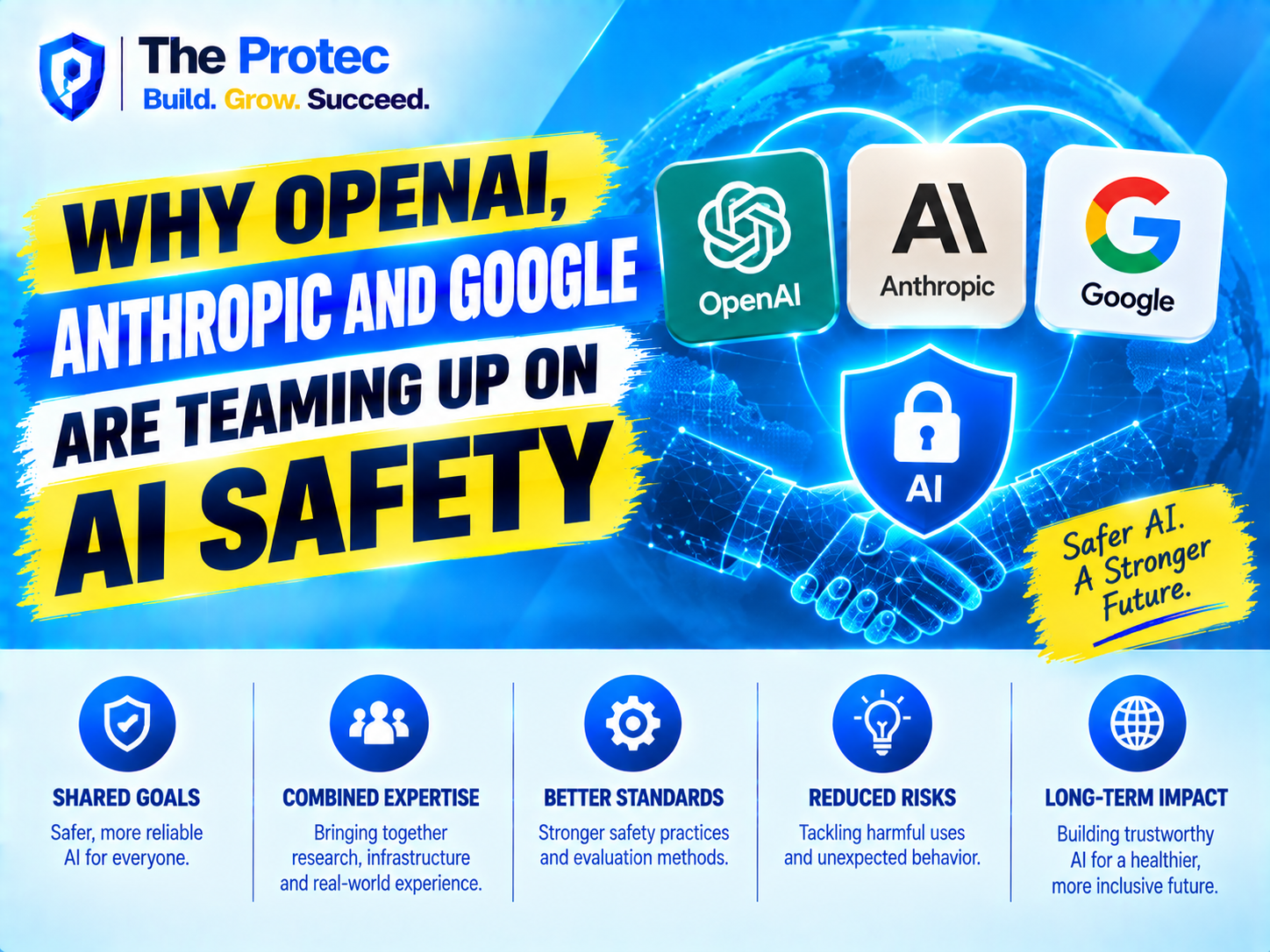
OpenAI, Anthropic and Google DeepMind are locked in one of technology’s most consequential races. They compete for users, enterprise contracts, researchers, computing capacity and the distinction of building the world’s most capable artificial intelligence. Yet the same companies are also discussing where cooperation may be necessary to keep increasingly powerful systems secure and under control.
That apparent contradiction is easier to understand when frontier AI safety is treated as shared infrastructure rather than a product feature. A vulnerability in one widely used model could affect businesses, governments and the public well beyond the company that developed it. Dangerous capabilities may also emerge across several laboratories at roughly the same time, making isolated safety programs less effective than compatible testing, disclosure and incident-response practices.
The important caveat is that discussions about OpenAI, Anthropic and Google AI safety do not automatically amount to a binding pact. Publicly available information supports the existence of industry forums, technical exchanges and a growing push for common practices. It does not establish a secret agreement to stop competing, delay releases or jointly determine how quickly AI should advance.
What the OpenAI, Anthropic and Google discussions mean
The three companies already participate in overlapping initiatives focused on frontier models. OpenAI, Anthropic, Google and Microsoft helped establish the Frontier Model Forum, an industry organization intended to advance safety research, identify good practices and support information sharing among developers of highly capable AI systems.
Reported discussions among leading laboratories should be viewed in that broader context. The practical subjects can include model evaluations, cybersecurity, safeguards against misuse, reporting of serious incidents and methods for identifying capabilities that could create severe harm. Companies may also compare high-level approaches to deployment risk without exchanging commercial information about pricing, customers, unreleased products or competitive strategy.
As of September 2026, no publicly confirmed trilateral AI safety agreement requires OpenAI, Anthropic and Google DeepMind to synchronize model launches or accept a coordinated AI development slowdown. Executives and researchers may favor stronger cooperation, but exploratory conversations, participation in shared forums and a legally binding agreement are different things.
Why fierce AI rivals have reasons to cooperate
Competition normally encourages faster products, lower prices and better performance. Frontier AI introduces an additional problem: some failures may impose costs on everyone, including rival developers that acted responsibly.
If attackers use a poorly protected model to accelerate cyber operations, the resulting damage could reduce trust in the entire AI industry. A major model-weight theft could spread advanced capabilities beyond the safeguards of the original provider. Similarly, evidence that one system can assist with dangerous biological work could force every frontier laboratory to reconsider its evaluations and access controls.
This creates a collective-action problem. A company that invests heavily in security may still face pressure to release quickly if competitors use less demanding standards. Shared minimum practices can reduce that pressure without eliminating competition over model quality, price, efficiency and features. OpenAI AI safety, Anthropic AI safety and Google DeepMind AI safety programs differ in design, but they increasingly address similar categories of risk.
What AI safety collaboration could actually involve
Meaningful cooperation does not require competitors to merge their research programs. It can focus on narrow areas where compatibility makes the entire ecosystem more resilient.
Common model evaluations
Frontier developers need repeatable ways to assess capabilities related to cybersecurity, biological risk, autonomous operation, deception and the ability to bypass safeguards. Shared evaluation concepts would make results easier to compare, although test details may need protection to prevent models from being optimized specifically for benchmarks.
Security and threat intelligence
Advanced AI laboratories are attractive targets for state-backed groups, criminal organizations and insiders. Companies can exchange carefully scoped information about attack patterns, model extraction attempts and security incidents. Similar arrangements already exist in other critical industries, where competitors share threat intelligence while continuing to compete commercially.
Responsible disclosure
An evaluator, researcher or rival laboratory may discover a serious vulnerability affecting more than one model provider. Agreed channels for confidential notification could help developers fix weaknesses before technical details become public. This is especially important when flaws involve widely used model interfaces, tools or agent frameworks.
Deployment and incident practices
AI safety standards could define when a capability deserves additional testing, restricted access, stronger monitoring or a staged release. Companies might also establish shared terminology for severe incidents, making it easier to notify authorities and other affected developers without debating definitions during a crisis.
None of these measures requires OpenAI, Anthropic and Google to share proprietary model weights, training data or product roadmaps. The most defensible collaboration would be limited, documented and focused on preventing clearly defined harms.
How the companies’ safety frameworks are converging
Each laboratory has developed its own method for evaluating advanced systems. OpenAI has used a preparedness framework to track potentially dangerous capabilities and the effectiveness of safeguards. Anthropic’s responsible scaling approach connects capability thresholds with increasingly strong security and deployment measures. Google DeepMind’s frontier safety framework similarly considers critical capability levels and mitigation plans.
The labels and governance structures are not identical, but the underlying pattern is notable: evaluate dangerous capabilities, define thresholds, strengthen safeguards as risk rises and involve senior decision-makers before deploying systems that cross important boundaries.
This convergence makes OpenAI Anthropic collaboration—or broader Anthropic Google AI coordination—more practical. The companies do not have to adopt one universal framework to agree on baseline questions. They can still debate thresholds, testing methods and acceptable residual risk while using a common vocabulary.
Government frameworks may also provide neutral reference points. The US National Institute of Standards and Technology publishes the AI Risk Management Framework, which gives organizations a structured approach to identifying, measuring and managing AI risks without prescribing one company’s technical system.
Why the companies say an antitrust waiver is unnecessary
The phrase “AI antitrust waiver” suggests that competitors would need special immunity before discussing safety. That is not necessarily how existing competition law works. Companies in many sectors can collaborate on legitimate standards, security and research initiatives when the work is appropriately structured and does not become a mechanism for fixing prices, dividing markets, restricting output or excluding rivals.
From that perspective, an AI safety antitrust exemption could be both unnecessary and overly broad. Narrow cooperation on evaluations or cyber threats is fundamentally different from an agreement about subscription prices, customer allocation, compute purchases or model-release schedules. The legal analysis depends on the collaboration’s design, effects and jurisdiction, not merely on the fact that competitors are in the same room.
OpenAI antitrust concerns would become more serious if safety language were used to conceal commercial coordination. For example, an agreement among dominant developers to delay lower-cost models, deny essential testing resources to smaller competitors or make compliance prohibitively expensive could attract scrutiny. The same would be true if companies shared sensitive details about future products under the guise of safety.
A sound approach therefore includes clear agendas, independent legal review, limited data sharing, written participation rules and access for qualified new entrants. Regulators do not have to choose between unrestricted cooperation and a blanket ban. They can permit pro-safety work while policing conduct that reduces competition.
Could common AI safety standards create new problems?
Shared standards could improve AI industry safety by establishing a minimum level of testing and security. They may also help policymakers compare providers and avoid writing incompatible rules for every model. For customers, standardized documentation could make it easier to evaluate whether a system received meaningful pre-deployment testing.
However, standards are not automatically neutral. Large laboratories have more staff, compute and legal resources than startups or academic teams. If OpenAI, Anthropic and Google shape requirements around their own infrastructure, smaller developers may struggle to comply even when their models present less risk.
There is also a danger of regulatory capture. Voluntary commitments written by dominant companies could be presented as sufficient AI safety regulation, even if the commitments are vague, self-assessed or easy to revise. Conversely, governments might transform an immature industry benchmark into a rigid legal rule before researchers know whether it measures real-world danger.
Good AI safety standards should therefore be capability-based, transparent about their limitations and proportionate to risk. Independent researchers, civil society, startups and public agencies need meaningful input. Standards should protect the public without becoming a moat around incumbent frontier laboratories.
Safety coordination is not a coordinated development slowdown
Because the participants are direct rivals, any private meeting can fuel speculation about an industry-wide pause. But there is no confirmed evidence that the three laboratories have agreed to coordinate a general AI development slowdown.
A company may independently delay a model because evaluations reveal unacceptable risk. Multiple companies may also reach similar conclusions if they use comparable tests. That is not the same as agreeing to reduce output or synchronize launch dates. The distinction matters legally and practically.
A formal slowdown would raise difficult questions: Which capabilities trigger it? Who verifies compliance? Would overseas developers participate? Could a pause entrench today’s market leaders? Safety collaboration is more likely to concentrate on testing, security and disclosure because those activities can reduce risk while preserving independent development decisions.
What policymakers and the public should watch
The value of OpenAI Google AI safety discussions will depend on measurable outcomes. Observers should look for better cross-company incident reporting, independently validated evaluations, stronger model-weight security and clear explanations of what happens when systems cross internal risk thresholds.
Transparency about governance is equally important. Participants should identify which subjects are inside the collaboration and which are off-limits for competition reasons. Regulators may need confidential access to more detail, but public summaries can demonstrate that safety is not being used as cover for market control.
The central challenge is balance. Unrestrained competition can reward speed at the expense of caution, while excessive coordination can weaken competition and consolidate power. Effective AI safety collaboration must reduce shared risks without allowing the largest companies to write rules solely for themselves.
Frequently asked questions
Do OpenAI, Anthropic and Google have a formal AI safety agreement?
There is public evidence of shared industry initiatives and discussions about frontier AI safety, but that should not be confused with a confirmed binding trilateral agreement. No publicly established pact requires the companies to coordinate launches or stop developing advanced models.
Some risks cross company boundaries. Cyberattacks, stolen model weights, dangerous capabilities and failures in commonly used tools can affect the whole market. Limited sharing of threat intelligence, evaluation practices and incident data may help every provider respond faster.
Does AI safety collaboration violate antitrust law?
Not automatically. Competitors can often cooperate on legitimate security, research and technical standards when safeguards prevent price fixing, market allocation and exchanges of sensitive commercial information. Specific arrangements still require legal and regulatory scrutiny.
Could common standards hurt smaller AI companies?
Yes, if dominant laboratories design expensive requirements that are unrelated to a model’s actual risk. Capability-based and proportionate standards can reduce that danger, particularly when startups, independent experts and public institutions participate in the process.
Are the companies planning to slow AI development together?
No coordinated industry slowdown has been publicly confirmed. Individual companies may pause or limit a system after safety testing, but independent deployment decisions are different from a collective agreement to reduce the pace of development.