








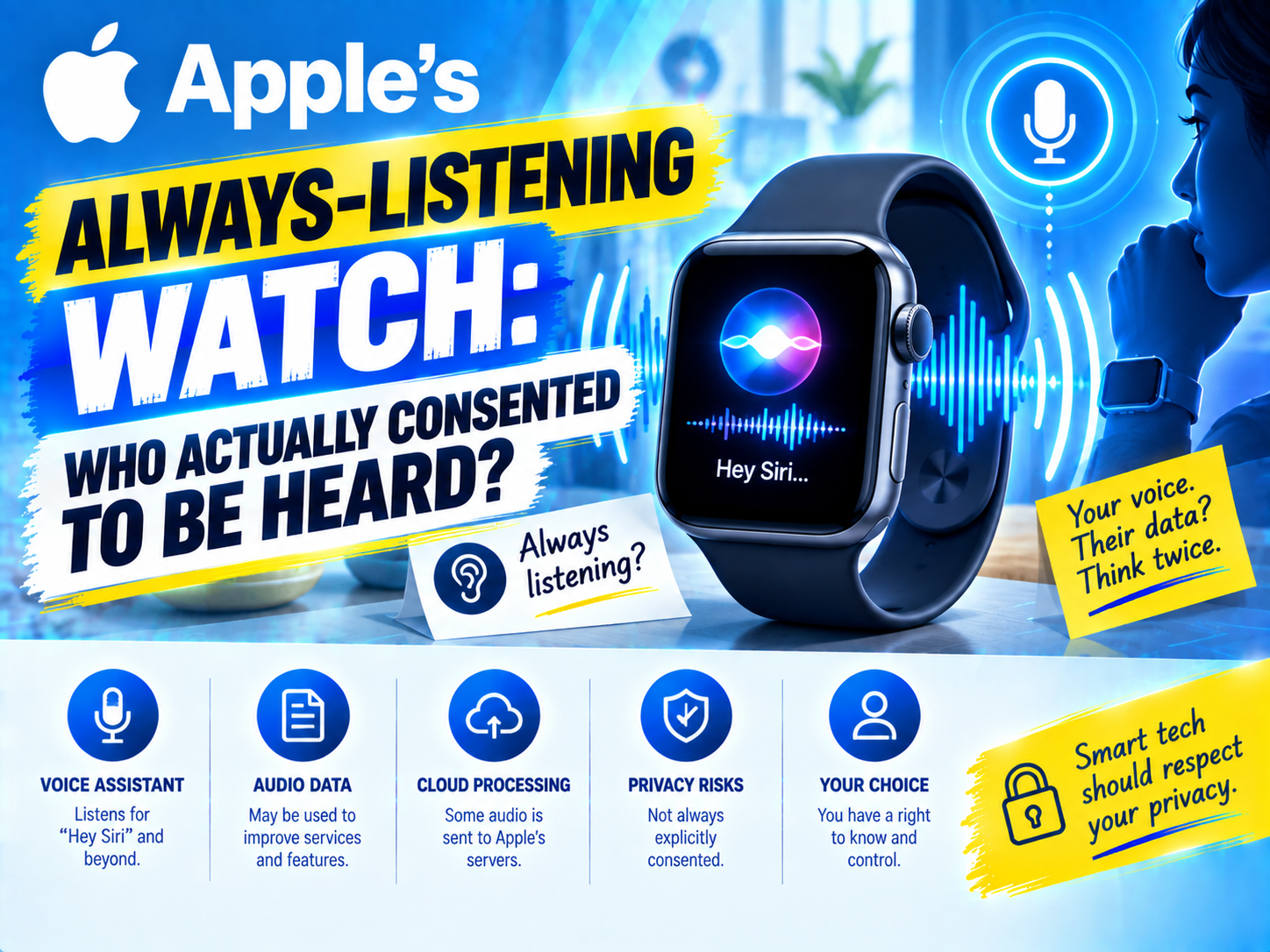
A smartwatch microphone does not stop at its owner’s voice. It can also pick up a colleague discussing a confidential project, a patient describing symptoms, a child speaking at home, or a stranger sitting at the next table. That makes the debate over an Apple always-listening Watch larger than the familiar question of whether the wearer trusts Apple. The harder question is whether everyone within earshot consented to being heard.
As of September 2026, Apple has not publicly characterized Apple Watch as a device that indiscriminately records and stores every surrounding conversation. The phrase “Apple Watch always listening” can nevertheless describe several distinct behaviors: waiting locally for a Siri activation phrase, measuring environmental sound, detecting a meaningful audio event, or potentially feeding ambient context into an AI feature. Those activities carry different risks, and listening is not automatically the same as recording. Yet even temporary audio processing can affect people who did not buy, configure, or knowingly interact with the device.
That gap between the wearer’s permission and the bystander’s consent is becoming one of the most important issues in wearable technology privacy.
What Does an Apple Always-Listening Watch Actually Mean?
“Always listening” is an imprecise phrase. It often suggests that a device is continuously saving conversations, but modern voice-enabled electronics can handle sound in several ways:
- Wake-word detection: The microphone monitors a short, rotating audio buffer for a phrase such as “Siri.” If no activation is detected, the buffer may be overwritten without becoming a saved recording.
- Environmental measurement: Apple Watch can analyze sound pressure levels for the Noise app and warn its wearer about potentially harmful exposure. Apple says this feature measures sound levels rather than recording or saving the audio itself.
- User-initiated recording: Voice Memos, calls, dictation, and other features capture audio after a deliberate action. These uses are more visible to the wearer, although not necessarily to nearby people.
- Audio-event classification: A device can use machine learning to recognize patterns such as an alarm, breaking glass, coughing, or distress without preserving an intelligible conversation.
- Ambient AI processing: A wearable AI system may analyze speech and surrounding context to produce summaries, reminders, suggested actions, or a searchable memory. This is the most consequential model because passive listening can become persistent knowledge.
These distinctions matter. A locally overwritten wake-word buffer presents a different privacy profile from an ambient audio recording uploaded for cloud transcription. Still, saying “nothing is stored” does not answer every Apple Watch microphone privacy question. Audio must be captured and processed at least momentarily for software to decide whether it contains a command or relevant event.
How Apple Watch Audio May Move Through an AI System
To evaluate Apple Watch privacy, users need to know where audio goes after it reaches the microphone. In the most privacy-preserving design, a low-power processor analyzes sound on the watch, retains only the minimum data required, and quickly discards raw audio. No human-readable conversation needs to leave the device.
Other tasks may involve a paired iPhone, internet service, or cloud model. A spoken request might be converted into text locally, routed to another Apple device, or sent to a remote system when greater computing power is required. The architecture can vary by Watch model, language, setting, and requested feature. Apple Intelligence branding should not be treated as proof that every task happens on the Watch or that every task reaches a server.
Apple’s published privacy information emphasizes data minimization, on-device processing, and protections for cloud-assisted AI requests. Those are meaningful safeguards. However, Apple AI privacy claims should be assessed feature by feature. Consumers need plain answers about whether raw audio is retained, whether transcripts are created, how long derived data survives, whether people review samples, and whether recordings are linked to an account.
The Overlooked Apple Watch Privacy Problem: Bystander Consent
The owner of a Watch can accept terms, adjust microphone permissions, and disable features. A bystander usually cannot. Someone entering a room may not know that a wrist-worn device is processing ambient audio, especially because a watch microphone is less conspicuous than a phone held up to record.
This creates an asymmetry of control. The wearer receives the convenience, while nearby people absorb part of the privacy risk. They may not know which mode is active, whether a wake word was detected accidentally, or whether spoken information has become a transcript. They cannot inspect the settings or easily withdraw their words once captured.
Consent also needs to be specific and informed. Agreeing to have a conversation with someone who wears a smartwatch is not necessarily agreement to let an AI system analyze that conversation. A general notice buried in the owner’s terms of service cannot realistically obtain permission from every person within microphone range.
Context changes the stakes. Passive audio processing is especially sensitive in medical facilities, schools, courtrooms, workplaces, counseling sessions, bathrooms, changing areas, and private homes. Even when speech is not stored, analysis could infer health conditions, emotional states, religious activity, relationships, or workplace behavior. Ambient audio recording can therefore expose more than the words themselves.
Confirmed Apple Watch Capabilities Versus Speculation
A responsible discussion of Apple Watch surveillance must separate available functions from hypothetical ones. Apple Watch models include microphones for features such as calls, Siri, dictation, and voice recording. The Noise app can sample environmental sound levels, and Siri can listen for an activation phrase when the relevant setting is enabled. These are established capabilities.
That does not prove Apple is secretly building a permanent archive of everything a wearer hears. Nor does the presence of wearable AI mean that every ambient sound is sent to a generative model. Claims of continuous covert recording require evidence about a specific feature, software version, and data flow.
The legitimate concern is forward-looking but not imaginary. Better batteries, efficient neural processors, personalized AI assistants, and multimodal models are making persistent contextual awareness technically practical. A future update could transform microphone input from a narrow command channel into background context for reminders, safety alerts, health insights, or automated summaries. Privacy protections need to exist before that transition, not after harmful recordings appear.
How Apple’s Approach Compares With Other AI Wearables
Apple is not alone in exploring hands-free computing. AI pendants, smart glasses, voice recorders, and clip-on assistants increasingly promise to transcribe meetings, remember conversations, identify objects, and answer questions about the wearer’s surroundings. Some products make recording central to their value; others activate only on command.
Apple begins with several advantages: control over its hardware and operating systems, experience with on-device processing, a large privacy engineering organization, and an ecosystem that can shift demanding tasks to a nearby phone. A Watch can also deliver useful features without publicly exposing a camera.
But Apple’s scale raises the impact. A niche AI pendant may alarm privacy advocates while remaining uncommon. Apple Watch is socially ordinary. If ambient AI becomes a default feature on a familiar device, always listening technology could enter offices, classrooms, and homes without the social negotiation that accompanied visible cameras or handheld recorders.
Some competing wearables use indicator lights or sounds to signal recording. These cues are imperfect—they can be overlooked, obstructed, or misunderstood—but they recognize that bystanders deserve information. A small screen icon visible only to the wearer does not provide equivalent notice.
Are Privacy Laws Ready for Always-Listening Wearables?
The legal answer depends on location, purpose, and data handling. In the United States, audio-recording rules vary by state. Some jurisdictions generally permit a participant to consent to recording, while others require permission from all parties in circumstances where people reasonably expect privacy. Wiretap laws may also distinguish between live interception, stored recordings, and ordinary in-person conversation.
Consumer privacy statutes can regulate companies that collect personal data, but household exemptions and thresholds may limit their reach. Workplace monitoring, children’s data, biometric identifiers, and health information can trigger additional rules. A transcript linked to a recognizable speaker is more clearly personal data than an anonymous measurement showing that a room reached 90 decibels.
In Europe, the General Data Protection Regulation requires a lawful basis, transparency, purpose limitation, and data minimization when personal data is processed. The household exemption may cover some purely personal activity, but it is not a blanket shield for systematic monitoring or broader publication. Voice data can also become especially sensitive when used for unique identification.
Existing laws were largely written around phone calls, security systems, and deliberate recordings. Wearable AI challenges those categories because it can process continuously while retaining only selected events, embeddings, summaries, or inferences. Regulators may need to clarify whether meaningful consent is possible when microphones are mobile, subtle, and controlled by someone other than the speaker.
What Apple, Wearers, and Bystanders Can Do
Apple should design for people who do not own the device
- Make ambient processing opt-in rather than enabled by default.
- Provide unmistakable visual or audible signals when speech is being recorded, transcribed, or uploaded.
- Separate local detection from cloud processing with clear controls.
- Publish retention periods for raw audio, transcripts, embeddings, and AI summaries.
- Offer a hardware-level microphone control or equally trustworthy software indicator.
- Automatically disable ambient capture in sensitive locations or calendar contexts when practical.
Privacy labels should explain not only what the wearer shares, but also what the product can collect from other people. Apple could set a strong industry standard by treating bystander privacy as a core product requirement rather than an edge case.
Wearers should use microphones contextually
Users should review Siri, dictation, Voice Memos, app permissions, analytics, and sound-monitoring settings. Recording or transcription should be announced before a meeting, interview, medical discussion, or private conversation begins. If consent is refused, the feature should remain off. Workplaces should establish explicit policies rather than leaving decisions to individual employees.
Bystanders can ask direct questions
It is reasonable to ask whether a wearable is recording, transcribing, or sending sound to an AI service. In sensitive settings, requesting that the device be removed or placed in airplane mode may be appropriate. A microphone-disabled symbol is useful only if everyone understands and trusts it.
Privacy and Consent Must Become Part of the Interface
The central Apple wearable privacy challenge is not whether microphones can deliver useful experiences. They can improve accessibility, hearing safety, communication, and hands-free assistance. The issue is whether those benefits are built around meaningful boundaries.
An Apple Watch owner can consent for themselves, but not automatically for a room. As wearable AI becomes more capable, privacy must be visible to the people being sensed—not just described to the person who bought the sensor.
Frequently Asked Questions
Is Apple Watch constantly recording conversations?
There is no basis for treating every Apple Watch as a device that continuously saves all nearby conversations. Some features listen for activation cues or analyze sound, while Voice Memos, calls, and dictation capture audio for specific purposes. Behavior depends on the feature and settings.
Does the Apple Watch Noise app save ambient audio?
Apple states that the Noise app samples sound levels to estimate environmental loudness and does not record or save the sounds themselves. Measuring decibels is different from preserving intelligible speech.
Can an Apple Watch record someone without consent?
The microphone can capture nearby voices during recording, calls, or dictation. Whether doing so is lawful depends on the jurisdiction and circumstances. Ethical consent may require notice even where one-party recording is legally permitted.
Is on-device audio processing completely private?
On-device processing generally reduces exposure because raw audio does not need to travel to a server. It is not automatically risk-free. Software may still retain transcripts, extract sensitive inferences, sync results, or expose data to apps. The specific data lifecycle matters.
What would make an always-listening Apple Watch safer?
Strong safeguards would include opt-in activation, local processing by default, short retention, visible recording indicators, separate cloud controls, restricted third-party access, and a reliable way for bystanders to know when their speech is being captured.