







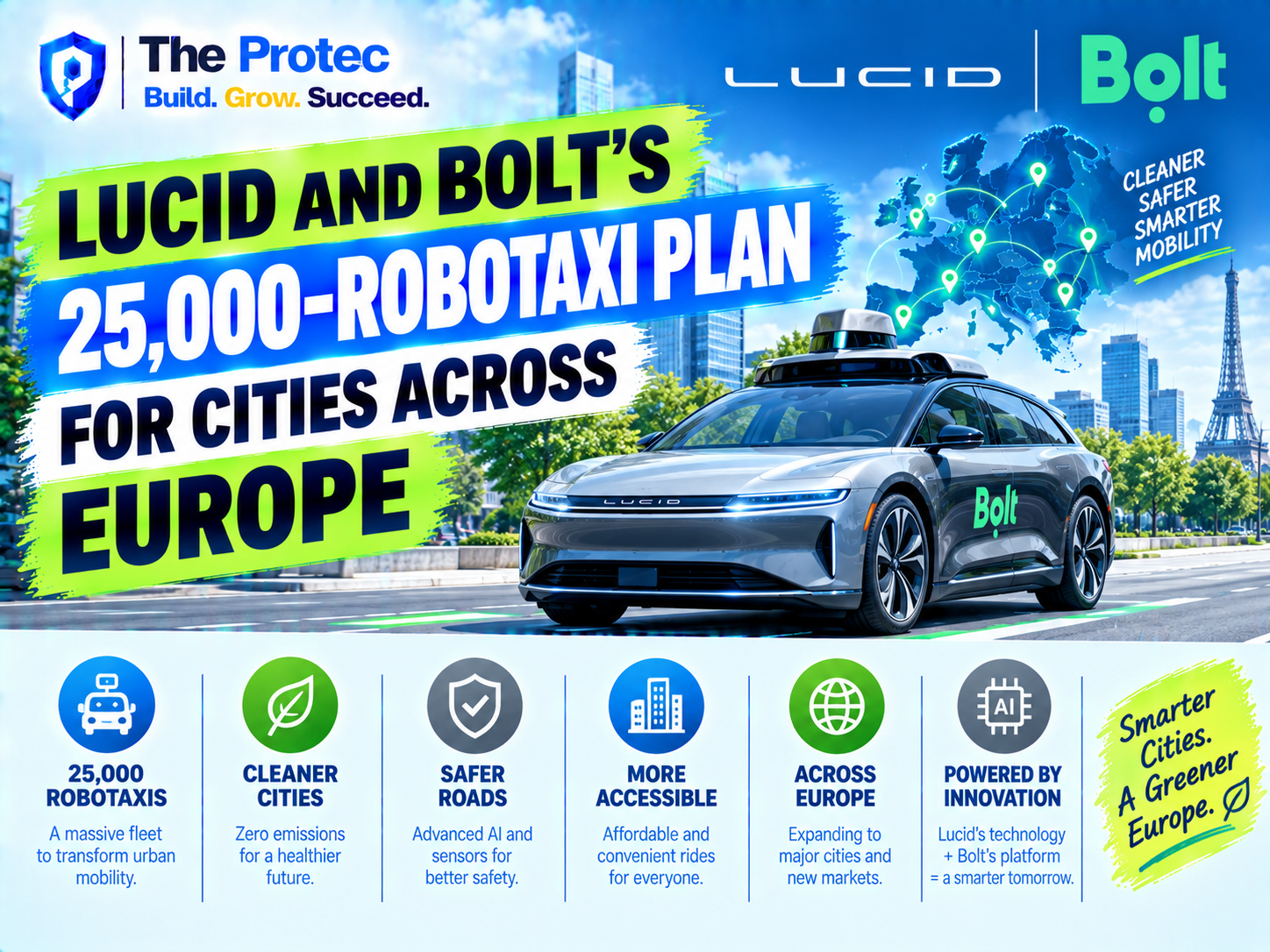
Europe’s autonomous mobility race is gaining a potentially significant new contender. Lucid and Bolt have announced plans to deploy at least 25,000 fully autonomous vehicles across European markets, creating a fleet that would combine Lucid’s future midsize electric vehicle platform, Bolt’s ride-hailing network and Nvidia’s Hyperion autonomous-driving technology.
The scale makes the Lucid Bolt robotaxi plan noteworthy. Rather than testing a few dozen vehicles in a single innovation district, the companies are describing a commercial fleet intended to operate across multiple European cities. Bolt plans to own and operate the vehicles, giving it direct responsibility for fleet availability, maintenance and the passenger experience.
Yet the headline number is also well ahead of the operational details. Lucid and Bolt have not disclosed a firm vehicle delivery schedule, an investment amount or the first cities where passengers will be able to request rides. That leaves a crucial distinction between an ambitious deployment target and actual commercial availability. Building 25,000 robotaxis Europe can legally and reliably use will require more than vehicles and computing power.
What the Lucid Bolt Partnership Is Designed to Build
The proposed fleet brings together three complementary parts of the robotaxi technology stack. Lucid contributes electric vehicle engineering and its upcoming midsize platform. Bolt supplies an established European mobility marketplace and local operating experience. Nvidia Hyperion provides an automotive reference architecture built around high-performance computing, sensors and software infrastructure for automated driving.
Under the proposed model, the Bolt autonomous fleet would consist of purpose-configured Lucid vehicles available through Bolt’s consumer platform. Bolt’s decision to own and operate the vehicles is especially important. Its existing ride-hailing business largely connects passengers with independent drivers or fleet partners, whereas autonomous taxis require centralized control over expensive physical assets.
Ownership means Bolt would need systems for charging, cleaning, inspections, tire replacement, sensor calibration and accident response. It would also need depots, trained technicians, remote assistance operations and procedures for retrieving a vehicle that cannot safely continue a trip. Robotaxis may remove the driver from the front seat, but they do not remove the labor or infrastructure needed behind the service.
The Lucid Bolt partnership could therefore turn Bolt from primarily a mobility platform into a large-scale autonomous fleet operator. That is a capital-intensive transition, particularly when the cost of each vehicle, autonomous hardware package and operating facility remains undisclosed.
Why Lucid’s Midsize Platform Matters
The Lucid robotaxi is expected to use the automaker’s upcoming midsize platform rather than simply converting an Air sedan or Gravity SUV. A smaller, more cost-conscious architecture is better suited to high-utilization urban service, where purchase price, energy consumption, interior durability and ease of repair directly affect the economics of every ride.
Lucid’s efficiency expertise could be a competitive advantage. A robotaxi traveling for much of the day must minimize charging downtime while maintaining enough range for changing weather, congestion and repositioning between passengers. Efficient propulsion can allow a smaller battery to deliver useful operating range, potentially reducing vehicle weight and cost.
However, Lucid self-driving cars will need more than an efficient electric foundation. Fleet vehicles must accommodate redundant power and braking systems, sensor cleaning, additional computing loads and thermal management for hardware that runs continuously. Doors, seats and cabin materials also face heavier use than those in privately owned cars.
The companies have not released the final vehicle design or confirmed whether it will be a conventional passenger model, a heavily modified derivative or a distinct robotaxi configuration. Production allocation for the project also remains unclear.
How Nvidia Hyperion Fits Into the Robotaxi Technology
Nvidia Hyperion is a reference architecture for autonomous vehicles that can combine centralized DRIVE computing with cameras, radar, lidar and other sensors. It is intended to give manufacturers and developers a validated foundation for building automated-driving systems instead of designing every hardware interface from the ground up.
For the Lucid autonomous vehicles, that foundation could help support perception, localization, route planning and real-time decision-making. AI driving technology processes sensor data to identify road users, estimate their likely movement and choose a safe path through complex environments.
Hyperion should not be confused with a finished, universally deployable robotaxi driver. The platform provides computing and sensor architecture, but the complete system still requires autonomous-driving software, extensive training data, safety validation, mapping and integration with the vehicle. Nvidia outlines the broader components of its approach on the Nvidia DRIVE platform website.
The partners will also have to demonstrate redundancy. A Level 4 system cannot depend on a single camera, computer or power source continuing to work perfectly. Critical failures must be detected, and the vehicle must be able to reach a minimal-risk condition, such as stopping safely, without expecting a passenger to take control.
What Level 4 Autonomous Driving Means for Passengers
SAE Level 4 autonomous driving means the automated system performs the entire driving task within a defined operational design domain. That domain can limit where, when and under what conditions the vehicle operates. Restrictions might cover mapped service areas, road types, speed ranges, construction conditions or severe weather.
For passengers, the defining feature is that they are not fallback drivers. A Level 4 Bolt robotaxi would not ask a rider to grab the steering wheel when the system encounters a problem. The vehicle must handle the situation itself or stop safely. It may not need conventional driver controls if regulations and its approved use case allow a purpose-built interior, although Lucid has not disclosed whether the planned vehicles will retain them.
Level 4 does not mean the vehicle can drive anywhere in Europe under every possible condition. That broader capability is associated with Level 5, which remains a more distant technical goal. Early commercial services are more likely to use geofenced zones with carefully assessed routes and operating conditions.
Passengers may also interact with remote support personnel for issues such as an obstructed pickup point, a medical incident or an object left inside the car. Remote assistance can provide guidance, but it should not be mistaken for continuous remote driving.
Why Robotaxis in Europe Face a Complicated Regulatory Path
The European robotaxi market offers dense cities, strong public interest in electric mobility and a large Bolt customer base. It also presents a demanding regulatory environment. Approval in one country does not automatically create permission to run an unrestricted commercial service in every other European market.
Self-driving cars Europe permits may be evaluated through overlapping layers of vehicle type approval, national road rules, city transportation licensing and local testing requirements. Regulators will examine cybersecurity, software updates, data recording, passenger safety, insurance and the process used to prove that the automated system performs safely.
Europe also applies strict rules to personal data. A robotaxi’s exterior and interior sensors can capture faces, license plates, location histories and passenger activity. Bolt and its partners will need clear policies covering what is recorded, why it is processed, how long it is retained and who can access it. Cybersecurity will be equally critical because a connected fleet creates a large attack surface.
European autonomous driving regulation is not necessarily an absolute barrier, but it can slow expansion. In the United States, robotaxi operators have often concentrated deployments in selected states and cities with relatively permissive testing or commercial frameworks. Europe combines region-wide technical standards with national and municipal authority, creating a more fragmented operational map.
Road design adds another challenge. Historic city centers, narrow streets, bicycles, trams, temporary construction and frequent interaction with pedestrians can produce difficult edge cases. A system validated for wide roads in a dry U.S. city cannot simply be transferred to snowy Nordic streets or dense Mediterranean centers without additional testing.
Consequently, the 25,000 robotaxis are more likely to arrive through phased approvals than through one simultaneous launch. The initial service areas will reveal how quickly the partners can move from supervised validation to driverless paid rides.
Lucid’s Saudi Manufacturing Plans Could Influence Scale
Lucid’s manufacturing strategy extends beyond its Arizona operations. Its AMP-2 facility in King Abdullah Economic City, Saudi Arabia, began as a site for assembling vehicles from partially completed kits, while the longer-term plan has been to develop full vehicle production capacity in the country.
Saudi manufacturing could eventually give Lucid greater production flexibility and place capacity closer to Europe than its U.S. factory. It also reflects the strategic role of Saudi Arabia’s Public Investment Fund, Lucid’s majority shareholder, in supporting the automaker’s expansion.
There is no public confirmation that the Bolt robotaxi fleet will be produced in Saudi Arabia, however. Vehicle sourcing will depend on the readiness of the Lucid midsize platform, factory tooling, supplier capacity and European homologation. Export logistics and the origin of batteries, sensors and Nvidia autonomous driving hardware would also affect cost and delivery speed.
The Saudi plan therefore strengthens the long-term scale story, but it does not answer when the first commercial Lucid robotaxi will carry a paying Bolt passenger.
Bolt’s Goal Extends Beyond 25,000 Robotaxis
Bolt’s broader ambition is to operate 100,000 autonomous vehicles by 2035. The Lucid fleet could account for at least one quarter of that target, making this partnership a major pillar rather than a small experiment.
Reaching 100,000 vehicles would require Bolt to develop repeatable deployment methods across many cities. It would need standardized depots, reliable charging access, regulatory teams and operational software capable of balancing demand with vehicle availability. The company would also need to decide how autonomous service fits alongside human drivers, taxis, scooters and other mobility options on its platform.
The economics will matter as much as the technology. Removing driver compensation can improve long-term margins, but autonomous fleets introduce vehicle depreciation, financing, maintenance, insurance, connectivity and remote support costs. High utilization is essential to spread those expenses across enough paid trips.
The Missing Details Behind the Deployment Target
Search interest around a robotaxi rollout 2026 or robotaxi rollout 2028 reflects demand for a concrete launch window, but neither phrase should be treated as a confirmed commercial schedule without a city, service area and passenger availability date attached.
The partners have not disclosed a firm delivery timeline, annual ramp plan or investment amount. They also have not detailed vehicle pricing, the autonomy software provider responsible for the complete driving system, initial markets or whether the 25,000-unit figure represents a binding purchase commitment.
Those omissions do not make the plan insignificant. Large fleet targets can help align manufacturing, regulators, infrastructure providers and investors. But commercial robotaxi programs are judged by completed driverless trips, service reliability and sustainable unit economics—not only by announced vehicle totals.
Key milestones to watch include the reveal of the midsize vehicle, prototype testing on European roads, regulatory approvals, a named launch city, depot construction and the start of public paid rides. Disclosure of fleet financing would also show how Bolt intends to fund ownership at this scale.
Frequently Asked Questions
When will the 25,000 Lucid and Bolt robotaxis launch?
Lucid and Bolt have announced a target of deploying at least 25,000 vehicles, but they have not provided a firm delivery schedule or confirmed when ordinary passengers can book the first rides. Testing, vehicle production and city-level approvals will influence the launch sequence.
Will the Bolt robotaxis be completely driverless?
The planned vehicles are described as Level 4 autonomous. Within an approved operational domain, they should complete the driving task without a human fallback driver. They may still be limited to certain areas, weather conditions, speeds or road types.
Will Nvidia Hyperion drive the vehicles by itself?
No. Nvidia Hyperion supplies a reference computing and sensor architecture for autonomous driving. A commercial service also needs a complete driving software stack, vehicle integration, safety validation, operational support and regulatory approval.
Why is Europe harder for robotaxi deployment than the United States?
European deployments must navigate technical standards alongside country-specific traffic laws, privacy requirements and local commercial transport rules. Dense urban environments and different conditions between markets add complexity. The U.S. is also fragmented, but some operators have found individual jurisdictions that allow faster initial deployment.
Could Lucid build the robotaxis in Saudi Arabia?
Lucid’s Saudi manufacturing expansion could support future production capacity, but the company has not confirmed that vehicles for Bolt will be built there. Factory readiness, midsize platform production and European certification will determine the final sourcing strategy.
A Major Plan That Still Has to Become a Service
The Lucid Bolt robotaxi initiative combines a large European mobility network, an efficiency-focused electric vehicle manufacturer and one of the leading automotive AI computing platforms. If the partners deliver 25,000 robotaxis, the program could materially change Europe’s autonomous taxi market and give Lucid’s midsize platform a high-volume commercial role.
For now, the most important facts are both the scale of the ambition and the gaps that remain. Bolt intends to own and operate the fleet, Level 4 technology is meant to remove the need for a fallback driver, and Saudi production could support future capacity. But there is still no firm commercial delivery timeline, investment figure or confirmed launch city. The next announcements must turn a compelling fleet target into vehicles that regulators approve and passengers can actually book.