








Wireless systems are steadily moving into higher frequency bands, but terahertz technology represents more than another incremental step up the spectrum. Terahertz waves could support immense data rates, detect subtle material characteristics and produce images without visible light or ionizing radiation. Those capabilities make the technology a compelling candidate for future 6G networks, short-range wireless links, industrial sensing, security screening and medical research.
The promise comes with difficult physics. Terahertz signals weaken quickly, interact strongly with the atmosphere and demand components that remain expensive or inefficient. As of August 2026, the field is progressing from laboratory demonstrations toward integrated prototypes and early commercial applications, while full terahertz 6G deployment remains a longer-term goal. Understanding that balance between potential and practicality is essential to seeing where THz will matter first.
What Is Terahertz Technology?
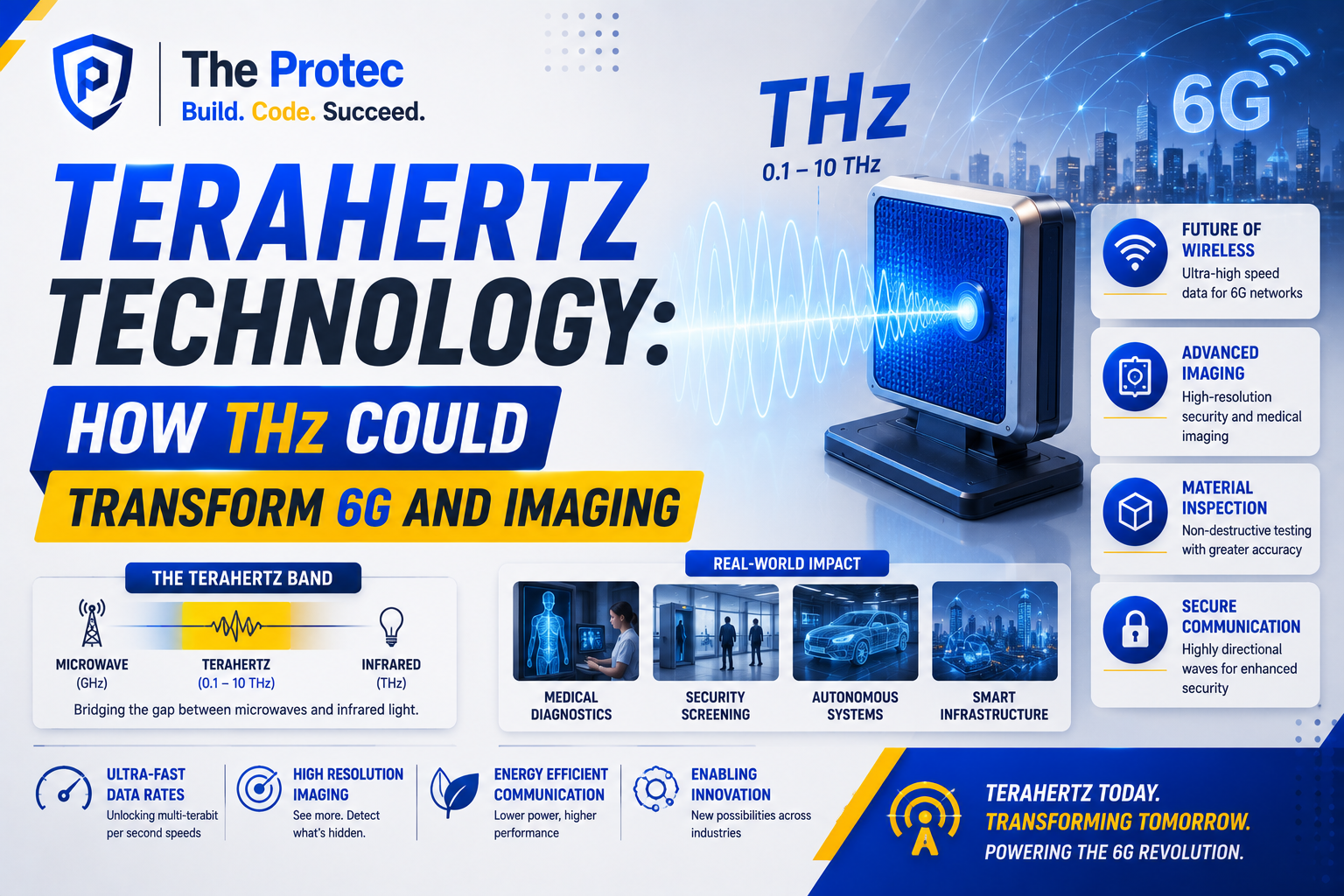
Terahertz frequencies occupy the region between microwaves and infrared light. Definitions vary by discipline, but the broader research field commonly covers approximately 0.1 to 10 terahertz, equivalent to 100 gigahertz through 10,000 gigahertz. The formally named extremely high-frequency and terahertz bands cover narrower portions of that range. Their wavelengths extend from a few millimeters down to tens of micrometers.
This position creates a so-called terahertz gap. Conventional electronics become less efficient as transistor switching and signal generation approach THz frequencies, while many optical techniques are difficult to operate efficiently at wavelengths longer than infrared. Researchers are closing that gap from both sides. Electronic approaches use advanced CMOS, silicon-germanium and compound-semiconductor devices, while photonic systems generate THz signals by mixing optical sources or using specialized lasers.
Terahertz waves offer several valuable properties:
- Enormous contiguous bandwidth for ultra-high-speed wireless transmission
- Short wavelengths that enable compact arrays and narrow, steerable beams
- Sensitivity to molecular rotation and vibration for spectroscopic sensing
- The ability to penetrate many fabrics, papers, foams and non-metallic materials
- Non-ionizing photons with far less energy than X-rays
Why Terahertz 6G Research Matters
Future networks will need to serve immersive spatial computing, machine-to-machine coordination, distributed artificial intelligence and sensing applications that are difficult to support with current cellular capacity. Terahertz 6G research explores whether extremely wide channels can provide hundreds of gigabits per second—or, under favorable short-range conditions, approach terabit-per-second throughput.
That does not mean every 6G phone will communicate at several terahertz. Early 6G systems are more likely to combine familiar low and mid bands with millimeter-wave and sub-terahertz spectrum. Frequencies around 100 to 300 GHz provide a practical bridge: they offer substantially more bandwidth than today’s mainstream mobile bands while remaining closer to the reach of electronic chip technologies.
The ITU framework for IMT-2030 describes the broad capabilities expected from 6G, including integrated sensing, extreme capacity and more precise positioning. It does not prescribe terahertz spectrum as the universal answer. Standards, spectrum allocations and practical network architecture still have to evolve, with current work focused on use cases, channel models and enabling radio technologies.
Where THz Could Fit Into a 6G Network
- Indoor hotspots: Rooms, venues and transport hubs could use directional THz access points for exceptionally high local capacity.
- Wireless backhaul: Fixed line-of-sight links could connect small cells without installing fiber in every location.
- Device-to-device transfer: Nearby devices could exchange large media files, sensor records or model data within seconds.
- Data centers: Reconfigurable wireless links could supplement cables between servers and racks.
- Joint communication and sensing: One radio system could transmit data while mapping objects, movement and environmental conditions.
How THz Communication Could Deliver Extreme Wireless Speed
Radio capacity depends partly on available bandwidth. Congested lower-frequency bands often provide channels measured in tens or hundreds of megahertz, while millimeter-wave systems can use gigahertz-wide channels. THz communication could open channels spanning tens of gigahertz, allowing far more symbols—and therefore more data—to be transmitted each second.
High-gain beamforming is central to making those links work. Because THz wavelengths are tiny, many antenna elements can fit into a small physical area. Coordinated arrays can focus energy into a pencil-like beam rather than broadcasting it widely. This concentration offsets some propagation loss, reduces interference and permits spatial reuse, where several narrowly directed links operate nearby.
Recent development increasingly combines beamforming with intelligent surfaces, machine-learning-assisted beam tracking and hybrid electronic-photonic transmitters. The likely result is not a replacement for Wi-Fi, fiber or lower-band cellular service. It is a specialized wireless layer used when exceptional capacity, low latency or cable-free deployment justifies the complexity.
THz Imaging and Sensing Applications
THz imaging measures how terahertz waves pass through, reflect from or are absorbed by an object. Materials that look identical under visible light can produce different THz responses. Water absorbs strongly, metals reflect most incident energy and many dry, non-conductive materials are partially transparent. These contrasts can reveal structures concealed beneath paint, packaging, clothing or protective coatings.
Industrial inspection is one of the strongest near-term applications. THz systems can look for delamination in composites, voids in foam, defects beneath coatings or foreign objects inside packaged products. Unlike a conventional photograph, time-domain THz imaging can estimate layer thickness by measuring when reflected pulses return. Spectroscopic measurements can also identify characteristic absorption patterns associated with certain chemicals.
Medical and biological researchers are studying THz responses to hydration, tissue structure, burns, dental conditions and skin abnormalities. The radiation is non-ionizing, but that does not automatically make every system risk-free or clinically useful. Water limits penetration into the body, and safe exposure levels, repeatability, diagnostic accuracy and regulatory approval all require careful validation. The most realistic medical uses may involve superficial tissue, excised samples or laboratory analysis rather than deep-body scans.
From Cameras to Computational Imaging
Traditional THz cameras have often been slow, costly or limited in resolution. Newer systems use detector arrays, compressed sensing, synthetic apertures and computational reconstruction to create better images with fewer physical components. Combining THz data with radar, infrared or visible-light imagery can also produce a more complete interpretation than any single sensor.
Security Screening Without X-Rays
Security is a prominent use case because terahertz waves can penetrate clothing and detect objects hidden underneath it. Passive systems measure naturally emitted energy, while active scanners illuminate a subject or package with controlled THz radiation. Potential targets include concealed weapons, prohibited items and suspicious substances.
Material identification is not foolproof. Humidity, packaging, surface shape and mixtures can distort a spectral signature, producing false alarms. Systems must also address privacy through low-detail representations, automated threat highlighting and strict retention policies. Effective screening depends as much on responsible system design as on detector sensitivity.
The Technical Challenges Holding Terahertz Back
Severe Propagation and Atmospheric Loss
Free-space path loss rises as wavelengths shrink, and atmospheric molecules absorb energy at specific THz frequencies. Water vapor is especially important. Rather than providing one uniformly useful band, the spectrum contains transmission windows separated by strong absorption peaks. Engineers must choose frequencies according to distance, humidity and required capacity. Outdoor links may be disrupted by rain, blockage or even a person crossing a narrow beam.
Beam Alignment and Mobility
A tightly focused beam improves range but must remain accurately pointed. Mobile devices change position and orientation, while objects can abruptly block line of sight. Fast beam discovery, tracking, handover and reflection-based backup paths are therefore essential. Constantly searching many beam directions can consume power and add latency, making efficient algorithms a major research priority.
Power-Efficient THz Hardware
Generating substantial output power at terahertz frequencies is difficult. Amplifiers lose efficiency, oscillators accumulate phase noise and receivers struggle to maintain sensitivity across enormous bandwidths. High-speed analog-to-digital converters can consume prohibitive energy. Practical equipment may divide wide spectrum into narrower channels, use lower-resolution conversion or process part of the signal in the analog domain.
Packaging, Heat and Manufacturing
At THz wavelengths, a connector, chip boundary or microscopic fabrication error can significantly affect performance. Antennas may need to be integrated directly into chip packages to avoid excessive interconnect loss. Thermal management is also challenging because dense arrays, processors and converters generate heat in compact devices. Moving from an impressive prototype to repeatable, affordable mass production remains a substantial hurdle.
Channel Models and Standards
Network designers need dependable models for reflections, scattering, absorption and blockage across homes, factories, streets and data centers. Those models influence waveform design and infrastructure placement. International coordination is equally important: regulators must protect scientific and passive sensing services, define usable spectrum and establish coexistence rules before high-volume deployment becomes practical.
Security, Health and Trust
Narrow beams can reduce casual interception, but they do not make THz communication inherently secure. Authentication, encryption and resilient control channels remain necessary. Imaging systems raise separate concerns about consent and privacy. Exposure standards must be followed as transmitter power and deployment density increase, with transparent testing needed to build public confidence.
What Comes Next for Terahertz Technology?
The first broadly useful THz products are likely to be controlled, short-range systems rather than nationwide mobile networks. Fixed backhaul, semiconductor inspection, pharmaceutical analysis, industrial quality control and specialized scanners can tolerate higher costs while benefiting immediately from bandwidth or material sensitivity.
For wireless access, sub-terahertz frequencies are emerging as the practical starting point. Continued advances in semiconductor output power, photonic integration, phased arrays and computational signal processing could gradually extend range and reduce cost. Terahertz technology will probably complement fiber, Wi-Fi and conventional cellular bands, creating an additional layer optimized for extreme capacity and precise sensing.
Frequently Asked Questions
Is terahertz technology the same as millimeter wave?
No. Millimeter-wave systems generally operate from roughly 30 to 300 GHz, although terminology varies. Terahertz research usually begins near 100 or 300 GHz and extends far higher. The ranges overlap in sub-terahertz research, but higher THz frequencies face greater hardware and propagation challenges.
Will 6G definitely use terahertz frequencies?
6G is expected to use a mixture of spectrum bands. Sub-terahertz or THz communication could support hotspots, backhaul and specialized links, but standards and allocations are still developing. Lower frequencies will remain necessary for broad coverage and reliable mobility.
Can THz imaging see through walls?
Not in the way fictional imaging systems suggest. Terahertz waves can pass through some thin, dry materials such as paper, fabric, plastic and foam, but water-rich materials and metals strongly absorb or reflect them. Thick walls usually create too much loss for detailed imaging.
Is terahertz radiation dangerous?
Terahertz radiation is non-ionizing, meaning individual photons do not carry enough energy to ionize atoms like X-rays can. High-power exposure can still produce heating, so equipment must comply with applicable safety limits. Medical and consumer uses require application-specific testing rather than assuming safety from frequency alone.