






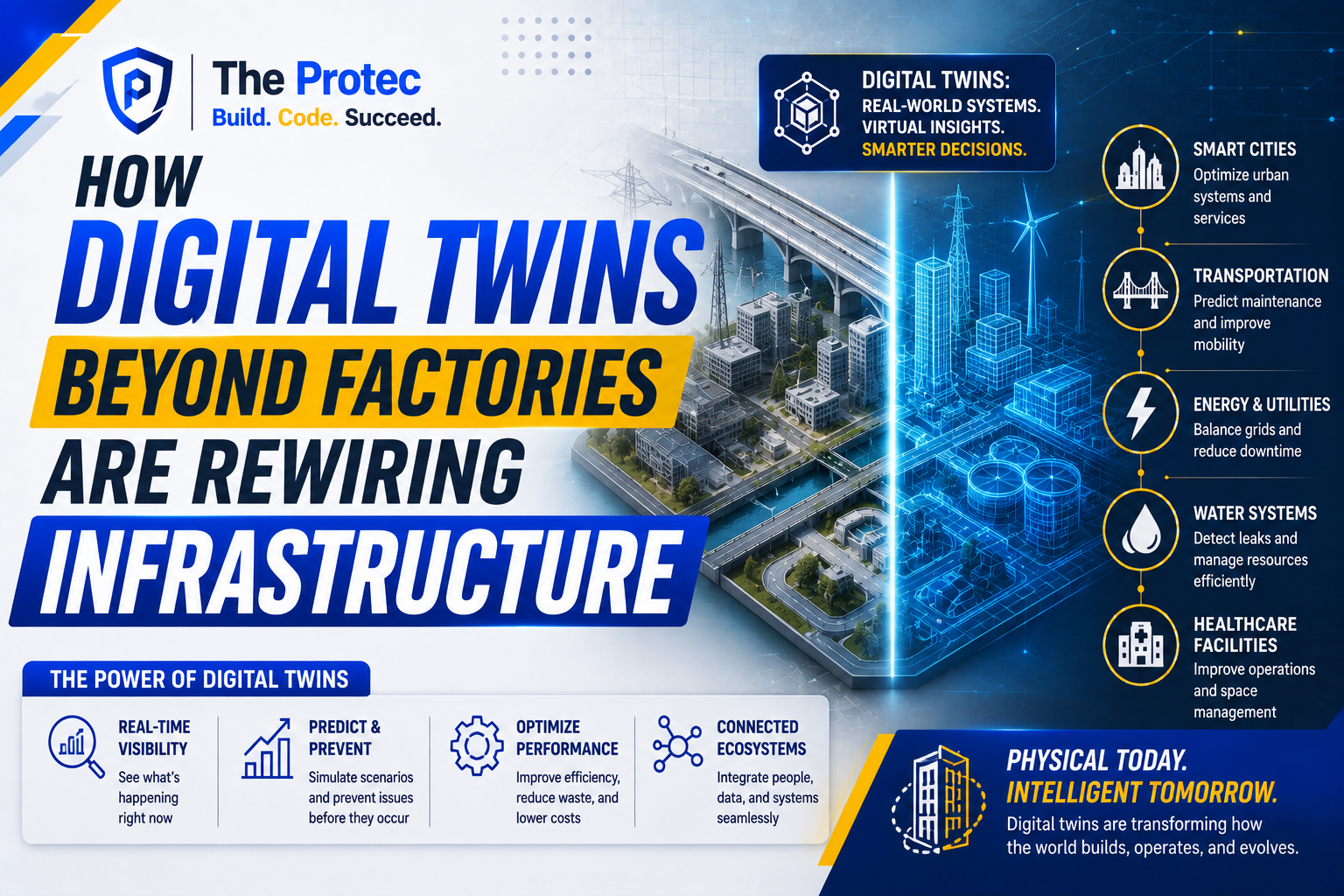
For years, digital twins were associated mainly with factory equipment: a virtual turbine, robot, or production line used to monitor performance and plan maintenance. That narrow definition is rapidly becoming obsolete. Digital twins are now being built for electrical grids, commercial buildings, rail corridors, airports, water systems, cities, and other infrastructure that people depend on every day.
The shift is more significant than simply creating larger models. Infrastructure is interconnected, continuously changing, and exposed to weather, demand fluctuations, human behavior, cyber threats, and aging physical assets. By combining sensor data, geospatial information, engineering models, and artificial intelligence, modern digital twin technology can help operators understand those relationships in real time. More importantly, it can simulate what might happen next.
As of August 2026, the direction is clear: digital twins are evolving from visual representations into operational decision systems. AI digital twins can identify emerging risks, compare possible responses, and optimize complex infrastructure without waiting for a failure to reveal the problem.
From Factory Machines to Connected Infrastructure Systems
A traditional industrial twin usually represents a defined asset with measurable inputs and outputs. Infrastructure is much harder to contain. A city transportation twin, for example, may need to account for traffic signals, buses, trains, road construction, weather, special events, pedestrian movement, and power availability for electric vehicle charging.
This expansion has produced a new generation of digital twins infrastructure operators can use at several levels. An asset twin may represent a transformer or ventilation unit. A system twin may model a substation, building, or transit line. A network twin can connect many systems across an entire utility territory or metropolitan region.
These layers do not necessarily live in one enormous model. The emerging approach is federated: specialized twins exchange trusted information while remaining under the control of different agencies, utilities, owners, or technology platforms. This makes large-scale deployment more practical and reduces the need to rebuild existing operational systems.
What Makes a Modern Infrastructure Digital Twin?
A digital twin is not simply a three-dimensional model or dashboard. It is a living virtual representation connected to the physical environment through recurring data flows. Effective infrastructure twins generally combine four capabilities:
- Observation: Sensors, meters, cameras, drones, satellites, control systems, and maintenance records describe current conditions.
- Context: Geographic information systems, building information models, asset registries, and engineering data explain where assets are and how they relate.
- Simulation: Physics-based and statistical models estimate how the system will respond to demand, failures, weather, construction, or policy changes.
- Action: Analytics and AI recommend or automate adjustments while recording results for future improvement.
Cloud computing supports large simulations, while edge computing processes time-sensitive data close to substations, intersections, buildings, and industrial control systems. Advances in spatial computing also make complex conditions easier to explore through interactive 3D environments. The result is a model that can support both long-range planning and minute-by-minute operations.
Digital Twins Are Making Power Grids More Adaptive
Power networks are becoming more dynamic as utilities connect renewable generation, batteries, electric vehicles, heat pumps, and distributed energy resources. Electricity no longer moves only from large power plants to passive consumers. It flows through a network in which homes, businesses, and vehicles can also store or supply energy.
Grid digital twins provide a synchronized view of that changing system. They can combine smart-meter readings, equipment status, weather forecasts, vegetation data, and power-flow models to estimate grid conditions that are difficult to measure directly. Operators can test how a heat wave, storm, unexpected generator outage, or surge in charging demand may affect specific circuits.
AI enhances these models by forecasting demand, detecting abnormal equipment behavior, and ranking maintenance priorities. A utility might use a twin to determine whether reconfiguring feeders, dispatching a battery, or reducing flexible loads could prevent an overload. Instead of relying solely on fixed schedules and historical averages, the grid can respond to actual conditions and predicted risks.
Buildings Are Becoming Continuous Performance Platforms
Building twins extend beyond architectural models created during design. Once connected to occupancy sensors, energy meters, equipment controls, indoor air monitors, and maintenance systems, they become operational tools.
Owners can compare actual energy use with expected performance, identify rooms that are being heated or cooled unnecessarily, and detect equipment degradation before comfort is affected. AI digital twins can continuously balance energy consumption, ventilation, occupancy, electricity prices, and carbon intensity. In campuses, hospitals, airports, and commercial portfolios, multiple building twins can also coordinate demand instead of optimizing each property in isolation.
The strongest business case often comes from practical outcomes: fewer emergency repairs, lower utility costs, improved space utilization, and better planning for renovations. A trusted twin can also preserve operational knowledge that might otherwise disappear when experienced facilities staff retire.
Transportation Networks Can Test Disruptions Before They Happen
Transportation agencies have long used traffic models, but digital twin technology adds live data and continuous calibration. Information from connected vehicles, road sensors, ticketing systems, GPS feeds, weather services, and construction schedules can create a current picture of how people and goods are moving.
A transportation twin can simulate the effects of closing a bridge lane, changing traffic-signal timing, adding a bus route, or redirecting passengers during a rail disruption. Airport twins can coordinate gates, ground equipment, passenger flows, and baggage operations. Port twins can model vessel arrivals, crane schedules, yard capacity, and connections to road and rail networks.
Prediction is especially valuable because congestion rarely remains local. A delayed train can affect bus connections, station crowding, road traffic, and staffing. By representing those dependencies, digital twins help operators compare interventions before committing resources. Increasingly, edge AI enables intersections and vehicles to react quickly while the broader twin maintains network-wide coordination.
City Digital Twins Are Moving From Visualization to Operations
Early city twins often emphasized impressive 3D skylines. Current projects are focusing more on decisions: where flooding is likely to occur, how new development will affect mobility, which neighborhoods face extreme heat, and where public infrastructure investment will have the greatest impact.
City-scale twins can combine land-use information, terrain, utilities, environmental sensors, transportation networks, and demographic data. Planners can explore the consequences of zoning changes or new transit services, while emergency teams can model evacuation routes and access to hospitals.
Large public initiatives such as the European Commission’s Destination Earth program demonstrate how high-resolution Earth-system data and simulation can support adaptation to climate and environmental risks. The broader trend is toward connected, multiscale twins that link buildings and neighborhoods with regional weather, energy, and transportation systems.
Critical Infrastructure Gains a Tool for Resilience
Water utilities, telecommunications providers, hospitals, dams, and emergency services operate systems where small failures can have wide consequences. Digital twins help reveal dependencies that conventional asset-management databases may miss.
A water-network twin can identify pressure anomalies, estimate the location of leaks, simulate contamination events, and prioritize pipe replacement. A telecommunications twin can predict how equipment failures or power loss may affect coverage. For hospitals, twins can model bed capacity, energy resilience, staff movement, and supply availability during emergencies.
These applications are increasingly important as climate hazards intensify and infrastructure ages. Operators can run stress tests involving floods, fires, prolonged heat, cyber incidents, or simultaneous equipment failures. Instead of producing a static resilience report, the twin can be updated as assets, threats, and operating conditions change.
How AI Turns Digital Twins Into Predictive Systems
Artificial intelligence is the technology moving twins from monitoring toward anticipation. Machine learning can uncover patterns across data volumes that exceed what human operators can inspect manually. It can estimate remaining asset life, forecast demand, identify subtle anomalies, and generate likely scenarios for further simulation.
Physics-informed AI is particularly important for infrastructure. Purely statistical models may produce unrealistic outputs when conditions differ from their training data. By combining machine learning with engineering constraints, operators can gain speed without discarding established knowledge about electrical, mechanical, hydraulic, or structural behavior.
Generative AI is also changing how people interact with twins. Rather than navigating multiple technical applications, an authorized user may ask which substations are most exposed to an incoming storm or why a building’s energy demand increased. The system can retrieve relevant twin data, explain likely causes, and propose simulations. However, high-impact actions still require defined permissions, validation, and human oversight.
The Hard Problems Are Data, Trust, and Governance
The technical potential of digital twins is substantial, but infrastructure deployments fail when organizations treat them as visualization projects rather than operational programs. Sensor readings may be incomplete, asset records may disagree, and older control systems may not provide modern interfaces. A precise-looking model can still be wrong.
Interoperability is another challenge. Infrastructure owners use different formats for geospatial, engineering, building, operational, and time-series data. Open standards and well-governed application programming interfaces are becoming essential, especially for federated twins spanning multiple organizations.
Security must be designed into the architecture. A detailed twin can expose sensitive information about vulnerabilities, capacity, and operating procedures. Teams need identity controls, encryption, network segmentation, audit trails, data minimization, and clear rules for third-party access. Guidance from organizations such as the National Institute of Standards and Technology can help operators align twin deployments with broader cyber-risk management.
Trust also depends on transparency. Every prediction should carry information about source data, model version, assumptions, uncertainty, and validation. Operators must know when a recommendation is reliable and when conditions fall outside the model’s tested boundaries.
Building Digital Twins Infrastructure Teams Can Actually Use
Successful programs usually begin with a defined operational decision rather than an ambition to model everything. Organizations should identify a costly or risky problem, determine what data is needed, and measure whether the twin improves the outcome.
- Start with one use case, such as leak detection, energy optimization, or disruption planning.
- Connect existing systems before purchasing unnecessary new sensors.
- Assign ownership for data quality, model validation, cybersecurity, and operational response.
- Design for interoperability so the twin can expand across assets and departments.
- Keep people in the workflow and document when automated actions are permitted.
- Track results such as downtime avoided, energy saved, response time, and prediction accuracy.
A twin creates value only when its insight changes a decision. Integrating recommendations into maintenance, dispatch, planning, and emergency workflows is therefore more important than producing the most visually detailed model.
The Next Phase: Infrastructure That Learns
Digital twins are becoming part of the operating layer for the physical world. The next phase will connect asset, system, and regional twins while preserving security and organizational control. Continuous data will update the models, AI will evaluate possible futures, and operators will select or authorize the best response.
The goal is not an autonomous city controlled by an algorithm. It is infrastructure that can reveal its condition, explain its risks, learn from outcomes, and adapt faster. That capability will be central to managing electrification, urban growth, climate pressure, and aging assets.
Frequently Asked Questions
What is digital twin technology?
Digital twin technology creates a dynamic virtual representation of a physical asset, process, or system. Unlike a static model, it receives recurring operational data and uses simulation or analytics to reflect current conditions, test scenarios, and support decisions.
How are digital twins used in infrastructure?
Infrastructure operators use digital twins to monitor equipment, forecast demand, plan maintenance, test disruptions, optimize energy and traffic flows, and evaluate resilience. Applications include power grids, buildings, roads, railways, airports, ports, water networks, and city planning.
What are AI digital twins?
AI digital twins combine virtual system models with machine learning or other AI techniques. AI can detect anomalies, predict failures, estimate future conditions, recommend responses, and make complex twin data easier for authorized users to query and understand.
What is the difference between a digital twin and a 3D model?
A 3D model primarily describes appearance and geometry. A digital twin connects representation with live or frequently updated data, operational context, simulation, and feedback. It may include a 3D interface, but its defining value comes from understanding behavior and supporting action.
What are the biggest risks of infrastructure digital twins?
Major risks include poor-quality data, inaccurate models, vendor lock-in, unauthorized access, exposed operational details, and overreliance on automated recommendations. Strong governance, cybersecurity, interoperability, validation, and human oversight are essential for responsible deployment.