








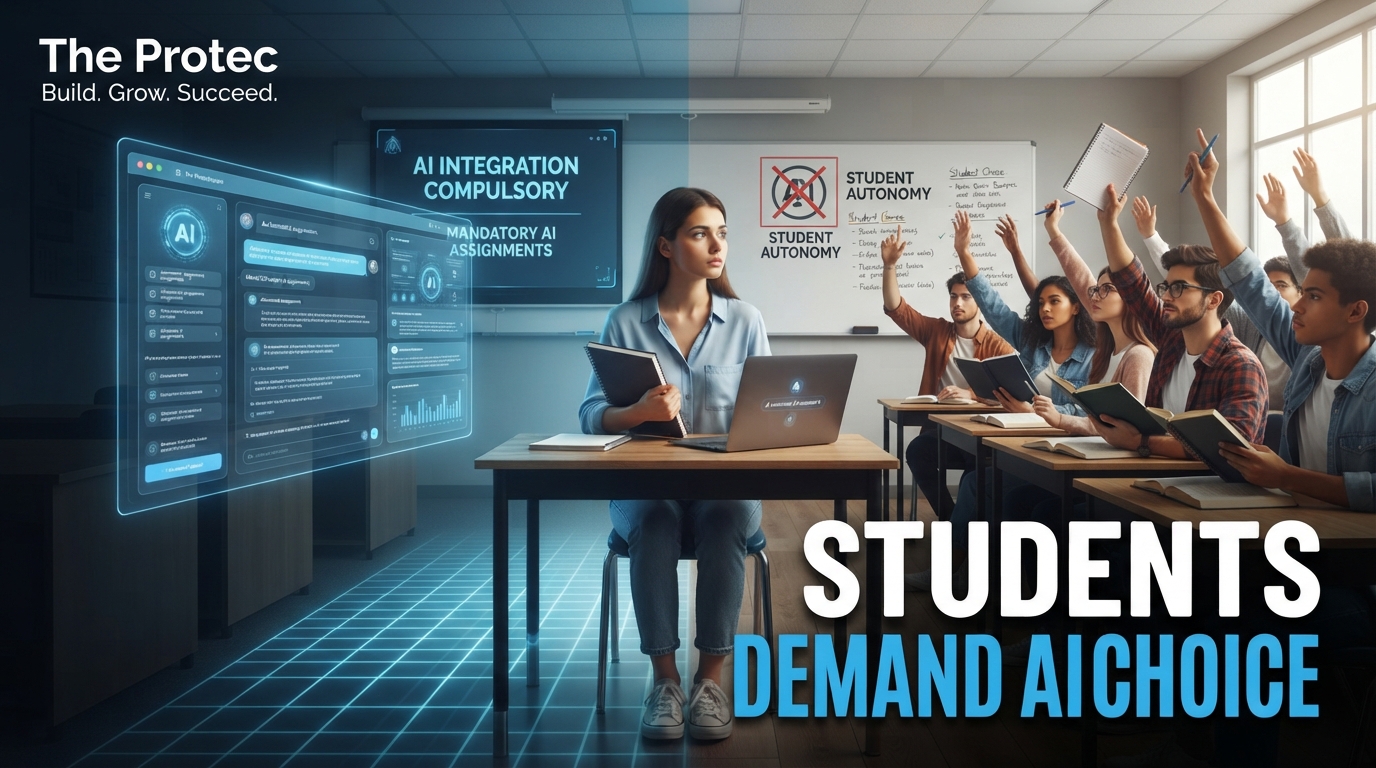
Across higher education, an unexpected fault line is opening: some of the strongest objections to compulsory artificial intelligence are coming from the people universities say they are preparing for an AI-shaped future. College students against AI mandates are organizing petitions, campaigns and protests that demand a choice when courses require commercial chatbots, coding assistants or image generators. Their argument is not necessarily that technology has no place in education. It is that learning about AI is different from being required to depend on it—and that universities should not erase that distinction.
The immediate questions are practical as well as philosophical. Can an instructor require students to create an account with a commercial AI provider? Should a university-wide enterprise license make AI the default across unrelated subjects? What happens when a student objects because of privacy, environmental, accessibility or academic-integrity concerns? Increasingly, students want clear answers before mandatory AI assignments become routine.
What the student resistance actually represents
Reports of student AI protests and petitions should be interpreted carefully. They document organized opposition on particular campuses, not a universal verdict from an entire generation. There is no sound basis for claiming that all students oppose AI in higher education, just as it would be misleading to suggest that every university requires it.
The emerging anti-AI campus movement also contains several positions. Some participants want AI-free education wherever independent writing and reasoning are central. Others accept optional AI learning tools but reject compulsory accounts or assignments. Still others support teaching AI literacy while asking for limits on data collection, clearer academic rules and equivalent ways to complete required work without generative AI.
That variety matters. A computer science student questioning a required coding assistant may be concerned about losing opportunities to debug independently. A writing student may object to outsourcing the difficult process of forming an argument. Another student may simply be unwilling to provide personal information to a company selected by the institution. Calling all of them anti-technology avoids the substance of their concerns.
Teaching AI is not the same as mandating dependence
Universities have a legitimate reason to address ChatGPT in colleges. Generative AI is already used in software development, marketing, research, administration and many other professions. Graduates should understand what these systems can do, where they fail and how their output should be verified.
But AI literacy does not require universal dependence. A course can teach students to evaluate a model’s claims, identify fabricated citations, compare outputs or examine bias without making the model responsible for every first draft. Students can learn how AI works while still completing core intellectual tasks themselves.
Mandatory AI assignments become especially contentious when using the tool is unrelated to the learning objective. Requiring an AI-assisted prototype in a class about human-AI collaboration may be defensible. Requiring a chatbot to brainstorm every essay in an introductory writing course is harder to justify if the objective is to develop original composition skills.
The central question should therefore be educational: does AI help students achieve the stated learning outcome, or does it perform the very skill they are supposed to acquire?
Why students worry about critical thinking and foundational skills
Writing, research, programming and problem-solving improve through effort, revision and productive failure. Students learn by confronting an unclear thesis, following a source trail, locating a software bug or testing an unsuccessful approach. An AI system can accelerate those activities, but it can also remove the struggle through which understanding develops.
This is why the debate over AI and critical thinking cannot be reduced to whether a generated answer is correct. A polished response may conceal shallow understanding. Students who routinely begin with machine-generated text can become editors of an existing argument before learning to construct one. Novice programmers may accept plausible code without developing the mental models needed to diagnose why it fails.
The risk depends on the student, task and level of assistance. Using AI to receive feedback after drafting is not equivalent to asking it to write the draft. Requesting an explanation of an error is different from copying a complete solution. Thoughtful university AI policies should recognize these differences instead of treating AI as either universally beneficial or inherently dishonest.
Privacy, consent and enterprise AI licenses
Institution-wide AI enterprise licenses can offer real advantages. A negotiated service may provide stronger security, administrative support and contractual limits that are unavailable through free consumer accounts. Central licensing can also reduce unequal access when some students cannot afford premium tools.
Yet those benefits do not settle the student privacy and AI debate. Students may reasonably ask:
- What account information, prompts, files and usage records are collected?
- Can instructors or administrators view activity associated with a student account?
- Are submitted materials retained or used to improve models?
- Which subcontractors or external services process the data?
- What happens to an account after graduation or withdrawal?
- Is a non-AI alternative available without penalty?
An enterprise contract does not automatically equal informed consent. If a service becomes embedded in coursework, students may have no meaningful ability to decline its terms. Institutional control can also create uncertainty about whether AI activity functions as a learning record, a surveillance mechanism or both.
There is a broader structural concern: universities could normalize dependence on a small group of commercial providers. Once one platform is integrated into identity systems, classrooms and assessments, changing vendors becomes difficult. Course design may gradually bend around a company’s product decisions rather than educational needs.
Environmental objections also appear in student campaigns. Training and operating large models consume electricity, water and computing infrastructure, although the impact of an individual prompt varies by model, data center and energy source. Because providers disclose uneven information, universities should avoid simplistic per-prompt claims while still considering aggregate use and procurement standards.
The case for making AI part of higher education
Supporters of faster adoption warn that an entirely AI-free education could leave graduates unprepared. Employers increasingly expect workers to assess, supervise and improve AI-assisted output. Students who never practice these skills may enter the workplace without knowing how to verify a model, protect confidential information or recognize automation bias.
Access is another argument. If universities refuse to teach AI, wealthier students may gain experience through private subscriptions and internships while others are left behind. Structured classroom use can expose every student to both the capabilities and limitations of generative systems.
These arguments are persuasive reasons to teach AI literacy. They are less persuasive as reasons to require AI in every course. Workplace preparation includes knowing when not to automate, how to complete essential work during system failures and how to retain professional judgment. Competence means controlling a tool, not being unable to work without it.
International guidance points in a similarly human-centered direction. UNESCO’s guidance on generative AI in education and research emphasizes privacy, age-appropriate use and human agency rather than adoption for its own sake.
NYU Tandon’s red, yellow and green alternative
A practical alternative to blanket mandates appeared in the NYU Tandon School of Engineering classroom framework released in November 2026. Its red, yellow and green categories connect permitted AI use to the purpose of each assignment rather than imposing one rule across an entire institution.
Red: AI prohibited
Red assignments prohibit AI when independent mastery must be demonstrated. Appropriate examples include foundational writing, closed assessments, core calculations or programming exercises intended to reveal whether a student can reason through a problem unaided. The restriction should be explicit and accompanied by a clear explanation.
Yellow: limited assistance
Yellow assignments permit defined forms of help. Students might use AI to generate practice questions, receive feedback, explain an error or improve grammar while remaining responsible for the underlying analysis. Instructors should identify acceptable functions, disclosure requirements and boundaries rather than telling students vaguely to use AI responsibly.
Green: AI permitted or encouraged
Green assignments allow or encourage AI because working with it is itself an educational objective. Students could compare models, audit unreliable output, document prompt iterations or complete a project that requires human oversight of an AI-assisted workflow. Assessment can focus on verification, judgment and reflection instead of rewarding raw generation.
This framework does not resolve every disagreement, but it begins with pedagogy. It also protects space for independent learning while acknowledging that AI fluency can be a legitimate course outcome.
What responsible university AI policies should include
Universities do not have to choose between ignoring AI and compelling everyone to use it. A balanced policy can combine technological literacy with meaningful student choice.
- Offer equivalent opt-out alternatives. Students opting out of AI should have a comparable way to meet the same learning objective without extra punishment, cost or public disclosure of personal objections.
- Publish assignment-level rules. Every syllabus should explain when AI is prohibited, limited or permitted; what must be disclosed; and how violations will be evaluated.
- Conduct privacy and procurement reviews. Institutions should disclose retention, access, model-training and deletion terms before activating enterprise accounts.
- Include students in governance. Student representatives should participate in committees that select tools, set policy and review complaints. Consultation after a contract is signed is not shared governance.
- Verify independent understanding. Oral explanations, in-class writing, version histories, demonstrations and process notes can show whether students understand submitted work.
- Review outcomes rather than adoption rates. Universities should examine whether AI use improves learning, widens disparities or changes student performance—not celebrate the number of activated accounts as proof of success.
These protections also make AI academic integrity rules more credible. Students cannot follow expectations that change silently between courses or rely on undefined concepts such as excessive assistance. Clear boundaries are fairer than retrospective suspicion or unreliable AI-detection scores.
Frequently asked questions
Can a college require students to use AI?
Institutions and instructors generally have broad authority to select educational tools, but that authority is shaped by contracts, privacy rules, accessibility obligations and institutional policy. Whether a particular requirement is permissible depends on the jurisdiction and circumstances. Even where a mandate is allowed, universities should provide a clear educational rationale and consider equivalent alternatives.
Are most college students against AI?
No reliable conclusion supports that broad claim. Documented student AI protests and petitions demonstrate organized resistance to particular mandates, licenses or classroom practices. They do not prove that most students reject AI. Many students support optional access or responsible instruction while opposing compulsory use.
What is a reasonable AI opt-out?
A reasonable opt-out lets a student achieve the same learning outcome through a comparable non-AI task. It should not impose a substantially heavier workload, lower the available grade or require the student to reveal sensitive personal information to classmates.
How can instructors confirm learning when AI is allowed?
Instructors can ask students to explain decisions orally, submit drafts, annotate sources, preserve coding history or complete part of the work under supervised conditions. Assessing the process and requiring verification makes it harder to substitute generated output for understanding.
Who should decide how AI enters the classroom?
The future of higher education will almost certainly include AI, but inclusion does not have to mean compulsion. Administrators can negotiate safer tools, instructors can define legitimate learning objectives, and students can identify harms that top-down adoption overlooks. Effective governance needs all three perspectives.
The defining issue in the AI education debate is therefore not whether universities should teach students to use AI. It is whether they should require students to use it—and who should have the final say when administrators, instructors and students disagree.