








AI Agents in Customer Support: Are Chatbots Finally Becoming Intelligent?
Customer support automation has come a long way from rigid decision trees and canned replies. For years, chatbots promised faster service but often delivered frustration: they could answer basic questions, yet struggled with nuance, context, and the messy reality of human conversation. That gap is now closing. A new generation of AI customer support agents is changing what businesses can expect from customer service automation.
These systems are no longer just keyword matchers or scripted interfaces. Powered by large language models, retrieval systems, workflow automation, and increasingly sophisticated guardrails, modern AI chatbot software can interpret intent, personalize responses, summarize histories, and even complete actions across connected tools. For businesses, that means faster resolution times, lower support costs, and a more scalable service operation. For customers, it means fewer dead ends and more meaningful help.
But the big question remains: are chatbots finally becoming intelligent, or are we simply giving old automation a smarter voice? The answer is more nuanced than a yes or no. Today’s AI support systems are genuinely more capable, but true intelligence in customer service still depends on architecture, data quality, process design, and human oversight.
What Changed: From Chatbots to AI Customer Support Agents
Traditional chatbots were built to follow scripts. They worked well when the customer asked a predictable question such as password resets, order status, or store hours. If the user drifted outside those scripted paths, the experience often broke down. The system might repeat itself, misunderstand the request, or force the customer to start over with a live agent.
AI customer support agents represent a different model. Instead of simply matching phrases to prewritten responses, they use natural language understanding, knowledge retrieval, and task execution. In practice, this means they can handle broader conversation patterns, ask clarifying questions, search internal documentation, and take action when permitted. They can also adapt their tone and response style based on the customer’s intent and the brand’s service standards.
What makes this shift important is not just better conversation. It is the ability to move from answering questions to resolving them. That distinction is the heart of modern customer service automation.
Why AI Chatbot Software Is Getting Smarter
The rise of intelligent support tools is being driven by several technology shifts happening at the same time. First, large language models have dramatically improved language fluency and contextual reasoning. Second, retrieval-augmented generation has helped AI systems answer with information pulled from real company sources instead of relying only on trained memory. Third, workflow orchestration tools now allow support bots to interact with billing systems, CRMs, ticketing platforms, and order management software.
These capabilities matter because customer support is rarely about a single question. It is usually about a chain of events: verifying identity, checking a record, confirming a policy, and then completing a request. AI chatbot software is becoming more intelligent because it can now participate in that chain instead of merely commenting on it.
Another major improvement is multimodality. Customers are increasingly able to submit screenshots, voice messages, images, and documents. Modern AI agents can interpret these inputs, extract relevant details, and reduce the back-and-forth that used to slow down support interactions.
For example, a customer who uploads a damaged product photo and explains the issue in plain language may receive a guided resolution path in seconds. The system can identify the likely issue, check warranty eligibility, and route the case appropriately. That is a different level of service from a bot that can only say, “Please choose from these options.”
What Makes an AI Support Agent Truly Intelligent?
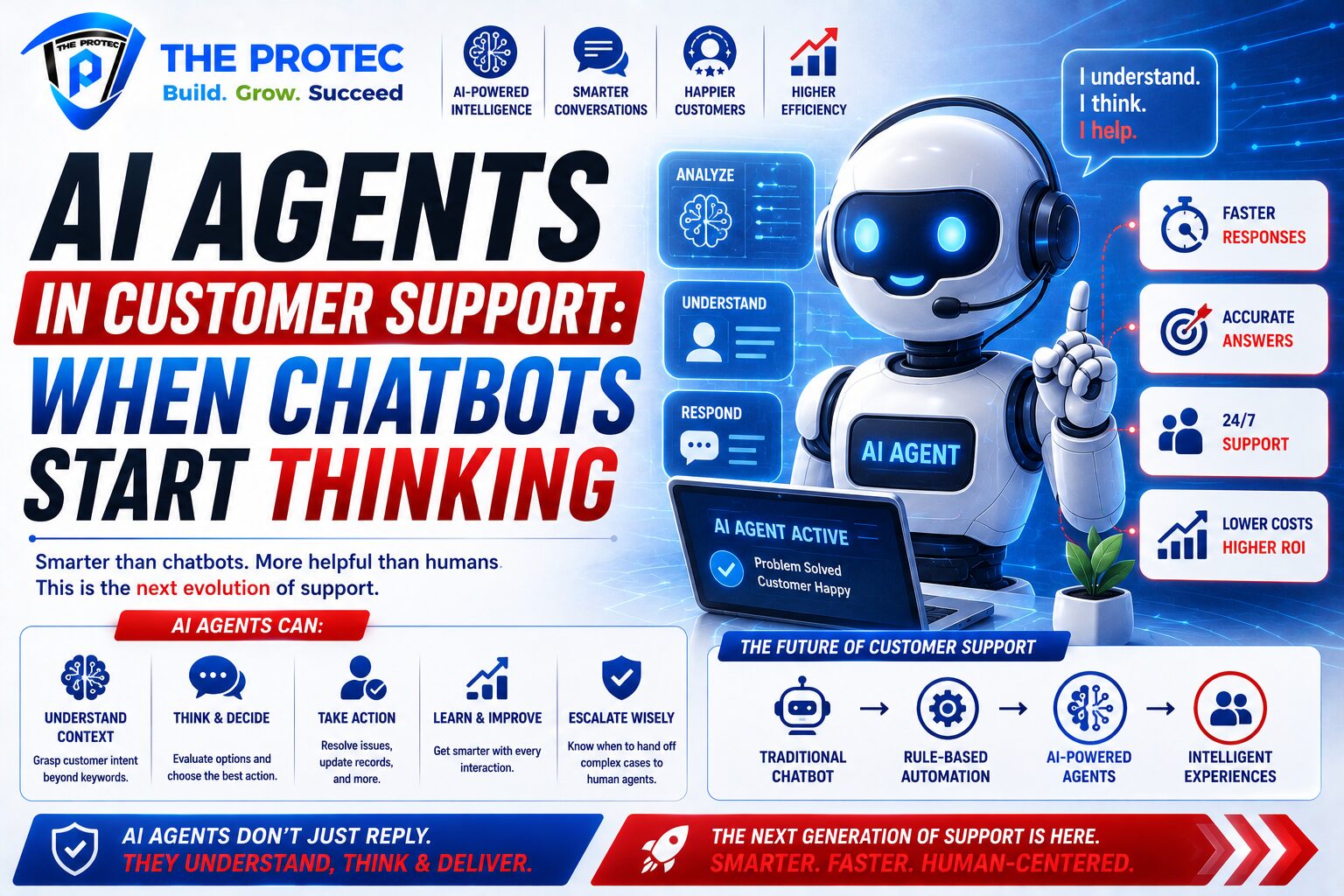
Not every tool branded as an AI agent is actually intelligent in a meaningful business sense. Real intelligence in customer service automation should be judged by outcomes, not marketing claims. The best AI customer support agents share a few core abilities:
- Intent recognition: They understand what the customer is trying to achieve, even when the wording is messy or incomplete.
- Context retention: They remember relevant details within a conversation and often across sessions when allowed.
- Knowledge grounding: They answer using verified company data, policies, and documentation rather than inventing responses.
- Action execution: They can perform tasks such as creating tickets, updating records, initiating refunds, or checking order status.
- Escalation awareness: They know when to hand off to a human agent based on confidence, sentiment, risk, or policy.
- Continuous learning: They improve through feedback loops, conversation analysis, and updated knowledge sources.
Without these capabilities, a chatbot may sound smart but still fail at the core job of customer support. Intelligence in this context is not about sounding human. It is about helping customers solve problems accurately, quickly, and consistently.
The Business Case for Customer Service Automation
From a business perspective, the appeal of AI customer support agents is straightforward: service demands are growing, customer expectations are rising, and labor costs remain significant. Support teams are under pressure to do more with less while maintaining quality. Intelligent automation helps close that gap.
One of the biggest advantages is 24/7 coverage. Customers expect help outside standard business hours, especially in e-commerce, SaaS, travel, finance, and logistics. AI agents can provide instant responses at any time, reducing wait times and improving satisfaction. They also handle repetitive inquiries at scale, freeing human agents to focus on high-value or emotionally sensitive cases.
There is also a strong operational benefit. When AI chatbot software handles common tasks such as account lookups, order tracking, appointment changes, or policy explanations, contact center volume becomes more predictable. That makes staffing easier and improves first response time. In many cases, businesses can reduce ticket backlog and shorten resolution cycles without sacrificing service quality.
Another often-overlooked value is consistency. Human agents vary in tone, knowledge, and performance. AI systems can deliver standardized answers and enforce policy-aligned responses across thousands of interactions. That consistency is particularly valuable in regulated industries where incorrect advice can create compliance risk.
For a broader industry perspective on AI in customer interactions, IBM’s overview of AI in customer service is a useful starting point: IBM: AI in customer service.
Where AI Agents Still Fall Short
Despite rapid progress, AI support tools are not ready to replace human agents across the board. There are still clear limitations that businesses must understand before deploying them at scale.
First, hallucinations remain a risk. Even strong models can produce confident but incorrect answers if they are not properly grounded in company-approved information. In customer support, that can create serious problems, especially when the bot offers policy advice, account guidance, or troubleshooting steps that are wrong.
Second, edge cases are difficult. Real customer conversations often involve overlapping issues, incomplete information, emotional frustration, and exceptions to policy. A bot may handle the standard path well but fail when the case becomes unusual. This is where human judgment still matters.
Third, AI systems can struggle with trust. Many customers are still skeptical of automated support, especially if they have had poor experiences in the past. If the bot feels evasive, repetitive, or overly eager to deflect, customers may abandon the channel and seek help elsewhere.
Finally, integration quality matters. Even the best model will underperform if it cannot access accurate data from CRM, billing, logistics, or knowledge management systems. AI chatbot software is only as effective as the workflows behind it.
For a technical perspective on how modern AI systems can ground answers in source material, see Google Cloud’s explanation of retrieval-augmented generation: Google Cloud: Retrieval-augmented generation.
How AI Customer Support Agents Change the Customer Journey
The most meaningful impact of intelligent support automation is not just on the contact center. It affects the entire customer journey. When support becomes faster and more proactive, customers are less likely to churn, abandon purchases, or develop frustration that damages brand loyalty.
AI agents can assist before, during, and after a transaction. Before purchase, they can answer product questions and reduce hesitation. During the purchase process, they can help with checkout issues or account verification. After purchase, they can manage tracking, returns, setup guidance, and issue resolution.
This creates a more seamless experience. Instead of forcing customers to navigate separate systems for sales, support, and service, intelligent automation can provide a unified conversational layer across the journey. That is especially powerful for businesses with high inquiry volume or complex products.
There is also a proactive dimension. Advanced systems can detect signs of frustration, identify repeated issues, and suggest next-best actions. Some can even surface self-service help before a customer submits a ticket. That kind of anticipatory support is one reason customer service automation is evolving from reactive deflection to proactive assistance.
What Businesses Need to Get Right Before Deploying AI Agents
Successful deployment requires more than buying the latest AI chatbot software. Businesses need a strategy that aligns technology, process, and governance. Without that foundation, even advanced systems can create more problems than they solve.
Start with use-case selection. Not every support scenario should be automated. The best candidates are high-volume, low-complexity, rule-based requests where success can be measured clearly. These may include order tracking, subscription changes, basic troubleshooting, password resets, appointment modifications, and FAQ resolution.
Next, audit knowledge sources. AI agents need accurate, current, and structured information. If policy documents are outdated or scattered across multiple repositories, the bot will inherit those inconsistencies. A clean knowledge base is essential.
Then design escalation paths carefully. A smart AI system should know when to stop. Customers should be able to reach a human without friction when the issue is sensitive, ambiguous, or high-value. Hand-off should include conversation context so the customer does not need to repeat everything.
It is also important to define quality metrics beyond deflection rate. Businesses should track first contact resolution, average handle time, escalation quality, customer satisfaction, containment accuracy, and post-interaction sentiment. A bot that reduces tickets but increases complaints is not a win.
Finally, establish governance. That includes approval workflows for content updates, monitoring for unsafe or incorrect outputs, privacy controls, and periodic review of conversation logs. Intelligent automation needs oversight to remain trustworthy.
The Role of Human Agents in the New Support Model
One of the biggest misconceptions about AI customer support agents is that they eliminate the need for human teams. In reality, they change the nature of human work. Repetitive, transactional inquiries move to automation, while human agents focus more on exceptions, relationship management, retention risks, and emotionally charged interactions.
This shift can improve morale as well as efficiency. Support representatives often spend too much time answering repetitive questions that do not require judgment. By offloading those tasks to AI, businesses can create a more engaging role for human agents. They become problem solvers rather than script readers.
That said, humans are still essential for quality assurance, training, escalation handling, and brand-sensitive conversations. The best support organizations are not replacing people with bots. They are building hybrid systems where automation handles scale and humans handle nuance.
The Future of AI Chatbot Software in Customer Support
The next phase of AI chatbot software will likely focus less on conversation for its own sake and more on autonomous task completion. That means bots that can not only answer a question but also complete the underlying workflow safely and accurately.
We are also likely to see tighter integration with enterprise systems, better memory controls, stronger compliance features, and more specialized support agents trained for specific industries. In highly regulated sectors, the most valuable systems will be the ones that can stay helpful while remaining policy-aware and auditable.
Another trend is the move toward agentic orchestration. Instead of a single bot doing everything, companies will use multiple AI agents for different tasks: one for triage, one for knowledge retrieval, one for workflow execution, and one for quality checks. This layered model can improve reliability and reduce risk.
At the same time, customer expectations will continue rising. As people become more comfortable with intelligent automation in other parts of their digital lives, they will expect support systems to be faster, more contextual, and less robotic. Businesses that adapt early will have a competitive edge in both service quality and operational efficiency.
How to Evaluate AI Customer Support Agents
If your business is considering an AI support rollout, evaluating the system properly is critical. A demo can be impressive, but real performance depends on actual customer scenarios.
- Test realistic conversations: Include messy phrasing, follow-up questions, and multi-step requests.
- Check grounding quality: Verify that answers align with company policy and approved knowledge sources.
- Measure resolution, not just response speed: Fast wrong answers are not useful.
- Review escalation behavior: Ensure the bot hands off appropriately and preserves context.
- Assess integration depth: Confirm the system can access the tools it needs to complete tasks.
- Monitor customer sentiment: Look for signs of frustration, confusion, or repeated contact.
The best AI support platforms should improve over time as they learn from real usage. But that learning has to be structured, monitored, and tied to business goals.
FAQ
Are AI customer support agents better than traditional chatbots?
Yes, in most cases. Traditional chatbots rely heavily on scripted flows, while AI customer support agents can understand intent, use context, retrieve relevant knowledge, and complete tasks. That makes them far more flexible and useful for modern customer service automation.
Can AI chatbot software replace human support teams?
Not completely. AI chatbot software is excellent for repetitive, high-volume requests, but human agents are still needed for complex, emotional, or high-risk cases. The strongest support model is usually hybrid, with AI handling scale and humans handling nuance.
What are the biggest risks of using AI in customer support?
The main risks are inaccurate answers, poor escalation handling, weak integration, and over-automation. If the system is not grounded in trusted knowledge and monitored carefully, it can damage customer trust instead of improving it.
How can businesses measure whether AI support is working?
Track metrics such as containment rate, first contact resolution, average handle time, escalation quality, customer satisfaction, and repeat contact rate. The goal is not just to reduce tickets, but to improve resolution quality and customer experience.
What should a company automate first?
Start with high-volume, low-complexity use cases such as order status, password resets, appointment changes, basic troubleshooting, and FAQ responses. These scenarios are easier to control and provide a clear return on investment.
Conclusion
AI customer support agents are not just better chatbots. They are the foundation of a new service model where customer support automation becomes more intelligent, more action-oriented, and more integrated into business operations. The technology is finally moving beyond simple deflection toward real problem-solving.
Still, intelligence in customer support is not guaranteed by the model alone. It depends on reliable data, thoughtful workflow design, proper escalation, and human oversight. Businesses that treat AI chatbot software as a strategic system rather than a novelty will be best positioned to improve speed, consistency, and customer satisfaction.
The bottom line: chatbots are becoming intelligent, but only when they are designed to solve real customer problems, not just answer questions. That is where the future of customer service automation is headed.